
线上销售

Search documents
“亏本算我的,赚钱大家分” :从华强北“一米柜台”,带出百人乡亲创业团
Sou Hu Cai Jing· 2025-08-26 14:56
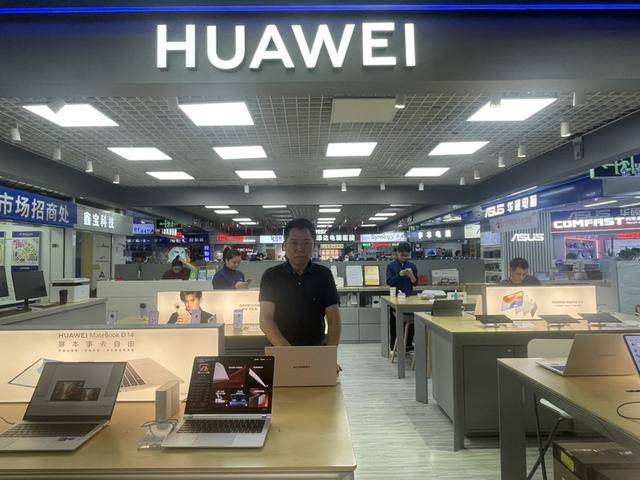
Core Viewpoint - The article highlights the entrepreneurial journey of Bao Lei, a significant figure in the computer business in Huaqiangbei, Shenzhen, showcasing his contributions to the local economy and the evolution of the computer industry over the past 34 years [1][4]. Group 1: Entrepreneurial Journey - Bao Lei began his career in Shenzhen in 1991, initially working for Giant Group and later starting his own business in 1998 after the company faced financial difficulties [1][4]. - He started with a small retail space in the SEG Electronics Market, where he sold computer components and assembled computers, achieving a monthly income exceeding 10,000 yuan despite high rental costs [3][4]. - Bao Lei has played a pivotal role in bringing over a hundred relatives from his hometown in Anhui to Shenzhen, training them to open their own computer shops, thus fostering entrepreneurship within his community [3][4]. Group 2: Business Strategy and Market Adaptation - His strategy involved a "rural encirclement of cities" approach, expanding his sales network throughout Shenzhen and ensuring that his associates rarely faced losses [4][6]. - By 2002, Bao Lei secured distribution rights for three major computer brands, transitioning from a sole trader to a regional distributor [4][6]. - The peak of offline sales in Huaqiangbei occurred around 2008, but the rise of e-commerce began to challenge traditional sales methods [4][6]. Group 3: Embracing Change and Future Outlook - In response to the e-commerce trend, Bao Lei has started to explore online sales channels, including live streaming on platforms like Douyin, despite initial losses [6][7]. - He emphasizes the importance of supporting domestic brands, particularly Huawei, and has provided market insights to help shape product offerings [7]. - Bao Lei's philosophy centers on perseverance and dedication, believing that sustained effort in a competitive market leads to unique opportunities [7].


“制造”网红村支书
Hu Xiu· 2025-08-25 04:54
Core Viewpoint - The phenomenon of village party secretaries becoming internet celebrities through short videos and live streaming is emerging as a new trend in rural revitalization, driven by the need to promote local agricultural products and attract tourism [1][19][21]. Group 1: Background and Motivation - Village secretaries like Wang Jiangtang began live streaming to address the challenges posed by the pandemic, which affected local agricultural sales and necessitated innovative solutions for economic development [4][8]. - The shift towards online platforms was influenced by training sessions that introduced concepts like "big data" and "online flow," which village leaders initially found confusing but later embraced as essential tools for community engagement [4][21]. Group 2: Strategies and Approaches - Wang Jiangtang's first live stream focused on selling unique gourd art created by a local artist, showcasing a community-oriented approach to support local artisans while leveraging online sales [5][10]. - The "Rural Revitalization Team" in Sihai Town exemplifies a collaborative strategy among village secretaries, who combine their resources to promote tourism and agricultural products through engaging content [9][10]. Group 3: Challenges and Limitations - Seasonal fluctuations in agricultural production create challenges for consistent content creation and product availability, leading to periods where village secretaries struggle to maintain viewer engagement [12][13]. - Issues such as logistics, product quality control, and the need for skilled personnel to manage online sales and marketing are significant hurdles that village secretaries face in their efforts to capitalize on internet fame [15][17][23]. Group 4: Policy and Support - Local government initiatives have begun to support village secretaries in their digital endeavors, providing training and resources to help them navigate the complexities of online marketing and e-commerce [21][24]. - The involvement of local authorities in promoting digital literacy among village leaders reflects a broader strategy to integrate digital economy principles into rural development efforts [21][24].
周六福(06168)发布中期业绩 净利润4.15亿元 同比增加约11.9% 中期息每股0.45元
智通财经网· 2025-08-22 13:25
Core Insights - The company reported a revenue of RMB 3.15 billion for the six months ending June 30, 2025, representing a year-on-year increase of approximately 5.2% [1] - Gross profit reached RMB 827 million, up about 8.7% year-on-year, while net profit was RMB 415 million, reflecting an increase of approximately 11.9% [1] - The interim dividend per share is set at RMB 0.45 [1] Online Sales Performance - Online sales generated revenue of RMB 1.632 billion, a year-on-year growth of approximately 34%, driven by improved operational efficiency and deeper collaborations with e-commerce platforms [1] - During the 2025 618 shopping festival, the company's self-operated sales GMV across all online platforms exceeded RMB 700 million, marking a 36% increase year-on-year, with growth rates exceeding 30% for two consecutive years [1] Offline Retail Developments - The company has seen a significant increase in the sales volume and revenue of marked products in offline retail, with growth rates of 73.2% and 44.4% respectively, and an increase in gross margin to 41.7% [2] - The company is focusing on product, brand, and operational synergies to enhance brand development and customer loyalty [2] Store Optimization and Closure - Due to geopolitical risks and economic uncertainties, the company closed 272 stores during the reporting period, resulting in a total of 3,760 franchise stores and 97 self-operated stores as of June 30, 2025 [3] - The store distribution has become more balanced, with nearly 50% of stores located in first and second-tier cities, and over 55% of stores situated in shopping centers and department stores [3]
新加坡线上消费增长明显
Jing Ji Ri Bao· 2025-08-07 22:49
Core Insights - Singapore's retail trade and food and beverage services showed growth in June 2025, with significant online sales growth indicating structural changes in consumer behavior [1][3] - The overall retail sales reached SGD 4 billion in June, with online sales accounting for 13.6%, up from 12.3% in May [1][3] - Year-on-year retail sales grew by 2.3%, continuing the 1.3% growth trend from May, although month-on-month sales saw a decline [1][2] Retail Sector Performance - The automotive sales sector experienced a year-on-year increase of 14.6%, attributed to higher Certificate of Entitlement (COE) quotas [2] - Sales in the computer and communication equipment, optical products and books, and leisure goods sectors grew by 7.3%, 5.9%, and 5.6% respectively [2] - Conversely, gas stations and food and alcohol retailers saw sales declines of 5.9% and 5.2% year-on-year [2] Food and Beverage Services - Food and beverage service sales reached SGD 962 million in June, with online sales comprising 26.7% [2][3] - Year-on-year food and beverage sales grew by 0.1%, but month-on-month sales declined by 1.5% [2] - Within the sector, restaurant sales fell by 5.6% year-on-year, while fast food sales increased by 2.3% [2] Online Sales Trends - Online sales penetration varies across sectors, with computer and communication equipment at 56.2% and furniture and home equipment at 32.8% [3] - The online sales penetration in the food and beverage sector remained high at 26.7%, indicating deep integration of delivery platforms into daily consumer life [3] - The report emphasizes the importance of seasonal adjustments to better observe potential sales trends [3]
简讯:锅圈从居家餐饮趋势中取增长
BambooWorks· 2025-08-05 07:49
Core Viewpoint - The company, Guoquan Food (Shanghai) Co., Ltd., reported a significant increase in revenue and net profit in the first half of the year, driven by the growing trend of home cooking among cost-conscious Chinese consumers [2]. Group 1: Financial Performance - The company's revenue rose by 22% year-on-year, from 2.67 billion yuan to 3.24 billion yuan (approximately 450 million USD) [2]. - Net profit surged by 123% year-on-year, reaching 190 million yuan [2]. Group 2: Expansion and Market Strategy - Guoquan Food accelerated the expansion of its home cooking ingredient retail network, focusing on price-sensitive lower-tier markets, with a total of 10,400 stores nationwide by the end of June [2]. - The company is actively exploring overseas market opportunities [2]. Group 3: Operational Efficiency - The company enhanced operational efficiency through increased automation and the establishment of centralized production centers [2]. - A 24-hour unmanned retail model was launched, allowing stores to operate automatically after staff hours, with over 2,000 stores already upgraded [2]. - Plans are in place to establish a production base in Danzhou, Hainan, to further expand regional coverage [2]. Group 4: Online Sales Development - To cater to the younger consumer demographic favoring online shopping, the company developed its online sales channels [2]. - The company's Douyin account matrix achieved over 3.2 billion exposures, leading to a more than 100% year-on-year increase in Douyin sales [2].

下滑32%,古典艺术不好卖了?从佳士得2025年中“成绩单”看投资市场风向变化
Mei Ri Jing Ji Xin Wen· 2025-07-16 14:13
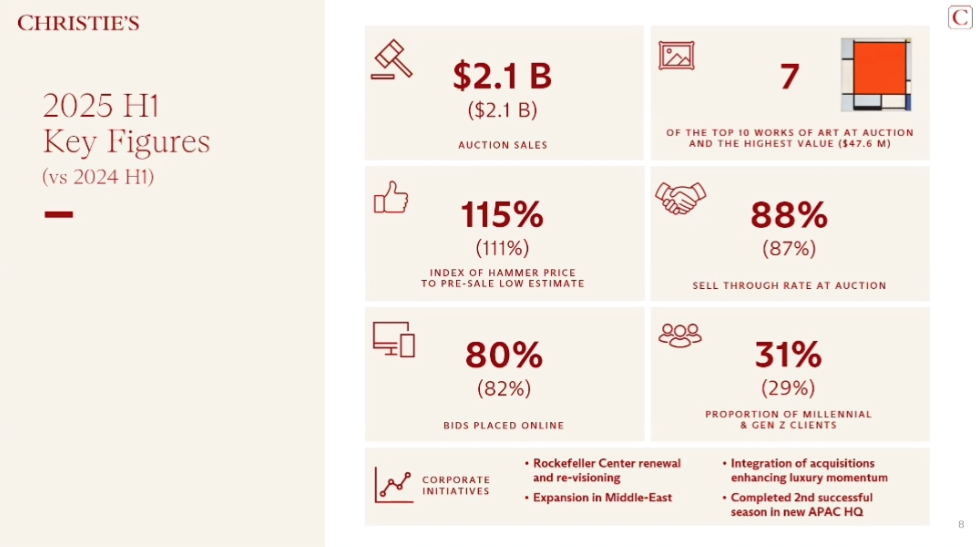
Core Insights - Christie's reported a 1% decline in global auction sales for the first half of 2025, totaling $2.061 billion, with a sales ratio of 88% and hammer prices exceeding low estimates by 115% [1][4][7] - The CEO Bonnie Brennan emphasized the stability of sales compared to the previous year, despite ongoing market challenges [1][7] - The auction house remains a leader in the industry, with significant contributions from various regions and categories [3][4] Sales Performance - Total auction sales decreased by 1% to $2.061 billion, with online auction sales amounting to $167 million [4][5] - The Americas contributed the most to sales at 45%, followed by Europe, the Middle East, and Africa at 34%, and Asia-Pacific at 21% [4] - Three out of five main categories saw declines: - 20th and 21st Century: $1.292 billion (-2%) - Asian Art/World Art: $156 million (-28%) - Classical Art: $9 million (-32%) - Notable growth in "Luxury" and "Old Masters" categories, with increases of 29% and 15% respectively [4][5][10] Market Trends - The luxury segment, including antiques, watches, and handbags, saw a remarkable 29% increase in sales, totaling $468 million [10] - The younger buyer demographic (Millennials and Gen Z) now represents 31% of Christie's clientele, indicating a shift towards attracting new collectors [13] - The auction house is focusing on digital engagement, with 80% of bids placed online, reflecting a trend towards digital tools in the auction process [9][10] Strategic Focus - Christie's aims to enhance its appeal to younger buyers through pricing and product strategies, encouraging them to transition from smaller purchases to higher-value items [13] - The company is observing a stable demand for collectibles, particularly in the high-end market, and plans to improve the presentation of auction items to attract buyers [13] - The management is considering adjustments in response to regulatory changes and market uncertainties, particularly regarding Asian art auctions [9][10]
吃货又立功!又一老字号要上市 靠一颗野果能否圆梦?
Zhong Guo Ji Jin Bao· 2025-07-05 12:21
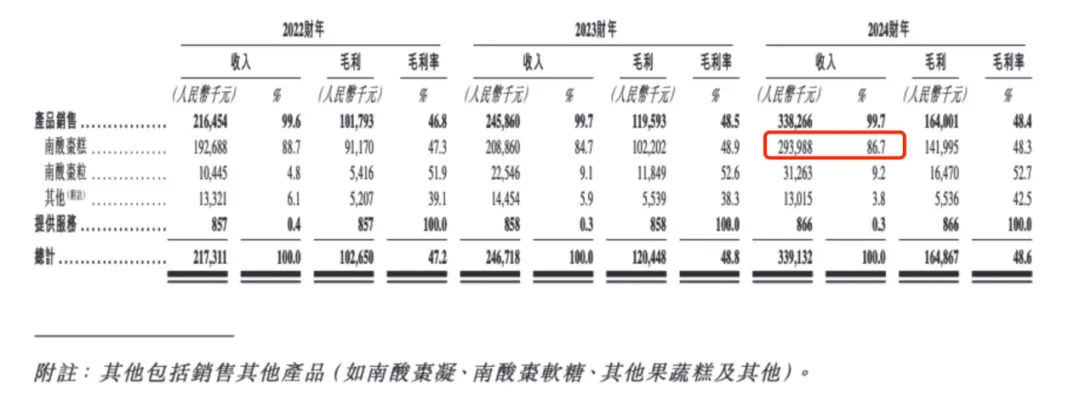
Core Viewpoint - Qiyunshan Food is preparing for an IPO, heavily reliant on its main product, South Jujube Cake, which contributed 2.94 billion RMB in revenue for 2024, accounting for 86.7% of total revenue [1][3]. Revenue and Product Performance - The South Jujube Cake has dominated the company's revenue, contributing 88.7%, 84.7%, and 86.7% of total revenue from 2022 to 2024 respectively [1][3]. - Other products, including South Jujube Granules, South Jujube Jelly, South Jujube Soft Candy, and South Jujube Frozen, are also based on South Jujube but have significantly lower revenue contributions [2]. - Revenue from South Jujube Granules increased from 10.44 million RMB in 2022 to 31.26 million RMB in 2024, but its share remains small at 9.2% [3]. Production Capacity and Strategy - The company strategically reduced production capacity for other products from 1,100 tons to 677 tons while increasing South Jujube Cake production capacity to 9,224 tons to meet rising market demand [4]. - The focus on a single product may enhance short-term efficiency but could limit long-term market adaptability due to a lack of product diversification [4][6]. Marketing and Sales Channels - Qiyunshan Food has a high marketing expenditure, with sales and marketing costs reaching 75.84 million RMB in 2024, accounting for 23.11% of revenue [10]. - The company relies heavily on offline sales channels, with 89.3% of revenue generated through 230 distributors, of which 199 are offline [7][9]. - Online sales have been declining, with online direct sales contributing only 10.4% of total revenue in 2024, down from 12.7% in 2022 [9][10]. Customer Concentration - In 2024, a single customer contributed 22.9% of total revenue, indicating a growing reliance on a few key clients [12][13]. - The share of revenue from the top five customers has increased from 26.4% to 38.7% over the past three years, raising concerns about customer concentration risk [13]. Industry Trends - The snack industry is witnessing a shift towards volume-based sales channels, which has become a new growth driver for companies [14]. - However, this model may pressure brand owners on cost management and supply chain efficiency due to lower profit margins associated with volume sales [15]. Supply Chain Risks - Qiyunshan Food faces supply chain risks as it relies on local farmers for raw materials without formal contracts, making it vulnerable to supply shortages and price fluctuations [16].
莎莎国际关闭内地所有门店,多家美妆巨头业绩失速,下滑明显
Sou Hu Cai Jing· 2025-06-26 13:35
Core Viewpoint - Sasa International Holdings Limited has announced plans to close all offline stores in mainland China by June 30, 2025, shifting focus to online sales due to declining profitability in physical retail [1][3]. Group 1: Company Performance - Sasa International, established in 1978, is a prominent beauty retail group in Asia, listed on the Hong Kong Stock Exchange since 1997, with operations in Hong Kong, Macau, mainland China, and Southeast Asia, offering over 600 product brands [2]. - For the fiscal year ending March 31, 2025, Sasa reported a 9.7% year-on-year decline in total revenue to HKD 3.942 billion, with net profit plummeting 64.8% to HKD 76.97 million [2]. - Online sales in mainland China reached HKD 418 million, a slight increase of 0.6% year-on-year, accounting for 58.4% of the group's total online revenue [2]. Group 2: Strategic Shift - The decision to close offline stores is driven by the inability to effectively cover the vast mainland market with only 18 stores, alongside the fact that online sales constitute 80% of the group's revenue in mainland China [3]. - Sasa International plans to concentrate resources on online business, having already established seven third-party online platforms in mainland China, with improving profitability in recent years [3]. Group 3: Market Outlook - Sasa International remains optimistic about retail performance in Hong Kong and Macau, despite a 12.3% decline in revenue to HKD 2.9918 billion for the fiscal year 2024/25 [7]. - The company anticipates a recovery in foot traffic and sales in the Hong Kong and Macau markets due to government initiatives to stimulate tourism, with a narrowing decline in offline sales from 19.4% in the first half to 6.3% in the second half of the fiscal year [7]. - The company will continue to seek suitable locations for new stores in traditional tourist areas to serve both local and mainland customers [7].

周六福启动招股,获深圳罗湖国资、永诚资本、灵宝黄金等青睐
Zheng Quan Shi Bao Wang· 2025-06-19 10:28
Core Viewpoint - Zhou Liufu Jewelry Co., Ltd. is set to launch its IPO on June 26, 2023, on the Hong Kong Stock Exchange, aiming to raise funds for expanding its sales network and enhancing brand recognition [3][4]. Company Overview - Zhou Liufu was founded in 2004 by brothers Li Weizhu and Li Weipeng, focusing on the research, design, production, and sales of various jewelry products including gold, platinum, diamonds, and jade [4]. - The company has maintained a position among the top five jewelry brands in China from 2017 to 2024 based on the number of stores [4]. - Zhou Liufu ranks second among national jewelry companies in China for the compound annual growth rate (CAGR) of online sales revenue from 2022 to 2024, and first in terms of online sales revenue as a percentage of total revenue for 2024 [4]. Sales Network - As of December 31, 2024, Zhou Liufu operates 4,125 stores across 31 provinces and 305 cities in China, with 91 self-operated stores and 4,034 franchise stores [4]. - The distribution of stores includes 8.3% in first-tier cities, 35.6% in second-tier cities, and 56% in third-tier and lower-tier cities, with over 50% of stores located in shopping centers and department stores [4]. Online Presence - Zhou Liufu has established a strong online presence, achieving significant sales growth on major e-commerce platforms, with a CAGR of 46.1% in online sales revenue from 2022 to 2024, and online sales accounting for 40% of total revenue in 2024 [5]. - The company received the annual best-selling product award from JD Retail's gold jewelry division in 2023 [5]. Financial Performance - Zhou Liufu's revenue figures for 2022, 2023, and 2024 are 3.102 billion RMB, 5.150 billion RMB, and 5.718 billion RMB, respectively, with a CAGR of 35.8%, ranking first among national jewelry companies [5][6]. - The net profit for the same years is reported as 575 million RMB, 660 million RMB, and 706 million RMB, with a CAGR of 10.8% [6].
周六福(06168)6月18日至6月23日招股 预计6月26日上市
智通财经网· 2025-06-17 23:09
Core Viewpoint - The company, Chow Tai Fook (06168), is set to launch an IPO from June 18 to June 23, 2025, offering 46.808 million shares at a price of HKD 24 per share, with trading expected to commence on June 26, 2025 [1] Group 1: Company Overview - Chow Tai Fook is a Chinese jewelry company that offers a variety of jewelry products, primarily focusing on gold jewelry and diamond-studded jewelry [1] - The company has maintained its position among the top five jewelry brands in China from 2017 to 2024 based on the number of stores [1] - As of December 31, 2024, the company ranked sixth in total merchandise transaction volume and tenth in revenue from gold jewelry products among all gold jewelry companies in China, with market shares of 6.2% and 1.0% respectively [1] Group 2: Retail Network and Online Sales - As of December 31, 2024, the company has a total of 4,129 retail stores across China, including both franchise and self-operated stores, with 4,125 located in 31 provinces and 305 cities [2] - The company has also expanded its online sales channels, achieving a compound annual growth rate (CAGR) of 46.1% in online sales revenue from 2022 to 2024, with online sales accounting for 40.0% of total revenue in 2024 [2] - In terms of online sales revenue CAGR from 2022 to 2024, the company ranks second among national jewelry companies in China, and it ranks first in the proportion of online sales revenue to total revenue in 2024 [2] Group 3: Use of Proceeds from IPO - The company estimates that it will net approximately HKD 1.024 billion from the global offering, assuming no exercise of the over-allotment option [3] - Approximately 50.0% of the net proceeds will be allocated to expanding and strengthening the sales network, which is crucial for enhancing market position and driving performance through direct consumer interaction [3] - About 20.0% of the net proceeds will be used to strengthen the brand and increase market awareness, another 20.0% will enhance product supply and design capabilities, and the remaining 10.0% will be allocated for working capital and general corporate purposes [3]