行业集中度提升

Search documents
均价跌至13.6万元!2025年12月新能源车降价幅度高达14.7%,机构人士:今年三季度行业利润率有望回升
Sou Hu Cai Jing· 2026-01-09 08:48
Core Insights - The Chinese automotive market is expected to achieve a scale breakthrough by 2025, but it will still face multiple challenges, including pressure on profitability. However, with a return to rational competition and an optimized market structure, the overall profit margin in the industry is anticipated to recover by the third quarter of 2026 [1] Group 1: Market Performance - In 2025, the average profit margin of the automotive industry is projected to be around 4.4%, significantly lower than the average profit margin of 6% for downstream industrial enterprises. More than half of the dealers are expected to be in a loss position, with the average price of passenger cars decreasing by approximately 9% year-on-year [1] - Data from the Passenger Car Association indicates that in December 2025, the average price of discounted domestic new energy vehicles was 136,000 yuan, with an average price drop of 20,000 yuan, representing a decline of 14.7%. Throughout 2025, the average price of discounted new passenger cars was 191,000 yuan, with an average price reduction of 20,000 yuan, resulting in a decline of 10.5% [3] Group 2: Industry Dynamics - The "price war" in the industry is showing signs of returning to rationality, with the number of discounted models decreasing by 42 compared to the previous year, totaling 177 models in 2025 [3] - The industry is expected to evolve into a structure characterized by a few leading companies, some mid-tier firms, and a large number of tail-end companies being reshuffled. Not all companies need to pursue sales volumes in the millions; some can find sustainable development paths by focusing on niche markets such as off-road and family vehicles [4] Group 3: Future Trends - The competition in the automotive industry in 2026 will shift towards the capital arena, where the competition will extend beyond technology, products, and customer relations to include capital strength, cash flow management, and merger and acquisition efficiency. The liquidity of capital and the efficiency of fund allocation will be critical in determining the survival and development space of enterprises amid the accelerating industry cycle adjustment and reshuffling [5]


煤炭行业2026年度策略-伺机而动
2026-01-08 02:07
Summary of Key Points from the Conference Call Industry Overview - The coal industry is facing challenges with significant amounts of outdated production capacity in the Shanxi, Shaanxi, and Inner Mongolia regions, which could constrain supply if these capacities are retired [1][3] - The implementation of Document No. 108 and disaster management projects is expected to impact raw coal production, collectively affecting over 100 million tons of capacity, necessitating ongoing monitoring of these developments in 2026 [1][3] Core Insights and Arguments - Clean energy is exerting pressure on thermal power, but the anticipated decline in demand for thermal coal may not be as severe as expected due to weakening new installed capacity [1][3] - The demand for coal in the U.S. is increasing due to AI-related electricity needs, with coal-fired power generation rising by 13% and coal demand increasing by 10% year-on-year from January to September 2025 [1][4] - There is significant potential for increasing the capacity utilization rate of U.S. coal-fired power plants, which, if raised to 55%, could lead to an additional demand of approximately 50 million tons of coal annually, potentially requiring increased imports from Australia [1][5] Policy Impacts - The Indonesian government has introduced measures to stabilize the coal market, including production halts for overproduction and increased export taxes, which will raise the cost baseline for global trade and support import prices in China [1][6][7] - Indonesia's new regulations set a price cap for coal used in domestic power plants at $70 per ton and $90 per ton for non-power uses, aiming to reduce the market share of small mining companies and enhance the concentration of the industry [2][7] Investment Opportunities - In a scenario of weak supply and demand, investors are advised to prioritize high-quality stocks such as Shenhua, China Coal, Shaanxi Coal, and Yanzhou Coal [1][8] - In the event of a black swan event causing supply-demand imbalances, attention should shift to more elastic stocks like Jinko, Lu'an, and Huayang [1][8] - Recommendations for U.S. stocks include Peabody Energy (BTU), while Hong Kong stocks such as Qinfa and Power Development are also suggested [1][8] - Companies with chemical operations, such as Yanzhou Coal Energy, China Coal Energy, Haohua Energy, and Huai Mining, are seen as having potential [1][8]
益丰药房:人口老龄化进程加快,零售药店作为社区健康流量入口,渠道价值将不断提升
Cai Jing Wang· 2026-01-04 07:36
Core Viewpoint - Yifeng Pharmacy has indicated that due to multiple factors such as the economic environment and industry cycles, the company will focus on improving operational quality, leading to a reduction in store openings and acquisition plans, resulting in a slowdown in revenue growth compared to previous periods [1] Group 1: Company Performance - For the period from January to September 2025, Yifeng Pharmacy achieved revenue of 17.286 billion yuan, representing a year-on-year growth of 0.39% [1] - The company reported a net profit attributable to shareholders of 1.225 billion yuan, which is a year-on-year increase of 10.27% [1] Group 2: Industry Outlook - The fundamental development logic of the industry remains unchanged, driven by factors such as accelerated population aging, medical reform separating medicine from medical services, and increased industry concentration [1] - Retail pharmacies are expected to continue to enhance their channel and social value as important entry points for community health [1] - The retail pharmacy industry is anticipated to experience new development opportunities with the ongoing innovation in diversified operations and the maturation of new retail models both online and offline [1]

国泰海通 · 晨报1231|建材、交运
国泰海通证券研究· 2025-12-30 14:28
Group 1: Waterproof Industry Insights - The waterproof industry has experienced the most severe clearing among consumer building materials, with the top four companies expected to capture nearly 50% market share by 2024 [3][4] - The industry's profitability is at a bottom position, with leading companies nearing breakeven in B-end engineering business, indicating potential for recovery in 2026 as price stabilization and recovery attempts begin [3][4] - The rapid increase in industry concentration reduces unnecessary price competition and enhances the feasibility of price increases among leading firms [4] Group 2: Future Profitability and Market Dynamics - In 2026, the industry is expected to continue attempts at price recovery, supported by lower asphalt prices at the beginning of the year, which will aid in profitability improvement [5] - The improvement in competition dynamics is anticipated to positively impact sales expenses, employee numbers, and accounts receivable turnover days for major companies [5] - Major companies are diversifying their business expansion beyond traditional domestic waterproof engineering, which may further enhance their market position [5] Group 3: Aviation Industry Outlook - The Chinese civil aviation sector is projected to continue recovering in 2025, with passenger traffic expected to grow by 5-6%, leading to a significant reduction in losses and potential profitability [10] - The supply side is entering a low-growth phase, with fleet size expected to increase by approximately 3.7% by November 2025, while passenger load factors are anticipated to reach historical highs [10][11] - The industry is expected to experience a "super cycle" starting in 2026, driven by steady demand growth and a recovery in customer structure, which will support price and profitability increases [12]

国泰海通|建材:防水行业出清领先,26年盈利修复可期
国泰海通证券研究· 2025-12-30 14:28
Core Viewpoint - The waterproofing industry is experiencing significant consolidation, leading to a potential recovery in pricing strategies and profitability by 2026, maintaining an "overweight" rating for the industry [1]. Group 1: Industry Overview - The waterproofing industry has undergone the most severe clearing among consumer building materials, with the top four companies expected to capture nearly 50% market share by 2024 [2]. - The industry's high exposure to credit risk from accounts receivable has led to the exit of many small enterprises, while the demand decline has been more pronounced due to the high proportion of construction activity [2]. - Intense price competition in recent years has contributed to the industry's challenges, but the increasing concentration of market share among leading firms may reduce the necessity for further price competition [2]. Group 2: Pricing and Profitability - The leading companies in the waterproofing sector have begun attempts to raise prices starting in 2025, indicating a collective shift in operational strategies [3]. - Although the impact of price increases on gross margins was not immediately evident in the third-quarter reports of 2025, there is a clear intent among leading firms to improve profitability [3]. - The low asphalt prices at the beginning of 2025 provide a favorable foundation for profitability recovery in 2026, with a focus on stable pricing strategies to enhance gross margins [3]. Group 3: Operational Improvements - The easing of competition is expected to positively affect sales expenses, employee numbers, and accounts receivable turnover for major companies in the industry [3]. - The primary companies are diversifying their business expansion beyond traditional domestic waterproofing projects, which may further enhance operational efficiency and financial performance [3].

今年黄羽鸡行业“冰与火”交织 2026年头部企业出栏或继续高增
Xin Lang Cai Jing· 2025-12-30 12:29
Core Viewpoint - The yellow feather chicken market in 2025 experienced a "roller coaster" with significant losses in the first half, followed by a rapid recovery in prices after August, leading to a potential balance between profit and loss for the year [1][2]. Group 1: Market Performance - The market faced a downturn in the first half of 2025, with prices hitting a low of 11.8 yuan/kg in July, and companies like Wen's Foodstuffs (温氏股份) reported a sales average of 10.29 yuan/kg in June, a 24.78% year-on-year decline [1][2]. - August marked a turning point, with prices increasing by over 20% month-on-month, allowing profitability to return, with profits of 3-4 yuan per chicken reported [2]. Group 2: Industry Dynamics - The industry is witnessing a polarization trend, with small farmers exiting the market while leading companies continue to grow rapidly. For instance, Wen's Foodstuffs and other listed companies reported significant increases in chicken sales, with Wen's selling 1.194 billion chickens, a year-on-year growth of 8.55% [3]. - The concentration of the industry is expected to increase, with leading companies projected to maintain a growth rate of around 10% in 2026, driven by cost advantages and a "company + farmer" model [3]. Group 3: Future Outlook - The industry is anticipated to shift from "cyclical speculation" to "value growth," with a focus on fresh and processed products as key growth areas. Price recovery is expected to be moderate, supported by supply adjustments and steady demand [3].



安井食品(603345):首次覆盖报告:景气拐点将至,速冻龙头有望率先修复
Shanghai Aijian Securities· 2025-12-26 11:12
Investment Rating - The report assigns a "Buy" rating for Anjuke Foods (603345.SH) as the initial coverage [2]. Core Views - The report highlights that Anjuke Foods, as a leading player in the frozen food sector, is expected to benefit from the recovery in dining consumption, the implementation of national standards for prepared dishes, and the expansion of new products, leading to performance growth [6][7]. - The frozen food industry in China is projected to maintain steady growth, with a market size of approximately 210 billion yuan in 2024 and a CAGR of about 6.5% from 2019 to 2024 [6]. - The company’s revenue for 2025, 2026, and 2027 is forecasted to be 157.3 billion yuan, 168.3 billion yuan, and 182.5 billion yuan, respectively, with year-on-year growth rates of 4.0%, 7.0%, and 8.5% [6]. Summary by Sections Market Data - Closing price: 81.52 yuan - Market capitalization: 23,909 million yuan - Price-to-earnings ratio (PE): 17.6X for 2025 [2]. Financial Performance - Revenue for 2023 is projected at 14,045 million yuan, with a year-on-year growth rate of 15.3% [8]. - The net profit for 2025 is expected to be 1,359 million yuan, reflecting a decline of 8.4% compared to the previous year [8]. - Gross profit margins for various product lines are forecasted to improve, with frozen prepared food margins expected to reach 27.5% by 2025 [6][7]. Product and Innovation Strategy - The company is focusing on innovation in frozen dishes, with significant revenue growth in this segment, which accounted for 32.0% of total revenue in the first three quarters of 2025 [6][7]. - The acquisition of Dingwei Tai is expected to enhance the company's capabilities in the frozen baking segment, which is one of the fastest-growing areas in the frozen food industry [7]. Competitive Positioning - Anjuke Foods is positioned to benefit from the increasing standardization and regulation in the prepared food industry, which is expected to raise entry barriers and favor leading companies [6][7]. - The company has established strategic partnerships with major retailers and restaurant chains, enhancing its market presence and customer loyalty through customized product offerings [7].

煤焦油市场年末为何降温?
Zhong Guo Hua Gong Bao· 2025-12-23 10:11
Core Insights - The domestic coal tar market experienced a recovery phase since mid-November, peaking at a transaction price of 3460 yuan per ton in early December, reflecting a 14% increase month-on-month. However, by mid-December, prices softened to around 3300 yuan due to various factors, including a decline in downstream market prices and increased production capacity utilization [2][3]. Group 1: Market Trends - The decline in the coal tar market is attributed to the weakening of the downstream processing industry, with significant price drops observed in products such as carbon black and coal pitch. For instance, as of December 18, prices for these products fell by 1.7% to 5.5% week-on-week [3]. - The core product, coal pitch, has seen a price drop, which has weakened the market's only support point, leading to a broader decline in coal tar prices across regions [3]. Group 2: Supply and Production - The supply side remains loose, with the capacity utilization rate of domestic coking enterprises exceeding 73%, a 2% increase from November. This stability in production levels contributes to a steady output of coal tar [4]. - The concentration in the coal tar industry has increased, with leading companies achieving significant economies of scale, with some facilities reaching annual production capacities of over 950,000 tons [4]. Group 3: Trade Dynamics - Traders' actions are significantly influencing market volatility, with a growing wait-and-see attitude among them. This has led to a notable decrease in auction participation and a downward adjustment in transaction prices [6]. - Despite the current bearish market sentiment, the overall supply of coal tar is expected to remain stable, with downstream processing enterprises maintaining relatively high operational rates [6].

国金证券:券商收并购事件有望提升行业集中度 催化板块估值修复
智通财经网· 2025-12-18 09:09
Core Viewpoint - The report from Guojin Securities highlights the proposed share-swap merger of Zhongjin Company with Dongxing Securities and Xinda Securities, indicating an acceleration in consolidation within the investment banking sector, which may enhance international competitiveness and strengthen the industry's Matthew effect [1] Summary by Sections Merger Proposal Highlights - The controlling shareholder remains unchanged, with Central Huijin still being the controlling shareholder and actual controller of Zhongjin Company [1] - The share-swap pricing for Zhongjin Company is set at 36.91 CNY per share, based on the average trading price over the last 20 trading days, while Dongxing Securities is priced at 16.14 CNY per share, reflecting a 26% premium [2] Development Outlook - The merger is expected to improve comprehensive rankings, with Zhongjin Company, Xinda Securities, and Dongxing Securities moving up in total assets, net assets, and net profit rankings post-merger [3] - The number of business outlets for Zhongjin Company is projected to increase from 245 to 436, enhancing regional distribution and customer base, with retail clients expected to rise from 9.72 million to over 14 million [3] - Capital efficiency is anticipated to improve, with the operating leverage ratios of Zhongjin Company, Dongxing Securities, and Xinda Securities being 5.42, 3.20, and 3.84 respectively, allowing for better capital utilization and international business expansion [4]




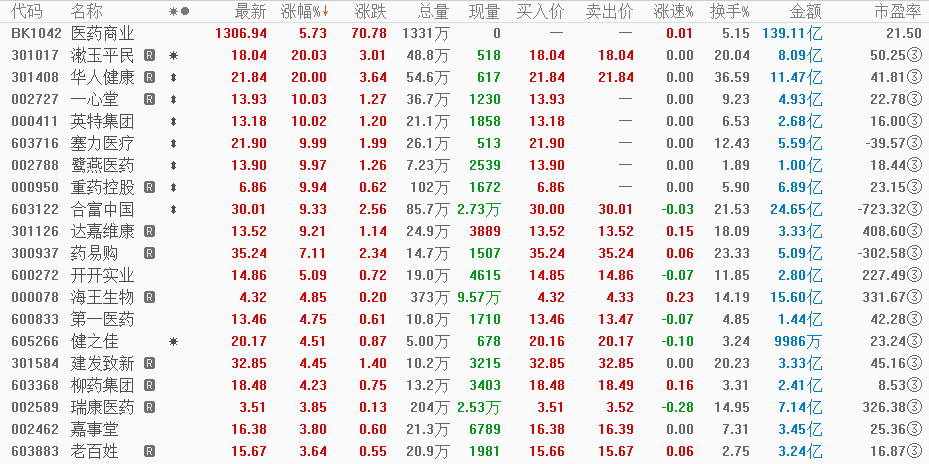
医药商业掀涨停潮,“内生+外延”双轮驱动行业集中度提升
Huan Qiu Wang· 2025-12-18 08:58
Core Viewpoint - The A-share pharmaceutical retail sector has experienced a significant rise, with the overall sector increasing by 5.73%, driven by renewed market recognition of the long-term growth logic in the pharmaceutical commercial industry [1][4]. Group 1: Market Performance - The pharmaceutical commercial sector saw a strong performance, with several stocks hitting the daily limit, including Huaren Health and Yiyuan Group, indicating a broad-based rally within the sector [1]. - The demand for protective products has directly translated into increased sales for retail pharmacies, effectively supporting the industry's overall prosperity [1]. Group 2: Industry Dynamics - The pharmaceutical retail industry is transitioning from rapid expansion to a phase of consolidation, with a notable decrease in the number of physical pharmacies, which has been declining for two consecutive quarters since Q4 2024 [2][3]. - The top 10 chain pharmacies are exhibiting significantly lower closure rates compared to smaller chains, leading to a concentration of market share among leading companies [3]. Group 3: Future Outlook - The growth path for industry leaders is becoming clearer, driven by both internal growth through improved product structure and external growth via mergers and acquisitions [3]. - Analysts believe that the recent surge in the pharmaceutical commercial sector reflects a re-evaluation of the industry's value, with a shift from being seen merely as "transporters" to key nodes in the health service ecosystem [4].