
原油供应过剩

Search documents
又爆了!黄金、原油大涨
中国能源报· 2025-10-06 02:39
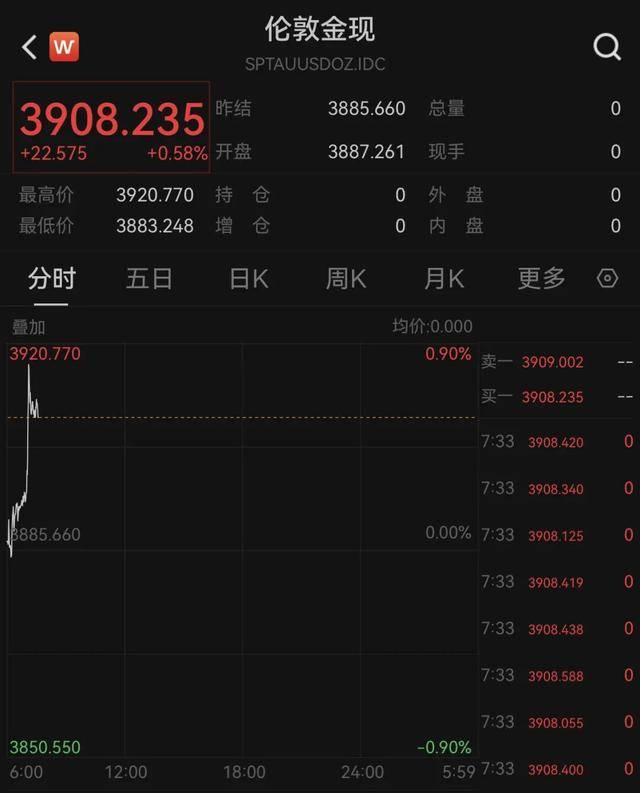
Group 1 - Spot gold opened strong, reaching a historical high of $3920.77 per ounce, with a year-to-date increase of 49% [3] - COMEX gold also surged, hitting a peak of $3945.2 per ounce, marking a new record [4][5] - The U.S. government shutdown has intensified uncertainty, contributing to rising expectations for interest rate cuts, which is driving demand for gold [6] Group 2 - The World Gold Council reported a significant inflow of $136 million into gold ETFs over the past four weeks, with total inflows exceeding $60 billion for the year, a record high [6] - Analysts predict that gold prices may continue to rise, with major banks forecasting potential prices of $4000 to $5000 per ounce [6] - The Federal Reserve is expected to cut interest rates, with a 95% probability of a cut in October and a 99% probability in December [7] Group 3 - International oil prices have risen over 1%, with WTI crude reaching $61.85 per barrel [8] - OPEC+ is expected to confirm an increase in oil production by at least 137,000 barrels per day in November, following the abandonment of previous production cuts [10] - Macquarie Group forecasts that if the supply surplus continues, Brent crude prices could drop to the $50 per barrel range in the coming quarters [11]


金价,爆了!油价,涨了!
Sou Hu Cai Jing· 2025-10-06 01:06
Group 1: Gold Market - The spot gold price opened strong on October 6, rising nearly 1% to a record high of $3920.77 per ounce, with a year-to-date increase of 49% [1] - COMEX gold also reached a new historical high, peaking at $3945.2 per ounce [1] - Over the past four weeks, net inflows into gold ETFs surged to $13.6 billion, bringing total net inflows for 2025 to over $60 billion, marking a record high [2] Group 2: Federal Reserve and Interest Rates - The Federal Reserve announced a 25 basis point cut in the federal funds rate target range to 4.00% to 4.25% in September [3] - The probability of a rate cut in October is close to 95%, with a 99% probability for December [3] - According to the CME FedWatch Tool, the likelihood of maintaining the current rate in October is only 5.4% [3] Group 3: Oil Market - International oil prices rose by over 1%, with WTI crude oil reaching $61.85 per barrel [4][5] - OPEC+ held an online meeting on October 5 to discuss production arrangements for November, with expectations to confirm an increase of at least 137,000 barrels per day [6][7] - Macquarie Group predicts that if the current oversupply trend continues, Brent crude oil prices could drop to the $50 per barrel range in the coming quarters [8]
OPEC+宣布11月增产13.7万桶/日,沙特、俄罗斯分歧后达成妥协
华尔街见闻· 2025-10-05 13:17
沙特阿拉伯和俄罗斯克服立场分歧后达成一致,OPEC+同意11月小幅增加原油产量。 ⭐星标华尔街见闻,好内容不错过 ⭐ 本文不构成个人投资建议,不代表 平台 观点,市场有风险,投资需谨慎,请独立判断和决策。 国际能源署预计,随着全球需求降温和美洲地区供应激增, 原油库存将在本季度快速堆积,2026年将出现创纪录的供应过剩。 觉得好看,请点"在看" 当地时间10月5日,OPEC+公告称,该组织八个产油国将在11月进一步增产13.7万桶/日。下次会议将于11月2日举行。 俄罗斯此前推动限制供应增加,倾向于有助于保卫价格的调整,而沙特阿拉伯更关注市场份额,支持更大幅度的增产。 一位代表在周日会议前表示,俄罗斯支 持较为谨慎的增产幅度,而沙特则支持更大规模的供应增加。 油价周五交易接近四个月低点,提醒OPEC及其盟友在向供应过剩市场恢复供应时需要谨慎平衡。该组织正在恢复另一层暂停生产——总计约165万桶/日,此 前刚刚恢复了更大规模的产量。 一系列增产也显示了OPEC+联盟实际可用备用产能的局限性。八个主要成员国在5-9月期间仅恢复了计划220万桶/日供应量的约60%,部分原因是某些国家正 在补偿此前的超额生产,但也表 ...

新一轮增产?原油最新消息!
Zheng Quan Shi Bao· 2025-10-05 12:07
Group 1 - OPEC+ is expected to confirm an increase in oil production by at least 137,000 barrels per day for November during its meeting on October 5 [1][2] - Since April, OPEC+ has abandoned its reduction strategy, with eight member countries fully canceling a voluntary reduction of 2.2 million barrels per day by the end of September [2] - The rapid increase in production has raised concerns about a potential oversupply in the oil market, with Bloomberg reporting a 400,000 barrels per day increase in September [2] Group 2 - Financial institutions are adjusting their oil price forecasts due to increasing supply, with the International Energy Agency predicting a potential historical oversupply by 2026 [3] - Macquarie Group forecasts that Brent crude prices could drop to the $50 per barrel range if oversupply continues, with an average price of $57 per barrel for West Texas Intermediate crude next year [3] - The European Parliament is considering accelerating the phase-out of Russian oil and gas imports, which could impact the overall energy supply dynamics in the region [3] Group 3 - The domestic chemical industry is focusing on "stabilizing total volume and optimizing structure" as outlined in a new plan by multiple government departments [4] - The plan emphasizes strict control over new capacity in traditional sectors like refining and ethylene, while supporting upgrades to existing facilities [4] - The initiative aims to reduce the output of refined oil products while increasing the production of chemical products, potentially affecting prices of basic chemicals like synthetic resins and ethylene glycol [4]

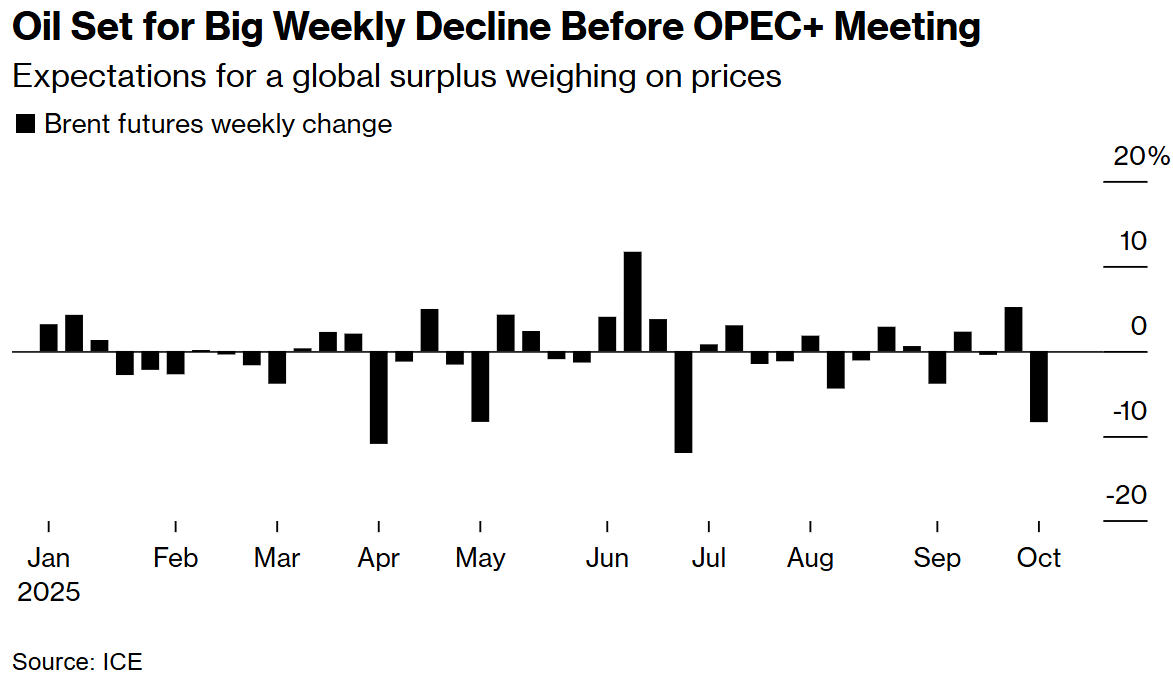
油价或将创6月底以来最大周跌幅!OPEC+会议前夕供应过剩担忧加剧
智通财经网· 2025-10-03 01:36
Group 1 - Oil prices are expected to see the largest weekly decline since late June, with Brent crude trading around $64 per barrel, down approximately 8% this week, and West Texas Intermediate below $61 per barrel [1] - The upcoming OPEC+ meeting is anticipated to address concerns over oversupply, with expectations of returning idle capacity [1] - Preliminary signs of global supply surplus have emerged in the Middle East, with the International Energy Agency forecasting record levels of oversupply next year, partly due to the return of OPEC+ production [4] Group 2 - In September, OPEC increased its daily production by 400,000 barrels, officially ending the production cuts implemented in 2023 [4] - Concerns about a potential long-term government shutdown in the U.S. may negatively impact the economy and suppress fuel demand [4] - Despite the oversupply concerns, worries about potential disruptions to Russian supply due to U.S. intelligence support to Ukraine have limited further declines in oil prices [4]
深夜,油价“连续崩跌”,金价“大跳水”,美国政府“停摆”可能延续至下周
Qi Huo Ri Bao· 2025-10-02 23:41
Oil Market - International oil prices have experienced a significant decline, with WTI crude oil futures dropping by $1.30 to $60.48 per barrel, a decrease of 2.1%, and Brent crude oil futures falling by $1.03 to $64.32 per barrel, down 1.58% [1][3] - Brent and WTI crude oil have seen four consecutive days of decline, reaching their lowest levels in nearly four months due to concerns over potential oversupply ahead of an upcoming OPEC meeting [3] - HFI Research indicates that U.S. oil inventories are expected to increase by year-end, contributing to a persistently weak oil market environment [4] Gold Market - Gold prices initially reached a record high of $3,897 per ounce before experiencing a sharp decline, dropping below $3,820 per ounce [5] - Year-to-date, spot gold prices have risen by $1,200 per ounce, representing an increase of over 45%, driven primarily by risks associated with the U.S. economy [9] - The ongoing U.S. government shutdown has heightened market risk aversion, leading to increased expectations for further interest rate cuts by the Federal Reserve, which has supported gold prices [10] - Institutions such as JPMorgan and UBS have raised their gold price forecasts, with expectations that gold could reach $3,800 per ounce by Q4 2025 and potentially exceed $4,000 per ounce in Q1 2026 [11] - Analysts predict that gold prices will likely fluctuate between $3,700 and $4,100 per ounce in Q4 2023, with a possibility of breaking above $4,200 per ounce if no significant negative factors arise [12]

油价或将跌至“5字头”!麦格理警告:市场面临严重供应过剩
Jin Shi Shu Ju· 2025-10-01 11:13
Core Viewpoint - Macquarie Group has lowered its oil price expectations, predicting a significant supply surplus in the market due to ongoing oil production expansion, with prices expected to fall to the $50 per barrel range in the coming quarters [2][3] Group 1: Oil Price Forecast - Analysts at Macquarie Group maintain a bearish outlook on the energy sector, citing that the market will face a severe supply surplus by the end of this year and into the first quarter of next year due to increased crude oil supply from OPEC+ and non-OPEC producers [2] - Brent crude oil prices have fallen approximately 11% this year, with a continuous decline observed in September, as OPEC+ has significantly relaxed supply restrictions to regain market share [2] Group 2: OPEC+ Production Plans - OPEC+ is set to meet this weekend to finalize production levels for November, with discussions indicating a potential plan to accelerate production by approximately 500,000 barrels per day over three months, although OPEC has stated that no such plan is currently in place [2][3] - Analysts note that Saudi Arabia shows no signs of slowing down production increases, which could lead to a prolonged period of low prices unless various factors align to restore market balance [3] Group 3: Supply and Demand Dynamics - Macquarie forecasts that the average price for WTI crude oil next year will be $57 per barrel, down from a previous estimate of $60, while Brent crude is expected to average $57 in Q1 and $59 in Q2 of next year [3] - The report indicates a projected global oil supply surplus of 4.63 million barrels per day in Q1 of next year, with surpluses expected to persist in the following quarters, albeit at decreasing levels [3] - The International Energy Agency (IEA) has predicted that by 2026, global oil production will exceed consumption by an average of 3.33 million barrels per day, marking a historic supply surplus on an annual basis [3]
多方利空突袭,油价大跌!“三桶油”股价承压
Sou Hu Cai Jing· 2025-09-30 12:42
Group 1 - The stock prices of China's "three oil giants" collectively declined on September 30, with China Petroleum (00857.HK) down 2.75%, China National Offshore Oil (00883.HK) down 1.24%, and China Petroleum & Chemical (00386.HK) down 1.22% [2][3] - In the A-share market, oil and gas stocks also faced pressure, with China Petroleum (601857.SH) down 1.35%, China National Offshore Oil (600938.SH) down 1.02%, and China Petroleum & Chemical (600028.SH) also declining [3] - Reports on September 29 indicated that OPEC+ is likely to approve a new round of oil production increases in their online meeting on October 5, with an increase of at least 137,000 barrels per day, aiming to regain market share [3][4] Group 2 - Following the news, concerns about oversupply in the oil market resurfaced, leading to a significant drop in international oil prices, with WTI crude futures falling 3.86% to $63.18 per barrel on September 29, and continuing to decline to $62.72 per barrel [4] - OPEC+ currently accounts for about half of global oil production, including member countries from OPEC and Russia along with other allies [4] - If the production increase plan is implemented in November, it could further expand global oil supply, exacerbating the risk of oversupply and putting pressure on oil prices [5] Group 3 - Geopolitical factors, including a new plan announced by the U.S. and Israel to end the Gaza conflict, have significantly reduced geopolitical risks, contributing to further declines in oil prices [6] - Analysts suggest that potential oversupply and changes in geopolitical risk premiums may dominate trading in the short term, with market focus on OPEC+'s next actions and the fragile diplomatic process regarding Gaza [6] - The ongoing U.S. government shutdown issue and upcoming non-farm payroll data release could also impact market risks and oil demand expectations [6]




OPEC+或再增产石油、中东局势缓和 国际油价一度跌4%
Hua Er Jie Jian Wen· 2025-09-30 01:32
Group 1 - WTI crude oil futures fell by 4% during trading, marking the largest decline since June, closing at $63.45 per barrel, a drop of 3.45% [1] - Brent crude oil futures also decreased, closing at $67.97 per barrel, down by 3.08% [1] Group 2 - OPEC+ is considering increasing production beyond the planned increase of 137,000 barrels per day next month, despite existing market surplus expectations [4] - RBC Capital Markets analysts predict that OPEC+ is likely to decide on the 137,000 barrels per day increase in their October 5 meeting, but actual increases may be lower due to many member countries reaching production limits [4] - Geopolitical tensions are currently supporting oil prices, but recent developments have reduced these risks, particularly regarding the Israel-Gaza conflict [4] - The restoration of oil exports from northern Iraq to Turkey has resumed after a two-year halt, which may impact supply dynamics [4] Group 3 - The International Energy Agency (IEA) forecasts a record oversupply of crude oil by 2026 as OPEC+ continues to restore production alongside non-OPEC competitors [5] - Goldman Sachs indicates that despite China's oil stockpiling, Brent crude may drop to the mid-$50 range next year [5]

OPEC+或再增产石油 WTI原油期货一度跌4%
Hua Er Jie Jian Wen· 2025-09-29 23:41
Group 1 - Oil prices experienced a significant drop due to indications that OPEC+ may decide to increase production again in November during the October meeting, erasing gains from the previous week [1] - WTI crude oil futures fell by 4% during trading, marking the largest decline since June, closing at $63.45 per barrel, a decrease of 3.45%, while Brent crude oil futures closed at $67.97 per barrel, down 3.08% [1] - OPEC+, led by Saudi Arabia, is considering increasing production by at least 137,000 barrels per day above the planned increase for next month, raising concerns about whether member countries have reached their production capacity limits [1] Group 2 - Geopolitical risks have decreased, with the U.S. and Israel discussing a plan to end the Gaza conflict, which could potentially reduce the "war premium" in oil prices if the conflict in the Middle East, a major oil supply region, comes to an end [2] - The IEA predicts a record oversupply of crude oil by 2026 as OPEC+ continues to restore production, while competitors outside the organization are also increasing output [2] - Despite China's oil stockpiling, Goldman Sachs forecasts that Brent crude oil prices may drop to the mid-$50 range next year [2]