
指数化投资

Search documents
从基金中报看北交所机构化趋势:——2025H1北交所公募持仓分析
Shenwan Hongyuan Securities· 2025-09-23 11:45
Overview - The trend of public funds increasing their allocation to the Beijing Stock Exchange (BSE) continues, with significant entry of active equity public funds. As of H1 2025, the market value allocated by public funds to the BSE reached 22.383 billion, with an allocation ratio of 0.37%, up by 0.15 percentage points quarter-on-quarter. The allocation coefficient reached 0.59, an increase of 0.07. Public funds have continuously increased their allocation to the BSE for three consecutive half-year periods since H1 2024. Among them, the proportion of active equity public funds allocated to the BSE reached 0.46%, up by 0.26 percentage points quarter-on-quarter, with an allocation coefficient of 0.74, an increase of 0.24 [7][24][47]. Active Equity - Active equity public funds significantly increased their allocation to the BSE, with a total market value of 11.22 billion as of H1 2025, a substantial increase of 116% compared to H2 2024. The BSE's thematic products also saw a market value of 3.9 billion, up by 54% quarter-on-quarter, primarily due to net value growth and the opening of subscriptions for the "Taikang BSE Selected Two-Year Open" fund [24][25][28]. Index Investment - The scale of index investment in the BSE is steadily expanding. As of H1 2025, the market value held by BSE index funds reached 11.08 billion, an increase of 48% quarter-on-quarter. The BSE 50 index fund accounted for 10.5 billion, up by 46%, while other index funds reached 580 million, up by 90%. The scale of passive index funds was 10.02 billion, up by 42%, and the scale of index-enhanced funds reached 1.06 billion, up by 162% [47][48]. Allocation - The institutionalization trend is accelerating, with a focus on growth sectors. As of H1 2025, the concentration of active equity public fund allocations has increased, with key stocks like Jinbo Bio, Naconoer, and Tongli Co. accounting for about half of the total market value held. The report emphasizes the importance of sectors with sustained growth potential, such as Jinbo Bio and Minshida [24][38][39].

半导体设备相关ETF大涨,机构看好设备国产进展丨ETF晚报
2 1 Shi Ji Jing Ji Bao Dao· 2025-09-23 11:14
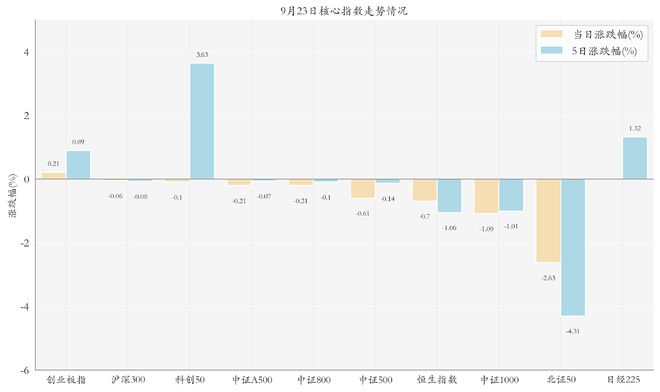
Group 1: ETF Industry News - The three major indices showed mixed results, with the semiconductor equipment-related ETFs experiencing significant gains, such as the Chip Equipment ETF (560780.SH) rising by 7.72%, Semiconductor Materials ETF (562590.SH) increasing by 6.04%, and the Semiconductor Equipment ETF by E Fund (159558.SZ) up by 5.76% [1][9] - Huatai Securities' report is optimistic about the continued investment in advanced logic and storage in China by 2026, predicting that the domestic equipment companies' market share in China may increase by 6 percentage points to 29% year-on-year [1] Group 2: A500 Index Fund Expansion - The CSI A500 Index Fund celebrated its first anniversary, with the number of products expanding to 267 (140 after merging different share classes), and the total product scale increasing by over 60% [2] Group 3: Market Overview - On September 23, the Shanghai Composite Index fell by 0.18% to 3821.83 points, while the Shenzhen Component Index decreased by 0.29% to 13119.82 points, and the ChiNext Index rose by 0.21% to 3114.55 points [3] - In the past five trading days, the ChiNext Index, Nikkei 225, and ChiNext 50 showed positive performance, with respective gains of 3.63%, 1.32%, and 0.89% [3] Group 4: Sector Performance - Among the Shenwan first-level industries, banking, coal, and electric equipment sectors performed well, with daily gains of 1.52%, 1.11%, and 0.43% respectively, while social services, retail, and computer sectors lagged behind with declines of -3.11%, -2.9%, and -2.39% [5][7] Group 5: ETF Market Performance - The average performance of different categories of ETFs showed that commodity ETFs had the best average daily gain of 0.79%, while cross-border ETFs had the worst performance with an average decline of -0.72% [6] - The top-performing ETFs today included the Chip Equipment ETF (560780.SH), Semiconductor Materials ETF (562590.SH), and Semiconductor Equipment ETF by E Fund (159558.SZ), with returns of 7.72%, 6.04%, and 5.76% respectively [9] Group 6: ETF Trading Volume - The top three ETFs by trading volume were the ChiNext ETF (159915.SZ) with a trading volume of 6.866 billion, the Sci-Tech 50 ETF (588000.SH) at 6.568 billion, and the Sci-Tech Chip ETF (588200.SH) at 5.364 billion [11][12]

银行理财周度跟踪(2025.9.15-2025.9.21):理财公司加码指数化布局:跟踪现有指数、自主构建双策并行-20250923
HWABAO SECURITIES· 2025-09-23 08:58
Investment Rating - The report does not explicitly provide an investment rating for the industry Core Insights - The report highlights a significant trend in the banking wealth management sector, with companies increasingly focusing on index-based products to enhance their offerings and meet market demands [4][11] - The collaboration between financial institutions, such as the partnership between Huaxia Wealth and Huaxia Fund, aims to create a robust index ecosystem to support high-quality development in asset management [13][14] - The report notes the successful IPO of Hesai Technology, marking a significant event in the market, with postal wealth management participating in this investment [15][16] - The introduction of the Shanghai Sci-Tech Financial Theme Wealth Management Product by Puyin Wealth Management reflects a strategic move to align with national innovation policies and support local tech enterprises [18] Summary by Sections 1. Regulatory and Industry Dynamics - Wealth management companies are actively launching index-based products, with an increase in both the number and issuance of such products in the market [4][11] - The core motivation for this shift includes reducing active management risks, enhancing strategy transparency, and meeting customized client demands through self-constructed indices [12] 2. Peer Innovation Dynamics - Huaxia Wealth and Huaxia Fund have signed a memorandum to deepen cooperation in the index business, aiming to build a market-influential index ecosystem [13][14] - Puyin Wealth Management has launched a new product focused on technology finance, raising 220 million yuan to support quality tech enterprises in Shanghai [18] 3. Yield Performance - Cash management products recorded a 7-day annualized yield of 1.29%, remaining stable compared to the previous week, while money market funds saw a slight increase to 1.19% [19][20] - The report indicates a general recovery in annualized yields for fixed-income products across various maturities [23][27] 4. Net Value Tracking - The net value ratio of banking wealth management products decreased to 2.04%, down by 0.61 percentage points, indicating a positive trend in credit spreads [29][32]

万亿公募博时基金换帅!张东接棒,江向阳将奔赴下一程
2 1 Shi Ji Jing Ji Bao Dao· 2025-09-23 08:12
Group 1 - The current chairman of Bosera Fund, Jiang Xiangyang, is set to transition to a new role at China Merchants Group's wholly-owned subsidiary, China Merchants Finance Leasing Co., Ltd. The current general manager and party secretary, Zhang Dong, is expected to be promoted to chairman [1] - Under Jiang Xiangyang's leadership for the past ten years, Bosera Fund's management scale has grown from 302.7 billion to 1.61 trillion yuan, covering a wide range of fund types including equity, bond, mixed, and QDII funds [1][4] - Zhang Dong has extensive experience in the banking sector, having worked at China Merchants Bank for nearly 30 years, and is expected to leverage his wealth management expertise to drive innovation at Bosera Fund [2][3] Group 2 - Bosera Fund, established in 1998, is one of the earliest public fund managers in China, with several subsidiaries including Bosera Fund (International) Co., Ltd. and Bosera Capital Management Co., Ltd. [4] - As of the end of 2024, Bosera Fund reported total assets of 13.421 billion yuan and a net profit of 1.515 billion yuan, with a slight increase in net profit to 763 million yuan in the first half of 2025 [4] - By the second quarter of 2025, Bosera Fund's public fund assets reached 1.13 trillion yuan, ranking among the top ten in the industry, with significant strengths in bond investments [5]
中证A500指数发布一周年!汇聚行业龙头力量,筑就时代标杆典范
Xin Lang Ji Jin· 2025-09-23 01:00
Core Insights - The China Securities A500 Index was officially launched on September 23, 2024, providing a new investment tool aligned with China's economic high-quality development and industrial transformation [1] - The A500 Index covers 91 sub-industries and significantly overweights five new economy sectors, reflecting the rising capital market share of industries related to new productive forces [1] - The A500 Index represents a substantial portion of the A-share market, covering 53.1% of total market capitalization and 67.7% of net profit attributable to shareholders [1] Market Performance - Since its launch, the A500 Index has seen a cumulative increase of 47.44%, outperforming nearly half of the Shenwan first-level industry indices and other major indices like the SSE 50 and CSI 100 [2][3] - The index has reached near three-year highs, supported by improved policy expectations and significant capital inflows [2] ETF Growth - The total scale of ETFs tracking the A500 Index has reached 187.3 billion yuan, making it the second-largest broad-based ETF in the A-share market after the CSI 300 Index [3] - The A500 ETF by Huatai-PB has seen its scale and shares grow by 1017.55% and 823.5%, respectively, since its inception, indicating strong market recognition [3] Fund Performance - The A500 ETF has a cumulative net asset value of 1.2101 yuan, making it the only ETF tracking the A500 Index with a net asset value exceeding 1.21 yuan [5] - The fund features a low fee structure, with management and custody fees at 0.15% and 0.05% per year, respectively, which are among the lowest in the A-share market [5][6] Economic Context - The launch of the A500 Index is seen as a response to structural improvements in the Chinese stock market, supported by factors such as recovering ROE, enhanced policy support, and technological innovation [5] - The index aims to provide diverse perspectives on macroeconomic and industrial changes, potentially advancing the maturity of index-based investment in China [5]
年内银行理财子公司指数化投资升温
Zheng Quan Ri Bao· 2025-09-22 16:13
Group 1 - The core viewpoint of the articles highlights the increasing trend of bank wealth management subsidiaries launching index-based financial products, driven by the ongoing transformation towards net value-based management and the acceleration of long-term capital entering the market [1][4]. - Index-based investment is gaining traction as a significant entry point for bank wealth management subsidiaries into the equity market, characterized by clear strategies, stable styles, and ease of understanding [1][4]. Group 2 - Recent activities include the launch of new index products by major bank wealth management subsidiaries such as China Merchants Bank Wealth Management and Bank of Communications Wealth Management, with specific indices developed for diversified asset allocation [2][3]. - The "China Merchants Bank Wealth Management Bay Area Global Asset Preferred Allocation Index" and the "China Chengxin - Bank of Communications Wealth Management Multi-Strategy Asset Allocation Index" are examples of newly introduced indices aimed at quantifying and diversifying risks across global assets [2][3]. Group 3 - As of May 2025, there are nearly 600 existing index-based financial products, reflecting an increase of over 100 products compared to the end of 2024, indicating a rise in both the number and popularity of these products [3]. - The trend of tracking mature indices is also noted, with new products launched that follow established indices such as the MSCI Dividend Index and the China Bond - National Development Bank Bond Total Wealth Index [3]. Group 4 - The average annualized return of newly issued index-based financial products in 2023 is reported at 16.72%, significantly higher than the overall market average of 2.85% [5]. - The demand for index-based investment is increasing, prompting a need for effective performance benchmarks and investment strategies, while balancing return elasticity and risk control remains a common challenge for bank wealth management subsidiaries [5].
科创板ETF数量突破百只大关,总规模近3000亿元
Di Yi Cai Jing Zi Xun· 2025-09-22 10:36
截至目前,全市场科创板ETF数量已突破100只大关,科创板形成覆盖宽基、主题、策略的多层次指数 产品体系,结构持续优化、生态日趋成熟。目前科创板ETF总体管理规模近3000亿元,科创板成为A股 指数化投资比例最高的板块。(第一财经记者 黄思瑜) ...
科创板ETF数量突破百只大关,总规模近3000亿元
第一财经· 2025-09-22 09:52
截至目前,全市场科创板ETF数量已突破100只大关,科创板形成覆盖宽基、主题、策略的多层次指数 产品体系,结构持续优化、生态日趋成熟。目前科创板ETF总体管理规模近3000亿元,科创板成为A 股指数化投资比例最高的板块。(第一财经记者 黄思瑜) ...

研究框架培训:资金面研究框架
2025-09-22 00:59
Summary of Key Points from Conference Call Records Industry Overview - The ETF market in China is rapidly expanding, expected to exceed 5 trillion by August 2025, surpassing Japan to become Asia's largest ETF market [1] - Passive funds are increasingly dominating the A-share market, with their market value share surpassing active funds for the first time in Q4 2024 [10] - The insurance sector is projected to inject an additional 300-400 billion into the market in the second half of 2025 due to policy guidance and premium growth [25] Core Insights and Arguments - The growth of stock ETFs is significant, with net inflows reaching 1 trillion in 2024, driven by a shift from state-backed support to industry-themed ETFs [1][5] - Active equity funds have been shrinking since 2022, but are expected to show excess returns starting in 2025, indicating a potential recovery in investor interest [13][15] - The social security fund, with a size of 3 trillion, plays a crucial role in the A-share market, holding approximately 21.4% of its assets in A-shares [34] Changes in Investor Behavior - There has been a notable shift in investor preferences, with insurance funds increasingly favoring high-dividend assets and expanding into broader sectors like telecommunications and automotive [25][26] - The participation of retail investors in the A-share market remains low, with a significant decline in new account openings compared to previous years [36] - The trend of active equity funds is showing signs of recovery, with improved performance and reduced redemption pressure since early 2025 [18] Market Dynamics and Future Outlook - The A-share market is currently characterized by a stock game environment, with ETFs providing essential passive incremental funds that influence market styles significantly [11] - The future of active equity funds looks promising, with expectations that they will become a significant source of incremental capital in the market starting in Q4 2025 [24] - External factors such as MSCI index inclusion, PMI index, US Treasury rates, offshore RMB exchange rates, and relative returns of A-shares are critical indicators for foreign capital inflow [31] Additional Important Insights - The insurance sector's asset allocation strategy is evolving, with a preference for high-dividend assets despite rising valuations and declining yields [25][26] - The performance of private equity funds has improved, with a notable increase in their market presence and flexibility in investment strategies [33] - The overall market sentiment is expected to improve as various types of funds, including public funds, insurance capital, and foreign ETFs, align to create a consensus for further capital inflow [38]
中证A500一周年成长记:新宽基“圈粉”无数 投资生态日趋完善
Zhong Guo Zheng Quan Bao· 2025-09-21 23:19
Core Insights - The launch of the CSI A500 index in September 2024 marks the beginning of a new era in broad-based index investment, attracting significant attention to core A-share assets [2][3] - The CSI A500 index has quickly gained recognition and scale, with 32 ETFs surpassing a total size of 180 billion yuan, making it the second-largest core broad-based index in the A-share market after the CSI 300 [2][3] - The index's unique characteristics, including balanced industry weightings and a focus on leading companies, have contributed to its outperformance compared to traditional broad-based indices [4][7] Investment Products and Strategies - A diverse product matrix has been established around the CSI A500 index, including ETFs, enhanced index funds, and various active strategies, catering to different investor needs [1][9][10] - The investment strategies range from passive tracking to active quantitative enhancements, providing flexibility for investors based on their goals and risk profiles [9][10] - The rapid growth of the CSI A500 ETF ecosystem reflects a healthy development in index investment, with over 100 products launched within a year [10][11] Institutional Participation - Institutional investors play a crucial role in the rapid expansion of the CSI A500 ETF, with over 70% of holdings in several ETFs attributed to institutional accounts [5][6] - Insurance funds have been significant contributors, with major players like China Life and Ping An heavily investing in CSI A500 ETFs, indicating strong alignment with their long-term investment strategies [6][8] - The participation of various entities, including state-owned funds, foreign institutions, and private investors, has diversified the funding sources for the CSI A500 ETF [7][8] Market Trends and Future Outlook - The CSI A500 index is expected to benefit from the ongoing transformation of the Chinese economy and the shift of investor sentiment towards equity assets [8][11] - As the market evolves, the introduction of derivative products linked to the CSI A500 index could further enhance investment strategies and attract more participants [10][11] - The overall trend towards index-based investment in China is supported by favorable policies encouraging long-term capital inflow into the stock market [11]