大语言模型

Search documents
外资在中国|首个大规模海外研发基地正式运营 保时捷加码在华布局谋与策
Zhong Guo Jing Ying Bao· 2025-11-06 05:32
Core Insights - The rapid changes in the Chinese market are leading the future of mobility, emphasizing electrification, digitalization, and new luxury concepts [1] - The automotive industry is undergoing a profound transformation, requiring companies to rethink their operational strategies and make decisive actions to appeal to younger customers [1] Group 1: Porsche's Commitment to China - The inauguration of the Porsche China R&D Center marks a significant milestone in the company's "In China, For China" strategy, enhancing local innovation capabilities [1][2] - The new R&D center is Porsche's first large-scale overseas facility outside Germany, equipped with modern facilities and a core team of over 300 engineers [2][3] - The center aims to integrate local R&D, procurement, and quality functions, allowing for rapid decision-making and a significant reduction in development cycles from years to months [2][4] Group 2: Focus on Localized Solutions - The R&D center is designed to create intelligent solutions that align with the digital lifestyles and unique needs of Chinese consumers while maintaining Porsche's engineering quality [3][5] - The center will focus on developing infotainment systems and advanced driver assistance systems tailored to the expectations of Chinese customers [4][5] - The first localized technology outcome will be a China-exclusive infotainment system, set to launch in mid-2026 [5] Group 3: Integration with China's Innovation Ecosystem - Porsche's R&D efforts in China have evolved over the past decade, with the establishment of various entities to deepen their commitment to the market [4] - The integration of the R&D center into China's fast-developing innovation ecosystem allows for quicker responses to changing customer demands [4][5] - The new infotainment system will feature AI voice assistants and 3D vehicle displays, enhancing the digital experience while preserving Porsche's driving passion [4][5]
数学界无视「30年漏洞」,GPT-5一眼看穿,陶哲轩:AI科研革命开始了
3 6 Ke· 2025-11-05 10:52
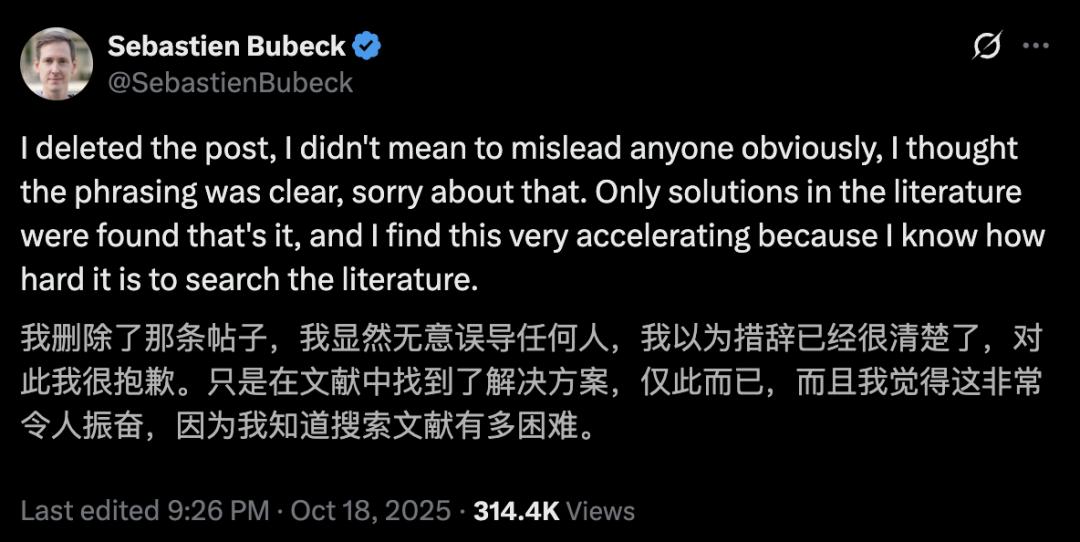
Core Insights - The article discusses the recent developments surrounding OpenAI's GPT-5, particularly its role in solving mathematical problems, including the Erdős problems, and the subsequent reactions from the academic community [1][6][8]. Group 1: GPT-5's Contributions - GPT-5 has been credited with accelerating scientific progress by identifying existing solutions to ten Erdős problems, although it was initially misrepresented as having solved them [1][12]. - The 707th Erdős problem, which had been thought unsolved for 30 years, was actually resolved before its proposal, highlighting the importance of literature review in mathematical research [8][10]. - Two mathematicians successfully used GPT-5 to generate formal proofs, demonstrating its potential as a collaborative tool in mathematical research [13][14]. Group 2: Academic Reactions - Yann LeCun criticized OpenAI, suggesting that the company was harmed by its own overzealous claims regarding GPT-5's capabilities [2]. - Sebastien Bubeck, an OpenAI scientist, faced backlash for his initial claims but later acknowledged the complexity of literature searches in mathematics [12][17]. - Mathematician Terence Tao praised the use of AI in generating verifiable proofs, emphasizing that AI should complement human efforts rather than replace them [14][17]. Group 3: Future Implications - The collaboration between AI and human researchers could lead to more efficient problem-solving processes, as demonstrated by the successful use of GPT-5 in generating a formal proof that required significant human input for refinement [16][29]. - The exploration of AI's role in mathematics is still in its early stages, with potential for further integration and optimization in research methodologies [16][18].

倪光南:发展“AI+机器人”,向新质生产力加速跃迁
Huan Qiu Wang Zi Xun· 2025-11-04 23:17
Core Insights - Artificial intelligence (AI) is a powerful engine driving technological and industrial development globally, with a focus on enhancing productivity through the "AI + Robotics" initiative in China [1] - The development of the robotics industry aims to extend human capabilities rather than replace them, emphasizing the importance of understanding the relationship between humans and robots [2][3] - The evolution of robotics is transitioning from traditional automation to "AI + Robotics," which will redefine manufacturing processes and enhance flexibility and customization [4] Industry Development - The robotics industry in China is at a critical juncture, requiring an upgrade in the intelligence level of robots, focusing on three core capabilities: perception, motion control, and decision-making [5] - The integration of AI and spatial computing is essential for enhancing robots' environmental perception and interaction capabilities, marking a shift towards a new paradigm in human-robot interaction [6][7] - The open-source AGIROS initiative aims to support the development of a collaborative ecosystem for intelligent robotics, enhancing the competitiveness of the "brain, eye, and action" systems in AI + Robotics [7][8] Future Directions - The potential for creating an ecosystem based on RISC-V architecture for AI + Robotics is being explored, which could lead to significant advancements in the industry [8] - The focus is on building a world where robots serve as extensions of human capabilities, contributing to a better quality of life [8]

强化学习AI系统的设计实现及未来发展
3 6 Ke· 2025-11-04 12:52
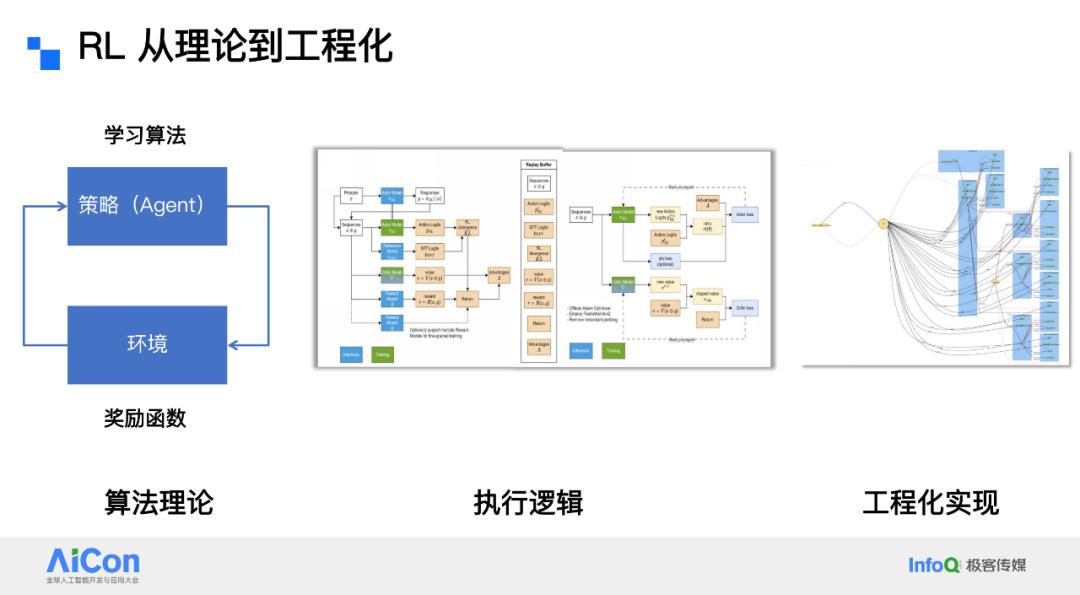
Core Insights - Reinforcement Learning (RL) is a crucial and complex component in enhancing the intelligence of large language models (LLMs) [1][2] - The presentation by Alibaba's algorithm expert, Cao Yu, at AICon 2025 discusses the current state and future directions of RL systems, particularly in the context of LLMs [1][2] Group 1: RL Theory and Engineering - The engineering demands of RL algorithms are multifaceted, focusing on the integration of LLMs as agents within RL systems [3][4] - The interaction between agents and their environments is essential, with the environment defined as how LLMs interact with users or tools [6] - Key components include the reward function, which evaluates the quality of actions taken by the agent, and various algorithms like PPO, GRPO, and DPO that guide policy updates [7][8] Group 2: Algorithm Development and Challenges - The evolution of RL applications has seen a shift from human feedback to more complex reward modeling, addressing issues like reward hacking [9][12] - The traditional PPO algorithm is discussed, highlighting its complexity and the need for a robust evaluation process to assess model capabilities [12][13] - Newer algorithms like GRPO have emerged, focusing on improving the efficiency of the critic model and addressing challenges in training and inference [20][22] Group 3: Large-Scale RL Systems - The rapid advancements in RL have led to a shift from simple human-aligned metrics to more sophisticated models capable of higher reasoning [25][28] - Future RL systems will require enhanced capabilities for dynamic weight updates and efficient resource allocation in distributed environments [36][38] - The integration of various frameworks, such as Ray and DeepSpeed, is crucial for optimizing the performance of large-scale RL systems [49][57] Group 4: Open Source and Community Collaboration - The development of open-source frameworks like Open RLHF and VeRL reflects the industry's commitment to collaborative innovation in RL [53][55] - Companies are encouraged to participate in the design and improvement of RL systems, focusing on efficiency, evaluation, and training balance [58]
想法流CEO沈洽金:AI驱动的下一代互动内容应该怎么做?|「锦秋会」分享
锦秋集· 2025-11-04 11:01
Core Insights - The evolution of AI content has transitioned from "generable" to "empathetic," indicating a shift from automated creation to personalized interaction, marking a move from an efficiency revolution to an emotional revolution [4][8] - The concept of "AI native IP" is emerging, where AI-generated characters and stories evolve through user interaction, creating lasting emotional connections rather than one-time consumption [24][26] Group 1: AI Content Evolution - The first phase of AI content was to prove its capability to create content, while the second phase focuses on understanding the audience and the manner of content creation [8][10] - The team behind "Idea Flow" is building an AI co-creation content universe where users actively participate in creating characters, worlds, and stories alongside AI [6][13] Group 2: Core Capabilities of AI Content - The two core capabilities of AI content are interactivity and imagination, which foster emotional connections and allow content to transcend reality [13][19] - AI-generated content is designed to be engaging and participatory, enabling users to "play" with the content rather than just consume it [13][22] Group 3: User Engagement and IP Development - The platform has developed over 300 AI native IP characters, which are co-created and evolve through community interaction, providing a sustainable relationship with users [24][25] - The use of IP as a core anchor point allows for repeated content experiences, fostering long-term emotional connections with users [26][29] Group 4: Creation Tools and User Experience - The creation tools provided by the platform allow users, even those with minimal technical skills, to easily create content using templates and workflows [29][36] - The introduction of a "creation agent" enhances user experience by automatically selecting the most suitable workflows based on user intent, streamlining the content creation process [33][37] Group 5: Future Directions and Innovations - The platform is exploring dynamic content generation, such as story-driven videos and interactive gameplay, leveraging advancements in AI models [53][60] - New functionalities like "Clue Cards" and "Send Characters on a Trip" are being developed to enhance user engagement and content depth [69][72]

苏州英伟达开发者日即将召开!科创人工智能ETF华夏(589010) 早盘震荡下探,短线在1.40元支撑位附近企稳
Mei Ri Jing Ji Xin Wen· 2025-11-04 05:05
Group 1 - The Core Point: The performance of the Science and Technology Innovation Artificial Intelligence ETF (589010) is under pressure, with a recent decline of 0.85% and a trading price of 1.408 yuan, indicating a weak market sentiment [1] - The ETF's component stocks show mixed results, with 14 stocks rising and 16 falling, highlighting a divergence in performance between software and hardware sectors [1] - Recent trading activity indicates a slowdown in net inflows, with a single-day inflow of approximately 12.71 million yuan, suggesting ongoing market volatility [1] Group 2 - CICC reports a new trend in China's dual circulation model, emphasizing internal circulation while also promoting external circulation, particularly in emerging markets and Belt and Road countries [2] - The report highlights that the financial cycle's second half is characterized by deleveraging, leading to excess savings being directed towards risk assets, which is a shift from previous patterns [2] - The breakthrough of DeepSeek is identified as a factor that has triggered a re-evaluation of China's innovation capabilities, enhancing investor risk appetite [2]

让LLM不再话痨,快手HiPO框架来了
机器之心· 2025-11-03 06:40
Core Insights - The article discusses the "overthinking" dilemma faced by large language models (LLMs), where they tend to generate lengthy reasoning chains for simple questions, leading to inefficiencies and increased costs [4][8][12] - The introduction of the HiPO (Hybrid Policy Optimization) framework aims to address this issue by allowing models to autonomously decide when to engage in detailed reasoning and when to provide direct answers, enhancing both efficiency and accuracy [5][10][11] Group 1: Challenges of LLMs - LLMs often exhibit a tendency to apply deep reasoning to all questions, regardless of complexity, resulting in wasted computational resources and slower response times [8][12] - Existing solutions to mitigate this issue lack a principled mechanism to balance accuracy and response efficiency, leading to a need for a more nuanced approach [9][12] Group 2: HiPO Framework Overview - HiPO's core concept is to empower models with the decision-making capability regarding their reasoning approach, supported by a systematic training method to ensure intelligent and balanced decisions [11][16] - The framework consists of two main components: a hybrid data cold start to familiarize models with both reasoning modes and a mixed reinforcement learning reward system to fine-tune decision-making [11][16] Group 3: Implementation Details - The data collection process involves integrating high-quality datasets for mathematical and coding reasoning, creating a robust training corpus [14] - HiPO generates responses in two modes—"Think-on" (with reasoning) and "Think-off" (direct answers)—and validates their correctness to guide model training [14][15] Group 4: Performance Results - HiPO has demonstrated significant improvements in efficiency, reducing average token length by 30% and reasoning rate by 37%, while also achieving a 6.3% increase in average accuracy [25][28] - The framework outperforms existing adaptive reasoning methods, showcasing its effectiveness in both accuracy and efficiency [25][29] Group 5: Future Implications - HiPO represents a shift in LLM development from merely enhancing reasoning capabilities to fostering smarter reasoning strategies, which could reshape the landscape of efficient LLM applications [32][33] - The framework's open-source availability on platforms like Hugging Face encourages community research and application, potentially leading to broader adoption in various sectors [34][35]


美团LongCat-Flash-Omni正式发布并开源
Xin Lang Ke Ji· 2025-11-03 02:46
Core Viewpoint - Meituan has launched the open-source multimodal model LongCat-Flash-Omni, which features capabilities such as network search and voice communication in its official app [1] Group 1: Model Features - The new model is the industry's first to achieve "full modal coverage, end-to-end architecture, and efficient inference with a large parameter count" in an open-source format [1] - It matches the capabilities of closed-source models in the open-source domain, showcasing its advanced multimodal capabilities [1] Group 2: Performance and Design - The innovative architectural design and engineering optimizations allow the large parameter model to achieve millisecond-level response times in multimodal tasks [1]

a16z将3000万开发者标价3万亿,等于法国GDP!网友:几个初创公司+大模型就想取代我们,疯了吧?
AI前线· 2025-11-01 05:33
Core Insights - The article discusses the valuation of the global developer community at $3 trillion, equating it to the GDP of France, highlighting the potential of AI programming to disrupt traditional production relationships and unlock significant value [1][6][5] - It raises concerns about the oversimplification of human creativity into monetary value and the implications of such a perspective on the future of developers [2][3] - The emergence of AI programming as a large-scale application market is emphasized, with significant investments flowing into this sector [6][18] Group 1: AI Programming and Economic Impact - The global developer community, estimated at 30 million, could generate approximately $3 trillion in value, assuming each developer creates $100,000 in value [1][6] - This valuation is comparable to the GDP of France, indicating the substantial economic impact of AI programming [1][6] - The article suggests that AI programming is the first true large-scale application of artificial intelligence, with the potential to create immense value [6][18] Group 2: Disruption of Traditional Software Development - The article posits that traditional computer science education may become obsolete as AI tools evolve, changing the landscape of software development [1][8] - AI tools are increasingly integrated into development processes, leading to unprecedented revenue growth in the IT startup sector [8][12] - The role of developers is expected to shift significantly, with AI taking over many coding tasks, thus altering the traditional software development lifecycle [8][10] Group 3: Future of Development Processes - The development cycle is anticipated to change, with AI agents taking on more responsibilities, potentially reducing the need for human oversight in certain tasks [10][11] - The article discusses the evolving nature of code review, suggesting that AI could handle many aspects of this process, allowing developers to focus on higher-level planning and design [10][14] - The emergence of multi-agent systems in coding could lead to new efficiencies and capabilities in software development [16][20] Group 4: Investment Opportunities and Startup Ecosystem - The article highlights the current environment as an ideal time for launching developer-focused startups, given the significant disruptions in the industry [24][25] - It emphasizes that innovative ideas often come from entrepreneurs rather than investors, suggesting a fertile ground for new ventures in AI programming [24][25] - The potential for creating products specifically for AI agents is identified as a promising area for future startups [25][24]

英诺李竹:一个酝酿已久的决定
投资界· 2025-10-31 08:15
Core Viewpoint - Inno Angel Fund is undergoing a significant transformation by splitting into two independent brands: Inno Angel Fund and Inno Sci-Tech Fund, each with dedicated teams focusing on early-stage technology investments [3][5][7]. Group 1: Transformation and Strategy - The transformation has been in the making for six years, with a strategic shift towards technology investments due to higher returns observed in tech projects [5][7]. - Inno Sci-Tech Fund was established in 2019 with an initial scale of 360 million RMB, focusing exclusively on technology investments, contrasting with the previous broad investment scope [5][11]. - The new structure will allow for larger investment amounts, with the target scale for the third phase of the Sci-Tech Fund set at 1.5 billion RMB [8][11]. Group 2: Investment Approach - The Inno Angel Fund will continue its early investment strategy with a new "111 mechanism," allowing for more efficient support to entrepreneurs [8]. - The Sci-Tech Fund will focus on new-generation information technology and intelligent manufacturing, with 70% of investments directed towards early-stage projects [8][11]. - The emphasis on larger investments is driven by the increasing valuations of early-stage projects, particularly in the hard tech sector, where initial valuations can reach several hundred million RMB [7][8]. Group 3: Market Context and Challenges - The early-stage investment landscape is becoming increasingly competitive, with many institutions moving towards early investments, leading to higher entry barriers [14][15]. - The shift in investment strategy is also a response to the challenges faced by smaller angel investment firms in a tightening market [14]. - The need for larger fund sizes is recognized as essential for survival in the evolving investment environment [14]. Group 4: Future Outlook - Inno aims to support companies through to their IPOs, with expectations of over ten companies applying for IPOs in the next two years [12]. - The focus on key innovations within the industry is seen as crucial for identifying potential billion-dollar enterprises [11][12]. - The company is committed to evolving its investment standards to include a thorough analysis of both projects and teams, ensuring better returns [15].