
人民币汇率

Search documents
美元周期还在探底,人民币升值顺风未尽
Orient Securities· 2026-01-05 08:24
External Factors - The primary driver for the RMB appreciation in 2025 is the weakening of the USD, which has declined by nearly 10% this year due to three rate cuts by the Federal Reserve[1] - The USD index fell to around 97 in December after failing to break the 100 resistance level, confirming a downward trend[19] - The expected mild depreciation of the USD is projected to be around 3% in 2026, with a "low first, high later" pattern anticipated[24] Internal Factors - The internal economic and policy environment in China is stabilizing, contributing to the RMB's appreciation[1] - China's exports have shown robust growth, exceeding expectations, particularly after tariff adjustments, leading to a steady appreciation channel for the USD/CNY exchange rate[14] - The internal economic surprise indices for both China and the US are trending downward, indicating limited support for the RMB from internal factors in the short term[27] Supply and Demand Factors - The supply and demand dynamics have not fully played out this year, with a decrease in market settlement willingness under a strong dollar environment[16] - Seasonal increases in foreign income in December may lead to higher settlement rates, potentially supporting RMB appreciation[21] - The rising implied volatility of the RMB and the risk reversal options favoring RMB appreciation indicate a market expectation of a wider trading range for the currency[27] Market Implications - The RMB's appreciation is expected to benefit foreign capital inflows into A-shares and Hong Kong stocks, favoring quality and growth styles[32] - The report emphasizes that the stock market's performance and fundamental improvements are more likely to drive RMB appreciation rather than the exchange rate itself influencing the stock market[32]
重回“6”时代 2026年人民币汇率能否维持升势
Xin Hua Cai Jing· 2026-01-05 06:53
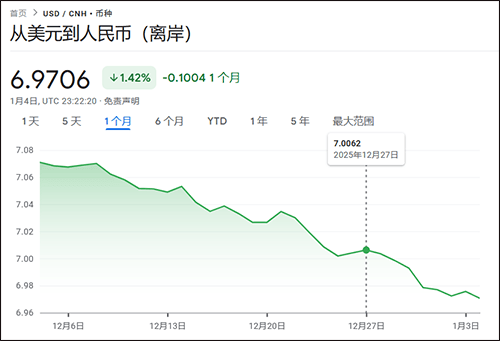
关于人民币在2025年末的强势走势,中国民生银行首席经济学家温彬称,主要受如下几方面因素支撑: 一是美元指数走弱;二是出口保持韧性;三是人民币资产吸引力提升;四是监管引导汇率升值见成效。 国家金融与发展实验室特聘高级研究员庞溟表示,本轮人民币升值的直接推动力来自美元环境的转变, 伴随美联储开启降息周期,市场预期美元长期走势将受进一步压制,为人民币提供了外部升值空间。中 长期来说,经济是汇率的基本盘,汇率走势在根本上取决于经济基本面。短期来看,汇率的影响因素则 比较多元,比如,经济增长、货币政策、金融市场、地缘政治、风险事件等。 新华财经北京1月5日电(马萌伟)人民币兑美元汇率在2025年末升破"7"整数关口,重新回到了"6"时 代。2026年第一个交易日(1月2日),离岸人民币兑美元延续了2025年以来的强势升值态势,逾两年半 来首次涨破6.97关口。5日亚洲交易时段尾盘,在岸人民币兑美元逼近6.98关口,最高升至6.9807;人民 币兑美元中间价升至2024年9月30日以来最高7.0230。 专家表示,短期内人民币汇率仍有一定升值空间,升值速率亦受到稳汇率政策力度等影响,人民币汇率 有望在7.0下方保持一段 ...
时隔34个交易日,上证指数盘中重回4000点
Jin Rong Jie· 2026-01-05 03:37
Group 1 - The core viewpoint is that incremental capital entering the market will not be the main factor for the market to reach a new level in 2026, with the biggest expectation gap coming from the balance between external and internal demand [1] - The trend of imposing tariffs externally and subsidizing domestic demand is expected to be a major direction, with this year being an important starting point [1] - The market is likely to experience a higher probability of upward fluctuations at the beginning of the year, considering the relatively low capital enthusiasm at the end of last year [1] Group 2 - The A-share cross-year market trend is unfolding as expected, with the liquidity and exchange rate environment at the beginning of this year being significantly better than the previous two years [1] - The strong renminbi exchange rate and favorable external environment may lead to a "New Year Red" market for A-shares after the New Year [1] - Multiple positive factors, including renminbi appreciation, concentrated benefits in the technology sector, improved macroeconomic expectations, and positive signals in the capital market, are expected to drive the A-share cross-year market [1] Group 3 - On January 5, the Shanghai Composite Index returned to 4000 points after 34 trading days, with a rise of 0.85% to 4002.40 points [2] - Insurance stocks led the gains, while sectors such as brain-computer interfaces and semiconductors were active [2]




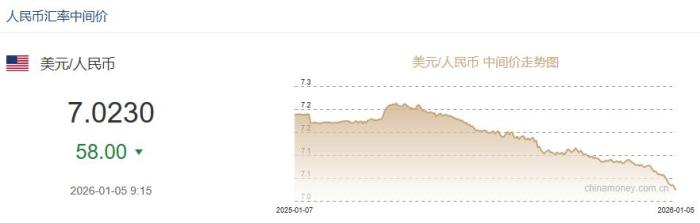
人民币中间价调升58个基点报7.0230
Bei Jing Shang Bao· 2026-01-05 02:49
北京商报讯(记者 岳品瑜 董晗萱)2026年1月5日,人民币对美元中间价调升58个基点,报7.0230。前 一交易日中间价报7.0288。 截至当日9时40分,在岸人民币对美元汇率报6.9825,日内贬值0.03%;离岸人民币对美元汇率报 6.9771,日内贬值0.11%。 ...
复旦大学经济学院教授沈国兵:人民币升值未必是坏事,传统“汇率贬值促进出口”已然失效
Sou Hu Cai Jing· 2026-01-05 02:40
Core Viewpoint - The recent discussions on the RMB exchange rate highlight a shift in the traditional understanding of currency depreciation and its impact on exports, suggesting that the previous assumptions may no longer hold true in the current geopolitical and economic landscape [1][4][8]. Group 1: RMB Exchange Rate Dynamics - The recent appreciation of the RMB is attributed to year-end settlement demands and a weakening US dollar index, influenced by the Federal Reserve's shift towards a dual focus on employment and inflation [2][12]. - The traditional theory that currency depreciation boosts exports is being challenged, as external factors like US tariff policies impose rigid constraints on the effectiveness of such depreciation [4][8]. - The RMB's future trajectory will be influenced by multiple factors, including the interest rate differential between China and the US, tariff policies, and the fundamental economic conditions in China [2][14]. Group 2: Financial Power and RMB Internationalization - China is recognized as a "financial power," but still has a significant gap to bridge to become a "financial strong power," with limitations in RMB convertibility and international financial influence [2][16]. - The current RMB internationalization process is hindered by low gold reserves and insufficient influence in the international financial order, which are critical for establishing a strong currency [2][16][17]. - The need for structural reforms in China's financial system is emphasized to enhance the convenience of financial services and strengthen currency credibility, which are essential for achieving the status of a financial strong power [2][17][18]. Group 3: Future Outlook and Strategic Considerations - The RMB exchange rate is expected to remain volatile, with potential for appreciation in the short term, but uncertainties will increase post-October 2026 due to evolving US-China relations and tariff negotiations [14][15]. - The ongoing capital outflow and the trend of Chinese companies expanding overseas are likely to create upward pressure on the RMB, complicating its appreciation prospects [15][16]. - The discussion around RMB's role in the global financial system underscores the importance of financial liberalization and the need for China to enhance its financial market's openness to transition from a financial power to a financial strong power [17][18].
人民币市场汇价(1月5日)
Sou Hu Cai Jing· 2026-01-05 02:16
Core Viewpoint - The People's Bank of China has announced the central exchange rates of the Renminbi against various currencies as of January 5, indicating the current market valuation of the Renminbi against major global currencies [1] Currency Exchange Rates - The central exchange rate for 100 US dollars is set at 702.3 Renminbi [1] - The central exchange rate for 100 euros is set at 820.27 Renminbi [1] - The central exchange rate for 100 Japanese yen is set at 4.4660 Renminbi [1] - The central exchange rate for 100 Hong Kong dollars is set at 90.141 Renminbi [1] - The central exchange rate for 100 British pounds is set at 941.68 Renminbi [1] - The central exchange rate for 100 Australian dollars is set at 468.17 Renminbi [1] - The central exchange rate for 100 New Zealand dollars is set at 403.07 Renminbi [1] - The central exchange rate for 100 Singapore dollars is set at 544.28 Renminbi [1] - The central exchange rate for 100 Swiss francs is set at 883.42 Renminbi [1] - The central exchange rate for 100 Canadian dollars is set at 509.45 Renminbi [1] - The central exchange rate for 100 Renminbi is 114.35 Macanese Patacas [1] - The central exchange rate for 100 Renminbi is 57.882 Malaysian Ringgits [1] - The central exchange rate for 100 Renminbi is 1149.24 Russian Rubles [1] - The central exchange rate for 100 Renminbi is 235.39 South African Rand [1] - The central exchange rate for 100 Renminbi is 20648 South Korean Won [1] - The central exchange rate for 100 Renminbi is 52.46 UAE Dirhams [1] - The central exchange rate for 100 Renminbi is 53.568 Saudi Riyals [1] - The central exchange rate for 100 Renminbi is 4678.37 Hungarian Forints [1] - The central exchange rate for 100 Renminbi is 51.332 Polish Zlotys [1] - The central exchange rate for 100 Renminbi is 91.12 Danish Krone [1] - The central exchange rate for 100 Renminbi is 131.77 Swedish Krona [1] - The central exchange rate for 100 Renminbi is 143.81 Norwegian Krone [1] - The central exchange rate for 100 Renminbi is 614.53 Turkish Lira [1] - The central exchange rate for 100 Renminbi is 255.57 Mexican Pesos [1] - The central exchange rate for 100 Renminbi is 450.08 Thai Baht [1]
1月5日人民币对美元中间价报7.0230 上调58个基点
Zhong Guo Xin Wen Wang· 2026-01-05 01:42
图片来源:中国外汇交易中心网站截图 来源:中国新闻网 1月5日人民币对美元中间价报7.0230 上调58个基点 中新网1月5日电 据中国外汇交易中心网站消息,中国人民银行授权中国外汇交易中心公布,2025年1月 5日银行间外汇市场人民币汇率中间价为:1美元对人民币7.0230元,上调58个基点。 本文为转载内容,授权事宜请联系原著作权人 中新经纬版权所有,未经书面授权,任何单位及个人不得转载、摘编或以其它方式使用。 关注中新经纬微信公众号(微信搜索"中新经纬"或"jwview"),看更多精彩财经资讯。 编辑:付健青 广告等商务合作,请点击这里 ...
人民币对美元中间价报7.0230 调升58个基点
Zhong Guo Jing Ji Wang· 2026-01-05 01:35
Core Viewpoint - The central point of the news is the announcement of the Renminbi (RMB) to US Dollar exchange rate, which is reported at 7.0230, reflecting an increase of 58 basis points from the previous trading day [1]. Exchange Rate Summary - The People's Bank of China has authorized the publication of the interbank foreign exchange market's RMB exchange rates as of January 5, 2026, with 1 US Dollar equating to 7.0230 RMB [2]. - Other notable exchange rates include: - 1 Euro to 8.2027 RMB - 100 Japanese Yen to 4.4660 RMB - 1 British Pound to 9.4168 RMB - 1 Australian Dollar to 4.6817 RMB - 1 New Zealand Dollar to 4.0307 RMB - 1 Canadian Dollar to 5.0945 RMB - 1 Swiss Franc to 8.8342 RMB - 1 Singapore Dollar to 5.4428 RMB - 1 Hong Kong Dollar to 0.90141 RMB - 1 South African Rand to 2.3539 RMB - 1 Turkish Lira to 6.14530 RMB - 1 Mexican Peso to 2.5557 RMB - 1 Thai Baht to 4.5008 RMB [2].
人民币“破7”冷思考 2026年升值动能与回调压力并存
2 1 Shi Ji Jing Ji Bao Dao· 2026-01-05 00:34
Core Viewpoint - The RMB/USD exchange rate is expected to experience both appreciation momentum and adjustment pressure in 2026, influenced by various economic factors and external uncertainties [1][8]. Group 1: Exchange Rate Trends - In 2025, the RMB/USD exchange rate exhibited a "weak first, strong later" trend, fluctuating between 7.30 and 7.35 until early April, before turning to an upward trend [1][2]. - By the end of 2025, both offshore and onshore RMB rates broke the psychological barrier of "7", reaching new highs since September 2024 and May 2023, respectively [1][3]. - The appreciation of the RMB is attributed to a weaker USD, stable Chinese economic fundamentals, and increased demand for currency settlement at year-end [1][2][3]. Group 2: Factors Influencing RMB Appreciation - The weakening of the USD is identified as a primary driver for the recent RMB appreciation, with the USD index dropping significantly after peaking above 100 in November [3][6]. - Seasonal factors also play a role, as historical trends show that the RMB tends to appreciate at the end of the year due to increased currency settlement needs from exporters [4][5]. - The strong performance of exports and the attractiveness of RMB-denominated assets have further supported the RMB's rise [6][8]. Group 3: Future Outlook - The People's Bank of China (PBOC) aims to maintain the RMB exchange rate at a reasonable and balanced level, emphasizing the prevention of excessive fluctuations [7][8]. - In 2026, the RMB is likely to experience a dual-directional fluctuation rather than a one-sided trend, with potential appreciation driven by favorable domestic and international conditions [1][8][9]. - Analysts predict that the RMB/USD exchange rate will likely remain within the range of 6.9 to 7.3, influenced by various economic factors and market dynamics [9].
新浪财经资讯AI速递:昨夜今晨财经热点一览 丨2026年1月5日
Xin Lang Cai Jing· 2026-01-04 22:57
Group 1: Company Conflicts and Governance - Dousheng Shoe Industry's founder Wang Hai announced a severance of ties with his son Wang Jun and daughter-in-law Xu Ying, highlighting a power struggle within the family over control of the company [1][7] - The internal conflict has reportedly drained the company's resources for transformation and has cast a shadow over the future of this traditional domestic brand [1][7] - Zong Fuli has resumed her role as the legal representative and manager of Hongsheng Group after a three-year hiatus, consolidating power to strengthen control over the company [2][10] Group 2: Market and Economic Updates - OPEC and non-OPEC oil-producing countries decided to maintain their current production levels for February and March 2026, aiming to stabilize the oil market [3][11][12] - The Chinese yuan has experienced a "weak to strong" trend, with both offshore and onshore rates surpassing the "7" mark by year-end 2025, driven by multiple factors including a weaker dollar and stable economic fundamentals [4][13] - The A-share market is anticipated to potentially see a "New Year opening red" as cyclical sectors may emerge as market leaders amid improving economic recovery expectations [4][14] Group 3: Real Estate Market Trends - The real estate market in key cities showed signs of "partial warming and continued differentiation" during the New Year holiday, with Beijing's new policies beginning to take effect and Shenzhen's second-hand housing transactions increasing by 43% year-on-year [4][15] - The publication "Qiushi" emphasized the need for stable expectations in real estate policies, indicating a shift towards a new phase focused on maintaining stability [5][15] Group 4: Corporate Actions and Clarifications - Yushutech issued a clarification denying involvement in any "green channel" application for its IPO, asserting that its listing process is proceeding normally [1][8] - Fangda Carbon announced the termination of its participation in the restructuring of Shanshan Group due to insufficient due diligence time, stating that this decision would not adversely affect its operations or financial status [5][16]