
智能化转型

Search documents
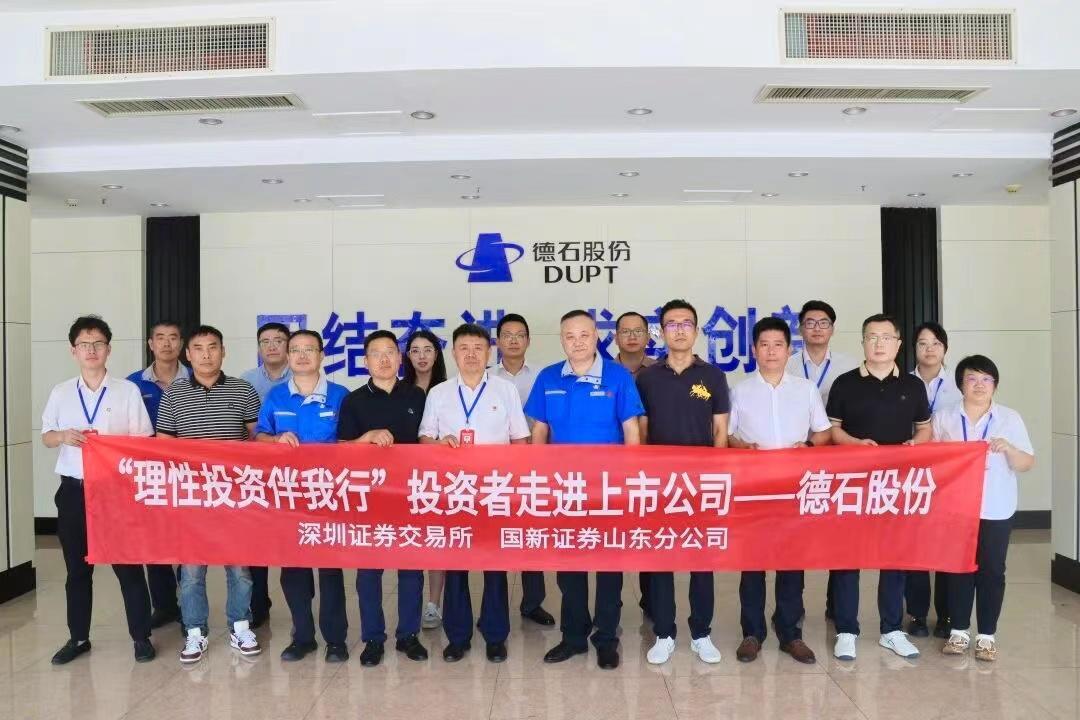
“理性投资伴我行”走进德石股份,老牌油企智能化突围
Da Zhong Ri Bao· 2025-09-11 07:44
Group 1 - The event "Rational Investment Accompanies Me" was held by Guoxin Securities Shandong Branch, focusing on the company Deshi Co., Ltd. (301158) listed on the ChiNext board [2] - Deshi Co., Ltd. was established in 1961 and transitioned to a private enterprise in 2004, with a focus on oil and gas equipment and a stable performance since its listing in 2022 [2] - The company expects revenue and profit growth in Q4, with over 2,800 rod drilling tools pending delivery [2] Group 2 - Artificial intelligence and smart transformation were key discussion points, with a focus on the "Jumang" robot operating system developed by Shandong Alexander Intelligent Technology Co., Ltd. [3] - Deshi Co., Ltd. is advancing automation and digital transformation in oil and gas, with expected revenue from automated equipment applications in Daqing and Xinjiang exceeding 30 million yuan [3] - The company is implementing digital technologies in product automation and production process automation [3] Group 3 - Talent cultivation is crucial for industry development, with Deshi Co., Ltd. exploring partnerships with educational institutions for targeted training programs [4] - The company is looking for investment or acquisition opportunities in emerging economic sectors, focusing on new production capabilities [4] - A site visit to Deshi Co., Ltd.'s exhibition hall and production area was conducted, followed by discussions on macroeconomic conditions and industry trends [4]

全新一代速腾L不到12万起售,会是燃油车的智能天花板吗?
Guan Cha Zhe Wang· 2025-09-11 07:10
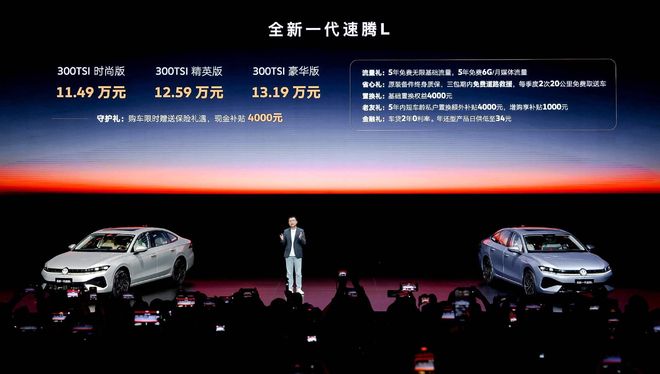
Core Insights - The new generation of the Volkswagen Sagitar L has been officially launched with a price range of 114,900 to 131,900 yuan, and promotional offers including insurance gifts and cash subsidies of 4,000 yuan [1][3]. Group 1: Market Position and Competition - The Sagitar has been a significant player in the A+ sedan market in China since its introduction in 2006, with cumulative sales exceeding 4.3 million units [1][3]. - The market for A-class vehicles is increasingly competitive, with new energy vehicles (NEVs) like BYD Qin L and Geely Galaxy Star 8 posing a direct challenge to traditional fuel vehicles [3][5]. Group 2: Technological Upgrades - The Sagitar L features the IQ. Pilot enhanced driving assistance system, which is claimed to be the only A+ fuel sedan equipped with end-to-end high-speed NOA capabilities, enabling advanced driving functions [3][5]. - The vehicle is powered by a 1.5T Evo2 engine, delivering a maximum power of 118 kW and a peak torque of 250 N·m, achieving a fuel consumption of 5.49 liters per 100 kilometers [5][7]. Group 3: Design and Features - The new model has a length of 4,812 mm, offering spacious interior dimensions comparable to B-class cars, along with 21 storage compartments for enhanced practicality [7]. - The starting price of the new Sagitar L is approximately 20,000 yuan lower than the previous model, positioning it competitively within the pricing range of domestic NEVs [7]. Group 4: Market Strategy and Future Outlook - The sales manager of FAW-Volkswagen stated that the competitive advantage of fuel vehicles is returning, but the effectiveness of the new intelligent features in attracting younger consumers remains to be seen [7].
博西家电胡博瀚:深耕渠道,寻求中国顶奢电器市场增量
2 1 Shi Ji Jing Ji Bao Dao· 2025-09-10 08:04
Core Insights - The luxury home appliance market in China is gaining attention, particularly with the recent launch of GAGGENAU's new flagship series after 20 years, indicating a strategic shift in response to market trends [1][5] Market Dynamics - The "trade-in" policy and market cycles are driving product upgrades in the Chinese home appliance market, with GAGGENAU focusing on high-end appliances where the connection to "trade-in" is less direct [2][3] - The overall slowdown in the real estate market is impacting the home appliance industry, prompting GAGGENAU to explore new sales channels for stable growth [2][3] Retail Strategy - GAGGENAU has opened more retail stores, including the largest flagship store in Shanghai and a new store in Beijing, aiming to create more consumer touchpoints and enhance brand experience [3][4] - Collaborations with cabinet makers and designers are being strengthened to better reach target consumers who prioritize overall home design [3][4] Consumer Trends - High-net-worth consumers are increasingly focused on how products integrate into overall home aesthetics and are looking for kitchens to serve as social spaces [4][5] - There is a growing demand for personalized consultation experiences, with GAGGENAU offering luxury-level services post-purchase, including home styling and cooking classes [5] Product Strategy - GAGGENAU's new product line reflects a minimalist design philosophy, adhering to Bauhaus aesthetics, which aligns with the brand's positioning as a global luxury appliance brand [5][6] - The new products incorporate digital and smart technologies to enhance user experience in cooking and baking [6]
长城汽车(601633):点评:8月销量11.6万辆,新能源同比持续高增,出口创新高
Changjiang Securities· 2025-09-07 14:42
Investment Rating - The investment rating for the company is "Buy" and is maintained [8] Core Views - In August 2025, the company achieved a total sales volume of 116,000 vehicles, representing a year-on-year increase of 22.3% and a month-on-month increase of 10.7%. Among these, export sales reached 45,000 vehicles, accounting for 39.1% of total sales. The sales of new energy vehicles (NEVs) reached 37,000 units, with NEV passenger vehicles accounting for 36.7% of total sales, showing a year-on-year increase of 5.9 percentage points [2][10] - The company is accelerating its global expansion and is committed to transitioning to new energy, with a continuous new vehicle cycle expected to drive improvements in sales and performance. Long-term strategies are expected to open up growth opportunities for sales, while the shift towards smart technology is anticipated to enhance profitability across the entire industry chain [2][10] Summary by Sections Sales Performance - In August 2025, total sales reached 116,000 vehicles, with NEV sales at 37,000 units, marking a year-on-year increase of 50.9%. Cumulatively, from January to August 2025, total sales were 790,000 vehicles, up 5.9% year-on-year, and NEV sales were 233,000 units, up 28.2% year-on-year [10][10] - By brand, Haval sold 68,912 vehicles, Tank sold 20,022 vehicles, WEY sold 8,028 vehicles, Ora sold 5,223 vehicles, and Great Wall Pickup sold 13,322 vehicles in August 2025 [10] Global Expansion - The company has implemented the "ONE GWM" strategy to accelerate its overseas expansion, covering over 170 countries and regions with more than 1,400 overseas sales channels. It has established three complete vehicle production bases in Thailand and Brazil, and several KD factories in Ecuador and Pakistan [10] Financial Projections - The company is expected to achieve net profits of 14.13 billion, 17.12 billion, and 21.52 billion yuan for the years 2025 to 2027, corresponding to A-share P/E ratios of 15.8X, 13.0X, and 10.4X, and Hong Kong stock P/E ratios of 10.6X, 8.8X, and 7.0X respectively [10]

百度商家智能体焕新升级,打造专属AI销售团队
Zhong Guo Chan Ye Jing Ji Xin Xi Wang· 2025-09-05 08:20
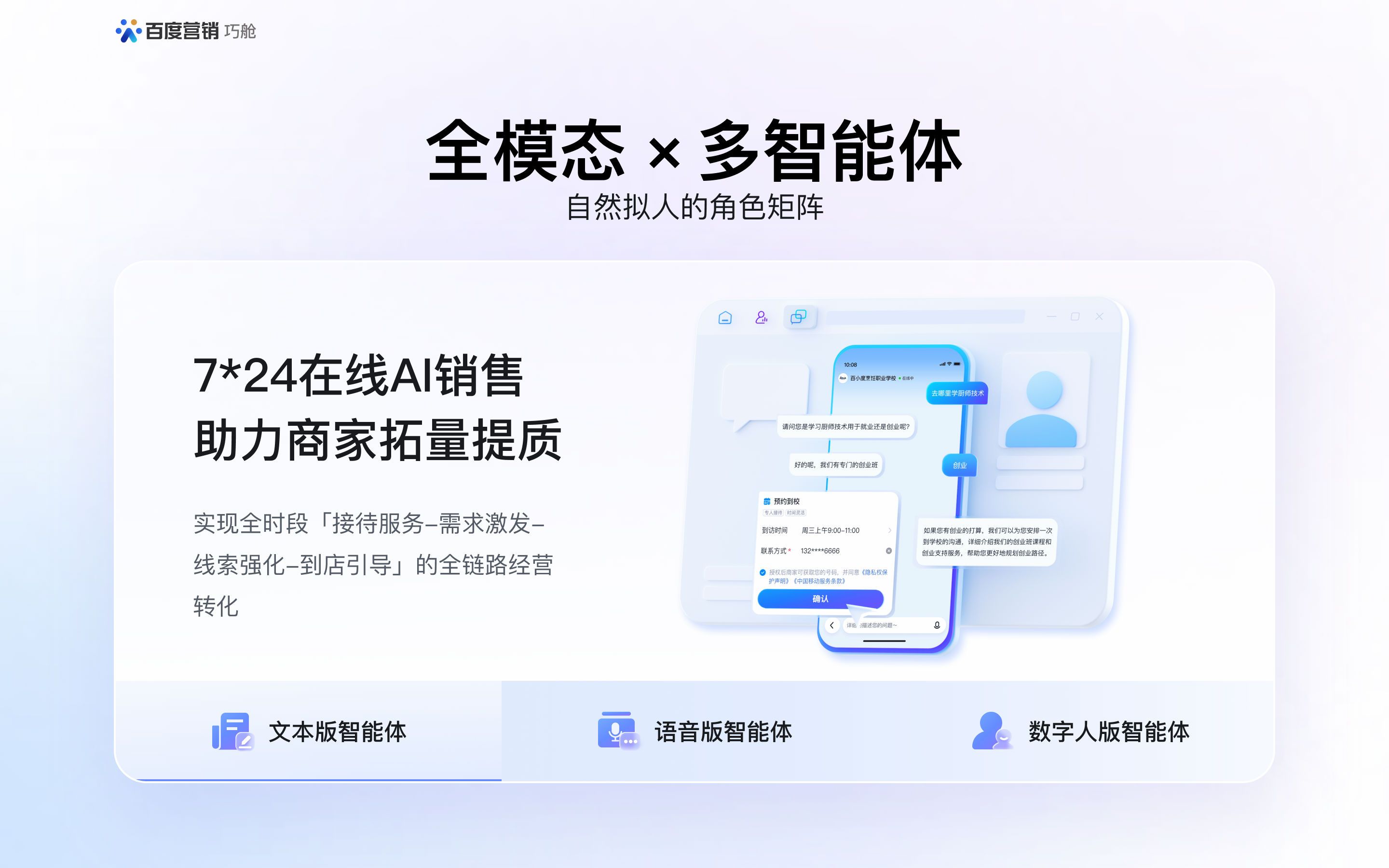
Core Insights - Baidu's merchant intelligent agent has upgraded from "AI customer service" to a comprehensive "dedicated AI sales team" aimed at enhancing business operations and addressing marketing growth and cost reduction challenges [1][14] - The upgrade features a full-modal role matrix, a marketing-aware conversion chain, and a strong cognitive sales system, providing businesses with a versatile AI sales framework [1][14] Group 1: Full-modal Role Matrix - The AI sales team includes a highly humanized role matrix, allowing businesses to configure different types of "AI sales employees" based on industry characteristics and business needs [1][3] - The text-based intelligent agent operates 24/7, ensuring comprehensive service across the entire conversion chain, currently serving over 20,000 clients [1][2] Group 2: Voice and Digital Human Versions - The voice version, equipped with human-like tones and advanced interaction technology, has reduced phone response times by 24% and has served over 1,000 advertisers [2][11] - The ultra-realistic digital human version acts as a "brand ambassador" and "video salesperson," significantly enhancing user trust and accelerating decision-making [2][11] Group 3: Marketing Conversion Chain - The AI team integrates deeply into the business's operational chain, improving lead effectiveness by an average of 22% and reducing in-store costs by 64% [7][11] - It provides seamless integration into various private domain platforms, generating over 10% additional leads for businesses [7][11] Group 4: Strong Cognitive Sales System - The intelligent agent is powered by Baidu's proprietary intelligent base, utilizing a collaborative architecture to address the complexities of commercial scenarios [9][10] - The system includes a "planning brain" that employs advanced thinking chain technology, simulating human decision-making processes [9][10] Group 5: Industry Impact and Results - The upgraded intelligent agent has shown significant results across various industries, with a travel agency reporting over a 25% increase in follow-up effectiveness and conversion rates [11][14] - A national legal service organization achieved a 22% increase in lead conversion rates and a 56% reduction in effective lead costs by utilizing the digital human lawyer [11][14]

中国车企齐聚慕尼黑车展,供应链企业全面出海
Jing Ji Guan Cha Bao· 2025-09-05 05:11
Group 1 - The 2025 Munich Motor Show (IAA Mobility) will take place from September 9 to 14, marking a transformation towards a comprehensive mobility platform, covering traditional automotive manufacturing and expanding into innovative vehicle technologies, infrastructure solutions, software development, and new mobility trends [1][2] - German automakers will leverage their home advantage to unveil several new models equipped with the latest features, including BMW's global debut of the new generation BMW iX3, Mercedes-Benz's launch of the new GLC electric version, and Volkswagen's introduction of the second-generation T-Roc in various powertrain options [1][2] - The number of Chinese exhibitors has increased from over 70 in 2023 to 103 this year, showcasing a range of vehicles and technologies, with notable participants including Avita, Changan, Dongfeng Liuzhou, GAC, Hongqi, and BYD [1][2] Group 2 - A significant highlight of this year's show is the large-scale participation of Chinese supply chain companies, covering areas such as electrification, software electronics, and advanced driver assistance systems, with major battery manufacturers like CATL and EVE Energy attending [2] - Several new vehicles will have their global or European premieres, including the Audi C concept car, and various models from Chinese brands such as Leapmotor's Lafa5 and BYD's Seal 06DM-i [2] - The Munich Motor Show is viewed as a barometer for the automotive industry, with the global market's shift towards electrification and intelligence making this event a crucial platform for competition between Chinese and European automakers [3]


新赛道·新故事:鑫源智造的户外进阶
3 6 Ke· 2025-09-04 10:01
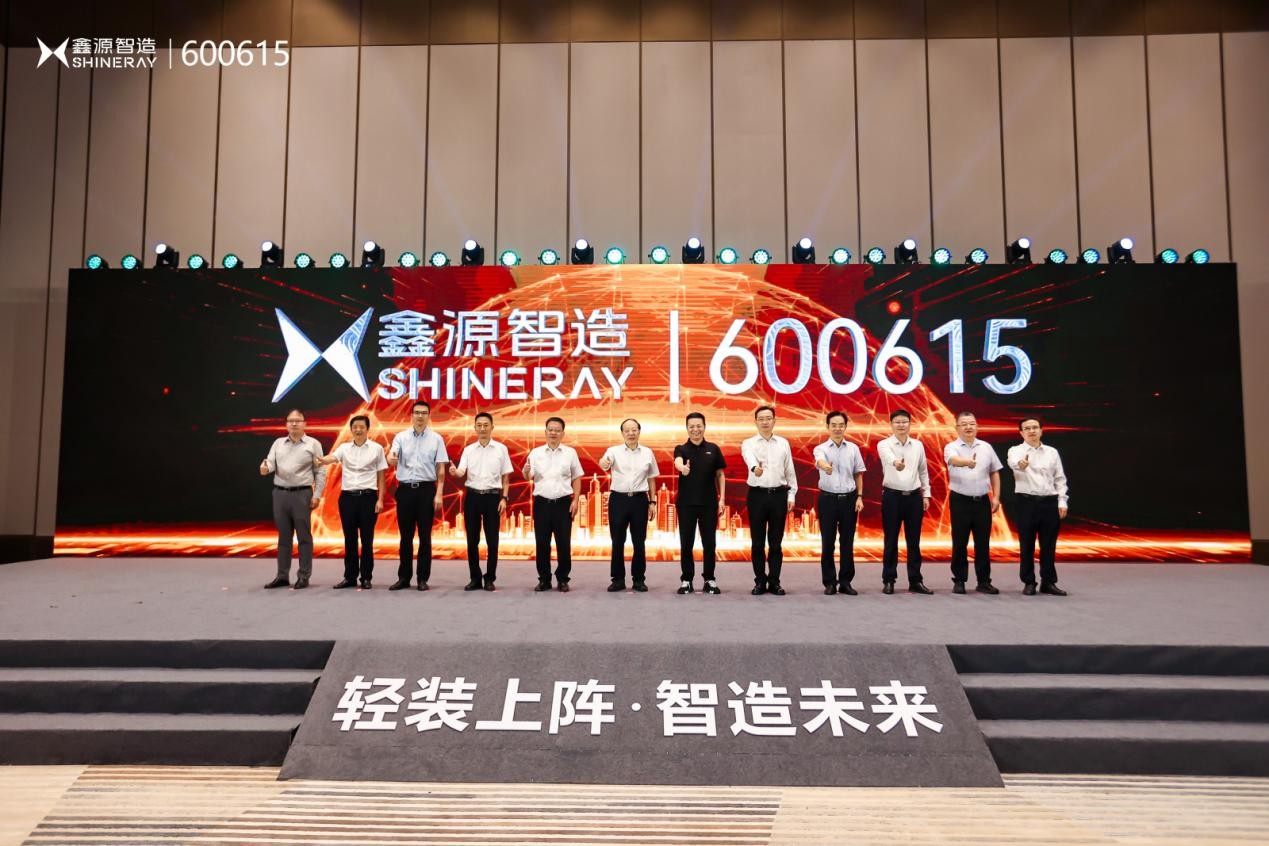
Core Viewpoint - The article discusses the strategic transformation of Chongqing Xinyuan Intelligent Manufacturing Technology Co., Ltd. (Xinyuan Intelligent Manufacturing) from a traditional manufacturing company to a leading brand in lightweight intelligent outdoor work equipment, emphasizing the integration of technology and market scenarios to capture niche market value [1][3]. Group 1: Transition from Manufacturing to Intelligent Manufacturing - The strategic upgrade involves a reconstruction of business logic, focusing on "intelligent + lightweight" paths to target the outdoor work intelligent equipment market [3]. - Xinyuan Intelligent Manufacturing aims to provide innovative intelligent solutions in the outdoor work equipment sector by leveraging its expertise in magnesium-aluminum alloy casting and agricultural machinery [3][7]. Group 2: Leveraging Traditional Business for New Markets - The company plans to utilize its existing agricultural machinery sales, which have exceeded 11 million units globally, to support the development of outdoor work equipment [8]. - The extensive experience in magnesium alloy applications positions the company to meet the lightweight component needs of outdoor work equipment [8]. Group 3: Cross-Industry Technology Utilization - The transition includes extending automotive technology into outdoor work equipment, where lightweight materials like magnesium alloys can significantly reduce energy consumption [10]. - A 10% reduction in vehicle weight can lead to a 6%-8% decrease in energy consumption, highlighting the importance of lightweight materials in enhancing efficiency [10]. Group 4: Channel Leverage for Global Expansion - Xinyuan Intelligent Manufacturing can utilize the global sales network of its parent company, which has over 2,000 sales points worldwide, to promote outdoor work equipment [12]. - This network will facilitate localized adaptations of agricultural machinery, accelerating the company's penetration into global markets [12]. Group 5: Reference for Traditional Manufacturing Transformation - The transformation of Xinyuan Intelligent Manufacturing serves as a model for traditional manufacturers, emphasizing the importance of reusing existing capabilities to enter high-value sectors [13]. - The company benefits from the regional industrial cluster in Chongqing, which is developing into a hub for intelligent connected vehicles, further enhancing its competitive edge [13]. Group 6: New Pathways for Chinese Equipment in Global Markets - The success of the parent company in overseas markets demonstrates that Chinese manufacturing can evolve from being synonymous with low prices to becoming market leaders through localization and channel development [15]. - Xinyuan Intelligent Manufacturing's journey in the outdoor work equipment sector represents a significant step in the broader narrative of China's manufacturing transformation towards intelligence [15].

国家管网油库智慧运营技术通过鉴定
Xin Hua Wang· 2025-09-04 02:23
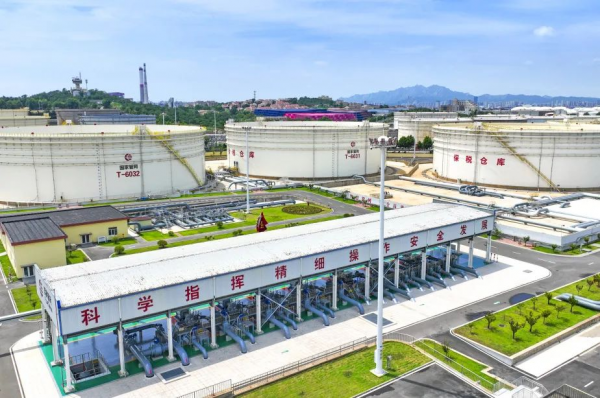
Core Insights - The National Pipeline Network Group's "Key Technology Research and Application for Smart Operation of Large Hub Oil Depots" has successfully passed authoritative certification, marking a significant advancement in the intelligent transformation of China's oil and gas storage and transportation industry [1][3]. Group 1: Technology Implementation - The technology will be fully implemented at the Huangdao Oil Depot by March 15, 2025, demonstrating significant advantages in efficiency, safety, and economics, with potential for promotion across similar oil depots and expansion into oil and gas storage, transportation, and chemical sectors [3][6]. - The Huangdao Oil Depot has been designated as a pilot for smart oil depot construction, focusing on production operation monitoring and workflow management, utilizing high-precision 3D modeling, real-time data integration, and dynamic simulation [5][6]. Group 2: Smart Operation System - The smart operation system comprises six core modules: intelligent operation, intelligent inspection, intelligent diagnosis, intelligent security, intelligent emergency response, and intelligent alarm, integrating AI models and big data analysis [6][8]. - Compared to traditional oil depot management, the smart oil depot reduces on-site personnel exposure, shifting safety management from "post-event handling" to "pre-event prevention," and decision-making from "experience-driven" to "data-driven" [9].
长城汽车(601633):中报点评:高价车型占比加之规模效应,盈利能力环比较好明显
Changjiang Securities· 2025-09-03 23:30
Investment Rating - The investment rating for the company is "Buy" and it is maintained [7]. Core Views - The company achieved a revenue of 52.32 billion yuan in Q2 2025, representing a year-on-year growth of 7.7%, and a net profit attributable to shareholders of 4.59 billion yuan, which is a year-on-year increase of 19.5% [2][4]. - The company is accelerating its global expansion and is committed to transitioning to new energy vehicles, with a continuous new car cycle expected to drive improvements in sales and performance [2]. - The company's four major expansion strategies are expected to open up long-term growth potential for sales, while the shift towards intelligent vehicles is anticipated to enhance profitability across the entire industry chain [2]. Summary by Sections Financial Performance - In Q2 2025, the company sold 313,000 vehicles, a year-on-year increase of 10.1% and a quarter-on-quarter increase of 21.9%. The sales of new energy vehicles reached 98,000 units, up 33.7% year-on-year and 56.4% quarter-on-quarter, with new energy vehicles accounting for 36.8% of total sales [2][4]. - The revenue for Q2 2025 was 52.32 billion yuan, a year-on-year increase of 7.7% and a quarter-on-quarter increase of 30.7%. The average revenue per vehicle was 167,000 yuan, showing a slight decrease of 0.4 thousand yuan year-on-year but an increase of 1.1 thousand yuan quarter-on-quarter [2][4]. - The gross profit margin for Q2 2025 was 18.8%, a decrease of 1.7 percentage points year-on-year but an increase of 1.0 percentage points quarter-on-quarter. The net profit margin was 8.8%, up 0.9 percentage points year-on-year and 4.4 percentage points quarter-on-quarter [2][4]. Strategic Initiatives - The company is focusing on three dimensions: product, channel, and supply chain adjustments in the domestic market. It is committed to deepening its transition to new energy, with a focus on plug-in hybrid vehicles and a clear positioning for new products [2]. - The "ONE GWM" strategy is accelerating the company's overseas expansion, covering over 170 countries and regions, with more than 1,400 overseas sales channels established [2]. - The company is enhancing its technological capabilities in the era of intelligence, focusing on data, algorithms, and computing power to strengthen its competitive edge [2]. Future Outlook - The company expects to see continued growth in sales and performance driven by its overseas expansion and the acceleration of new energy vehicle transitions, along with an increase in the proportion of high-value models like the Tank and WEY [2]. - Forecasted net profits for 2025, 2026, and 2027 are 14.13 billion yuan, 17.12 billion yuan, and 21.52 billion yuan, respectively, with corresponding A-share PE ratios of 15.7X, 12.9X, and 10.3X [2].
广汽集团中报"失速":历史最大亏损背后业绩仍存水分高研发投入难掩重大决策失误
Xin Lang Cai Jing· 2025-09-03 12:06
Core Viewpoint - GAC Group has reported significant financial losses in the first half of 2025, with a notable decline in both revenue and net profit, primarily due to falling sales across its main brands and poor strategic decisions [1][2][4]. Financial Performance - In the first half of 2025, GAC Group achieved revenue of 42.61 billion yuan, a year-on-year decrease of 7.9%, and a net profit of -2.54 billion yuan, representing a decline of 267.4% [1]. - The second quarter revenue was 22.73 billion yuan, also down 7.9% year-on-year, with a net profit of -1.87 billion yuan, worsening from a profit of 300 million yuan in the same quarter of 2024 [1][3]. Sales Performance - GAC Group's total sales for the first half of 2025 reached 755,000 units, a year-on-year decline of 12.5%. Notably, GAC Honda, GAC Trumpchi, and GAC Aion saw sales drop by 25.6%, 22.6%, and 14.0% respectively [2]. - GAC Toyota was the only brand to show a slight increase in sales, up 2.6% [2]. Profitability Issues - The gross profit margin for GAC Group fell to -3.4% in the second quarter, a decrease of 10 percentage points year-on-year, while the half-year gross margin dropped to -1.7% [3]. Research and Development - GAC Group's R&D expense ratio has remained low, between 1% and 2%, indicating that a significant portion of R&D investments is not accounted for in current expenses [4][5]. - Despite high R&D spending historically, the company has faced multiple strategic missteps, particularly in the electric vehicle sector, leading to a delayed transition to electrification and smart technology [5]. Strategic Decisions - GAC Group's previous decision to terminate its partnership with Huawei has been criticized, especially as competitors who maintained such collaborations have seen success [6]. - The company has recently announced a renewed partnership with Huawei to establish a new automotive brand, but market skepticism remains regarding the potential success of this initiative [6]. Leadership Changes - The recent leadership change, with Feng Xingya taking over from Zeng Qinghong, raises questions about the company's ability to reverse its current downward trend [6].
