世界模型

Search documents
鹏城实验室出品,一座“世界模型”融资数亿元
3 6 Ke· 2025-12-02 03:56
在如今的人工智能竞赛里,扎克伯格和他的Meta可能是最"激进"的玩家,没有之一。 在过去一年时间里,扎克伯格豪掷千金、四处摇人,试图组建世界上最强大的AI产品团队,动辄就为那些有过OpenAI、Anthropic等头部公司工作经 历的人才开出1亿美元的"跳槽奖金"。其中最大一笔开支用在了汪涛身上——为了让这位天才少年顺利地加入Meta,带队人工智能团队,扎克伯格豪 掷148亿美元直接收购了汪涛创办的Scale AI,直接整体打包带走。 如果谈得再务实一点,大语言模型虽然在文本推理与知识处理上取得突破,但在理解真实物理空间、进行连续动作规划以及与环境实时交互方面仍 然存在根本性缺陷。这类缺陷不仅让AGI的实现遥遥无期,更直接限制了人工智能技术向具身智能等更实际应用场景的拓展。 除此而外,扎克伯格SSI的首席执行官、前Y Combinator合伙人丹尼尔·格罗斯(Daniel Gross)旗下的风险投资基金NFDG,并顺势邀请NFDG的两位 合伙人——丹尼尔·格罗斯与前GitHub首席执行官、著名科技播客"Hacker Medley"的主理人纳特·弗里德曼(Nat Friedman)加入Meta,准备组建Meta ...


让 AI 变得更透明,长城汽车 VLA 首搭魏牌全新蓝山智能进阶版
晚点Auto· 2025-12-01 11:54
Core Viewpoint - The article discusses the evolution of advanced driver assistance systems (ADAS) towards a Vision-Language-Action (VLA) model, highlighting Great Wall Motors' leadership in this transition and its commitment to safety and reliability in autonomous driving technology [3][5][10]. Group 1: VLA Development and Implementation - Great Wall Motors is one of the first automakers to achieve mass production of VLA technology, which will debut in the new Weipai Blue Mountain Intelligent Advanced Edition [3][10]. - The VLA model represents a shift from traditional end-to-end systems to a more sophisticated approach that incorporates semantic understanding, reasoning, and decision-making capabilities [5][11]. - The VLA system can interpret user commands and predict potential risks, enhancing the vehicle's ability to make informed decisions in complex driving scenarios [7][8]. Group 2: R&D Investment and Strategy - In the first three quarters of the year, Great Wall Motors invested approximately 6.636 billion yuan in R&D, with smart technology accounting for about half of this expenditure [4]. - The company plans to allocate at least 1 billion yuan annually to the field of autonomous driving, demonstrating a long-term commitment to technological advancement [4][10]. - Great Wall Motors emphasizes a cautious approach to technology deployment, prioritizing safety and reliability over flashy features that may introduce risks [10][15]. Group 3: Market Position and Competitive Landscape - The Blue Mountain model has achieved significant market success, with over 110,000 units delivered since its launch, indicating strong consumer acceptance in a competitive SUV market [12][14]. - The article notes that the penetration rate of ADAS in the domestic market has exceeded 60%, reflecting a growing acceptance and demand for such technologies [10]. - Great Wall Motors aims to differentiate itself by focusing on building trust with users, ensuring that their systems are reliable and safe for family use [16]. Group 4: Future Directions - The integration of VLA with the Hi4 performance version of the intelligent four-wheel drive system is designed to enhance the vehicle's responsiveness to real-time conditions [15]. - Great Wall Motors is committed to evolving its technology to create a truly intelligent vehicle, with plans for further advancements beyond the VLA system [16]. - The company’s strategy aligns with industry trends emphasizing the need for higher controllability and stability in smart vehicle systems [15][16].


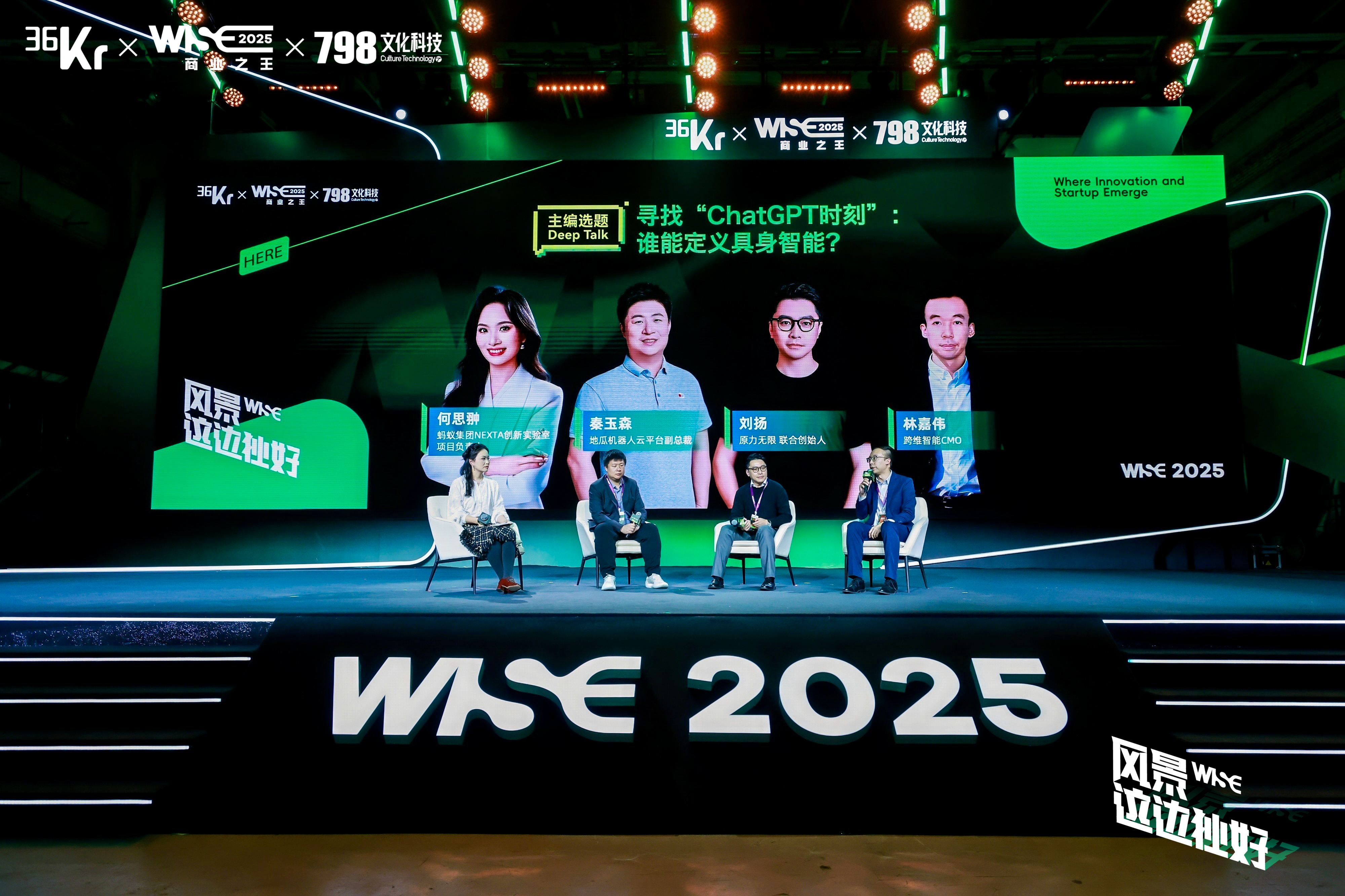
寻找“ChatGPT时刻”:谁能定义具身智能?| 36氪 WISE2025 商业之王大会
3 6 Ke· 2025-12-01 11:06
Group 1 - The WISE 2025 conference in Beijing focuses on immersive experiences and the impact of AI on various industries, highlighting trends such as hardware transformation and brand globalization [1] - The concept of embodied intelligence is identified as a hot topic for 2025, emphasizing its transition from a mere execution tool to an intelligent partner capable of perception and autonomous decision-making [4][5] - The conference features discussions on significant advancements in AI and embodied intelligence, with industry leaders sharing their insights and product developments [12][13][14] Group 2 - Companies like DiGua Robotics, Yuanli Unlimited, and Kuawei Intelligent are actively developing products in the embodied intelligence space, showcasing innovations such as the RDK Agent and humanoid robots [12][13][14] - The advancements in AI are enabling developers to leverage large models, enhancing their capabilities and allowing for more complex applications in robotics [15][16] - The industry is witnessing a shift towards using synthetic data for training models, which is crucial for overcoming challenges in real-world applications [20][32] Group 3 - The panelists discuss the potential for AI to create scalable value in industries that are currently limited by slow productivity and knowledge transfer [21] - The importance of industry acceptance and the maturity of AI technology are highlighted as critical factors for achieving large-scale impact [22][23] - The future of AI and embodied intelligence is seen as a long-term journey, with expectations for significant changes in daily life and work processes over the next five years [33][34]
CES2026超前瞻:AI是核心议题,中国企业或将再度霸展
3 6 Ke· 2025-12-01 04:09
Core Insights - CES 2026 is set to showcase significant advancements in AI technology, with major companies like Siemens, Caterpillar, AMD, and Lenovo focusing on AI in their presentations [5][8][19] - The event will highlight a variety of AI hardware products, including AI glasses, AI PCs, AI smartphones, and humanoid robots, indicating a strong trend towards AI integration in consumer electronics [18][19] - Chinese brands are expected to dominate CES, showcasing their technological innovations across various categories, reflecting their growing influence in the global market [40][41] AI as the Central Theme - AI will be the overarching theme of CES 2026, with confirmed keynote speeches from industry leaders emphasizing its importance [5][19] - Companies like Siemens will demonstrate how AI and digital twin technology can transform manufacturing and infrastructure [8] - Lenovo plans to unveil innovations related to AI-driven experiences, including applications in sports and personalized user interactions [11] PC and Gaming Innovations - Intel, AMD, and NVIDIA are anticipated to launch new products, including Intel's Panther Lake mobile processors and AMD's R9 9950X3D processor with enhanced cache capabilities [19][21] - The introduction of new gaming processors and graphics cards is expected to attract significant attention from the gaming community [21][22] Display Technology Competition - Major TV manufacturers, including TCL and Hisense, are expected to showcase advancements in RGB display technology, competing with international brands like LG and Samsung [25][26] - The CES 2026 will feature a variety of display technologies, including Micro RGB LCD and Mini LED, highlighting the competitive landscape in the display sector [25][26] Smart Cleaning Devices - Chinese smart cleaning brands are set to unveil new products, including robotic vacuums and lawn mowers, reinforcing their leadership in the global smart cleaning market [27][30] - The focus will be on comprehensive cleaning solutions that leverage AI and advanced navigation technologies [30] Accessory and Audio Innovations - Accessory brands like Baseus and Ugreen are expected to expand their product lines beyond traditional charging devices, venturing into audio and smart home solutions [31][34] - The introduction of high-end audio products and smart home security devices will be a key focus for these brands at CES 2026 [36] AI Glasses and New Hardware - AI glasses are anticipated to be a major highlight, with various brands competing in this emerging category [38] - The presence of established players and new entrants in the AI hardware space will create a dynamic showcase of innovative products [39] Chinese Brands' Dominance - Chinese companies are projected to play a pivotal role at CES, with a significant share of exhibitors and a focus on technological innovation rather than just cost competitiveness [40][41] - The event serves as a platform for Chinese brands to demonstrate their rapid product development and engineering capabilities across multiple tech sectors [40][41]



为机器人而生!NVIDIA 开启具身智能新纪元的终极大脑
机器人大讲堂· 2025-12-01 01:30
Core Insights - The next challenge for robots is not just to see accurately but to make correct decisions and actions based on what they see, requiring a new, generalized AI capability framework [1] - The global robotics industry is at a historical "singularity moment," transitioning from specialized to general-purpose robots driven by breakthroughs in AI technology [3] Group 1: Acceleration Towards Generalization - Achieving the vision of generalization in robotics requires unprecedented demands on foundational technologies, including significant advancements in computational power [4] - Training robots to understand the complexities of the physical world necessitates a shift from current kilowatt clusters to megawatt scales [4] - High-fidelity simulation platforms are essential for training robots, allowing them to learn through extensive trial and error in a digital twin environment [5] Group 2: Understanding Physical World Laws - The core of generalization is the robot's deep understanding of fundamental physical laws, such as gravity and friction, which is increasingly recognized in academic research [7] - The concept of world models is gaining traction, enabling robots to perform logical reasoning and predict the consequences of their actions [7][13] - A richer perception system is required, as single sensory inputs are insufficient for reliable actions in unstructured environments [8] Group 3: Paradigm Shift in Robotics - The robotics industry is experiencing a profound architectural restructuring, moving from tools to partners in embodied intelligence [9] - Traditional methods relying on manual programming are being replaced by a new paradigm that integrates simulation, world models, and edge computing [10] - The "simulation-first" approach is becoming central to the next generation of robot development, emphasizing the importance of digital twins throughout the entire lifecycle [12] Group 4: NVIDIA's Role in Robotics - NVIDIA's comprehensive solution, centered around the "three computers" architecture, aims to integrate cloud, edge, and endpoint capabilities to set new industry standards [15][17] - The introduction of the Jetson AGX Thor is a milestone product designed to support edge computing, crucial for real-time perception and decision-making in robots [22] - NVIDIA's open-source Isaac GR00T series models facilitate significant advancements in robot cognition and motion skills, simulating human cognitive processes [24] Group 5: Industry Adoption and Future Outlook - Numerous robotics companies globally are adopting NVIDIA's solutions, indicating a collective decision driven by efficiency and risk mitigation in the uncertain landscape of general-purpose robotics [33] - The transition to a "simulation-first" development paradigm, combined with robust edge computing, is propelling general robots from science fiction to commercial reality [35][36] - The integration of advanced technologies like NVIDIA's Jetson AGX Thor is making the path to achieving general-purpose robots clearer and more feasible [37]


中金机器人播客 #6 | 朱政:“世界模型”的路线与前沿
中金点睛· 2025-11-30 23:49
Core Viewpoint - The podcast explores the development and application of world models in robotics, emphasizing their significance in embodied intelligence and autonomous driving [6]. Summary by Sections World Models - World models are essential for understanding and simulating environments, which is crucial for the advancement of robotics [6]. Applications in Embodied Intelligence - The application of world models in embodied intelligence is discussed, highlighting their role in enhancing robot capabilities [6]. Challenges in Application - Various challenges associated with the implementation of world models are identified, indicating the complexities involved in their practical use [6]. Differences in Applications - The podcast differentiates between the applications of world models in embodied intelligence and autonomous driving, noting the unique requirements of each field [6]. Evolution of Simulation - The evolution of simulation techniques from 1.0 to 2.0 is explained, showcasing advancements in how world models are utilized [6]. Understanding Robot World Models - Insights into how to comprehend the world models used in robotics are provided, emphasizing their foundational role in robot functionality [6]. Data Sources and Limitations - The sources of data for world models and their capability boundaries are discussed, underlining the importance of accurate data in model effectiveness [6]. Future Development Trends - Future trends in the development of world models are anticipated, suggesting potential advancements and innovations in the field [6]. Ensuring Physical Consistency - The importance of ensuring physical consistency in world models is highlighted, which is critical for their reliability in real-world applications [6]. Technological Projections for 2030 - Projections regarding technological advancements by 2030 are made, indicating the expected growth and evolution of robotics and world models [6].

北京人工智能产业白皮书:各类AI Agent将迎来爆发式增长
Xin Jing Bao· 2025-11-29 07:55
Core Insights - The Beijing Artificial Intelligence Industry White Paper (2025) predicts explosive growth in various AI agents capable of serving as personal assistants, automating enterprise processes, and acting as scientific research assistants [1][3] - The development of embodied intelligence will enable a transition from information processing to physical tasks [3] Industry Overview - Beijing has registered 183 large models, maintaining its position as the national leader [2] - The AI core industry in Beijing is projected to reach a scale of 215.22 billion yuan in the first half of 2025, reflecting a year-on-year growth of 25.3% [2] - The total industry scale is expected to exceed 450 billion yuan by the end of 2025, with over 2,500 AI companies operating in the region [2] Technological Advancements - Various innovative entities in Beijing are producing leading-edge results, including the launch of FlagOS by the Beijing Zhiyuan Artificial Intelligence Research Institute and the introduction of "Tongtong 2.0" by the Beijing General Artificial Intelligence Research Institute [3] - The establishment of the world's first AI research platform covering literature review, computation, experimentation, and multidisciplinary collaboration has been achieved with the launch of the Bohr Research Space Station [3] Future Trends - The white paper outlines future trends in the AI industry, indicating that AI agents will experience significant growth and that embodied intelligence will bridge the gap between information processing and physical operations [3] - The development of world models is expected to enhance the generalization capabilities and reliability of AI systems [3] - The "AI for Science" initiative is anticipated to accelerate scientific discovery and lead to breakthroughs across various fields [3]
世界模型,是否正在逼近自己的「ChatGPT时刻」?
机器之心· 2025-11-29 01:49
Core Viewpoint - The article discusses the emerging focus on "world models" in the AI field, highlighting its potential applications and the ongoing debates among experts regarding its definition, construction, and commercialization [1][3]. Definition of World Models - Experts provided various definitions of world models, with key perspectives including: - A predictive model that forecasts the next state based on current conditions and action sequences, with applications in autonomous driving and embodied intelligence [4]. - A framework for AI to predict and assess environmental states, evolving from simple game worlds to complex virtual environments [4]. - An ambitious goal to create a 1:1 model of the world, acknowledging the impracticality of such precision but emphasizing purpose-driven modeling [4]. Construction of World Models - A central dilemma in developing world models is whether to prioritize model creation or data collection. Experts discussed: - The challenge of training models with limited data, particularly in autonomous driving, where most data is collected under ideal conditions [5]. - The importance of high-quality data for specific applications to enhance model performance [5]. - A proposed iterative approach where initial models generate data that can be used for further training [5]. Technical Implementation Paths - There are notable disagreements among experts regarding the technical paths for world models: - Some advocate for incorporating physical information into models, while others suggest a more pragmatic approach based on specific needs [7]. - The potential for models to evolve towards purely generative forms as capabilities improve [7]. Architectural Debate: Diffusion vs. Autoregressive - Experts shared their views on the suitability of diffusion versus autoregressive architectures for world models: - Diffusion models are seen as more aligned with the physical generation of content, reflecting how the brain decodes complex signals [8]. - There is a trend towards integrating different architectures to enhance model performance, recognizing the strengths of both diffusion and autoregressive methods [9]. Future of World Models - The timeline for achieving a "ChatGPT moment" for world models is uncertain, with estimates suggesting it may take around three years to realize significant breakthroughs [10]. - The current lack of high-quality long video data poses a significant challenge, with existing models primarily generating short clips [10]. - The commercialization of world models faces challenges in defining value for both business-to-business (B2B) and business-to-consumer (B2C) applications [10][11]. Conclusion - The roundtable discussion highlighted the vibrant and diverse nature of the world model field, emphasizing its potential for growth while acknowledging the challenges related to data, computational power, and technical direction [13].

贝索斯、杨立昆纷纷“出山”创业:AI黄金十年还是泡沫前夜?
Sou Hu Cai Jing· 2025-11-28 15:03
Core Insights - The return of Jeff Bezos and Yann LeCun to the AI sector marks a significant shift in the industry, with their contrasting approaches aiming to address the real bottlenecks in AI technology and its application in creating tangible value [1][3][4] Group 1: Major Players Re-entering the AI Arena - Jeff Bezos has taken on a leadership role in the AI startup "Project Prometheus," securing $6.2 billion in funding, making it one of the best-funded early-stage AI companies globally [4][5] - Yann LeCun, a Turing Award winner, is establishing a new company focused on Advanced Machine Intelligence (AMI), with Meta as a strategic partner, emphasizing foundational research over immediate commercialization [5][6] Group 2: Diverging Paths in AI Development - Bezos's "physical AI" approach targets the optimization of engineering manufacturing in sectors like hardware, automotive, and aerospace, aiming to reduce production cycles significantly [5][7] - LeCun's focus on AMI seeks to address the fundamental challenges of AI, such as understanding the physical world and developing reasoning capabilities, which he believes are essential for the next AI revolution [8][9] Group 3: Capital and Talent Dynamics - The influx of capital into the AI sector is accelerating, with 57% of new unicorns being AI companies, and the funding environment becoming increasingly competitive [10][11] - Talent acquisition has intensified, with companies offering substantial compensation packages to attract top AI researchers, further reshaping the competitive landscape [11][12] Group 4: Industry Trends and Future Outlook - The AI industry is transitioning from a phase of technological explosion to one of deep industry engagement, characterized by a focus on foundational innovation and vertical integration [9][10] - The potential for AI to drive significant advancements in manufacturing and healthcare is evident, with applications already demonstrating substantial efficiency gains and cost reductions [13][14] Group 5: Balancing Opportunities and Risks - While the enthusiasm for AI's potential is high, concerns about a possible bubble due to overvaluation and a lack of sustainable business models are emerging [14][16] - The industry's future will depend on maintaining a balance between innovation quality and commercial viability, as well as navigating regulatory uncertainties [14][16]

90后华人科学家:超一亿美金年薪背后的权力游戏
创业邦· 2025-11-28 10:14
Core Insights - The departure of Yann LeCun, a Turing Award winner and AI pioneer, from Meta marks a significant shift in the company's AI strategy towards a more pragmatic, product-oriented approach [5][6][27] - The recruitment of Shengjia Zhao, a former key developer at OpenAI, highlights the intense competition for AI talent in Silicon Valley and reflects a deeper power struggle within Meta [6][17][30] Group 1: Key Events - Yann LeCun announced his departure from Meta after 12 years, indicating a shift from long-term idealism to practical application in AI [5][6] - Shengjia Zhao joined Meta with a reported annual salary exceeding $100 million, showcasing the aggressive talent acquisition strategies employed by tech giants [6][10][20] - Zhao's rapid rise within Meta, including his appointment as Chief Scientist of the newly formed Meta Super Intelligence Lab (MSL), underscores the company's urgent need to enhance its AI capabilities [19][20][30] Group 2: Internal Dynamics - Meta's internal turmoil is evident as Zhao faced management chaos and cultural clashes shortly after joining, leading him to consider returning to OpenAI [19][21] - The establishment of MSL and Zhao's leadership role have exacerbated existing tensions between new and old factions within Meta, as evidenced by the departure of other top researchers [22][25] - The marginalization of the FAIR lab, previously led by LeCun, reflects a broader shift in Meta's AI focus, moving away from academic ideals towards commercial viability [26][27] Group 3: Future Implications - The challenges faced by Zhao in navigating Meta's bureaucratic environment while striving to advance AI technology signal a critical juncture for the company [30] - The competition for AI talent and the strategic shifts within Meta may influence the broader AI industry, as companies seek to balance idealism with practical outcomes [30]