
降准降息

Search documents
螺纹日报:震荡整理-20251225
Guan Tong Qi Huo· 2025-12-25 11:48
1. Report Industry Investment Rating - Not provided in the report. 2. Core Viewpoint of the Report - The current market is in a volatile situation with supply support and weak demand in the off - season. Supply is at a relatively low level but has started to rise in the past two weeks, and there are expectations of steel mill复产 in January. Demand is showing off - season characteristics with a decline. It is necessary to observe whether the winter storage market can be launched in January. Inventory destocking has slowed down, but the overall inventory level is acceptable. The macro - outlook is relatively loose, but real - estate regulation restricts demand space. The recent market has been volatile after a low - level rebound, indicating that the current supply - demand contradiction is not prominent. It is expected to be weakly volatile in the short term [6]. 3. Summary by Relevant Catalogs Market行情回顾 - Futures price: On Thursday, the position of the rebar main contract decreased by 15,590 lots. The trading volume continued to decline compared with the previous trading day. It fluctuated within the day, with a minimum of 3,123 yuan/ton, a maximum of 3,144 yuan/ton, and closed at 3,127 yuan/ton, up 1 yuan/ton or 0.03%. The trading volume was 502,388 lots [1]. - Spot price: The spot price of HRB400E 20mm rebar in the mainstream region was 3,320 yuan/ton, remaining stable compared with the previous trading day [1]. - Basis: The futures price was at a discount of 193 yuan/ton to the spot price, which continued to support the futures price to some extent [1]. Fundamental Data Supply and Demand Situation - Supply side: As of the week of December 25, rebar production increased by 27,100 tons week - on - week to 1.8439 million tons, rising for two consecutive weeks. It was 319,100 tons lower year - on - year on the Gregorian calendar, and the production was still at a near - 4 - year low. As of December 18, the blast furnace operating rate of 247 steel mills was 78.47%, down 0.16 percentage points week - on - week and 1.16% lower than last year. The steel mill profitability rate was 35.93%, unchanged from last week. The daily average hot metal output decreased by 26,500 tons to 22.655 million tons, 28,600 tons lower than last year. This week's production continued to rise slightly, which would weaken price support to some extent [2]. - Demand side: Terminal demand was weak. The average daily trading volume of building materials nationwide remained at 90,000 - 100,000 tons, at a near - five - year low for the same period. As of the week of December 25, the apparent consumption decreased by 59,600 tons week - on - week to 2.0268 million tons, 169,000 tons lower year - on - year on the Gregorian calendar, at a near - 4 - year low. Demand showed regional differences. Construction in the north stopped due to cold weather, while in the south, existing projects were rushing to complete, with good demand resilience. The apparent demand declined due to the off - season, and it was necessary to pay attention to whether winter storage could boost demand in January [2]. - Inventory side: Inventory continued to decline. As of the week of December 25, the total inventory decreased by 182,900 tons week - on - week to 4.3425 million tons, declining for 8 consecutive weeks, but still 345,100 tons higher year - on - year. Among them, the social inventory was 2.9419 million tons, down 188,100 tons week - on - week with a slowdown in destocking, and the steel mill inventory was 1.4006 million tons, slightly increasing by 5,200 tons. The destocking of social inventory showed current demand resilience. Although the inventory destocking rate slowed down this week, the overall inventory pressure was still controllable [3]. Macro - aspect - The Central Economic Work Conference proposed to flexibly and efficiently use various policy tools such as reserve - requirement ratio cuts and interest - rate cuts to maintain sufficient liquidity and smooth the monetary - policy transmission mechanism. It focused on stabilizing the real - estate market, adjusting policies according to cities to control new supply, destock, and optimize supply, and encouraging the acquisition of existing commercial housing for affordable housing. The Fed cut interest rates by 25 basis points in December as expected. The macro - outlook was moderately positive. The 14th Five - Year Plan provided a transformation path for the steel industry, focusing on "controlling production capacity, optimizing structure, promoting transformation, and improving quality." Macro - economically, incremental demand was relatively limited, but the loose cycle provided some support, and the upper limit of demand determined the pressure [3]. Cost - aspect - The futures of iron ore and coking coal stabilized, enhancing cost support [4]. Driving Factor Analysis - Bullish factors: Low supply, continuous inventory destocking, expectations of policy easing, a large futures discount providing bottom - support, strong iron ore in the furnace charge, and stable coking coal enhancing cost support [5]. - Bearish factors: Seasonal weakening of terminal demand, more construction site closures in the north, cautious winter - storage willingness of traders, and weak real - estate data [5]. Short - term View Summary - The current market is in a volatile situation. Supply is at a relatively low level but has increased recently, and there are expectations of steel mill复产 in January. Demand shows off - season characteristics. The inventory destocking rate has slowed down, and the overall inventory level is okay. The macro - outlook is relatively loose, but real - estate regulation restricts demand space. The market has been volatile recently, indicating a non - prominent supply - demand contradiction. It is expected to be weakly volatile in the short term [6].
固收|降准降息,何谓“灵活高效”?
2025-12-25 02:43
Summary of Key Points from the Conference Call Industry Overview - The discussion revolves around China's monetary policy, particularly focusing on the flexibility and efficiency of tools like interest rate cuts and reserve requirement ratio (RRR) adjustments in response to economic conditions [1][2][3]. Core Insights and Arguments - **Monetary Policy Flexibility**: The central bank emphasizes a flexible and effective application of monetary policy tools, allowing for adjustments based on economic conditions. This flexibility provides the central bank with significantly more opportunities for intervention compared to the Federal Reserve [2][3]. - **Interest Rate Types**: China has four main types of interest rates: policy rate (7-day reverse repo rate at 1.4%), benchmark rate, deposit rate, and loan rate. Each serves distinct functions in regulating market liquidity, pricing financial products, influencing savings, and corporate financing [4][5]. - **Assessment of Rate Cuts**: The effectiveness of interest rate cuts can be evaluated through stock market performance, which serves as a macroeconomic barometer. Historical data shows that significant market rebounds occurred following key interventions by the central bank [6]. - **Future Expectations**: For 2026, there is an expectation of continued downward adjustments in deposit rates, primarily through the maturity of high-interest fixed deposits rather than direct reductions in listed rates. This could lead to challenges in maintaining deposit levels while balancing profitability [16][17]. - **Debt Structure Focus**: The emphasis for 2025-2026 is on altering the debt structure rather than merely reducing financing costs. The government is expected to leverage its position to optimize financing structures, indicating that multiple significant rate cuts may not be necessary [9]. - **Impact of Policy Rate Cuts**: A reduction in the policy rate does not automatically lead to a decrease in the yield curve. Market expectations and institutional behaviors play crucial roles in determining the actual outcomes of such cuts [10]. - **Banking Sector Dynamics**: The relationship between deposit rates and bank interest margins is complex. While lower deposit rates can enhance the attractiveness of other assets, the actual impact on loan issuance and bond allocation is influenced by various factors, including market rates and internal pricing mechanisms [15][20]. Other Important Considerations - **Liquidity Management**: The central bank's ability to manage liquidity through RRR adjustments is limited by current economic conditions. A significant reduction in the RRR could lead to market instability [27][29]. - **Geopolitical Influences**: Global geopolitical and trade policy changes are anticipated to have profound effects on market dynamics, particularly in the context of upcoming policy announcements [6]. - **Risk Management in Banking**: Different types of financial products (credit, credit bonds, and interest rate bonds) require distinct risk management strategies, highlighting the complexity of banking operations [22]. - **Market Reactions to Policy Changes**: The market's response to anticipated policy changes can vary significantly, with short-term rates likely to react more predictably than long-term rates, which may be influenced by broader economic pressures [25][26]. This summary encapsulates the key points discussed in the conference call, providing insights into the current state and future expectations of China's monetary policy and banking sector dynamics.
华泰证券:产品力或将成为2026年房企穿越周期的核心竞争力之一,有望重塑企业市场地位和竞争格局
Xin Lang Cai Jing· 2025-12-24 23:56
Core Viewpoint - The report from Huatai Securities indicates that the Ministry of Housing and Urban-Rural Development held a work meeting to summarize the real estate work for 2025 and outline key tasks for 2026, emphasizing a commitment to stabilize the industry and implement policies focused on controlling growth, reducing inventory, and optimizing supply [1] Group 1: Policy Outlook - The policies for 2026 will focus on controlling new supply, reducing inventory, and optimizing supply, which are expected to be further implemented [1] - Potential monetary easing measures, such as interest rate cuts, may support market stabilization [1] Group 2: Market Dynamics - The supply-side optimization is anticipated to enhance product competitiveness, which could become a core strength for real estate companies to navigate through economic cycles [1] - The meeting reflects a firm stance from the central government to stabilize the industry and provides a series of directional guidelines [1] Group 3: Investment Recommendations - Recommended investments include real estate stocks that possess "good credit, good cities, and good products" [1] - Companies that can manage cash flow effectively during market adjustments are highlighted as strong candidates [1] - Local Hong Kong real estate firms are expected to benefit from the recovery of the Hong Kong market [1] - Property management companies with stable cash flow and dividend advantages are also recommended [1]

央行明日开展1年期4000亿元MLF操作|快讯
Sou Hu Cai Jing· 2025-12-24 13:35
Group 1 - The central bank announced a 400 billion MLF operation on December 25, with a one-year term, to maintain ample liquidity in the banking system [1] - The net MLF injection for December is 1000 billion, marking the tenth consecutive month of increased operations, aligning with market expectations [1] - The total net liquidity injection in mid-December reached 3000 billion, a decrease of 3000 billion from the previous month, influenced by a decline in net financing of government bonds [1] Group 2 - The central economic work conference for 2026 emphasizes the continuation of a moderately loose monetary policy, focusing on stabilizing economic growth and reasonable price recovery [1] - The central bank is expected to utilize various liquidity tools to inject short, medium, and long-term liquidity into the market, ensuring a stable and ample funding environment [2] - This approach will support the smooth issuance of government bonds and encourage financial institutions to increase credit investments, signaling a sustained supportive stance in monetary policy [2]
【冠通期货研究报告】螺纹日报:震荡整理-20251224
Guan Tong Qi Huo· 2025-12-24 12:00
1. Report Industry Investment Rating No relevant content provided. 2. Core View of the Report The current market has low supply, rising demand, strong raw materials, and inventory de - stocking, which provides support. The market has digested the off - season demand and steel export license news. It is expected to trade on the winter storage expectation in the future. In the short term, it is expected to continue to operate in a volatile and slightly upward trend. Attention should be paid to whether production capacity can continue to shrink and the start time of winter storage demand [7]. 3. Summary by Relevant Catalogs Market行情回顾 - Futures price: The open interest of the main rebar contract increased by 17,388 lots on Tuesday. The trading volume slightly decreased compared with the previous trading day. It fluctuated within the day, with the lowest at 3,111 yuan/ton, the highest at 3,144 yuan/ton, and closed at 3,136 yuan/ton, up 2 yuan/ton or 0.06%. The trading volume was 837,866 lots [1]. - Spot price: The spot price of HRB400E 20mm rebar in the mainstream area was 3,320 yuan/ton, remaining stable compared with the previous trading day [1]. - Basis: The futures price was at a discount of 184 yuan/ton compared with the spot price, which provided some support for the futures price [1]. Fundamental Data Supply - demand situation - Supply side: As of the week of December 18, rebar production increased by 29,000 tons week - on - week to 1.8168 million tons, and decreased by 370,500 tons year - on - year. The production was at a near - 4 - year low. The blast furnace operating rate of 247 steel mills was 78.47%, down 0.16 percentage points week - on - week and 1.16% year - on - year. The steel mill profitability rate was 35.93%, unchanged from last week. The daily average pig iron output decreased by 26,500 tons to 2.2655 million tons, down 28,600 tons year - on - year [2]. - Demand side: Terminal demand was weak, with the average daily trading volume of building materials nationwide maintaining at 90,000 - 100,000 tons, at a near - 5 - year low. As of the week of December 18, the apparent consumption increased by 55,500 tons week - on - week to 2.0864 million tons, and decreased by 300,400 tons year - on - year, at a near - 4 - year low. There were regional differences in demand. Construction in the north stagnated due to cold weather, while in the south, existing projects rushed to complete, and demand had good resilience. The increase in apparent demand was higher than that in production. There was a possibility of winter storage driving demand later [2]. - Inventory side: Inventory continued to decline, and the decline rate increased. As of the week of December 18, the total inventory decreased by 269,600 tons week - on - week to 4.5254 million tons, with an 8 - week consecutive decline, but still 495,200 tons higher year - on - year. Social inventory was 3.13 million tons, down 257,000 tons week - on - week, and the de - stocking accelerated. Steel mill inventory was 1.3954 million tons, slightly down 12,600 tons. The de - stocking of social inventory showed the current demand resilience. The overall inventory pressure was still controllable [3][4]. Macroeconomic aspect The Central Economic Work Conference proposed to use various policy tools such as reserve requirement ratio cuts and interest rate cuts flexibly and efficiently to maintain sufficient liquidity and smooth the monetary policy transmission mechanism. It aimed to stabilize the real estate market, control new supply, reduce inventory, and optimize supply according to local conditions, and encourage the acquisition of existing commercial housing for affordable housing. The Fed cut interest rates by 25 basis points in December as expected. The macro - economic outlook was moderately positive. The 14th Five - Year Plan provided a transformation path for the steel industry, focusing on "controlling production capacity, optimizing structure, promoting transformation, and improving quality" [4]. Cost aspect Iron ore was strong, and coking coal and coke futures stabilized and rose, which continued to increase cost support [5]. Driving Factor Analysis - Bullish factors: Low supply, rising apparent demand, continuous inventory de - stocking, loose policy expectations, large discount on the futures market providing bottom support, strong iron ore, and significant rebound of coking coal and coke to increase cost support [6]. - Bearish factors: Seasonal weakening of terminal demand, more construction site closures in the north, cautious winter storage willingness of traders, and weak real estate data [6]. Short - term View Summary The market is expected to continue to operate in a volatile and slightly upward trend in the short term. Attention should be paid to whether production capacity can continue to shrink and the start time of winter storage demand [7].
央行宣布:4000亿元操作来了!
中国基金报· 2025-12-24 11:47
Core Viewpoint - The People's Bank of China (PBOC) will conduct a 400 billion MLF operation to maintain liquidity in the banking system, with a focus on optimizing market liquidity structure [2] Group 1: MLF Operations - On December 25, the PBOC will carry out a 400 billion MLF operation with a one-year term, increasing the amount by 100 billion compared to the 300 billion MLF maturing in December [2] - This operation is part of a continuous effort by the PBOC, marking the seventh consecutive month of net liquidity injection through MLF since the reserve requirement ratio (RRR) cut in May [3] Group 2: Economic Context and Future Outlook - The central economic work conference emphasizes the need for a moderately loose monetary policy, focusing on stabilizing economic growth and ensuring reasonable price recovery [3] - There is a possibility of a reserve requirement ratio cut in the first quarter of 2026, which could inject significant long-term liquidity into the market [3] - Future monetary policy will prioritize balancing short-term and long-term goals, supporting economic growth while managing risks associated with capital turnover and local government debt [4]


A股,突发!午后,直线涨停!两大利好来袭
券商中国· 2025-12-24 06:44
Core Viewpoint - The financial sector in A-shares experienced significant movement, with various stocks, including 瑞达期货, reaching their daily limit, indicating a potential bullish trend driven by expectations for the 2025 annual reports and monetary policy easing [1][2]. Group 1: Financial Sector Performance - The financial sector saw a notable surge, with 瑞达期货 hitting a daily limit and other companies like 翠微股份 and 南华期货 also rising [1][2]. - The overall performance of 43 listed securities firms in the first three quarters of 2025 showed a combined revenue of 421.62 billion yuan and a net profit of 169.25 billion yuan, reflecting year-on-year growth of 16.88% and 62.41% respectively [2]. Group 2: Market Expectations - Despite no reduction in the LPR in December, there remains a strong market expectation for monetary easing, with analysts predicting potential rate cuts in early 2026 to stabilize economic operations [2]. - Analysts from 天风证券 and 东方金诚 suggest that the window for monetary easing may open in the first quarter of 2026, which could further support the financial sector [2]. Group 3: Future Market Dynamics - The securities sector is expected to benefit from a favorable policy environment aimed at stabilizing growth and boosting the capital market, with factors such as liquidity and investor confidence playing crucial roles [3]. - The current valuation of the non-bank financial sector is considered low, with significant potential for recovery as the fundamentals improve in 2024 [3]. Group 4: Fund Allocation Trends - Historical trends indicate that low allocation of public funds to the non-bank sector, combined with regulatory changes, could lead to a rebound in this sector, similar to the rapid rise of financial stocks in late 2014 [4]. - The non-bank sector is currently underrepresented in public equity funds compared to its index weight, suggesting potential for capital inflow as fund managers adjust their portfolios [4]. Group 5: Sector Beta Returns - The beta returns of the securities sector are primarily influenced by overall market trends, with expectations that a market breakout could enhance the performance of the brokerage sector [5].

兴业证券:历史上的牛市躁动行情有何规律?
智通财经网· 2025-12-23 12:37
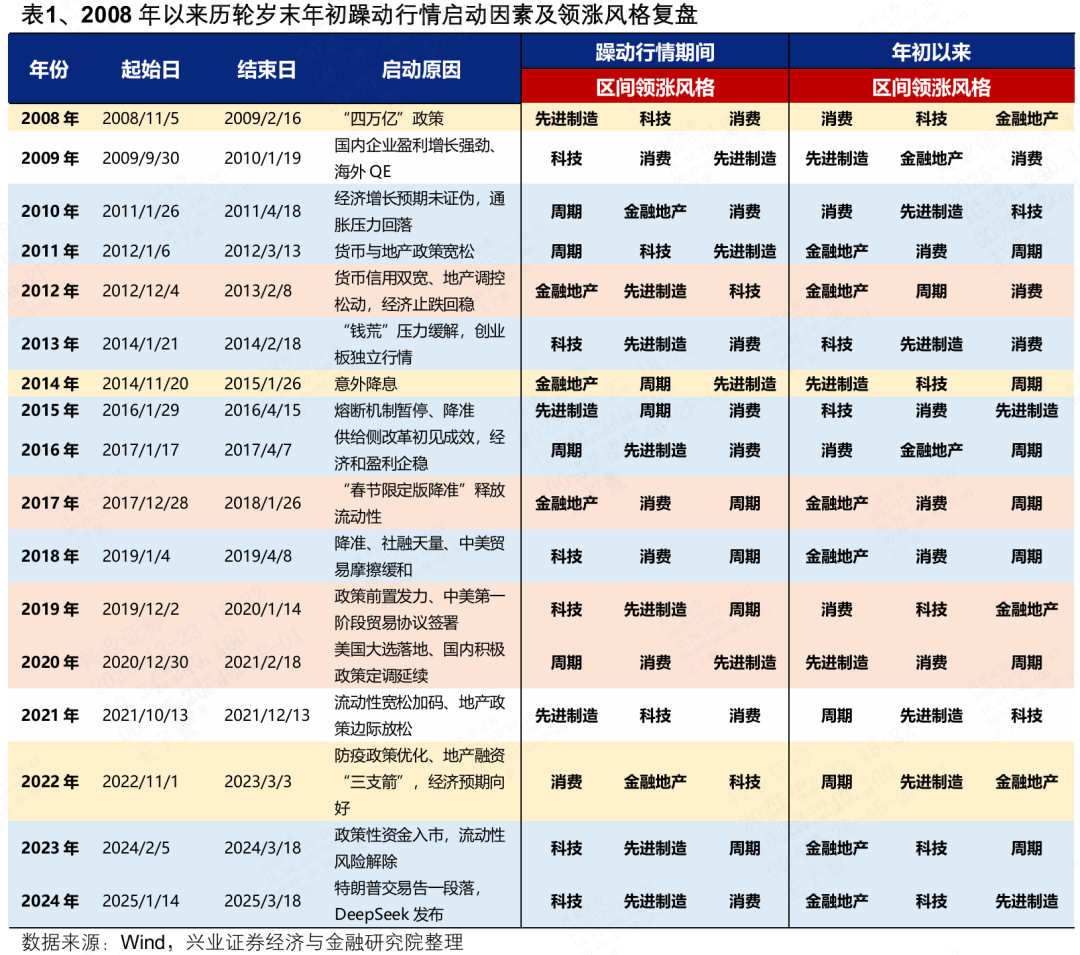
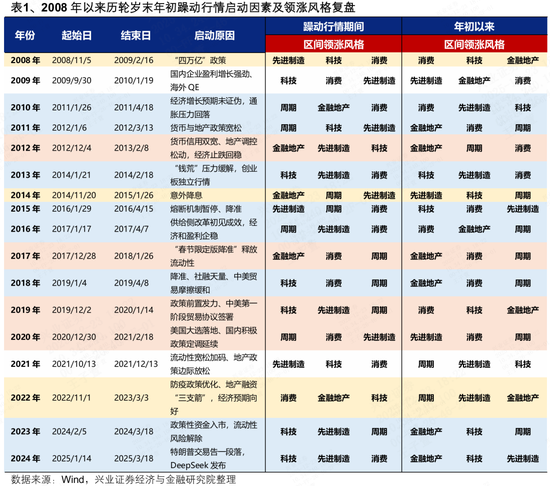
Core Viewpoint - The current bull market is supported by a solid foundation, including an expansionary economic policy tone, improving domestic fundamentals, and ample liquidity in the market [1][5]. Group 1: Economic Indicators and Market Conditions - The economic work conference continues to maintain a positive expansionary tone from last year [5]. - Key data is expected to validate the improvement in domestic fundamentals, with the end of the year and the beginning of the new year serving as critical windows for verifying the upward trend in PPI [5]. - Domestic macro liquidity is abundant, with options for further policy easing such as reserve requirement ratio (RRR) cuts and interest rate reductions [5]. Group 2: Historical Patterns of Bull Market Trends - Historical bull market trends can be categorized into three types based on their initiation timing and catalysts: November starts requiring strong macro policy shifts, December starts following market disturbances, and January-February starts which are common for most bull markets [1][2]. - The analysis of past bull market trends from 2008 onwards shows that even in the absence of strong macro policy shifts, market rallies can still commence following the resolution of prior disturbances [2][9]. Group 3: Potential Catalysts for Market Movement - Key events that may signal the start of a market rally include the resolution of uncertainties that previously suppressed the market, the implementation of easing policies like RRR cuts, and key data that confirms improving fundamentals [8]. - The next potential catalysts for further market excitement include the possibility of RRR cuts and interest rate reductions at the end of the year and early January, as well as key data releases such as PPI, PMI, M1, social financing, and corporate earnings forecasts [8]. Group 4: Market Performance Characteristics - During bull market rallies, the leading sectors typically do not experience significant structural shifts, maintaining a correlation with the performance of sectors from the beginning of the year [9]. - In past bull market rallies, the leading sectors included traditional value stocks and blue-chip companies, with a consistent performance observed across the rallies in 2017, 2019, and 2020 [9].

兴证策略张启尧团队:历史上的牛市躁动行情有何规律?
Xin Lang Cai Jing· 2025-12-23 11:05
Core Viewpoint - The article analyzes the historical patterns of stock market rally initiations since 2008, categorizing them based on their starting times and catalysts, highlighting the significance of macroeconomic policies and market conditions in triggering these rallies [1][3]. Group 1: Historical Rally Patterns - The article identifies three main categories of rally initiation times: 1. January-February starts, which are the most common for historical rallies [1][3]. 2. November starts, which require a clear shift in macroeconomic policy [1][3]. 3. December starts, which occur after strong market performance but face disturbances that, once resolved, lead to a rally [1][3]. Group 2: Key Factors for Rally Initiation - The analysis of the rallies in 2017, 2019, and 2020 reveals that they often began despite lacking strong macroeconomic policy shifts, indicating that market sentiment can drive early rallies [15][20]. - Important factors contributing to the initiation of these rallies include: 1. Positive policy signals from year-end meetings that bolster market sentiment [15][20]. 2. Improvement in economic fundamentals and corporate earnings, with no significant disturbances in economic data or earnings forecasts [15][20]. 3. Loose monetary policy and ample liquidity supporting market growth [15][20]. Group 3: Signals for Rally Initiation - The article outlines three main types of events that can signal the start of a rally: 1. Resolution of prior uncertainties that have suppressed the market [19]. 2. Implementation of easing policies such as rate cuts that can ignite market enthusiasm [19]. 3. Key economic data that confirms improving fundamentals, enhancing investor participation [19]. Group 4: Industry Performance During Rallies - The analysis indicates that during the rallies of 2017, 2019, and 2020, the leading sectors did not experience significant shifts, maintaining a correlation with the performance trends established earlier in the year [20]. - The leading sectors during these rallies included: 1. In 2017, low-valuation value stocks and blue-chip companies dominated the market [20]. 2. In 2019, the TMT sector continued to thrive, with the rise of the new energy industry [20]. 3. In 2020, the focus remained on high-end manufacturing and consumption, with some resource sectors benefiting from favorable monetary policies [20].
博时宏观观点:降准降息预期保守,债市短期或维持震荡格局
Xin Lang Cai Jing· 2025-12-23 02:34
Group 1: Economic Overview - US inflation for October and November was significantly lower than expected, with a potential rebound in December. The focus of the Federal Reserve has shifted towards addressing weak employment under a K-shaped recovery, maintaining an overall accommodative policy stance, and market expectations for interest rate cuts next year have increased [1][11] - In China, November data on consumption and investment showed weakness, indicating that domestic demand still needs stabilization. However, the recovery in export growth has supported industrial production, while retail sales were affected by the decline in government subsidies and the "Double Eleven" shopping festival [1][11] Group 2: Market Strategy - In the bond market, the funding environment remained stable, with short-term yields declining and mid to long-term yields showing volatility. The central bank is expected to implement substantial easing to lower bank funding costs ahead of potential interest rate cuts [2][12] - For A-shares, the framework indicates a bottoming of profits, but liquidity and risk appetite remain negative. The rapid decline in US CPI has raised expectations for interest rate cuts, positively impacting the offshore market [2][13] - The Hong Kong stock market is currently in a phase benefiting from liquidity but facing weak fundamentals. The improvement of the price level in 2026 will be crucial for market performance [2][13] Group 3: Commodity Insights - In the oil market, global economic fundamentals indicate weak demand, continuous supply release, and inventory accumulation, leading to sustained price pressure [3][14] - For gold, the reduction of uncertainties due to easing US-China trade tensions and a shift in focus from trade to domestic policy may lead to a gradual decrease in risk premiums, potentially slowing the pace of gold price increases while maintaining a positive long-term outlook [3][14]