新兴产业

Search documents
通鼎互联:通过参股上海屹锂新能源科技有限公司布局了固态电池领域
Zheng Quan Ri Bao Wang· 2025-09-29 09:44
Group 1 - The company, Tongding Interconnection (002491), is actively investing in the solid-state battery sector through its stake in Shanghai Yili Lithium New Energy Technology Co., Ltd., holding 2.36% as of September 29, 2025 [1] - The company is continuously monitoring the dynamics and development opportunities in emerging industries to support sustainable development [1]

返投仅一倍,这个市的产业母基金招GP了
母基金研究中心· 2025-09-29 08:46
Group 1 - The core idea of the article is the establishment of a sub-fund under the Shaoxing Industrial Fund to promote the integration of education, technology, and industry innovation, focusing on emerging industries such as integrated circuits, low-altitude economy, biomedicine, energy equipment and materials, robotics, artificial intelligence, and software information [1] - The Shaoxing Industrial Fund was established in March 2022 with a subscribed scale of 15 billion RMB, aiming to accelerate technological innovation and industrial transformation in Shaoxing [1][2] - The sub-fund must have a minimum scale of 1 billion RMB and will be selected through a public recruitment process [2][3] Group 2 - The Shaoxing Industrial Fund can invest up to 40% of a single sub-fund's scale, with a maximum investment of 80 million RMB [4] - The sub-fund must be registered in Shaoxing and have a lifespan of no more than 15 years, extendable by 2 years with partner agreement [5][6] - Management fees during the investment period cannot exceed 2% of the sub-fund's paid-in scale per year [8] Group 3 - The investment direction of the sub-fund focuses on emerging industries, including integrated circuits, low-altitude economy, biomedicine, energy equipment and materials, robotics, artificial intelligence, and software information [9] - The sub-fund will establish an investment decision-making committee to oversee major investment and exit decisions, with the Shaoxing Industrial Fund having the right to appoint an observer [10] - The distribution mechanism follows a principle of returning capital first, with a minimum return threshold of 6% per year [11] Group 4 - The exit strategies for the sub-fund's investments include IPOs, equity transfers, buybacks by major shareholders, and mergers and acquisitions [12] - Investment amounts in eligible enterprises must not be less than 70% of the sub-fund's paid-in scale, with specific criteria for eligible investments [12] - The sub-fund must invest at least 1 times the amount contributed by Shaoxing in local enterprises, and the management institution must return at least 1.2 times the amount contributed by Shaoxing [13] Group 5 - The management institution must be legally established and registered with the China Securities Investment Fund Industry Association, with a minimum registered capital of 10 million RMB [15][16] - The management team must include at least 10 full-time staff dedicated to investment, with at least 3 senior managers having over 3 years of equity investment experience [19] - The management institution must have managed a total of at least 500 million RMB in venture capital funds and have at least 3 successful investment cases in seed or early-stage technology enterprises [20]

主动权益基金分红榜揭晓!易方达霸榜!西部利得旗下基金高频分红超10次!
私募排排网· 2025-09-29 03:05
Core Viewpoint - The article discusses the performance and dividend distribution of actively managed equity mutual funds in the A-share market, highlighting the significant gains in the market and the limited number of funds that have distributed dividends this year [4][5]. Summary by Sections Market Performance - The A-share market has seen a significant rise, with major indices reaching new highs. As of September 24, the Shanghai Composite Index has increased by approximately 15% year-to-date, while the Shenzhen Component Index and the ChiNext Index have risen by 28% and over 48%, respectively [4]. Dividend Distribution - As of September 21, only 127 out of 7463 actively managed equity mutual funds have distributed dividends this year, accounting for less than 2% of the total [4]. - The total dividend amount for actively managed equity funds with a scale of over 1 billion yuan that have distributed dividends this year is 2.106 billion yuan, with 32 distributions [5]. Top Dividend Funds - The top three actively managed equity funds in terms of dividend distribution this year are: 1. E Fund's E Fund Kexun Mixed Fund (110029) managed by Liu Jianwei, with a total dividend of 530.63 million yuan and a year-to-date return of 78.24% [6][7]. 2. E Fund's E Fund Value Selection Mixed Fund (110009) managed by Bao Zhengyu, with a total dividend of 437.51 million yuan and a year-to-date return of 28.11% [6][7]. 3. Huashang Fund's Huashang Advantage Industry Mixed A (000390) managed by Zhang Mingxin, with a total dividend of 170.30 million yuan and a year-to-date return of 81.98% [6][7]. Fund Strategies and Outlook - The E Fund Kexun Mixed Fund focuses on emerging growth sectors such as artificial intelligence and innovative pharmaceuticals, with the manager optimistic about continued investment opportunities in the equity market [7][8]. - The Huashang Advantage Industry Mixed A fund's manager adjusted the portfolio significantly after market fluctuations, leading to strong performance [7][8]. Fund Performance by Scale - For funds with a scale of 5-10 billion yuan, the top three in dividend distribution are: 1. Penghua Fund's Penghua Shengshi Innovation LOF (160613) [9]. 2. Caitong Asset Management's Caitong Digital Economy Mixed Fund (017483) with a total dividend of 53.71 million yuan and a year-to-date return of 61.98% [11]. 3. Xinhua Fund's Xinhua Preferred Dividend Mixed A (519087) [9]. - For funds with a scale of 1-5 billion yuan, the top three are: 1. Southern Fund's Southern North Exchange Selection Two-Year Open Mixed Fund (014294) [13]. 2. Yinhua Fund's Yinhua Huixiang Three-Year Regular Open Mixed Fund (019597) [13]. 3. West China Fund's West China Quantitative Preferred One-Year Holding Period Mixed A (010779) with a total dividend of 42.69 million yuan [13]. - For funds with a scale of 1 million to 1 billion yuan, the top three are: 1. Hongta Hongtu's Hongta Hongtu Shengfeng Mixed A (013733) with a total dividend of 16.52 million yuan [16][17]. 2. West China Fund's West China Quantitative Preferred One-Year Holding Period Mixed C (010780) [16]. 3. West China Fund's West China Central Enterprise Preferred Stock A (022164) [16].
通鼎互联:公司通过参股上海屹锂新能源科技有限公司布局了固态电池领域
Mei Ri Jing Ji Xin Wen· 2025-09-29 01:08
Core Viewpoint - The company is exploring opportunities in the solid-state battery sector and is committed to sustainable development through investments in emerging industries [1]. Group 1 - The company has a 2.36% stake in Shanghai Yili Lithium New Energy Technology Co., Ltd. as part of its strategy to enter the solid-state battery market, with the investment expected to last until September 2025 [1]. - The company is actively monitoring trends and development opportunities in emerging industries to enhance its business operations [1].
富国观市丨持股过节还是持币过节?
Sou Hu Cai Jing· 2025-09-28 15:42
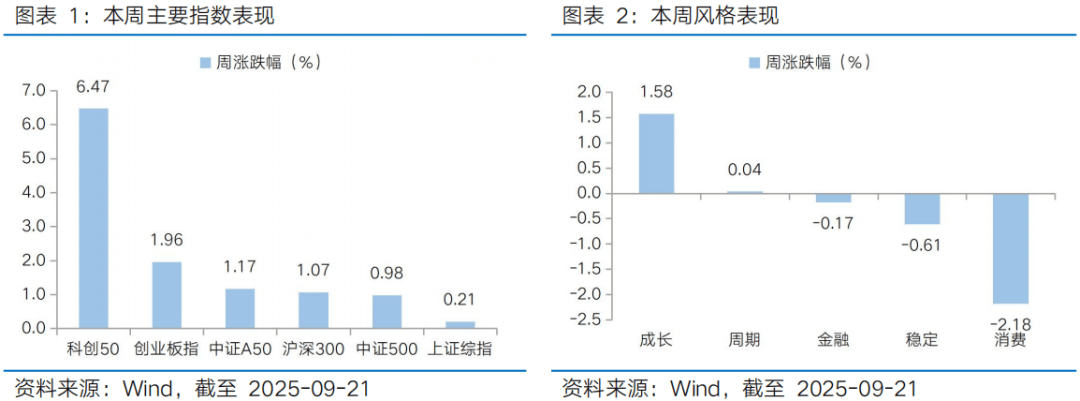
Part 1: A-share Market Analysis - The A-share market saw most major indices close in the green this week, with the STAR Market particularly strong due to semiconductor sector stimulation, while broader indices like the Shanghai Composite Index had limited gains [1] - The Shanghai Composite Index rose by 0.21%, the ChiNext Index increased by 1.96%, and the STAR Market surged by 6.47%. Growth and cyclical stocks performed relatively well, while consumer and stable sectors lagged [1][4] - Among the Shenwan first-level industries, the top performers included power equipment (3.86%), non-ferrous metals (3.52%), and electronics (3.51%), while social services (-5.92%) and retail (-4.32%) were among the worst performers [1] - Notable concept sectors included semiconductor silicon wafers (13.06%) and semiconductor equipment (11.22%), while tourism (-8.39%) and circuit boards (-4.89%) faced declines [1] Part 2: Market Sentiment and Future Outlook - The A-share market is expected to experience a "calendar effect" around the National Day holiday, with historical data indicating a tendency for the market to decline before the holiday and rebound afterward [4][5] - The market's trading volume remains above 2 trillion yuan but has shown a marginal decline, influenced by holiday effects and a lack of clear catalysts [4] - The upcoming U.S. economic data releases, including the ISM Manufacturing PMI and non-farm employment figures, may further adjust market expectations regarding interest rate cuts [4][5] - The technology sector is anticipated to remain a key focus, driven by liquidity and positive fundamentals, despite recent adjustments [6][7] Part 3: Hong Kong Market Analysis - The Hong Kong market faced collective declines, with the Hang Seng Index down 1.57% and the Hang Seng Tech Index down 1.58%, primarily due to tariff impacts and market risk aversion [10][14] - The recent U.S. tariff announcements have raised concerns about trade tensions, particularly affecting sectors like construction and pharmaceuticals, although the core drivers of the Hong Kong market remain focused on domestic economic recovery and global liquidity [15][16] - Despite the tariff-induced volatility, there is a strong inflow of southbound capital, indicating long-term confidence in Hong Kong stocks [15][16] Part 4: Upcoming Macro Events - Key macroeconomic indicators to watch include China's official manufacturing PMI for September, expected at 50.1, and various U.S. employment data releases [17]
八部门发文推动有色金属行业稳增长
Xin Hua Wang· 2025-09-28 09:18
Core Viewpoint - The Ministry of Industry and Information Technology, along with seven other departments, has issued a plan for the non-ferrous metals industry aimed at achieving an average annual growth of approximately 5% in value-added output from 2025 to 2026 [1] Group 1: Industry Growth Targets - The plan sets several key targets for the non-ferrous metals industry from 2025 to 2026, including an average annual production growth of about 1.5% for ten types of non-ferrous metals [1] - Significant progress is expected in the domestic resource development of copper, aluminum, and lithium, with recycled metal production projected to exceed 20 million tons [1] - The plan emphasizes the enhancement of high-end product supply capabilities and the continuous improvement of green, low-carbon, and digital development levels [1] Group 2: Key Measures for Industry Development - The plan outlines ten key measures focusing on improving resource security, enhancing effective supply capacity, promoting industry transformation, stimulating market consumption potential, and increasing international development levels [1] - It highlights the promotion of high-end product innovation, including breakthroughs in ultra-pure metals, copper alloy materials, and high-end rare earth new materials [1] - The plan aims to elevate the application levels of rare metals in emerging industries such as integrated circuits, industrial mother machines, and artificial intelligence [1] Group 3: Recycling and Resource Utilization - The plan supports the establishment of recycling bases for non-ferrous metals in qualified regions, emphasizing the comprehensive utilization of waste copper, waste aluminum, and new solid waste like used batteries and photovoltaic components [2] - It includes the acceleration of the formulation of import standards for recycled metals such as tungsten and supports the import of qualified recycled resources [2] - The Ministry of Industry and Information Technology will coordinate with relevant departments to enhance policy support and ensure the effective implementation of these measures [2]
全球大类资产配置周报:美联储降息周期启动下的全球资产分化-20250928
Yin He Zheng Quan· 2025-09-28 08:39
Global Asset Performance - The global market is experiencing a divergence between safe-haven assets and risk assets, with gold prices continuing to rise while equities show mixed performance [5][50] - The S&P 500 and Nasdaq indices have seen declines due to strong U.S. economic data reinforcing expectations for sustained high interest rates, negatively impacting growth stocks [50][51] - The A-share market has demonstrated resilience amidst global volatility, with a slight increase in the index [50] Commodity Market - Gold prices reached a historical high of $3758.78 per ounce on September 22, with a weekly increase of 2.01%, driven by the market's reaction to the Federal Reserve's interest rate cuts [7][8] - The oil market is characterized by rising prices due to geopolitical risks, with WTI and Brent crude oil prices increasing by 4.85% and 5.17% respectively [12][13] Bond Market - U.S. Treasury yields unexpectedly rose following the Fed's rate cut, with the 10-year yield increasing to 4.20%, reflecting a "sell the fact" behavior among investors [18][19] - The Chinese bond market showed a slight upward trend in yields, influenced by liquidity conditions and the strong performance of the A-share market [20][22] Currency Market - The U.S. dollar index exhibited a strong performance, supported by robust U.S. economic data, while the euro weakened against the dollar due to widening economic data disparities between the U.S. and Europe [25][31] - The British pound declined against the dollar, driven by weak economic data from the UK and contrasting monetary policy signals from the Bank of England and the Federal Reserve [40][42] Equity Market - European stock markets, particularly the UK, Germany, and France, showed gains, while U.S. markets faced declines, highlighting a divergence in performance based on regional economic conditions [50][51] - The Japanese stock market benefited from domestic stimulus expectations and a weaker yen, supporting export-oriented companies [50]
韩政府推动AI等新兴产业监管改革
Shang Wu Bu Wang Zhan· 2025-09-26 16:20
Core Points - The South Korean government held its first core regulation rationalization strategy meeting to address challenges such as demographic changes, global uncertainties, and intensified competition in technological advantages [1] Group 1: Data Accessibility - The government plans to enhance data usability by establishing guidelines for the reasonable use of copyrighted works by November and clarifying the reasonable trading and compensation system for copyright data within the year [1] - Initiatives include creating a "Public Servant Exemption Guide" and an "Alias Information System Operation Innovation Plan" to promote timely public data disclosure from all public institutions, including court rulings and public works [1] Group 2: Legal and Regulatory Optimization - The government will allow the use of raw video data for autonomous driving learning and significantly expand the pilot areas for autonomous driving [1] - There will be a comprehensive overhaul of AI robot-related regulations, with special provisions added to the Personal Information Protection Act and the Autonomous Vehicle Act within the year [1] Group 3: Penalty System Reform - The government aims to simplify economic penalty measures and address overlapping obligations and penalties in laws such as the Fair Trade Act, Capital Market Act, and Commercial Act through expert consultations [1] - A regulatory sandbox will be established for emerging industries, with the chair of the Regulatory Reform Committee elevated from the Prime Minister to the President, and an increase in private sector membership [1]
炬华科技:公司将会审慎研讨与战略布局 决定在未来进一步强化新兴产业研究和投入
Zheng Quan Ri Bao· 2025-09-25 14:08
Group 1 - The company aims to enhance its core competitiveness and achieve sustainable development through careful consideration of strategic layout [2] - The company plans to further strengthen research and investment in emerging industries in the future [2]

铜价狂飙,有色板块10股股价翻倍
2 1 Shi Ji Jing Ji Bao Dao· 2025-09-25 11:09
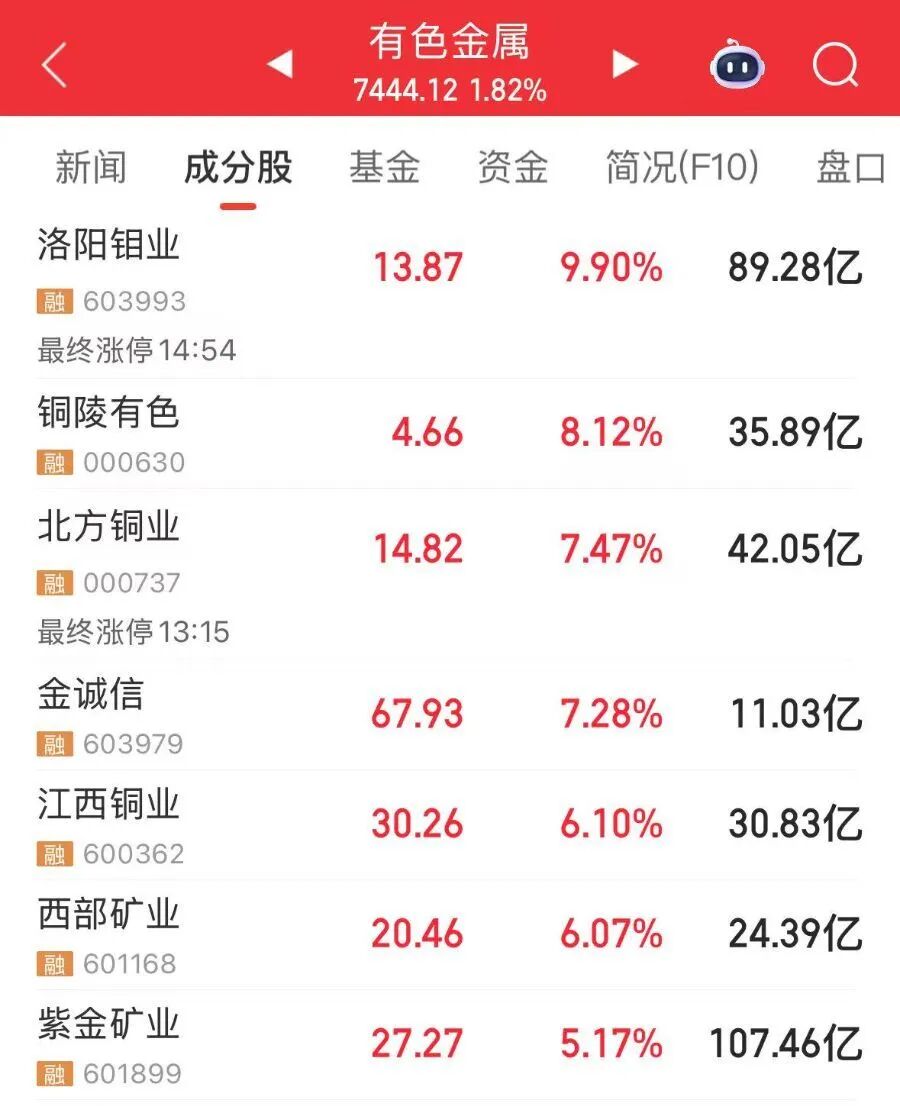
Group 1: Market Performance - The non-ferrous metal sector experienced a significant rise on September 25, with stocks like Jingyi Co., Ltd. (002295) hitting the daily limit, and other copper-related stocks such as Northern Copper Industry (000737) and Luoyang Molybdenum (603993) showing strong gains [1][4] - As of September 24, the Shenwan first-level non-ferrous metal sector had accumulated a remarkable increase of 53.46% year-to-date, with 103 stocks rising over 20%, 59 stocks over 50%, and 10 stocks doubling in value [5] Group 2: Copper Price Dynamics - The copper price surged following a significant incident at Freeport McMoRan's Grasberg mine in Indonesia, which is expected to reduce copper and gold production by 35% in 2026 due to a large-scale wet material outflow [8][10] - On September 24, LME copper reached a peak of $10,364 per ton, the highest level since June 2024, while domestic copper prices approached 83,000 yuan per ton, marking a 15-month high [10] - Analysts predict a long-term positive demand for copper driven by the expansion of new industries, including electric vehicles and robotics, with significant copper consumption in the automotive sector [10][11] Group 3: Company Highlights - Zijin Mining (601899) reached a market capitalization of 732.1 billion yuan, surpassing the $100 billion mark for the first time, ranking third among global mining giants [2] - Other notable performers in the copper sector included Jiangxi Copper (30.26 yuan, +6.10%), Western Mining (20.46 yuan, +6.07%), and China Molybdenum (13.87 yuan, +9.90%) [2]