
能源安全

Search documents
新疆油田勘探开发70周年:立足国家所需 服务能源安全
Ren Min Ri Bao· 2025-10-28 09:09
Core Viewpoint - The Xinjiang Oilfield has developed over 70 years, becoming a crucial contributor to China's energy security, evolving from the first major oil field in the country to a significant player in both oil and gas production [1][2][3][4][5][6] Group 1: Historical Development - The Xinjiang Oilfield was established in 1955 with the discovery of the Karamay No. 1 well, marking the birth of China's first major oil field [2] - By 1960, the oilfield accounted for 39% of the national oil production, significantly supporting the Daqing oil campaign [2] - The oilfield has produced a cumulative total of 180 million tons of crude oil by the end of the 20th century, establishing a complete oil industry system [3] Group 2: Technological Advancements - The introduction of advanced exploration technologies such as digital logging and 3D seismic significantly improved exploration accuracy [3] - Major discoveries include the Cainan Oilfield in 1991 and the Karamay Gas Field in 2008, marking significant milestones in exploration [4] - The development of the "fan-controlled accumulation" theory and associated technologies for the Mahu Oilfield has advanced traditional oil-finding concepts [4][6] Group 3: Production Achievements - The Xinjiang Oilfield became the first in western China to produce over 10 million tons of crude oil annually in 2002, with production reaching 12.47 million tons in 2019 [4] - Cumulative production has reached 470 million tons of crude oil and 112.1 billion cubic meters of natural gas over its 70-year history [6] Group 4: Environmental and Green Initiatives - In 2019, the oilfield closed 284 oil-water wells to restore the ecological environment, reducing crude oil production by 69,000 tons annually [4] - The establishment of a coal-electricity CCUS integrated demonstration project and the launch of a solar thermal replacement project for heavy oil extraction reflect the commitment to green development [6] Group 5: Future Prospects - The Xinjiang Oilfield aims to enhance energy security through high-quality development, with plans to produce 14.86 million tons of crude oil and 4.51 billion cubic meters of natural gas in 2024 [5][6] - The construction of the largest gas storage facility in China, with a working gas volume of 4.5 billion cubic meters, supports energy supply security [6]

印外长苏杰生硬刚美国:25%惩罚性关税不怕,34%俄油进口一分不减
Sou Hu Cai Jing· 2025-10-28 04:20
Core Viewpoint - The article discusses India's firm stance against U.S. pressure regarding oil imports from Russia, highlighting India's strategic economic calculations and diplomatic maneuvers to maintain its energy security and economic interests [2][4][24]. Group 1: India's Energy Economic Calculations - India imports 85% of its crude oil and is the world's third-largest oil consumer, with a daily consumption sufficient to circle Mumbai port multiple times [4][6]. - Since the outbreak of the Russia-Ukraine conflict in 2022, India has increasingly turned to Russian oil, which is priced 10 to 15 USD cheaper per barrel than Middle Eastern oil, allowing India to save over 4 billion USD annually [4][6]. - Russian oil has become India's largest supply source, accounting for 34% of total imports, with 1.6 million barrels supplied daily [6][7]. Group 2: U.S. Miscalculations - The U.S. imposed a 25% tariff on India due to failed trade agreements and later increased tariffs related to Russian energy imports, using the justification that India's purchases exacerbate the Ukraine conflict [9][24]. - India's Foreign Minister highlighted the inconsistency in U.S. policy, questioning why other nations can continue purchasing Russian oil while India is singled out [9][24]. Group 3: India's Dual Response Strategy - India has initiated a "dual response" strategy, seeking new trade agreements to mitigate the impact of U.S. tariffs, such as a free trade agreement with the UK that has led to a 22% increase in exports of textiles and agricultural products [12][24]. - India is also actively collaborating with other nations to expose Western hypocrisy regarding energy needs, gaining support from countries like Brazil and South Africa [14][24]. Group 4: Energy Countermeasures - India is challenging Western energy pricing power by collaborating with Saudi Arabia, the UAE, China, and Russia to develop third-party energy markets in Africa, providing low-cost oil to African nations [18][24]. - The upcoming BRICS "Energy Security Conference" in 2025 aims to unify member countries for joint oil procurement, enhancing India's negotiating power with oil-producing nations [20][24]. Group 5: U.S.-India Relations - The U.S. attempts to rally allies in the Asia-Pacific region to pressure India, but India is pursuing dialogue with China and renewing military cooperation with Russia, emphasizing the importance of partnerships over confrontation [22][24]. - India's actions reflect a calculated approach to safeguard its interests, demonstrating that developing countries' voices and needs should not be overlooked in international relations [24].

立足国家所需 服务能源安全 新疆油田勘探开发70周年
Ren Min Ri Bao· 2025-10-27 22:24
新中国成立初期,石油资源极度匮乏。为甩掉"贫油国"的帽子,1955年,一支由8个民族、36人组成的 1219青年钻井队挺进准噶尔盆地浩瀚戈壁。钻井队克服重重困难,1955年10月29日,克拉玛依一号井喷 出工业油流,宣告了新中国第一个大油田——克拉玛依油田诞生。 从天山北麓的苍茫戈壁,到准噶尔盆地的浩瀚沙海,位于祖国西北的新疆油田已勘探开发70载。从1955 年黑油山脚下克拉玛依一号井喷出工业油流,到成长为今日我国西部地区首个千万吨级大油田,新疆油 田为国家能源安全提供坚实支撑。 服务祖国所需:戈壁荒滩铸起创业丰碑 "到克拉玛依去,为祖国找石油!"成为一代青年的豪迈誓言。万千建设者从四面八方涌来,展开了一场 气壮山河的石油大会战。到1960年,油田产量占当年全国石油产量的39%,并有力支援了1960年大庆石 油会战。新疆油田工作者用"安下心、扎下根,不出油、不死心"的坚定信念,在戈壁滩上建起了克拉玛 依这座石油新城,创造了油田与城市同步发展的模式。 拥抱改革开放:战略接替中的快速成长 改革开放为新疆油田发展注入了新活力。随着国家确立石油工业"稳定东部、发展西部"战略,新疆油田 迎来快速发展。 勘探技术取得显著 ...

制裁中国炼油厂,欧盟强硬施压,俄方承诺全面兜底
Sou Hu Cai Jing· 2025-10-27 19:01
Core Points - The EU's recent sanctions against Chinese energy companies signal a deeper geopolitical conflict, involving both political and economic dimensions [1][3][11] - The sanctions specifically target 12 Chinese and Hong Kong companies, which play a crucial role in the processing and export of Russian oil, indicating a significant impact on Sino-Russian oil trade [3][9] - The EU's strategy includes secondary sanctions aimed at third parties providing services to the targeted companies, reflecting a comprehensive approach to disrupt cross-border supply chains [3][5] Industry Impact - The targeted Chinese companies account for less than 3% of national refining capacity but are vital for importing, processing, and exporting Russian oil, suggesting a short-term disruption in Sino-Russian energy trade [3][9] - The sanctions may lead to increased oil prices, nearing $95 per barrel, which could compress profit margins for industries in Europe and the US due to cost transmission to end consumers [9][11] - The EU's ambition to "de-China" the renewable energy supply chain faces significant challenges, as reliance on China for rare earths and manufacturing remains difficult to replace in the short term [9][13] Geopolitical Context - The sanctions represent a strategic shift where Western powers attempt to intertwine geopolitical and industrial policies, but practical implementation may be hindered by supply chain realities and member state interests [11][13] - Russia's willingness to support China during this period indicates a robust political and economic partnership, with Russian oil exports to sanctioned Chinese firms accounting for over 800 million tons, or 12% of the EU's targeted oil exports [7][11] - The situation is characterized by a complex interplay of interests, where both sides must navigate the costs and benefits of their actions, suggesting a long-term strategic competition rather than a straightforward confrontation [11][15]

AI时代来了,电力成新石油!国外频频缺电,中国电量还扛得住吗?
Sou Hu Cai Jing· 2025-10-27 17:42
Core Insights - The article emphasizes the critical role of electricity in powering artificial intelligence (AI), suggesting that control over stable, cheap, and large-scale electricity supply is essential for technological advancement [1][30] - It highlights a significant shift in global power dynamics, moving from oil to electricity as the defining resource for geopolitical influence [1][28] Electricity Demand and AI Growth - The annual electricity consumption of a large AI data center is equivalent to that of 750,000 households, with global data center electricity use projected to reach 945 terawatt-hours by 2030, comparable to Japan's total annual consumption [3] - In China, the electricity consumption for internet data services surged by 33% year-on-year in the first half of 2025, with AI hubs like Hangzhou experiencing a staggering 237.7% increase [3] Energy Supply Challenges - The increasing demand for electricity due to AI is straining power grids, leading to frequent large-scale blackouts in countries like Spain, Czech Republic, and Brazil, with the U.S. being particularly affected [5] - In Georgia and Virginia, local governments have halted new data center approvals due to grid capacity nearing physical limits, with warnings from the U.S. Department of Energy about a potential doubling of blackout frequency by 2030 [6] Policy Responses and Energy Strategies - The U.S. is shifting towards practical energy solutions, prioritizing natural gas and coal over clean energy goals to meet rising electricity demands, with Georgia's projected demand growth of 16 times over the next seven years [8] - A $92 billion investment plan initiated in early 2025 allocates $15 billion for grid upgrades, with the remainder focused on AI infrastructure and traditional energy expansion [10] Global Energy Dynamics - China is leveraging geopolitical changes to enhance its energy security, increasing electricity imports from Russia significantly post-Ukraine conflict, while also exporting stability through energy projects in countries like Brazil and Thailand [12] - The article notes a structural shift in energy competition, with the U.S. and China adopting different approaches to energy and technology integration, impacting their respective positions in the global AI race [14][21] Future Outlook - The competition for energy resources is expected to intensify, with the next five years being crucial for establishing a stable, clean, and efficient energy-technology system [26] - The article concludes that electricity is becoming the new strategic resource of the 21st century, with implications for everyday life, including potential increases in electricity costs and changes in AI service pricing [28][30]
特朗普又对俄下手,制裁俄60%原油企,中国能源安全咋保障?
Sou Hu Cai Jing· 2025-10-27 03:21
回顾事件的背景,这次美国的行动并非偶然。早在2025年3月,华盛顿就提出了一个"全面无条件停火倡 议",乌克兰表示接受,但俄罗斯却坚决拒绝,并继续在多个地方对乌克兰进行军事打击。 特朗普最近在对俄罗斯的政策上做出了多次调整,令人应接不暇。首先,他拒绝了向乌克兰提供"战 斧"巡航导弹的请求,导致基辅方面极为失望。然而,没过多久,他却转变立场,对俄罗斯的两大能源 公司实施了严厉的制裁。 这次的制裁并非普通的限制措施,而是精准打击——卢克石油和俄罗斯石油这两家公司是俄罗斯原油生 产的核心,合计贡献了约60%的原油产量。此举实际上是从根源上切断了俄罗斯能源出口的"生命线"。 能源是俄罗斯经济的支柱产业,特朗普的这一举动不仅改变了俄乌战争的战略态势,也在全球能源市场 引发了一系列连锁反应,油价波动、交易避险、供应链调整等现象频繁出现。 然而,这一行动也带来了新的问题:俄罗斯是中国的重要能源供应国之一,这次美国的高压制裁将如何 影响中国的能源供应体系?我们又该如何应对这些潜在的风险? 这使得特朗普政府的情绪进一步恶化。虽然特朗普之前多次公开批评普京,但一直未采取实质性的制裁 措施。直到10月23日,制裁正式生效的同时,美 ...

美国成屋销售回暖——全球经济观察第17期【陈兴团队•财通宏观】
陈兴宏观研究· 2025-10-26 01:46
Global Asset Price Performance - Gold prices have decreased, while major global stock markets have shown an upward trend this week. The S&P 500, Dow Jones, and Nasdaq indices increased by 1.9%, 2.2%, and 2.3% respectively [2][3] - In the bond market, yields in major overseas markets mostly rose, with the 10-year U.S. Treasury yield remaining flat compared to last week [2] - Commodity prices have seen an increase, with WTI and Brent crude oil prices rising by 8.4% and 8.1% respectively, while London gold prices fell by 3.2% [2][3] - The U.S. dollar index strengthened by 0.4% [2] Major Central Bank Monetary Policies - September inflation data has reinforced expectations for interest rate cuts, with the U.S. core CPI showing a year-on-year decline [5] - The Federal Reserve is focusing on digital assets and AI payment integration, with a new "streamlined main account" allowing non-bank institutions direct access to the Fed's payment channels [5] - The European Central Bank's President Lagarde highlighted the need for an annual investment of approximately €150 billion to enhance energy security and sustainability in the EU [5] U.S. Economic Dynamics - The U.S. government remains shut down as the Senate has repeatedly rejected temporary funding bills [9] - The core CPI for September has decreased by 0.1 percentage points to 3%, indicating a cooling in inflation [9] - Existing home sales have rebounded by 1.5% month-on-month in September, driven by lower mortgage rates and a slowdown in home price increases [9] Other Regional Economic Dynamics - France's credit rating has been downgraded from "AA-" to "A+" due to high public finance uncertainty [13] - Sanctions against Russia have intensified, with the U.S. and EU implementing new measures targeting Russian oil exports and cryptocurrency platforms [13] - Japan's new Prime Minister aims to maintain monetary easing and implement large-scale economic stimulus plans [14] Key Focus for Next Week - Upcoming data releases include U.S. housing price indices and Eurozone GDP figures, along with central bank meetings from the Federal Reserve and the European Central Bank [21][22]

重庆地下喷涌亿吨页岩油!中国能源安全再添底气
Sou Hu Cai Jing· 2025-10-25 22:30
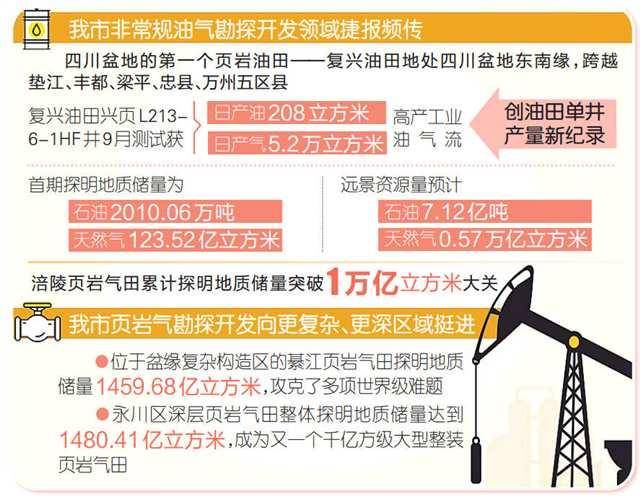
Core Insights - The discovery of high-yield industrial oil and gas flow at the Qilu Yey 1 well in the Qijiang area of the Sichuan Basin marks a significant advancement in China's energy sector, with daily production of 38.64 cubic meters of shale oil and 10,000 cubic meters of natural gas, indicating a total shale oil resource potential of over 100 million tons [1][3][5] Exploration and Development - The successful breakthrough at Qilu Yey 1 well reveals a unique "gas below, oil above" energy storage pattern, complementing the previously discovered large-scale Qijiang shale gas field [3][5] - The well has confirmed a resource target exceeding 100 million tons of shale oil, representing a strategic shift in oil and gas exploration from marine to terrestrial environments in southern Sichuan [5][11] - The drilling team utilized advanced technologies such as "sweet spot" prediction and volume fracturing, achieving a 100% success rate in identifying productive zones [8][10] Production Growth - The annual shale oil production at Changqing Oilfield in the Ordos Basin has surged from less than 500,000 tons in 2020 to 3 million tons currently, establishing it as a key base for shale oil development in China [3][11] - China Petroleum & Chemical Corporation (Sinopec) aims for a shale oil production target of 705,000 tons in 2024, reflecting an increase of 308,000 tons from the previous year [13] Strategic Importance - Shale oil is recognized as a crucial unconventional oil resource with significant development potential, serving as an important substitute for long-term crude oil production stability in China [11][21] - The global perspective indicates that the world's shale oil resources are abundant, with proven reserves far exceeding conventional oil reserves [15] Future Development Path - The discovery of large-scale shale oil resources necessitates a focus on efficient development and green transformation, as exemplified by Changqing Oilfield's integrated approach to "oil and gas + new energy + ecological protection" [15][17] - Initiatives such as the establishment of a 100 MW solar power generation base and the implementation of carbon capture, utilization, and storage (CCUS) technologies are part of the transition towards a comprehensive energy company [17][20] - The successful development of shale oil in China is expected to enhance energy security, drawing parallels with the U.S. shale oil revolution that achieved energy independence [21]

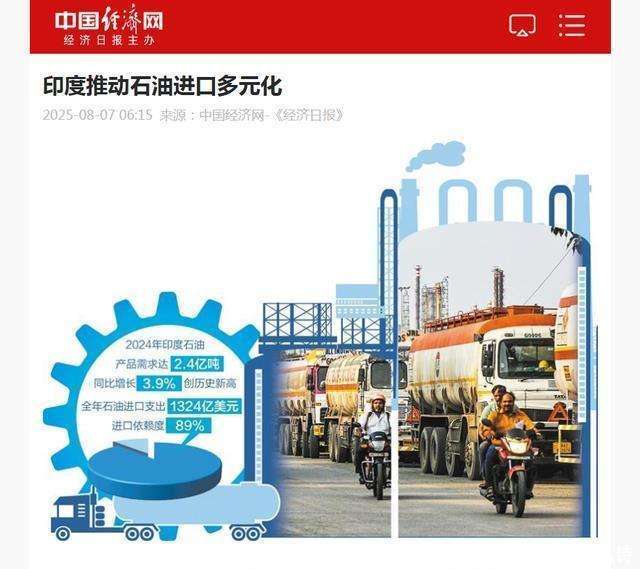
前沿观察 | 印度弃购俄罗斯石油?野村:美国可降关税来抵消其影响
Sou Hu Cai Jing· 2025-10-25 14:00
Core Viewpoint - India is reducing its imports of discounted Russian crude oil, and a potential reduction in U.S. tariffs could significantly offset the impact of this decision [3] Group 1: Trade Relations and Tariffs - Nomura Holdings suggests that if the U.S. lowers tariffs, it could help restore India's competitiveness in labor-intensive exports [3] - Economists predict that the punitive 25% tariff on Russian oil imports may be lifted after November, while a reciprocal 25% tariff will remain until the end of the fiscal year in March [3] Group 2: Oil Import Dynamics - India has imported approximately 1.8 million barrels of crude oil per day from Russia this year, accounting for 36% of its total crude imports [4] - Major Indian refiners have indicated that their imports of Russian oil will drop to nearly zero due to U.S. sanctions on Russian oil companies [3][4] Group 3: Economic Impact - The direct impact of India's reduced Russian oil imports is estimated to account for about 0.04% of its GDP [3] - The Reserve Bank of India estimates that a 10% increase in oil import costs could raise inflation by approximately 30 basis points and reduce economic growth by about 15 basis points [4]

AI时代如何保障能源安全,这份报告给出建议
Di Yi Cai Jing· 2025-10-25 05:14
Core Insights - China's energy security is undergoing a profound transformation from "risk prevention" to "strong systems" in response to the restructuring of the global energy landscape and the rapid rise in energy demand from emerging fields like artificial intelligence [1][2] Group 1: Energy Security Transformation - The report indicates that by 2035, China aims to establish a modern energy security framework characterized by safety, greenness, efficiency, intelligence, and openness [1] - The systematic construction of institutional, technological, and market frameworks during the "14th Five-Year Plan" period is expected to lead to fundamental improvements in the energy system's structure, resilience, governance modernization, and international competitiveness [1] Group 2: External and Internal Challenges - China faces internal challenges such as resource endowment constraints (rich in coal but poor in oil and gas), regional supply-demand mismatches, and an underdeveloped electricity market [2] - External challenges include fragmented energy trade, reshaped green rules, differentiated carbon pricing systems, and intensified great power competition [2] Group 3: Impact of Artificial Intelligence - The most significant new variable on the demand side is artificial intelligence, with power consumption related to AI expected to increase by 33%-50% for every doubling of computing power [2] - The ongoing "East Data West Computing" project and accelerated deployment of computing infrastructure are driving rapid growth in energy demand from AI-related facilities, posing new challenges for regional load distribution, system scheduling, and power security [2] Group 4: Recommendations for Energy System - The report suggests systematically incorporating the potential energy consumption growth from AI-related industries into national energy planning [2] - It emphasizes the need for institutional innovation, market mechanism reform, and systematic governance to achieve an integrated layout of "source-network-load-storage-computing" [2] Group 5: Market Reforms and Financial Support - Market-oriented reforms are identified as the core approach to enhance the efficiency and resilience of the energy system, advocating for the establishment of a unified national electricity market system [3] - The report calls for a shift from subsidy-driven to value-driven frameworks, proposing the establishment of a green tax system and carbon tax pilot programs to incentivize investments in energy storage, hydrogen energy, carbon capture, and energy efficiency [3]