
人民币升值

Search documents
圣诞美欧韩股休市,离岸人民币破7,黄金失守4500美元,白银高位震荡
Sou Hu Cai Jing· 2025-12-25 11:07
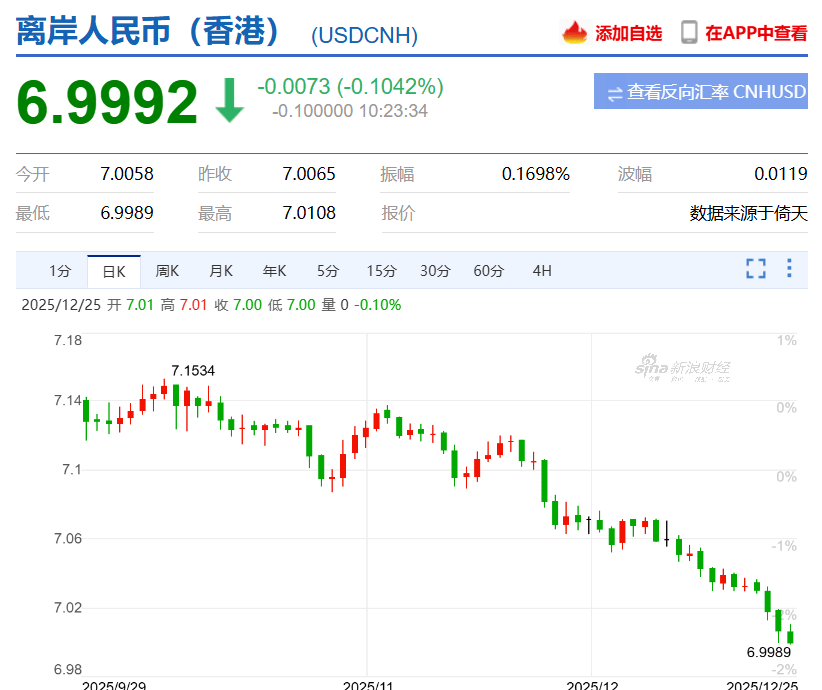
Market Overview - The Christmas holiday has led to a one-day closure of U.S. stock and bond markets, with major European stock markets also closed [1] - Asian stock indices showed mixed results, with the Nikkei 225 index rising by 0.13% to 50,407.79 points [1] - The offshore RMB broke the 7.0 mark against the USD for the first time since September 2024, indicating a strengthening of the Chinese currency [1][2] Currency Movements - The Japanese yen rebounded to around 155.8, supported by comments from the Bank of Japan's governor regarding approaching the 2% inflation target [1][5] - The offshore RMB's appreciation is attributed to increased market capital inflows and demand for currency settlement, driven by expectations of a shift towards a more accommodative U.S. monetary policy [2] Bond Market - The yield on Japan's 2-year government bonds rose to 1.125%, marking a new high since 1996, due to weak demand in recent auctions [1][8] Precious Metals - Gold prices fell below $4,500 per ounce after reaching a historical high of $4,525.18, with analysts remaining optimistic about future price targets [1][11] - Silver maintained a strong performance, fluctuating around $71.80 per ounce after hitting a historical high of $72.70, with a year-to-date increase of 149% [1][14]

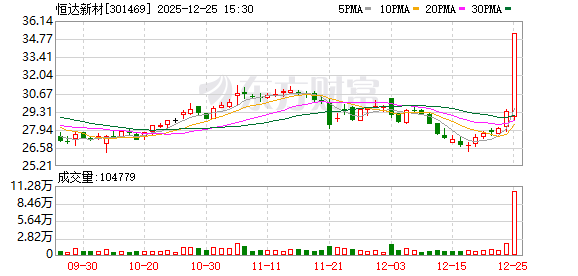
造纸板块大爆发,恒达新材20cm涨停
2 1 Shi Ji Jing Ji Bao Dao· 2025-12-25 10:42
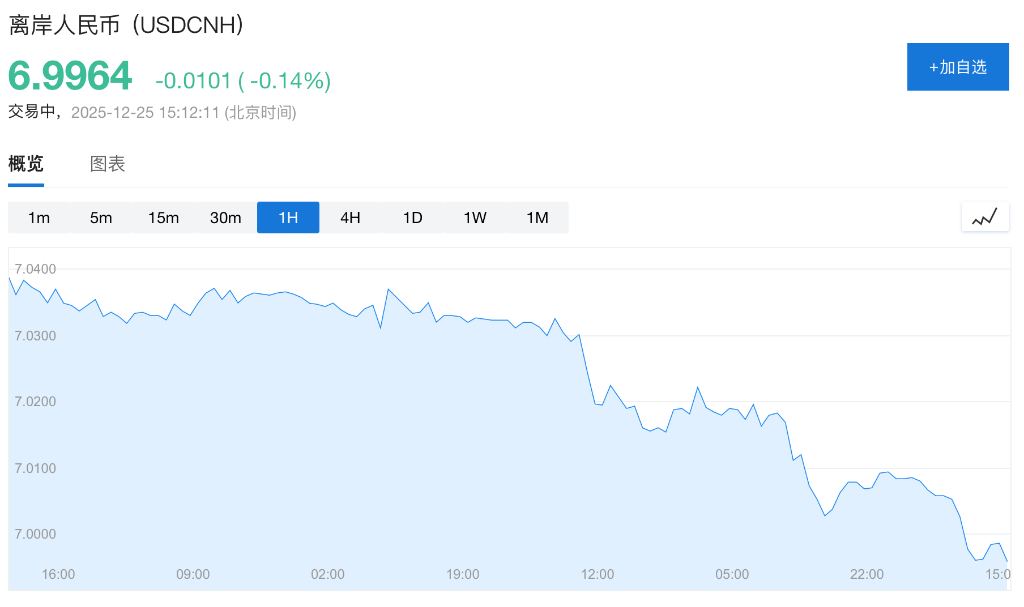
Group 1 - The A-share market saw all three major indices rise collectively on December 25, with the paper industry experiencing significant gains, highlighted by stocks such as Hengda New Materials and Bohui Paper reaching their daily limit up [2] - The offshore RMB broke the 7.0 mark against the US dollar for the first time in 2024, peaking at 6.9962, which enhances purchasing power and reduces procurement costs for dollar-denominated raw materials in the paper industry [2] - Daitong Securities believes the paper industry is benefiting from a combination of "supply optimization, cost support, and policy protection," with a mild recovery in demand and resilient packaging paper demand [2] Group 2 - The supply side is improving due to production cuts and the winding down of capacity, which enhances the supply-demand balance in the paper industry [2] - The cost side is supported by rising pulp prices, which stabilize product pricing and enhance the profitability of integrated pulp and paper companies [2] - The valuation of the paper sector is at historical lows, and with expectations of industry recovery by 2026, the investment value is becoming more prominent [2]




龙虎榜复盘丨航天持续大涨,造纸板块迎集体反弹
Xuan Gu Bao· 2025-12-25 10:25
Group 1 - Institutions ranked 35 stocks today, with net purchases in 16 stocks and net sales in 19 stocks. The top three stocks with the highest net purchases were Hainan Development (289 million), Western Materials (244 million), and Chaojie Co., Ltd. (226 million) [1] - Chaojie Co., Ltd. saw a net purchase of 226 million from four institutions on the 3rd. The company is actively expanding its customer base in the commercial aerospace sector and has made substantial progress in acquiring new customer orders, expecting to enter into batch cooperation with new clients starting in Q1 next year [2] - The company holds an 8.3% stake in Blue Arrow Aerospace, which successfully conducted its first flight test of the Zhuque-3 rocket in December [3] Group 2 - The onshore RMB against the USD broke the 7.01 mark, reaching a new high since September 27, 2024. The offshore RMB also surpassed 7.0 for the first time since the end of September 2024. This appreciation of the RMB is expected to alleviate the procurement cost pressures for industries with high import dependence, such as aviation and paper manufacturing, while also potentially enhancing profit elasticity due to foreign exchange gains [4] - Wuzhou Special Paper focuses on producing specialty paper for medical and food packaging [5]
人民币破"7"风暴席卷外贸圈!
Sou Hu Cai Jing· 2025-12-25 10:00
12月24日晚间至25日清晨,离岸人民币兑美元汇率两度突破7.0心理关口,在岸人民币也逼近这一关键点位,引发市场强烈关注。这场岁末年初的 汇率"升值风暴"正在深刻影响着外贸企业的经营决策。 • 内在支撑:中国经济展现强大韧性与投资吸引力 值得注意的是,年末特有的"结汇潮"效应进一步推高了人民币汇率。东方金诚首席宏观分析师王青表示:"随着春节临近,企业结汇需求集中释 放,形成季节性升值压力。而持续走强的汇率又加速了前期积压结汇需求的出清。"历史数据印证,春节前银行代客结售汇顺差通常达到年度峰 值。 展望后市,多数机构持乐观态度: → 短期:可能出现技术性波动 → 中长期:升值趋势明确,或将步入"6时代" "现在货款一到账就立即结汇,大额订单更是分秒必争。"浙江外贸商丁先生坦言,近期人民币的持续升值迫使他们改变了以往的操作习惯。上周 一笔结汇业务就因汇率波动直接损失数万元利润,"每笔账算下来都让人心疼不已"。厦门外贸经理刘女士也证实,其公司已采取"即到即结"的应 对策略。 市场分析指出,本轮人民币升值呈现"内外双驱动"特征: • 外部因素:美元指数持续走弱创造有利环境 德意志银行预测: 2026年底:人民币兑美元 ...
人民币连涨14个月!出口商亏掉数万利润,老百姓却意外享福利
Sou Hu Cai Jing· 2025-12-25 09:49
Group 1 - The recent appreciation of the Renminbi (RMB) against the US dollar has reached a 14-month high, with offshore RMB surpassing 7.02 and onshore RMB exceeding 7.03 [1][3] - The appreciation is driven by two main factors: external environmental changes and seasonal domestic demand, which have combined to initiate a sustained upward trend in the RMB [4][8] - The weakening of the US dollar, particularly after the Federal Reserve announced interest rate cuts, has diminished the dollar's attractiveness, leading to a relative appreciation of other currencies, including the RMB [6][8] Group 2 - The year-end demand for currency exchange has significantly contributed to the RMB's appreciation, as many companies need to convert USD to RMB for year-end payments [8][10] - The issuance of RMB-denominated bonds by foreign entities, such as Kazakhstan and Indonesia, indicates increasing international recognition of the RMB, supporting its long-term appreciation [12][14] - The RMB's appreciation has mixed effects: export companies face profit pressures, while import companies and consumers benefit from lower costs for foreign goods [16][22] Group 3 - Export companies are struggling with the rapid appreciation, as their USD-denominated orders yield less RMB upon conversion, impacting their profit margins [18][20] - In contrast, import companies and consumers enjoy lower prices for imported goods, making travel and overseas education more affordable [24][26] - The RMB's appreciation can help stabilize domestic prices and align with national strategies to boost consumption and economic growth [26][40] Group 4 - Market consensus suggests that the RMB will maintain a strong position in the short term, influenced by the ongoing weakness of the US dollar and year-end exchange demands [29][31] - The central bank is actively managing the exchange rate to prevent excessive volatility, making it challenging for the RMB to break through the 7.0 mark [31][33] - Companies are encouraged to adapt to these changes by utilizing hedging tools to mitigate risks associated with currency fluctuations [35][37] Group 5 - The ongoing appreciation of the RMB reflects broader trends in the global financial market and the internationalization of the currency [38][41] - Companies are advised to enhance their risk management capabilities and core competitiveness in response to currency fluctuations [40][41]

快评年末人民币强势“破7”:南华人民币汇率热点
Nan Hua Qi Huo· 2025-12-25 09:36
Group 1: Report Industry Investment Rating - Not provided Group 2: Core Viewpoints of the Report - The RMB showed a significant strong performance against the US dollar at the end of 2025, with the offshore RMB exchange rate breaking through the key psychological level of 7.00, indicating a re - emergence of strong appreciation momentum [2]. - The appreciation of the RMB at the end of 2025 is driven by the resonance of internal and external factors, including the weakening of the US dollar index, the narrowing of the Sino - US interest rate spread, and the concentrated release of seasonal year - end settlement demand [5][6]. - Although there are expectations for the RMB to appreciate and break through 7 and enter the 6 range in 2026, there are also potential risks such as geopolitical black - swan events, the domestic economic recovery falling short of expectations, and central bank foreign exchange policy adjustments [13]. Group 3: Summary by Relevant Catalogs I. RMB's Strong Year - End Performance: Symbolic "Breaking 7" and Its Market Characteristics - **Offshore RMB "Breaking 7": The First Time Since September 2024** - At the end of 2025, the offshore RMB exchange rate broke through 7.00 during intraday trading on December 25, the first time since September 2024, attracting high market attention and indicating enhanced market confidence in the RMB [2]. - **Market Volatility Characteristics: Strong but Low - Volatility, Contrasting with the September 2024 Market** - The implied volatility of the RMB is at a historically low level, indicating a more rational and orderly appreciation process and providing a stable foreign - exchange environment for enterprises and investors [2]. - The RMB's strong performance at the end of 2025 is fundamentally different from the 2024 market fluctuations. The latter was driven by the global yen carry - trade unwind, while the former is based on the resonance of internal and external supply - demand factors [2][5]. II. Driving Forces for RMB Appreciation: Resonance of Internal and External Factors - **External Factors: Weakening US Dollar Index and Narrowing Sino - US Interest Rate Spread** - The Fed's interest - rate cuts led to the downward trend of the US dollar index, narrowing the Sino - US interest rate spread and providing an external environment for the RMB's appreciation [6]. - The seasonal contraction of market liquidity during the Christmas holiday exacerbated the weakness of the US dollar, contributing to the year - end situation of a weak US dollar and a strong RMB [6]. - The market is generally pessimistic about the US dollar's trend in 2026, and the divergence in the Fed's expected interest - rate cuts, the change of the Fed chairman, and the "de - dollarization" trend all add uncertainty to the long - term prospects of the US dollar [7]. - **Internal Factors: Concentrated Release of Seasonal Year - End Settlement Demand** - The concentrated settlement of foreign - trade enterprises at the end of the year is a more direct and strong driving force for the RMB's appreciation, as evidenced by the fact that the RMB's appreciation amplitude is greater than the US dollar index's depreciation amplitude [8]. - China has maintained a trade surplus for seven consecutive months, and there is still a large amount of pending settlement funds being digested, which supports the RMB's appreciation [8]. III. A Cold - Blooded Reflection under the Market's Optimistic Expectations: Appreciation Space and Potential Risks - **Appreciation Space** - Huang Qifan's view that the RMB will appreciate to 6.0 in the next ten years is based on rational deductions of China's economic fundamentals, trade - structure optimization, and RMB internationalization [9]. - The RMB's actual effective exchange rate shows significant appreciation potential, as the gap between the nominal and real effective exchange rates indicates that the RMB's real purchasing power is undervalued [10]. - The narrowing Sino - US interest rate spread, the central bank's monetary - policy stance, and the increasing attractiveness of the A - share market are all factors that support the RMB's appreciation [11][12]. - **Potential Risks** - Geopolitical black - swan events, the domestic economic recovery falling short of expectations, and central bank foreign - exchange policy adjustments are potential risks for the RMB's appreciation [13].
人民币升值将对资本市场形成积极影响
Sou Hu Cai Jing· 2025-12-25 09:00
the the state of the AND STORE THE and and the company e No t 2017-01-11 the state of the ME Spec 人民币升值对资本市场的积极影响并非单一维度,而是通过估值提振、资金流入、信心修复形成三重赋能,覆盖A股、债市、港股等多个领域,且具备明确 的数据支撑与逻辑传导路径。 第一重赋能是估值修复效应。国际投行高盛的复盘研究显示,汇率上涨0.1个百分点,股票估值可提升3%—5%。这一逻辑在人民币升值周期中同样适用:随 着人民币兑美元走强,以人民币计价的资产相对美元资产的估值吸引力同步提升,尤其是外资偏好的消费白马、成长股等板块,有望迎来估值重塑。中金公 司在研报中指出,人民币突破7.0关键关口的客观变化,可能引发短期市场叙事共振,从交易层面提振预期,类似7—9月的资金入市叙事,对受情绪影响较 大的成长板块形成利好。 2025年12月25日,人民币汇率迎来标志性突破:截至当日10:40左右,离岸人民币兑美元升破7.0大关,最高触及6.9985,为2024年以来首次;在岸人民币同 步升破7.01关口,创下2024年9月27日以来新 ...
人民币大涨:对你我有何影响?
Xin Lang Cai Jing· 2025-12-25 08:16
来源:郑经 简单说,美元最近像是个过气的明星,有点黯淡。 今年美联储降了三次息,美元指数跌破了90,年内 跌了超过8%。大家对他的热情,肉眼可见地降 温。 1. 经济基本盘在好转:咱们前三季度GDP增速稳在 5%以上,出口连续正增长,尤其像新能源汽车、 锂电池这些"新东西"出口很猛。这是支撑汇率的 底气。 2. 年底"结汇潮"汹涌:每年四季度,外贸企业都 要把赚的美元换成人民币(结汇)。今年大家预期 人民币升值,更急着换,形成"越涨越换,越换越 涨"的循环。市场里等着换回人民币的美元,是个 不小的数字。 3. 中美经济周期"错位"了:用个简单比喻,美国 经济在"踩刹车",而我们在艰难"爬坡过 坎"后,开始"轻踩油门"了。一边在挤泡沫,另 一边在攒后劲。货币强弱,说到底就是国力强弱的 镜子。 为啥会这样? 几个原因: 1. 美国经济有点"虚":最直观的是就业,失业率 升到了4.6%,新增就业人数断崖式下跌。这说明企 业收缩,消费乏力,经济在减速。 2. 政治开始"指挥"央行:特朗普放话要找个听话 的美联储主席。一旦央行失去独立性,印钞就变成 了政治工具,大家对美元的信任自然会打折扣。一 个信用基石松动了的货币, ...
人民币汇率“破7”,你的钱袋子将受影响?这几类人赚了!
Sou Hu Cai Jing· 2025-12-25 08:02
Group 1 - The offshore RMB has recently surpassed the 7.0 mark against the USD, indicating a significant shift in the financial market that affects various sectors and individual consumers [1][3] - The appreciation of the RMB is driven by three main forces: a weakening USD, increased demand for RMB from domestic companies converting foreign earnings, and inflows from international investors seeking undervalued assets in China's stock and bond markets [1][2] Group 2 - Industries benefiting from the RMB appreciation include those that import goods, such as airlines, which will see reduced costs for their USD-denominated debts, leading to increased profits [4] - Other sectors like paper, chemicals, and non-ferrous metals will also benefit from lower import costs due to the stronger RMB, enhancing their profit margins [4] - Core Chinese assets are being revalued positively as foreign investors are attracted to stable blue-chip stocks and leading companies in the financial and consumer sectors [4] Group 3 - Conversely, export-oriented industries, such as home appliances, clothing, and machinery manufacturers, face challenges as their products become more expensive in USD terms, potentially leading to reduced orders and profit compression [5] - The stock market is reacting to these concerns, with companies heavily reliant on exports already showing signs of pressure in their stock prices [5] Group 4 - The RMB's appreciation has implications for consumers, such as lower costs for overseas education, travel, and online shopping, making it a favorable time for currency exchange [6][8] - Investors are advised to reassess their portfolios, focusing on sectors that benefit from the RMB's strength while avoiding those that are negatively impacted by the currency's appreciation [9]
杨德龙:人民币兑美元汇率破7标志着人民币升值趋势确立 利好人民币资产价值重估
Xin Lang Cai Jing· 2025-12-25 07:47
Core Viewpoint - The article discusses the formation of MACD golden cross signals, indicating a positive trend in certain stocks, suggesting potential investment opportunities in those equities [1]. Group 1 - The MACD golden cross signal is a technical indicator that suggests a bullish trend in the stock market [1]. - The article highlights that stocks showing this signal have experienced notable upward momentum [1].