
美国通胀

Search documents
关税影响温和——7月美国通胀数据解读【陈兴团队•财通宏观】
陈兴宏观研究· 2025-08-13 01:40
Inflation Overview - The July CPI year-on-year growth rate remained stable at 2.7%, with a slight month-on-month deceleration to 0.2% [2][10] - Core CPI year-on-year growth increased to 3.1%, while core services remained unchanged [4][10] Energy and Food Prices - Energy inflation decreased, with the CPI energy component showing a year-on-year decline of -1.6%, and gasoline prices dropping by 9.5% [6] - Food prices also saw a cooling effect, contributing to the overall inflation dynamics [10] Service Sector Dynamics - Core services year-on-year growth was stable at 3.6%, but month-on-month growth rose to 0.4%, driven by increases in medical and transportation services [7] - Housing inflation remained steady, with owner-equivalent rent slightly decreasing to 4.1% [7] Impact of Tariffs - Tariffs had a mild impact on commodity prices, with core commodity year-on-year growth rising to 1.2% [9] - The prices of used cars surged by 4.8%, influenced by tariffs, although a potential decline in used car prices is expected in the coming months [9] Market Reactions and Interest Rate Expectations - Following the inflation data release, U.S. stock indices rose, bond yields fell, and the dollar index decreased, leading to a 94% probability of a rate cut by the Federal Reserve in September [10] - The average expected rate cuts for the year are approximately 2.4 times [10] Consumer Inflation Expectations - The one-year inflation expectation among consumers dropped to 4.5%, while the five-year expectation fell to 3.4%, indicating a decline in inflation concerns [12]


张尧浠:9月超幅降息预期升温、金价多头蓄力等待蠢蠢欲动
Sou Hu Cai Jing· 2025-08-13 01:23
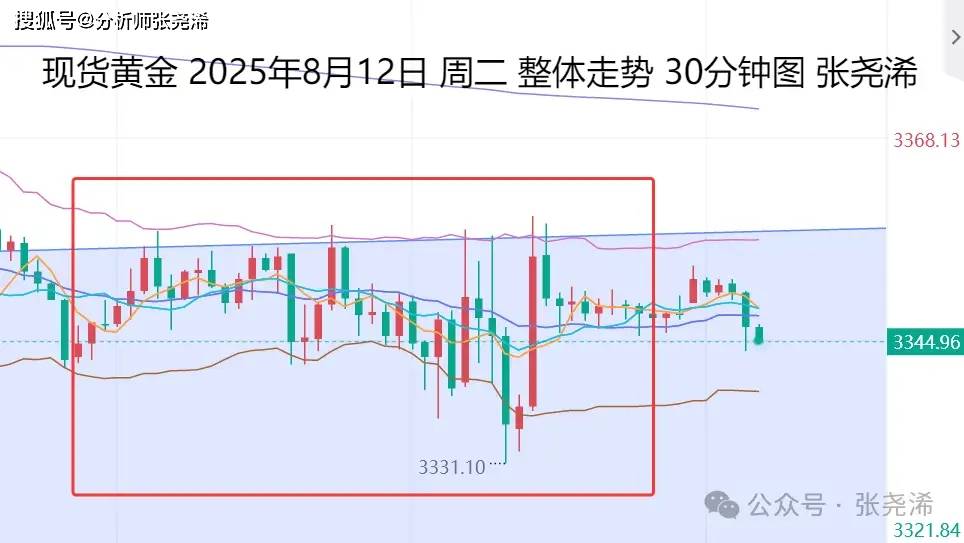
Core Viewpoint - The expectation for a significant interest rate cut in September has increased, leading to bullish sentiment in gold prices as market participants await potential upward movements [1][7]. Market Performance - On August 12, international gold prices fluctuated, opening at $3342.73 per ounce, reaching a low of $3331.22 and a high of $3358.67, ultimately closing at $3347.97, with a daily range of $27.45 and a gain of $5.24, or 0.16% [3][5]. - The market is currently in a consolidation phase, with gold prices expected to remain volatile but with a potential upward trend if certain resistance levels are breached [6][11]. Economic Indicators - U.S. inflation data for July showed only a moderate increase, which supports the possibility of the Federal Reserve cutting interest rates next month [3][7]. - The total U.S. debt has surpassed $37 trillion, raising concerns about fiscal sustainability and prompting expectations for a more dovish monetary policy from the Federal Reserve [7]. Technical Analysis - Gold prices are currently facing resistance around $3360 to $3370, with support levels identified at $3337 and $3325 [12]. - The daily chart indicates a potential bullish reversal if gold can close above the 5-day moving average, while a failure to do so may lead to further declines towards the 100-day moving average [11][9]. Future Outlook - The market anticipates that the Federal Reserve will enter a more accommodative monetary policy cycle starting in September, which could lead to significant increases in gold prices, potentially reaching $4200 within the next year [7][9].
日股再创纪录新高,日经225指数首破43,000点
Sou Hu Cai Jing· 2025-08-13 00:33
Core Viewpoint - US inflation is lower than expected, maintaining market expectations for a Federal Reserve interest rate cut, while Japanese stock markets follow the rise of US stocks [1] Group 1: Market Performance - The Nikkei 225 index rose by 1.2% in the first few minutes of trading, surpassing the 43,000-point mark for the first time in history, reaching a high of 43,241.27 points [1] - The Topix index also hit a record high, with an intraday increase of 0.8%, reaching 3,092.05 points [1] Group 2: Sector Performance - Electronic and automotive stocks led the gains, with Advantest increasing by 3.5% and Subaru rising by 2.2% [1] Group 3: Investor Sentiment - Investors are closely monitoring US tariff news and domestic political developments [1]
华泰证券:维持美联储9月首次降息、年内降息2次的判断
Zheng Quan Shi Bao Wang· 2025-08-13 00:29
Core Viewpoint - Huatai Securities maintains the judgment that the Federal Reserve will implement its first interest rate cut in September and will lower rates twice within the year [1] Inflation and Tariffs - July inflation data in the U.S. indicates that the transmission of tariffs to inflation is relatively mild [1] - Research by Cavallo et al. shows that after tariffs are announced, the maximum increase in commodity prices occurs within 10-15 weeks (3-4 months) [1] - Due to weak perceived demand, companies only pass on 50-60% of the tariff pressure to consumers, preventing a larger increase in inflation [1] Future Outlook - With an expected increase in tariffs in August, core inflation may continue to rise moderately [1] - Weak corporate demand and a weakening labor market will constrain the extent of inflation increases [1] - The slowdown in demand and accelerated deportation of illegal immigrants suggest that the labor market will continue to face pressure in the third quarter [1]

中信证券:预计美联储年内将连续降息三次
Zheng Quan Shi Bao Wang· 2025-08-13 00:25
Core Viewpoint - The report from CITIC Securities indicates that the U.S. inflation in July was largely in line with expectations, with tariffs continuing to moderately push prices up, although at a slower pace compared to the previous month [1] Group 1: Inflation and Tariffs - Tariffs are expected to have a prolonged but milder impact on prices due to a slower transfer of costs from businesses to consumers [1] - The rebound in service inflation does not show significant signs of a slowdown in service consumption demand [1] Group 2: Economic Outlook - CITIC Securities forecasts that the Federal Reserve will implement three consecutive rate cuts within the year, each by 25 basis points [1] - The increase in rental vacancy rates and a slowdown in labor demand suggest a more stable outlook for service inflation [1]

中信证券:预计美联储年内将连续降息三次,每次25bps
Sou Hu Cai Jing· 2025-08-13 00:21
Core Viewpoint - The report from CITIC Securities indicates that U.S. inflation in July was largely in line with expectations, with tariffs continuing to moderately push up prices, although at a slightly slower pace compared to the previous month [1] Group 1: Inflation and Tariffs - Tariffs are expected to have a more gradual and prolonged impact on prices, as the ability of companies to pass on tariff costs to consumers remains intact [1] - The rebound in service inflation does not show significant signs of a slowdown in service consumption demand [1] Group 2: Economic Outlook - The increase in rental vacancy rates and a slowdown in labor demand suggest a more stable outlook for service inflation [1] - The expectation is for the Federal Reserve to implement three rate cuts within the year, each by 25 basis points [1]
中信证券:预计美联储年内将连续降息三次 每次25bps
Xin Lang Cai Jing· 2025-08-13 00:20
Core Viewpoint - The report from CITIC Securities indicates that U.S. inflation in July was largely in line with expectations, with tariffs continuing to moderately push up prices, although at a slightly slower pace compared to the previous month [1] Group 1: Inflation and Tariffs - Tariffs are expected to have a more moderate and prolonged impact on prices due to a slower pass-through to consumers [1] - The rebound in service inflation does not show significant signs of a slowdown in service consumption demand [1] Group 2: Economic Outlook - The increase in rental vacancy rates and a slowdown in labor demand suggest a more stable outlook for service inflation [1] - The company now anticipates that the Federal Reserve will implement three rate cuts within the year, each by 25 basis points [1]
华泰证券:维持联储9月首次降息、年内2次降息的判断
Mei Ri Jing Ji Xin Wen· 2025-08-13 00:11
Group 1 - The core viewpoint of the report indicates that the transmission of tariffs to inflation in the U.S. is relatively mild, which reduces the constraints on the Federal Reserve's interest rate cuts [1] - The report maintains the prediction of the Federal Reserve's first interest rate cut in September and two cuts within the year [1] - Research by Cavallo et al. (2025) shows that after the announcement of tariffs, the maximum increase in commodity prices occurs within 10-15 weeks, indicating a rapid transmission of tariffs [1] Group 2 - Despite the rapid transmission of tariffs, companies are only passing on 50-60% of the tariff pressure to consumers due to weak perceived demand, which prevents a larger increase in inflation [1] - Looking ahead, the report anticipates that the rise in tariffs in August may continue to moderately push up core inflation, but weak corporate demand and a weakening job market will limit the extent of inflation increases [1] - The report highlights that demand slowdown and accelerated deportation of illegal immigrants indicate that the job market will continue to face pressure in the third quarter [1]
中金:美国核心通胀反弹或加剧美联储内部分歧
智通财经网· 2025-08-13 00:11
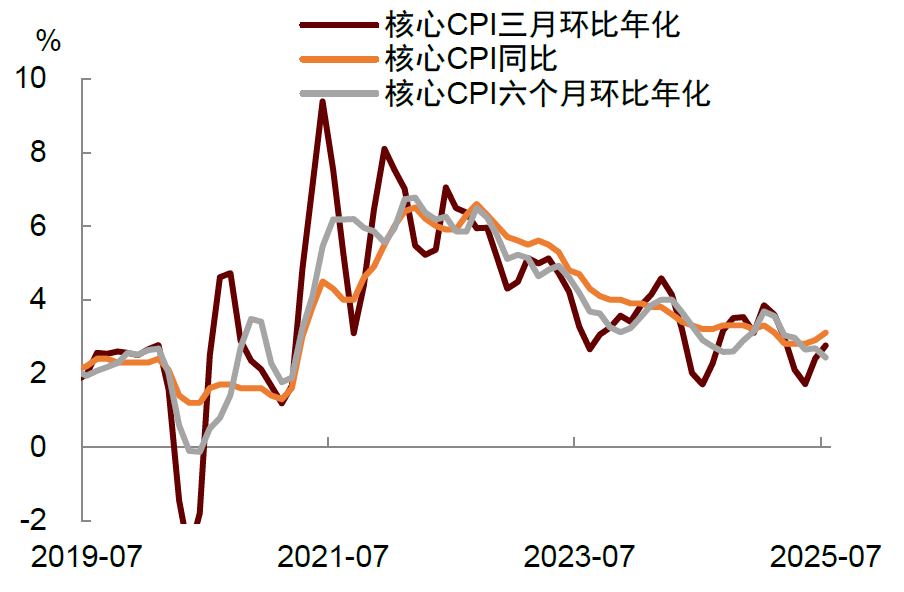
中金公司发布研究报告称,美国7月核心CPI季调环比上涨0.3%,同比由2.9%反弹至3.1%,高于市场预期;整体CPI环比上涨0.2%,同比维持在2.7%,略 低于预期。从分项来看,7月通胀呈现商品温和,服务反弹的特征:关税成本仍在向零售端传导,但也有部分价格出现回落。一些此前下跌的服务价格转 为上涨,增加了通胀的粘性。维持此前判断,美国通胀将进入一轮结构性上行阶段。对美联储而言,核心CPI并未朝着2%目标收敛,而是重回3%以上, 与目标越来越远。这可能加大美联储内部分歧,使其难以就政策决议形成共识。货币政策路径的变数将大大提升,市场波动将加剧。 7月通胀呈现商品温和,服务反弹的特征。商品方面,关税成本仍在向消费者传导,但也有部分价格出现回落。核心商品价格指数季调环比增长0.2%,增 幅与上月持平。其中,家具床具(环比+0.9%)、窗帘(+1.2%)、音视频设备(+0.8%)、摄影设备(+2.1%)仍然保持较高增速,显示关税成本持续传导。但也有 部分此前涨势较猛的项目在7月环比走弱,比如家电(-2.2%)、男装(-1.3%)、非处方药品(-0.5%)、电脑(-2.6%)等。 此前一直没有涨价的汽车价格在7月出 ...
华泰证券:维持美联储9月首次降息、年内2次降息的判断
Sou Hu Cai Jing· 2025-08-13 00:09
Core Viewpoint - The report from Huatai Securities indicates that the impact of tariffs on inflation in the U.S. is relatively mild, with companies passing on only 50-60% of tariff pressures to consumers, thus preventing a larger increase in inflation [1] Inflation and Tariffs - U.S. inflation data for July shows that the transmission of tariffs to inflation is moderate, with the maximum price increase occurring 10-15 weeks after the announcement of tariffs [1] - The report suggests that while tariffs may continue to gently push up core inflation due to an increase in tariffs in August, weak corporate demand and a weakening job market will limit the extent of inflationary pressure [1] Employment Market and Economic Outlook - The demand slowdown and accelerated efforts to deport illegal immigrants indicate that the job market will continue to face pressure in the third quarter [1] - The company maintains its forecast for a rate cut in September and two rate cuts within the year, reflecting the anticipated economic conditions [1]