美联储货币政策

Search documents
美国11月PPI意外升温 支撑美联储“按兵不动”计划
智通财经网· 2026-01-14 14:29
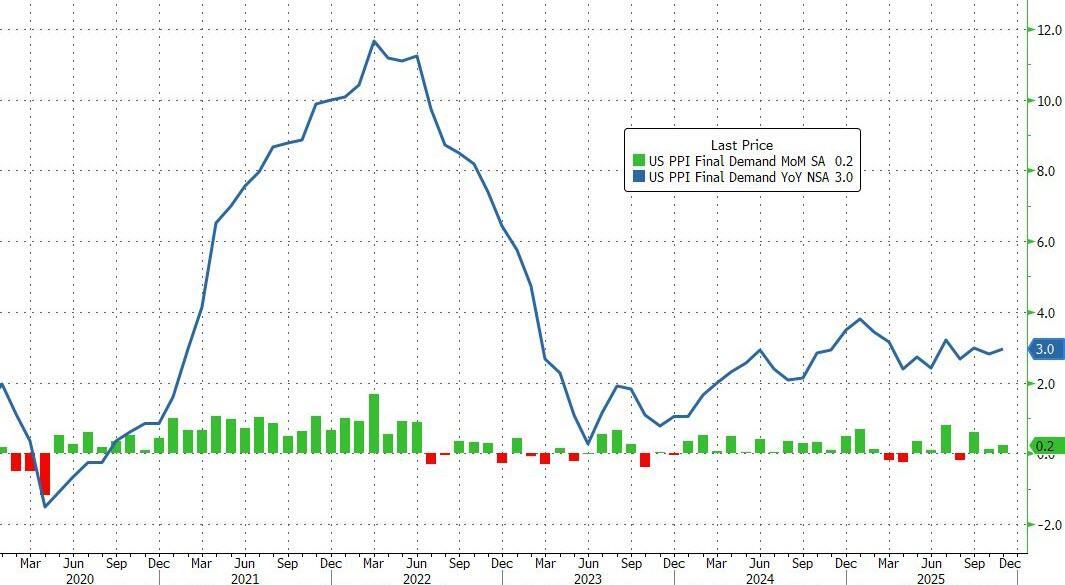
Core Insights - The core point of the articles is the analysis of the Producer Price Index (PPI) data for November in the United States, indicating a slight increase in wholesale inflation driven by rising energy costs, while service prices remained stable [1][2]. Group 1: PPI Data Overview - The November PPI year-on-year rate was reported at 3%, exceeding the expected 2.7%, while the month-on-month rate was 0.2%, matching expectations [1]. - The core PPI, excluding food and energy, also showed a year-on-year increase of 3% and a month-on-month rate of 0%, which was below the expected 0.2% [1][4]. - The final demand goods index rose by 0.9% in November, marking the largest increase since February 2024, with over 80% of this increase attributed to a 4.6% rise in energy prices [2]. Group 2: Components of PPI - A significant portion of the increase in the final demand goods index was due to a 10.5% rise in gasoline prices [2]. - The report highlighted that investment management fees increased by 1.4%, while airline passenger service costs decreased by 2.6% [3]. - Service costs remained stable in November after a 0.3% increase in October, with a slight decline in profit margin indicators [4]. Group 3: Market Expectations and Federal Reserve Outlook - The upcoming release of the Personal Consumption Expenditures (PCE) price data is scheduled for January 22, which will provide further insights into inflation trends [5]. - Following three consecutive interest rate cuts, the Federal Reserve is expected to maintain rates during the upcoming policy meeting, with market expectations indicating a 47.8% probability of a rate cut in June [5].

国泰海通 · 晨报260115|宏观、金融工程 、固收
国泰海通证券研究· 2026-01-14 12:25
Macroeconomic Insights - US inflation remains moderate, with December CPI year-on-year growth at 2.7%, unchanged from November, and month-on-month growth at 0.3%, also stable since September. Core CPI year-on-year growth is at 2.6%, slightly below the expected 2.7% [1] - The structure of inflation shows weakness in goods and strength in services. Core goods month-on-month growth is 0%, primarily dragged down by used cars. Even excluding used cars, core goods growth remains low, while core services show a general month-on-month rebound [1] Short-term Inflation Outlook - Despite lower-than-expected inflation data, the market does not anticipate an early rate cut by the Federal Reserve, with expectations for the first rate cut still set for June 2026. Food inflation is expected to cool gradually, while used car prices may see marginal rebounds, and rent remains stable [2] Financial Engineering Strategies - The quantitative model signals a recommendation to overweight small-cap stocks in January, with a model signal of 0.17 indicating a preference for small caps. The model's return as of the end of December is 27.56%, outperforming the equal-weight benchmark by 0.71% [4] - For value and growth styles, the model signal is neutral, suggesting an equal-weight allocation between the two styles. The model's return is 22.72%, with an excess return of 1.93% over the benchmark [4] Fixed Income Insights - Concerns about long-term bond supply do not necessarily imply a tightening of interbank liquidity. The central bank's support is expected to keep liquidity stable, with funding rates likely remaining low in the first quarter of 2026 [10] - The central bank's ability to smooth out funding fluctuations has improved, with a flexible approach to liquidity management anticipated. If necessary, measures such as large-scale MLF injections or reserve requirement ratio cuts may be employed [12]

现货白银再创历史新高!90美元已破,100美元还远吗
Sou Hu Cai Jing· 2026-01-14 12:19
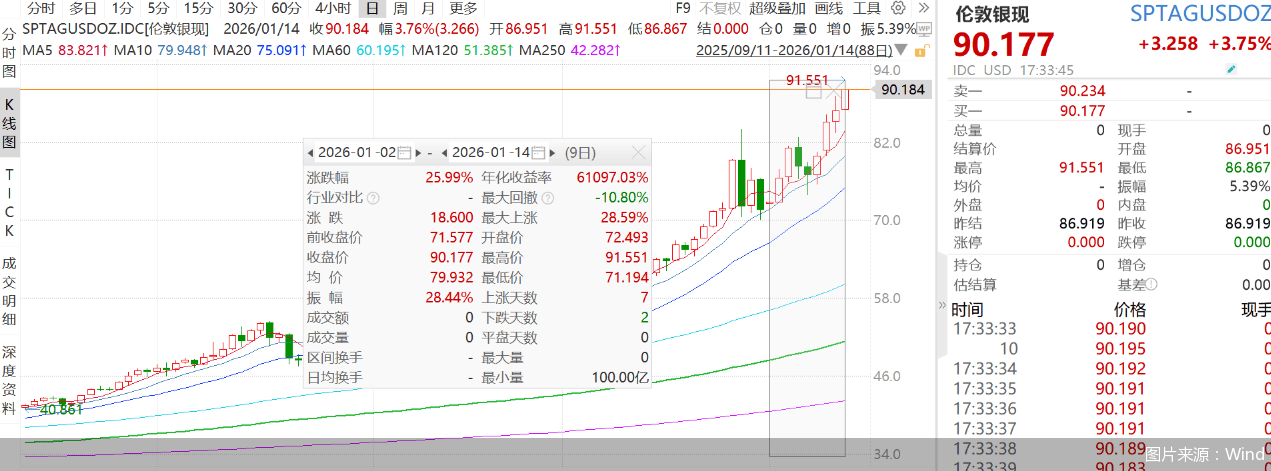
Core Viewpoint - The price of spot silver has continued its strong upward trend since 2025, breaking the $90 per ounce mark for the first time, with a year-to-date increase of over 25%, leading the precious metals market [1]. Price Movement - As of January 14, 2026, spot silver reached a high of $91.551 per ounce, with a closing price of $90.177, reflecting a daily increase of 3.76% [2]. - In 2025, silver's maximum increase was 196.84%, significantly outperforming gold, making it a focal point in the capital market [1][3]. Market Drivers - The current bull market for silver is driven by a combination of industrial demand growth and financial attributes, with sectors like photovoltaics, electric vehicles, and AI hardware increasing silver consumption [3]. - The expectation of continued global liquidity easing and the current gold-silver ratio being above historical averages provide further support for silver's price increase [3]. Future Price Predictions - Analysts predict that silver may target the $100 per ounce mark, driven by structural supply-demand gaps, expectations of Federal Reserve interest rate cuts, and the reassessment of silver's strategic reserve value by some countries [4]. - The market is expected to experience a "volatile upward" trend rather than a straight line increase, with key factors including the Federal Reserve's monetary policy, industrial demand for silver, and inventory trends at major exchanges [4]. Investment Strategies - Investors are advised to adopt a strategy of "gradual allocation, diversified investment, and long-term perspective" to avoid being trapped by high prices, suggesting a dollar-cost averaging approach [5]. - It is recommended to focus on physical silver, silver ETFs, and mining stocks while managing risk through careful position sizing [5].
2025年12月美国通胀数据点评:美国通胀:延续温和
GUOTAI HAITONG SECURITIES· 2026-01-14 12:18
Inflation Overview - December CPI in the U.S. remained at 2.7% year-on-year, unchanged from November, and the month-on-month growth was 0.3%, consistent with September levels[7] - Core CPI year-on-year growth was 2.6%, slightly below the market expectation of 2.7%, and month-on-month growth was 0.2%, also below the expected 0.3%[7] Structural Analysis - Core goods inflation was weak, with a month-on-month growth rate of 0% in December, primarily dragged down by used car prices, which fell from 0.29% in November to -1.11%[11] - In contrast, core services showed a general recovery, with housing services rebounding from 0.2% in September to 0.4% in December[11] Market Reaction and Future Outlook - The market's reaction to the inflation data was muted, with expectations for the first Fed rate cut still set for June 2026, despite the lower-than-expected inflation figures[16] - Future food inflation is expected to gradually cool, while used car prices may see marginal rebounds, and rent inflation is likely to remain stable, contributing to a continued moderate inflation environment[16] Risk Factors - Potential risks include escalating geopolitical conflicts leading to surges in oil prices, unexpected fiscal policies, and the possibility of the Fed's independence being compromised, which could destabilize market inflation expectations[22]
美国通胀水平保持稳定 市场预计1月份美联储大概率不降息
Sou Hu Cai Jing· 2026-01-14 11:02
据新华财经消息,1月13日晚,美国劳工部公布了2025年12月份美国CPI(消费者物价指数)数据。具 体看,美国2025年12月份CPI同比涨幅为2.7%,环比涨幅为0.3%,同环比涨幅均与市场预期保持一致。 剔除波动较大食品和能源价格后的核心CPI同比涨幅为2.6%,环比涨幅为0.2%。 "美国2025年12月份总体通胀符合预期、核心通胀略低于预期。"东方金诚研究发展部高级副总监白雪在 接受《证券日报》记者采访时表示,此前,市场普遍认为数据收集窗口推迟、统计范围不完整等因素, 会令美国2025年11月份通胀数据被低估,因此美国2025年12月份通胀可能会出现反弹。在这一背景下, 美国2025年12月份CPI、核心CPI同环比增速总体均基本持平,打消了市场对于美国2025年11月份通胀 数据失真的疑虑,进一步确认了美国通胀缓步下行的大趋势。 本报记者 韩昱 从美联储货币政策角度看,1月14日,芝商所FedWatch(美联储观察)工具数据显示,市场押注美联储 1月份维持利率不变的概率高达97.2%,降息25个基点的概率仅为2.8%。 "在2025年三次降息后,当前美联储政策利率已趋近中性利率水平区间。与此同时, ...
瑞达期货铝类产业日报-20260114
Rui Da Qi Huo· 2026-01-14 09:01
Report Industry Investment Rating - Not provided in the content Core Viewpoints - For alumina, the fundamentals may be in a stage of slightly converging supply and slightly increasing demand. It is recommended to take short - long positions at low prices with a light position, while controlling the rhythm and trading risks [2] - For electrolytic aluminum, the fundamentals may be in a stage of slightly increasing supply and cautious demand. It is recommended to trade in a volatile manner with a light position, while controlling the rhythm and trading risks [2] - For cast aluminum alloy, the fundamentals may be in a stage of slightly converging supply and in the off - season of demand. It is recommended to trade in a volatile manner with a light position, while controlling the rhythm and trading risks [2] Summary by Directory Futures Market - The closing price of the main contract of Shanghai aluminum was 24,595 yuan/ton, up 220 yuan; the closing price of the main contract of alumina futures was 2,800 yuan/ton, up 20 yuan [2] - The spread between the main and the second - consecutive contracts of Shanghai aluminum was - 110 yuan/ton, down 30 yuan; the spread between the main and the second - consecutive contracts of alumina was - 221 yuan/ton, down 8 yuan [2] - The LME aluminum cancelled warehouse receipts were 47,425 tons, unchanged; the LME aluminum inventory was 494,000 tons, down 1,825 tons [2] - The net position of the top 20 in Shanghai aluminum was - 65,487 hands, up 17,640 hands; the Shanghai - London ratio was 7.69, up 0.04 [2] - The closing price of the main contract of cast aluminum alloy was 23,380 yuan/ton, up 215 yuan; the registered warehouse receipts of cast aluminum alloy on the Shanghai Futures Exchange were 68,831 tons, down 30 tons [2] Spot Market - The average price of Shanghai Non - ferrous A00 aluminum was 24,670 yuan/ton, up 370 yuan; the average price of ADC12 aluminum alloy ingots nationwide was 24,200 yuan/ton, up 250 yuan [2] - The basis of electrolytic aluminum was 75 yuan/ton, up 150 yuan; the basis of cast aluminum alloy was 820 yuan/ton [2] - The Shanghai Wumao aluminum premium and discount was - 120 yuan/ton, down 30 yuan; the LME aluminum premium and discount was 22.09 US dollars/ton, up 11.69 US dollars [2] - The basis of alumina was - 225 yuan/ton, down 25 yuan [2] Upstream Situation - The output of alumina was 813.80 million tons, up 27.30 million tons; the demand for alumina (electrolytic aluminum part) was 705.96 million tons, down 24.27 million tons [2] - The average price of crushed raw aluminum in Foshan metal waste was 18,850 yuan/ton, up 200 yuan; the average price of crushed raw aluminum in Shandong metal waste was 18,300 yuan/ton, up 150 yuan [2] - The export volume of alumina was 17.00 million tons, down 1.00 million tons; the import volume of alumina was 23.24 million tons, up 4.31 million tons [2] Industry Situation - The import volume of primary aluminum was 146,109.72 tons, down 101,652.54 tons; the export volume of primary aluminum was 53,047.69 tons, up 28,474.13 tons [2] - The output of aluminum products was 593.10 million tons, up 23.70 million tons; the export volume of unwrought aluminum and aluminum products was 54.50 million tons, down 2.50 million tons [2] - The output of recycled aluminum alloy ingots was 68.40 million tons, down 1.60 million tons; the export volume of aluminum alloy was 3.06 million tons, down 0.03 million tons [2] Downstream and Application - The completed production capacity of recycled aluminum alloy ingots was 126.00 million tons, unchanged; the National Real Estate Prosperity Index was 91.90, down 0.52 [2] - The output of aluminum alloy was 173.90 million tons, unchanged; the output of automobiles was 351.90 million vehicles, up 24.00 million vehicles [2] Option Situation - The 20 - day historical volatility of Shanghai aluminum was 21.08%, down 0.81%; the 40 - day historical volatility of Shanghai aluminum was 18.08%, down 0.05% [2] - The implied volatility of the at - the - money option of the main contract of Shanghai aluminum was 28.86%, down 0.0274; the call - put ratio of Shanghai aluminum options was 1.71, down 0.0183 [2] Industry News - In December 2025, the US CPI increased by 2.7% year - on - year, and the core CPI increased by 2.6%, both remaining the same as the previous value. The market expects the Fed to keep the policy rate unchanged in January 2026 with a probability of 95% [2] - The Ministry of Industry and Information Technology held the 18th manufacturing enterprise symposium, emphasizing active participation in industry rule - making and self - regulatory mechanism construction [2] - The President of the St. Louis Fed said there was little reason to further relax monetary policy in the short term [2] - Shanghai introduced 28 measures to promote the quality improvement and efficiency increase of the service industry and the expansion of consumption [2] - In 2025, the trading volume of the Chinese second - hand car market exceeded 20 million for the first time, reaching 20.108 million, with a year - on - year increase of 2.52% [2]

沪铜产业日报-20260114
Rui Da Qi Huo· 2026-01-14 08:54
1. Report Industry Investment Rating - Not provided in the content 2. Core View of the Report - The Shanghai copper main contract fluctuates at a high level, with increasing open interest, spot discount, and weakening basis. Fundamentally, on the raw material side, the spot TC processing index of copper concentrate runs at a low level, and the domestic copper ore supply remains tight, providing strong cost support for copper prices. On the supply side, due to the high prices of copper and smelting by - products such as sulfuric acid, smelters are still actively producing, and the production schedule in January is expected to maintain a slight growth trend. On the demand side, the downstream purchasing sentiment is still cautious due to high copper prices, and the growth of new orders in the downstream is limited due to the off - season, so the trading volume in the spot market is still light, and industrial inventories are accumulating. Overall, the fundamentals of Shanghai copper may be in a stage of slight supply increase and cautious demand, with social inventories accumulating. In terms of options, the call - put ratio of at - the - money option positions is 1.54, a month - on - month decrease of 0.0044, indicating a bullish sentiment in the options market, and the implied volatility slightly decreases. Technically, for the 60 - minute MACD, the double lines are above the 0 - axis, and the red bars are converging. The view is to conduct light - position oscillating trading, paying attention to controlling the rhythm and trading risks [2]. 3. Summary According to Relevant Catalogs 3.1 Futures Market - The closing price of the Shanghai copper futures main contract is 104,120 yuan/ton, up 1,830 yuan; the price of LME 3 - month copper is 13,176 dollars/ton, up 12 dollars. The spread between the main contract and the next - month contract is - 250 yuan/ton, down 60 yuan. The open interest of the Shanghai copper main contract is 241,222 lots, up 68,262 lots. The net position of the top 20 futures holders of Shanghai copper is - 75,925 lots, down 8,758 lots. The LME copper inventory is 141,550 tons, up 4,325 tons; the Shanghai Futures Exchange inventory of cathode copper is 180,543 tons, up 35,201 tons; the LME copper cancelled warrants are 51,825 tons, up 29,750 tons; the Shanghai Futures Exchange warehouse receipts of cathode copper are 149,339 tons, down 2,856 tons [2]. 3.2 Spot Market - The price of SMM 1 copper spot is 103,915 yuan/ton, up 1,405 yuan; the price of Yangtze River Non - ferrous Market 1 copper spot is 104,115 yuan/ton, up 1,800 yuan. The CIF (bill of lading) price of Shanghai electrolytic copper is 43 dollars/ton, unchanged; the average premium of Yangshan copper is 37 dollars/ton, down 1.5 dollars. The basis of the CU main contract is - 205 yuan/ton, down 425 yuan; the LME copper cash - to - 3 - month spread is 90.23 dollars/ton, up 25.92 dollars [2]. 3.3 Upstream Situation - The import volume of copper ore and concentrates is 252.62 million tons, up 7.47 million tons. The TC of domestic copper smelters is - 45.41 dollars/thousand tons, down 0.43 dollars. The price of copper concentrate in Jiangxi is 94,400 yuan/metal ton, up 1,820 yuan; the price of copper concentrate in Yunnan is 95,100 yuan/metal ton, up 1,820 yuan. The processing fee for blister copper in the south is 2,000 yuan/ton, unchanged; the processing fee for blister copper in the north is 1,200 yuan/ton, unchanged. The output of refined copper is 123.60 million tons, up 3.20 million tons; the import volume of unwrought copper and copper products is 437,000 tons, up 7,000 tons [2]. 3.4 Industry Situation - The social inventory of copper is 41.82 million tons, up 0.43 million tons. The price of 1 bright copper wire scrap in Shanghai is 68,800 yuan/ton, down 690 yuan; the price of 2 copper scrap (94 - 96%) in Shanghai is 84,100 yuan/ton, down 550 yuan. The ex - factory price of 98% sulfuric acid of Jiangxi Copper is 1,030 yuan/ton, unchanged [2]. 3.5 Downstream and Application - The output of copper products is 222.60 million tons, up 22.20 million tons. The cumulative completed investment in power grid infrastructure is 560.39 billion yuan, up 77.956 billion yuan. The cumulative completed investment in real estate development is 7,859.09 billion yuan, up 502.82 billion yuan. The monthly output of integrated circuits is 4,392 million pieces, up 215 million pieces [2]. 3.6 Option Situation - The 20 - day historical volatility of Shanghai copper is 26.23%, down 0.93%; the 40 - day historical volatility of Shanghai copper is 22.38%, up 0.13%. The implied volatility of at - the - money options in the current month is 32.34%, down 0.0151%; the call - put ratio of at - the - money options is 1.54, down 0.0044 [2]. 3.7 Industry News - In December 2025, the US CPI rose 2.7% year - on - year, and the core CPI rose 2.6%, both unchanged from the previous value. Affected by the long - term "shutdown" of the US federal government, the reference value of this data for the market to predict the future policy path of the Federal Reserve may be weakened. The CME FedWatch shows that the market expects the Federal Reserve to keep the policy rate unchanged in January 2026 with a probability as high as 95%. The Ministry of Industry and Information Technology held the 18th symposium for manufacturing enterprises, with 12 enterprise leaders from key industries participating. The meeting emphasized actively participating in industry rule - making and self - regulatory mechanism construction and consciously resisting "involution". The President of the St. Louis Fed said that there is currently little reason to further ease monetary policy in the short term because the Fed's policy rate is at a "near - neutral" level. Shanghai introduced 28 measures to promote the quality improvement and efficiency increase of the service industry and the expansion of consumption. The China Automobile Dealers Association data shows that in 2025, the trading volume of the Chinese used - car market exceeded 20 million vehicles for the first time, reaching 20.108 million vehicles, a year - on - year increase of 2.52%, and the trading volume of new - energy used cars reached 1.6 million vehicles, accounting for 7.9% [2].
美国12月CPI点评:美联储短期挑战或不在通胀,而在政治端
KAIYUAN SECURITIES· 2026-01-14 05:15
Inflation Data Summary - The U.S. CPI increased by 2.7% year-on-year in December 2025, meeting market expectations, while core CPI rose by 2.6%, falling short of expectations[2] - Energy inflation saw a significant decline, with energy prices rising by only 2.3% year-on-year, down 1.9 percentage points from November[4] - Food prices increased by 3.1% year-on-year in December, up 0.5 percentage points from November, indicating a seasonal demand increase[4] Core Inflation Insights - Core CPI remained stable, with core goods' year-on-year growth at approximately 1.4%, and core services rising by about 3.03%[4][21] - The price of used cars decreased by 1.1% month-on-month, contributing to the overall stability in core inflation[21] - Housing costs increased by 3.2% year-on-year, reflecting a slight rebound in rental inflation[22] Future Inflation Outlook - Inflation levels may continue to decline due to high base effects in early 2025, but potential rebound pressures exist from fiscal policies and economic support measures[5][36] - The Federal Reserve may tolerate slightly higher inflation to support the economy and labor market, with expectations that inflation will not return to 2% by 2026[42] - Political challenges are emerging for the Federal Reserve, particularly with the upcoming leadership changes and increased scrutiny from the Trump administration[6][48] Risk Considerations - Risks include potential geopolitical tensions leading to unexpected inflation spikes and the possibility of a more severe economic downturn than anticipated[7][49]
美通胀风险或正缓和白银td走涨
Jin Tou Wang· 2026-01-14 03:08
Core Viewpoint - Silver TD prices have shown a significant increase, currently trading above 22,394, with a notable rise of 7.82% from the opening price of 21,125 [1] Group 1: Economic Indicators - Federal Reserve's Musalem indicated that inflation risks are easing, predicting prices will return to the Fed's target later this year [1] - He noted that after last year's rate cuts, the Fed's monetary policy is well-positioned to address price stability and employment risks [1] - Current interest rates are close to neutral levels, suggesting no further rate cuts are necessary despite ongoing inflation concerns [1] Group 2: Silver TD Market Analysis - Silver TD prices continued to rise, with an increase of over 8% today, reaching a high of 22,860 and a low of 21,125 [1] - Technical indicators show a bullish trend, with the MACD histogram in positive territory and the RSI nearing overbought levels [1] - Short-term outlook remains bullish, with support levels identified between 20,500 and 21,000, and resistance levels between 22,500 and 23,000 [1]
现货白银大涨超2%!地缘局势提振油价 特朗普称已取消所有与伊朗官员的会谈!
Sou Hu Cai Jing· 2026-01-14 01:47
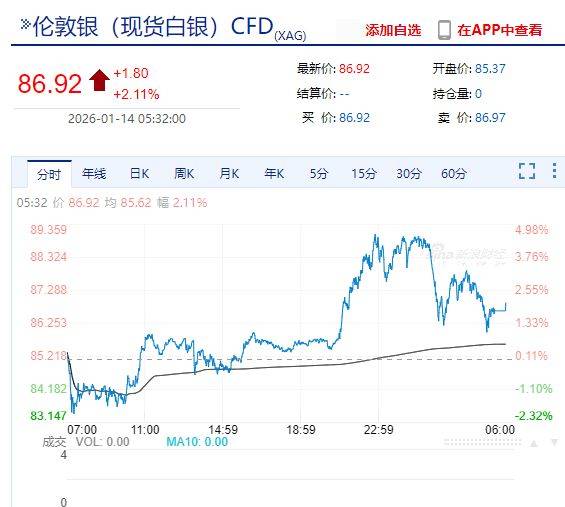
Market Performance - The Dow Jones Industrial Average fell by 398.21 points, a decrease of 0.80%, while the Nasdaq dropped by 0.1% and the S&P 500 declined by 0.19% [1] - Bank stocks experienced a widespread decline, with the KBW Bank Index down by 1.3% and JPMorgan Chase falling by 4.2% [1] - Technology stocks showed mixed results, with Intel rising over 7% to reach a nearly two-year high, while AMD increased by over 6%. However, Meta, Amazon, and Microsoft all fell by more than 1% [1] - The Nasdaq Golden Dragon China Index dropped by 1.86%, with notable declines in Pinduoduo (over 5%), NIO and Xpeng (over 3%), and JD.com and Li Auto (over 1%) [1] Commodity Market - The FTSE China A50 Index futures closed down by 0.01% at 15,398 points [2] - Crude oil futures on the Shanghai Futures Exchange rose by 2.90%, closing at 450.40 RMB per barrel [2] - Spot silver increased by 2.11%, reaching $86.92, with an intraday surge exceeding 4% [3] - Both New York and Brent crude oil prices rose by over 2% [5] Economic Indicators - The U.S. Consumer Price Index (CPI) for December 2025 increased by 2.7% year-on-year, with a core CPI (excluding food and energy) rising by 2.6% [8] - The U.S. government recorded a fiscal deficit of $145 billion in December 2025, a 67% increase year-on-year, marking a historical high for that month [8] - Analysts from Morgan Stanley noted that the December inflation data may contain "technical noise" due to the previous government shutdown, potentially affecting its predictive value for future Federal Reserve policy [8] - The market currently anticipates a 95% probability that the Federal Reserve will maintain interest rates at the upcoming meeting [8] Federal Reserve Outlook - St. Louis Federal Reserve President Alberto Musalem indicated that inflation-related risks are diminishing, and he expects prices to align more closely with the Fed's target later this year [9] - Musalem stated that current monetary policy is appropriately positioned to address risks related to both price stability and employment [9] - Investors believe the likelihood of a rate cut at the next Federal Reserve meeting is low, but anticipate two rate cuts in 2026, each by 25 basis points [9] Venezuela Market Developments - Following significant political changes in Venezuela, the country's benchmark stock index surged over 130% since January 3, driven by expectations of economic recovery and U.S. government proposals for oil revitalization [9][10] - The U.S. White House has requested major oil companies to invest in Venezuela to restore its oil extraction infrastructure [10] - Teucrium, an ETF issuer, has applied to establish what is believed to be the first ETF focused on companies with exposure to Venezuela, indicating a potential opening for global capital into this previously closed market [10]