
价值投资

Search documents
段永平再晒部分苹果持仓!2011年开始买入苹果股票,累计收益率超16倍
Ge Long Hui A P P· 2026-01-04 01:46
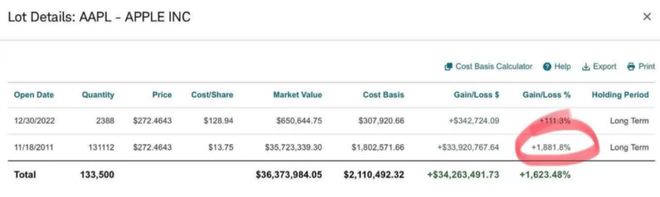
格隆汇1月4日|据红星资本局,知名投资人段永平在投资交流平台上,以"大道无形我有型"的ID发文晒 出部分持仓。图片显示,该账号于2011年11月开始买入苹果股票,累计收益率达1623.48%,目前收益 金额约为3426万美元。 段永平称,"这是我管的一个账号上的苹果(股票),这么多年几乎没怎么动过。"图片显示,该账号分 别于2011年11月和2022年12月买入苹果股票,第一次购入13.1万股,平均价13.75美元/股;第二次购入 2388股,平均价128.94美元/股。两次投资分别为段永平带来3392万美元、34.27万美元的收益,收益率 高达1881.8%、111.3%。 有网友转发段永平的帖子称:"折合年化收益率约24%,这笔投资赚了3400多万美元。伟大公司真是时 间的朋友,买定离手便是最好的交易。" | | | | | | | | Cost Basis Calculator 9 Help & Export @ Print | | | --- | --- | --- | --- | --- | --- | --- | --- | --- | | Open Date | Quantity | Price ...


后巴菲特时代,阿贝尔可能比巴菲特赚得更狠!
Xin Lang Cai Jing· 2026-01-04 01:24
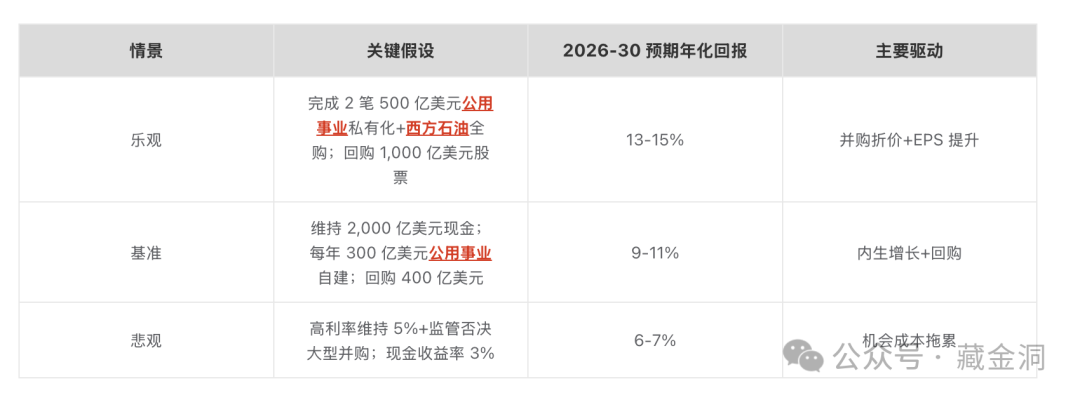
Core Viewpoint - The transition from Warren Buffett to Abel marks a significant shift in Berkshire Hathaway's strategy, moving from brand investment to resource control, with a focus on hard assets and cash management [1][7][30]. Group 1: Financial Position - Berkshire Hathaway's cash reserves have reached a record high of $381 billion, surpassing the total market value of its stock holdings, which stands at $283 billion [17][18]. - This unprecedented cash position indicates a strategic pivot, suggesting that Abel views the current stock market as inflated and prefers liquidity as a strategic asset [19][20]. Group 2: Leadership Transition - Abel, who has a background in energy and railroads, is characterized as a pragmatic and aggressive leader, contrasting with Buffett's more romantic investment philosophy [10][14]. - Abel's approach is expected to focus on acquiring distressed hard assets, such as utilities and infrastructure, rather than traditional consumer brands [21][23][28]. Group 3: Investment Strategy - The investment strategy under Abel is anticipated to shift towards "survival" rather than "pleasure," emphasizing essential services and resources [28][30]. - Abel's recent acquisition of $4.3 billion in Google stock reflects a strategic interest in stable cash flow assets related to AI data centers, rather than speculative technology investments [28]. Group 4: Market Outlook - The current market environment is characterized by high valuations and rising interest rates, which are seen as challenges for companies in utilities and energy sectors [20][21]. - Abel's strategy may involve privatization and full acquisitions of struggling companies, aiming to generate revenue through essential services rather than stock price appreciation [25][26]. Group 5: Future Projections - Projections for Berkshire's annualized returns from 2026 to 2030 vary based on different scenarios, with optimistic estimates suggesting returns of 13-15% through strategic acquisitions and share buybacks [29]. - The company is expected to evolve into a more stable income-generating entity, resembling a super bond or enhanced utility index ETF, with reduced volatility and increased dividend potential [3][30].
95岁“股神”巴菲特正式退休!63岁接班人阿贝尔与他性格完全不同,芒格曾称他是“升级版巴菲特”
Sou Hu Cai Jing· 2026-01-03 11:54
据央视新闻消息,当地时间2025年12月31日,著名投资人沃伦·巴菲特正式退休,从知名投资机构伯克希尔-哈撒韦公司的首席执行官岗位上卸任。 沃伦·巴菲特现年95岁,常年担任伯克希尔-哈撒韦公司的首席执行官。他信奉"价值投资法",是价值投资、长期投资的代表人物。 2025年11月,巴菲特在其年度感恩节致股东信中宣布,会在年底辞去相关职务,但将继续担任该公司董事会主席并暂时保留"相当数量"的股份。 巴菲特在信中写道,虽然自己整体感觉良好,但行动迟缓,阅读也越来越吃力。巴菲特表示,他将不再撰写伯克希尔-哈撒韦公司的年度信函,也不会在 公司股东大会上发言。 图片来源:视觉中国 63岁接班人竟与巴菲特性格完全不同 2025年11月,据外媒报道,这位亿万富翁将继续持有伯克希尔-哈撒韦公司的A类股票,直到投资人对将接任首席执行官的该公司副董事长格雷格·阿贝 尔"感到满意"为止。 巴菲特也在致股东信中宣布了最新的慈善捐赠计划,并将加速向其子女管理的基金会捐款以继续支持慈善事业。2025年11月10日,巴菲特向四家家族基金 会捐赠了270万股伯克希尔-哈撒韦公司B类股票,价值约13亿美元。 自1965年掌控伯克希尔公司以来,巴 ...
CleanSpark Stock: New Year Ahead After Data Center Pivot (NASDAQ:CLSK)
Seeking Alpha· 2026-01-03 08:34
Core Viewpoint - The article discusses the journey of an individual transitioning from a potential career in politics to a focus on value investing, emphasizing the importance of risk management and long-term wealth growth [1] Group 1: Career Transition - The individual initially pursued a career in politics but faced challenges that led to a shift towards finance and investment [1] - After experiencing financial setbacks in 2019, the decision was made to study value investing to create wealth and mitigate risks [1] Group 2: Professional Experience - From 2020 to 2022, the individual worked in a sales role at a law firm, becoming the top-grossing salesman and managing a team, which contributed to a deeper understanding of sales strategies [1] - The experience gained during this period was instrumental in assessing company prospects based on their sales strategies [1] Group 3: Investment Advisory Role - Between 2022 and 2023, the individual served as an investment advisory representative with Fidelity, focusing on 401K planning [1] - The individual excelled in this role, passing Series exams ahead of schedule, but faced frustration due to the reliance on modern portfolio theory rather than value investing principles [1] Group 4: Current Endeavors - In November 2023, the individual began writing for Seeking Alpha, sharing investment opportunities and insights with readers [1] - The articles serve as a platform for the individual to document and share the investment journey alongside readers [1]


巴菲特时代谢幕,价值投资理念能否传承
Nan Fang Du Shi Bao· 2026-01-02 15:24
2025年12月31日,沃伦·巴菲特正式卸任伯克希尔·哈撒韦公司首席执行官一职,这位95岁的投资大师用 60年时间创造了61000倍的投资回报神话,将伯克希尔塑造成为价值投资的图腾,其价值投资理念深刻 重塑了全球资本市场的认知范式。巴菲特的卸任标志着全球投资界一个传奇时代的终结,以及"后巴菲 特时代"的正式开启。这不仅仅是一位商业巨擘的退休,更是一种投资哲学、一种公司治理模式乃至一 种商业文化符号的交接与传承。 巴菲特对投资如此,对人也是如此,在2025年11月的谢幕信中,巴菲特用大量篇幅温情回忆了在奥马哈 的成长岁月、与查理·芒格64年的友谊,以及众多来自奥马哈或与之结缘的伙伴。这并非闲笔,而是对 其成功密码的一种揭示:对社区、对朋友、对简单而核心价值的坚守,构成了他庞大商业帝国的人文基 石。 巴菲特的慈善事业同样恢弘,自2010年与盖茨夫妇发起"捐赠誓言"以来,已累计捐出超过600亿美元, 并承诺将几乎全部财富用于慈善。他对遗产的豁达处理同样引发了中外富豪的效仿。 格雷格·阿贝尔接替巴菲特,实际上是巴菲特社会影响力的代际迁移。真正的考验不在明天,而在未来 五年甚至更久。当市场再次陷入狂热或恐慌、当股东高呼 ...
价值和成长风格,怎么划分呢?|投资小知识
银行螺丝钉· 2026-01-02 14:07
Group 1 - The core viewpoint of the article highlights the potential for companies to leverage funds raised from IPOs for short-term income and profitability enhancement, regardless of whether the funds are reinvested in core business or used for financial products [2] - Companies in the growth phase often experience rapid revenue increases through production expansion and marketing efforts, leading to significant market share growth [3] - During the growth phase, companies tend to reinvest earnings to strengthen competitive advantages and attract talent with high compensation, reflecting a typical characteristic of the industry boom period [4] Group 2 - In the growth value phase, companies may see a slowdown in revenue growth as they approach their limits, but can maintain profitability through cost-cutting measures [5] - Companies in this phase, such as leading domestic internet firms, may exhibit high profit growth and increasing return on equity (ROE) despite slower revenue growth [6] - The deep value phase is characterized by both revenue and profit growth slowing down, leading to lower valuations and higher dividend yields, indicating a shift from growth to value investment strategies [7]

富国基金:以投资者为本,共筑高质量发展新生态
Jin Rong Jie· 2026-01-02 02:21
Core Viewpoint - The release of the "Regulations on the Management of Sales Expenses for Publicly Raised Securities Investment Funds" marks a significant milestone in the public fund industry, aimed at enhancing investor benefits and promoting high-quality industry development [1][4]. Summary by Sections Sales Fee Rate Reform - The overall reduction in sales expenses across the industry is 34%, expected to save investors approximately 30 billion yuan annually [2]. - Specific fee reductions include a decrease in the sales service fee for money market funds from 0.25% to a lower rate, saving investors 10 yuan annually on a 10,000 yuan investment, and a reduction in the subscription fee for actively managed equity funds from 1.5% to 0.8%, saving 70 yuan on the same investment [2]. Mechanism Optimization - The reform aims to shift the focus from short-term trading to long-term investment by ensuring that redemption fees are fully allocated to fund assets, thus decoupling sales agency income from short-term trading behaviors [3]. - Non-money market funds will have a one-year holding period to waive sales service fees, encouraging long-term investment [3]. Development Orientation - The regulations encourage a focus on personal investors by limiting the client maintenance fee for personal investors to no more than 50% of management fees, enhancing service experiences [3]. - A new direct sales service platform (FISP) is established to improve cost efficiency and risk control for fund managers [3]. Key Transformations - The reform emphasizes a shift from a "scale" to a "return" orientation, reducing "traffic fees" to promote a healthier long-term relationship with clients [4]. - It encourages a long-term investment philosophy by implementing measures such as redeeming fees being returned to assets and waiving sales service fees for long-term holders [4]. - The regulations clarify long-standing ambiguities regarding fund interest allocation and advisory fees, aiming to create a fairer and more transparent industry ecosystem [4]. Reform Progress - Since the initiation of the fee rate reform in July 2023, significant progress has been made, with cumulative annual savings for investors exceeding 50 billion yuan [5]. - The reform is viewed as not just a fee reduction but also a mechanism optimization and ecosystem restructuring effort [5].
四大热点齐发:茅台直销战略落地、巴菲特退休、GPU四小龙集结上市、DeepSeek再释信号
Jin Rong Jie· 2026-01-02 00:17
Group 1: Moutai's Direct Sales Strategy - Moutai officially launched its direct sales strategy by selling Feitian Moutai on the "i Moutai" platform at a price of 1499 yuan per bottle, with a purchase limit of 12 bottles per user per day [2] - The move aims to reduce intermediaries, potentially converting some dealer profits into direct company revenue, which is expected to positively support mid-to-long-term performance [2] - The market response was extremely enthusiastic, with all six rounds of product releases selling out quickly, indicating strong demand for reasonably priced Feitian Moutai [2] Group 2: Warren Buffett's Retirement - Warren Buffett, the legendary investor, announced his retirement at the age of 95, marking the end of a nearly century-long investment career [3] - His career exemplified that investing can be a lifelong endeavor and has prompted a renewed examination of long-term investment philosophies [3] - Buffett emphasized the importance of focusing on quality assets and long-term holding, a principle that remains relevant despite the rise of high-frequency trading and quantitative strategies [3] Group 3: Domestic GPU Companies Accelerating Capitalization - The four leading domestic GPU companies, including Suiruan Technology, have initiated their IPO processes, with Suiruan recently completing its IPO counseling [4] - This acceleration in the capitalization of the domestic GPU sector reflects an unprecedented speed in the industry, with multiple companies moving towards public offerings [4] - The upcoming wave of IPOs in the tech sector is expected to inject capital into the economy and support the goal of self-sufficiency in the industrial chain [4] Group 4: DeepSeek's Research Publication - DeepSeek recently published an important research paper on a preprint platform, with founder Liang Wenfeng listed as one of the authors, highlighting the company's strategic focus on technological advancement [5] - The release of the paper follows the market's high interest in their DeepSeek-R1 model, indicating the company's strong technical capabilities [5] - Despite mixed opinions on the pace of AI technology iteration, DeepSeek's continuous output of significant research results suggests a robust technical strength [5]


股神谢幕!伯克希尔生涯最后一年,巴菲特坚决“卖股票,囤现金”
美股IPO· 2026-01-01 16:08
Core Viewpoint - Warren Buffett officially stepped down as CEO of Berkshire Hathaway, marking a significant transition in the company's leadership as he hands over to Greg Abel. This year, Berkshire has sold $10 billion worth of stocks, becoming a net seller for the third consecutive year, while cash reserves have surged to a historic high of $358 billion. Since Buffett took over, an initial investment of $100 has grown to approximately $5.5 million, compared to about $39,000 from the S&P 500 index during the same period, with Buffett's portfolio outperforming the market benchmark approximately 67% of the time [1][3]. Group 1 - In his final year as CEO, Buffett adhered to his investment principles, maintaining patience in a high market and significantly increasing cash reserves. He sold stocks to push cash reserves to a record high, demonstrating a classic strategy of "selling stocks and hoarding cash" during market peaks [3][6]. - Buffett's decision to reduce his stake in Apple, selling approximately 41.79 million shares in the third quarter, reflects a disciplined approach even as Apple's stock price rose by 9% this year. The total reduction over two quarters exceeded 60 million shares, indicating a strategic exit from a previously significant holding [6][7]. - Berkshire Hathaway completed its last major acquisition under Buffett's leadership, purchasing OxyChem for $10 billion, which provided Western Oil with much-needed cash while potentially offering Berkshire an attractive price [9]. Group 2 - The transition of leadership has led to notable personnel changes, including the departure of key executives such as Todd Combs and Marc Hamburg. Buffett expressed confidence in his successor Greg Abel, highlighting Abel's superior understanding of the company's potential and risks compared to many seasoned executives in the field [5][10]. - Following Buffett's announcement of his retirement, Berkshire's stock has seen a decline of over 6%, with concerns that the absence of Buffett's influence may lead to a loss of talent and a shift towards a more ordinary corporate structure [10].
策马新程!一位股市“识途者”的新年眺望
Zhong Guo Zheng Quan Bao· 2026-01-01 14:29
Group 1 - The core investment strategy focuses on aligning with national strategies, particularly in sectors like AI, semiconductors, and robotics, which are considered key areas for growth [2][4] - The recent capital market reforms, including stricter regulations against fraud and support for technological innovation, have created a healthier investment environment, enhancing investor confidence [1][3] - Long-term capital inflows and a focus on fundamental research are essential for capturing core value in the market [1][3] Group 2 - The investment outlook for 2026 emphasizes the importance of maintaining a balanced portfolio, expanding beyond just technology to include attractive consumer sectors and financial institutions [5] - Companies with strong brand value and resilient channels in the consumer sector are seen as having recovery potential, while top-tier brokers and banks are also on the radar due to their performance recovery certainty [5] - The need for continuous research and understanding of market fundamentals is highlighted, as opposed to chasing market trends or rumors [5][7] Group 3 - The expectation for a more regulated and transparent capital market is expressed, with a focus on protecting genuine value investors through stringent measures against market manipulation [7] - New investors are encouraged to study national development plans and maintain a respectful approach to the market, emphasizing the importance of solid research over speculative trading [7]