
物联网

Search documents
全病程数字智能康复平台 获评数字民生省级示范项目
Xin Lang Cai Jing· 2026-01-19 19:14
Core Insights - The "Digital Intelligent Rehabilitation Platform for Full Course" project from Guiyang Second People's Hospital has been awarded the "2025 Provincial Demonstration Project for Digital Livelihood" due to its innovative strength and value for people's livelihoods [1] - The platform has been recognized as a national-level smart rehabilitation project, being the only one approved in Guizhou province by the Ministry of Industry and Information Technology and the National Health Commission [1] Group 1: Platform Features and Innovations - The platform utilizes artificial intelligence, 5G communication, and IoT technology to break traditional barriers in rehabilitation healthcare, creating a three-tier service system: "hospital-community-home" [2] - AI assessments can complete a comprehensive analysis of patient movement trajectories in just 3 minutes, achieving over 90% accuracy in agreement with experienced physicians, and improving assessment efficiency by over 300% compared to traditional methods [2] - The platform offers seamless integration of "hospital diagnosis-home rehabilitation-remote guidance," allowing patients to initiate personalized home rehabilitation training via mobile apps or TV screens, with real-time monitoring and dynamic optimization of training plans [2] Group 2: Impact and Achievements - Since its launch, the platform has served nearly 1,400 patients and conducted over 1,700 AI assessments, with an average improvement rate of 30% in limb function for patients who have used the service for more than six months [2] - The operational efficiency of the hospital departments has increased by 20%, fulfilling the commitment to reduce costs without compromising quality [2] Group 3: Future Plans - The hospital aims to deepen the construction of the digital rehabilitation ecosystem by integrating more medical institutions into the platform, thereby benefiting a wider population [3] - There will be a focus on technical collaboration with authoritative institutions to continuously optimize rehabilitation algorithms and training program libraries, enhancing the platform's intelligence and clinical adaptability [3] - Talent cultivation will be strengthened through specialized research and skills training, aiming to develop composite talents in the field of digital rehabilitation [3]
单日销量增长超200%:新广货解锁“爆款密码”
2 1 Shi Ji Jing Ji Bao Dao· 2026-01-19 13:39
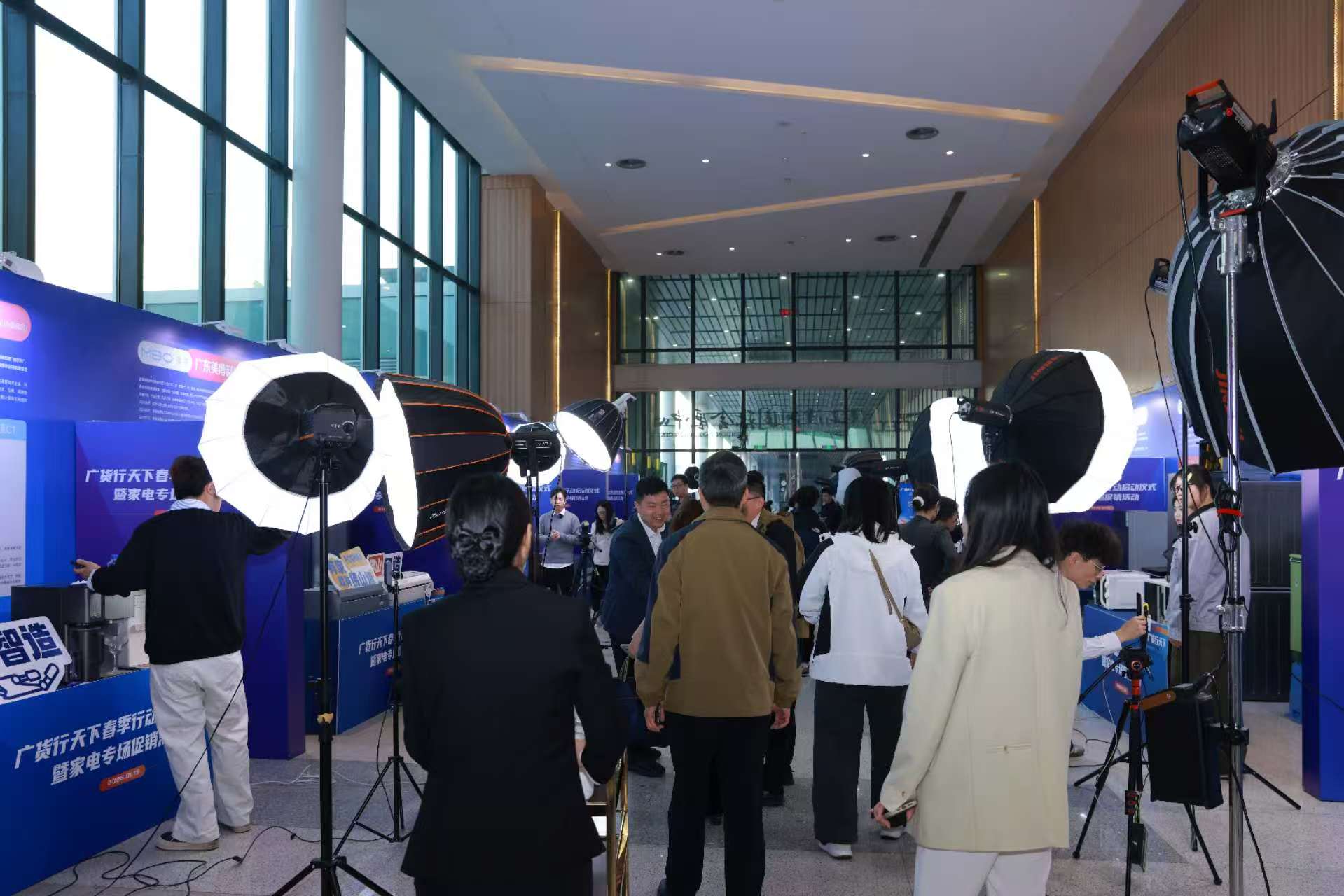
Core Viewpoint - The "Guangdong Goods Going Global" spring campaign has successfully boosted sales and showcased the evolution of Guangdong's manufacturing, emphasizing the importance of adapting to new market demands and technological advancements [2][3][7]. Group 1: Campaign Overview - The "Guangdong Goods Going Global" spring campaign features nearly 30 key events, engaging over 10 major commercial platforms and more than 6,000 enterprises, highlighting Guangdong's strengths in various sectors including smart home appliances and high-end mobile phones [2][11]. - On January 15, the campaign's launch event in Foshan saw participating companies achieve a sales increase of 110% compared to the previous day, with some products experiencing sales growth exceeding 200% [2][3]. Group 2: Sales Performance - During the campaign, companies like Mofei Technology reported a fivefold increase in sales for certain products, with their seasoning machine sales up by 159% compared to the previous day [4][6]. - The event demonstrated significant online sales, with one company reporting over 100,000 yuan in sales within just three hours of live streaming [3][6]. Group 3: Product Innovation and Market Adaptation - Guangdong's products have evolved from being perceived as merely functional to embodying advanced technology and design, with a focus on meeting specific consumer needs through innovative solutions [7][8]. - The integration of new materials and technologies has allowed Guangdong manufacturers to create products that cater to specific scenarios, leading to impressive sales figures during the campaign [6][9]. Group 4: Broader Implications for Guangdong Manufacturing - The success of the campaign reflects a broader trend of Guangdong's manufacturing sector transitioning from a focus on production to creating value through innovation and brand enhancement [8][10]. - The campaign is part of a larger strategy to expand Guangdong's market reach, including plans for numerous promotional activities across various sectors such as agriculture and tourism [11].






北方导航:公司持续健全导航特色核心技术体系
Zheng Quan Ri Bao· 2026-01-19 12:14
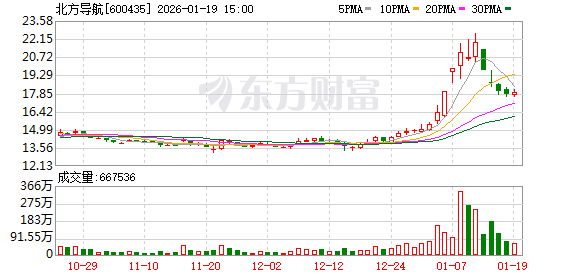
Core Viewpoint - The company is focused on enhancing its navigation technology system and aligning with the technological innovation development of the weaponry group, aiming to improve its technological capabilities and establish a robust industrial ecosystem [2]. Group 1: Technology Development - The company is developing a navigation and control, military communication, and intelligent integration connection ecosystem through an "8+3" technology system [2]. - It is actively involved in the research and development of equipment, technology, and capability enhancement projects to accelerate the improvement of its technology system [2]. - The company aims to promote high-end development of advantageous industries, modernization of traditional industries, and scaling of emerging industries [2]. Group 2: Digital Transformation - The company is enhancing its digital manufacturing, digital operation, and digital process capabilities as part of its smart engineering strategy [2]. - It emphasizes the integration of data-driven smart factory construction, focusing on the synergy between industrial digitalization and digital industrialization [2]. - The company is applying technologies such as big data, AI algorithms, IoT, and digital twins to advance new processes, technical standards, and information applications [2]. Group 3: Operational Management - The company is optimizing its "1+N" smart operation system, which includes a comprehensive management system and multiple information platforms [2]. - This system aims to achieve comprehensive perception, risk warning, scientific decision-making, and precise control in operational management [2].

能源数智化发展获政策支持,剑指构建创新应用体系
2 1 Shi Ji Jing Ji Bao Dao· 2026-01-19 11:07
Core Viewpoint - The article emphasizes the necessity of energy digitalization and intelligence as a global trend in energy transition, focusing on technological breakthroughs and industry applications to create a closed-loop system of "perception-planning-decision-execution" for efficient, low-carbon, and safe energy system transformation by 2030 [1][2]. Group 1: Policy Framework - In 2023, China has reinforced its commitment to digitalization in energy through the release of the "Opinions on Accelerating the Development of Energy Digitalization and Intelligence," outlining several goals to be achieved by 2030, including the establishment of a digital innovation application system and enhanced operational efficiency and reliability of energy systems [5]. - The "Guiding Opinions on Promoting High-Quality Development of Energy Equipment" was jointly issued by four government departments, aiming for significant advancements in the energy equipment industry's supply chain by 2030, focusing on digital and intelligent upgrades [6]. Group 2: Technological Breakthroughs and Industry Applications - The policies form a comprehensive framework combining "system empowerment and carrier support," with the former focusing on the integration of digital technologies across the energy value chain and the latter emphasizing the role of equipment in driving digital upgrades [7]. - Key technological breakthroughs are identified as essential drivers for energy digitalization, with a focus on overcoming critical technologies and integrating digital innovations such as AI, digital twins, IoT, and blockchain into the energy sector [8]. - The policies promote the application of digitalization across the entire energy chain, including generation, grid, coal, and oil & gas sectors, with specific tasks outlined for enhancing grid management and oil & gas operations [9]. Group 3: Key Focus Areas - The policies highlight three main areas of focus: intelligent equipment, system collaboration, and precise management, emphasizing the importance of both physical equipment and digital capabilities [10]. - The upgrade of energy equipment is prioritized, with three paths outlined: enhancing key technology research, intelligent retrofitting of equipment, and promoting green and circular upgrades to align with carbon neutrality goals [11]. - The transition to collaborative operation of energy systems aims to shift from decentralized to intelligent interconnected operations, focusing on enhancing the integration of renewable energy and storage, as well as optimizing the entire energy supply chain [12]. - Precision management in energy is targeted through the development of predictive maintenance and carbon management systems, aiming to reduce operational risks and support carbon reduction efforts [13].

亿纬获评全球首个圆柱电池灯塔工厂!
起点锂电· 2026-01-19 10:56
Core Insights - EVE Energy's Jingmen base has been awarded the world's first cylindrical battery lighthouse factory certification, showcasing advanced technology integration and over 40 smart solutions [2] - The lighthouse factory concept, selected by the World Economic Forum and McKinsey, represents the highest standards in global smart manufacturing and digitalization [2] - EVE Energy has achieved a 15% reduction in the carbon footprint of its products through renewable energy use, recycling materials, and energy-saving technology upgrades [3] Group 1: Technological Advancements - The lighthouse factory utilizes a combination of physical simulation and AI process models, reducing R&D experimental iterations by 75% and significantly shortening the time from R&D to mass production [2] - Automation in key production processes has reached 100%, with unmanned material delivery and an intelligent scheduling system that analyzes global orders in seconds, balancing capacity and materials automatically [2] - The factory has established China's first 300ppm high-speed production line, capable of producing 300 cylindrical battery cells per minute with a first-pass yield rate exceeding 97% [2] Group 2: Quality Control and Safety - An AI vision system achieves a detection efficiency of 0.3 seconds per cell, ensuring 100% inspection and strict quality control with zero missed judgments [2] - The factory promotes human-machine collaboration, transforming production line personnel into algorithm "conductors" [3] - Monitoring of factory operations is enhanced through smart sensors and drones, with AI models providing real-time risk alerts to ensure zero accidents in production [3] Group 3: Industry Impact - EVE Energy's lighthouse factory exemplifies a feasible path to achieving breakthroughs in manufacturing efficiency and green performance through cutting-edge technologies [3] - The company is positioned to play a more critical role in the global energy transition, contributing Chinese wisdom and solutions to the world [3]


机器人板块早盘走强,指数涨超1%,机器人ETF易方达(159530)半日净申购超2亿份
Mei Ri Jing Ji Xin Wen· 2026-01-19 09:44
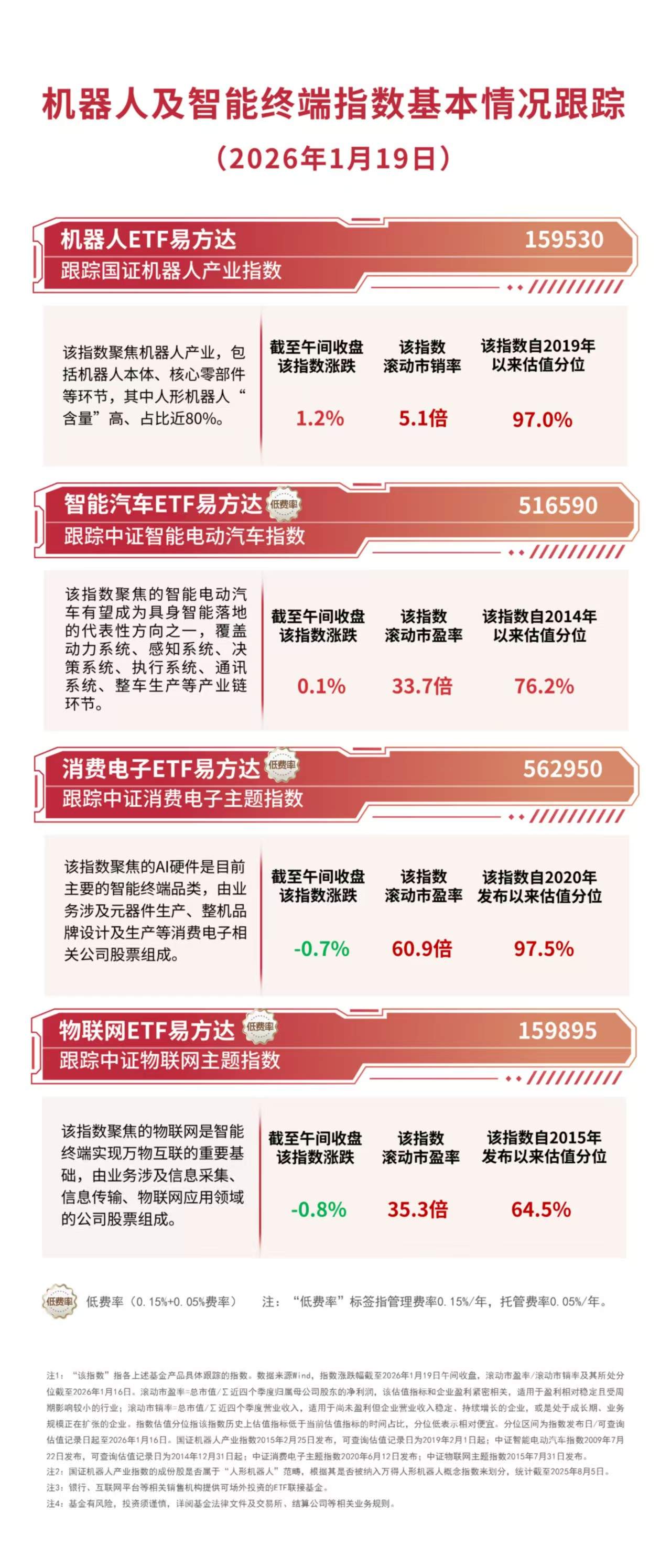
Group 1 - The index experienced a slight increase of 0.1% with a rolling price-to-earnings ratio of 33.7 times, reflecting a valuation increase of 76.2% since 201 [3] - The index saw a decrease of 0.7% with a rolling price-to-earnings ratio of 60.9 times, indicating a valuation increase of 97.5% since its release [5] - Another index reported a decline of 0.8% with a rolling price-to-earnings ratio of 35.3 times, showing a valuation increase of 64.5% since 201 [6]

国家大基金重仓锁定,芯片唯一“扫地僧”觉醒,第三代半导体+先进封
Xin Lang Cai Jing· 2026-01-19 06:14
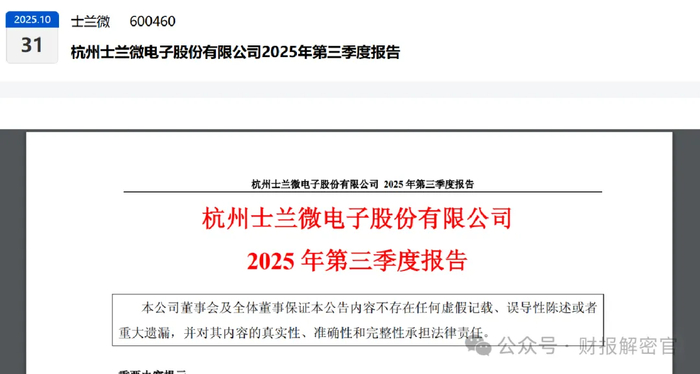
Core Viewpoint - The company Silan Microelectronics reported a significant increase in net profit for Q3, reaching 349 million yuan, a year-on-year growth of 1108.75% [1][3]. Financial Performance - The net cash received from sales reached 1.199 billion yuan, more than three times the net profit, with a year-on-year increase of 722.38% [3]. - The net increase in cash and cash equivalents was reported at -3.757 million yuan, reflecting a 74.87% change [3]. - The company's bad debt provision at the end of the reporting period was 46.8482 million yuan, a 39.62% increase compared to the same period last year, which is significantly higher than the growth rates of revenue and profit [9][10]. Shareholder Dynamics - Key shareholders include the National Integrated Circuit Industry Investment Fund, holding 5.22%, and Hong Kong Central Clearing Limited, indicating strategic interest from significant institutional investors [4][5]. - The presence of the National Fund serves as a "national certification," suggesting alignment with national strategies to address critical issues in the semiconductor industry [5]. Strategic Positioning - The company has successfully transitioned from traditional consumer electronics to high-demand sectors such as new energy vehicles, photovoltaic storage, and industrial control, which are characterized by high added value [7]. - The shift in product structure and the company's entry into high-end markets have led to a transformation in its business model from "order-based production" to "strategic supply," enhancing customer relationships and cash flow [7]. Long-term Outlook - The company's identity as a key enterprise in national planning, along with support from the National Fund, provides advantages in R&D investment, capacity expansion, and ecosystem collaboration [8]. - The simultaneous interest from institutional investors suggests that the fundamental changes in the company may be long-term and strategic rather than short-term fluctuations [6]. Conclusion - The financial report indicates a significant transformation for Silan Microelectronics, reflecting a successful transition from technological breakthroughs to commercial realization, supported by national strategies and institutional backing [11][12].

资本“运动特质”的数字跃迁——从“惊险跳跃”到“光速闭环”
Jing Ji Guan Cha Bao· 2026-01-19 02:25
Core Insights - The article discusses the transformation of capital movement in the digital age, emphasizing the shift from traditional methods to a near real-time, globally interconnected "light-speed closed loop" due to advancements in technologies like blockchain, AI, and IoT [1][3]. Theoretical Foundation - Marx's analysis of capital movement includes three forms: monetary capital circulation (G-W...P...W'-G'), production capital circulation (P...W'-G'-W...P), and commodity capital circulation (W'-G'-W...P...W'). The efficiency of capital movement is determined by turnover time, with shorter times leading to higher annual surplus value rates [2]. - The successful reproduction of social total capital relies on maintaining proportional relationships between the two main classes of production, as any imbalance can lead to economic crises [2]. Micro Circulation Acceleration - Digital technology has significantly compressed capital turnover time and optimized social production ratios, leading to a "digital leap" in capital movement [3]. - **Production Cycle (G-W...P)**: Companies like SHEIN utilize data analytics and AI to minimize inventory, achieving a turnover time of just 7 days compared to the traditional 180 days in the apparel industry, thus reducing capital occupancy in production [5]. - **Circulation Cycle (W'-G')**: Blockchain technology has streamlined cross-border payments, reducing transaction times from 7-10 days to under 4 hours, with a 40% reduction in fees, enhancing the speed of capital transformation [6]. - **Reproduction Cycle (G'-G)**: The C2M model allows for real-time feedback from consumer data, enabling rapid product iteration and efficient capital cycles, creating a self-optimizing "light-speed closed loop" [7]. Macro Circulation Structural Imbalance - The micro-efficiency revolution does not guarantee macro-level stability and may exacerbate structural contradictions [8]. - **Virtual Economy Expansion**: The global financial derivatives market has reached 8.2 times the size of the real economy, driven by AI quantitative trading, which can lead to systemic risks during market volatility [9]. - **Ecological Costs of Capital Movement**: Bitcoin mining consumes more electricity annually than Sweden, highlighting the environmental impact of high-energy capital movement models [10]. - **Global Value Chain Fragmentation**: Geopolitical factors hinder the optimal allocation of resources, as seen in the U.S. policies that force companies to relocate manufacturing, disrupting global supply chains [12]. China's Coordinated Practice - China’s governance practices aim to balance the efficiency and risks associated with accelerated capital movement [13]. - **Technological Empowerment**: Initiatives like the "East Data West Computing" project optimize resource allocation and reduce costs, enhancing macro movement efficiency [13]. - **Regulatory Frameworks**: The introduction of mechanisms like the "regulatory sandbox" aims to prevent disorderly capital expansion and ensure that financial technology serves the real economy [13]. - **Process Reengineering**: The "digital port" system has significantly reduced customs clearance times and created profit-sharing mechanisms for stakeholders, promoting equitable benefits from capital movement [13].
科技日报:“贴标签式创新”要不得
Ke Ji Ri Bao· 2026-01-19 00:39
Core Insights - The 2026 CES in Las Vegas highlighted AI as the main focus, but many products labeled as "AI" have faced criticism for not meeting real user needs [1][2] - There is a trend of "labeling innovation" where companies create products that appear technologically advanced but fail to address practical consumer demands [1][2] Group 1: Product Critique - Products like the smart hair clipper require cumbersome setups, such as wearing a mask and connecting to an app, which contradicts the core desire for convenience in home haircuts [1] - Smart refrigerators claiming to recognize ingredients have a low accuracy rate, with 83% of users abandoning them after initial use [1] - Smart pillows designed to monitor sleep quality often have issues like hard materials and frequent false triggers, leading to poor user experiences [1] Group 2: Market and User Perspectives - The superficial use of advanced technologies like AI and IoT for marketing can lead to short-term gains but risks long-term market viability [2] - Consumers are increasingly skeptical of products that prioritize concepts over practical effectiveness, which can erode trust in genuine technological innovations [2] - Successful innovation requires a balance between technological advancement and addressing real user needs, emphasizing the importance of "human-centered" design [2]
创新治理方式 守护“舌尖上的安全”
Xin Lang Cai Jing· 2026-01-18 21:31
Core Viewpoint - Food safety is a fundamental aspect of public welfare and a crucial foundation for high-quality economic and social development in China. Recent governance efforts have made significant progress in enhancing food safety regulations and practices across the entire supply chain [1][2]. Group 1: Regulatory Framework and Innovations - The implementation of the "Opinions on Further Strengthening Food Safety Full-Chain Supervision" has effectively addressed regulatory barriers across production, storage, transportation, and sales [1]. - The introduction of the food safety law amendment includes regulations on the transportation of bulk liquid foods and the registration management of infant formula liquid milk [1]. - The promotion of "Internet + Bright Kitchen Bright Stove" and the integration of market supervision big data into a multi-dimensional analysis system have shifted regulatory approaches from reactive to proactive [1]. Group 2: Challenges in Food Safety Governance - New challenges in food safety governance arise from the rapid development of online food delivery and live-streaming sales, which outpace regulatory updates [2]. - There is a gap between consumer demand for information on emerging food products and the willingness of companies to disclose such information [2]. - Continuous innovation in governance methods is required to address these challenges and deepen food safety governance [2]. Group 3: Source Control and Industry Responsibility - Strengthening source control is essential for food safety, emphasizing the importance of strict regulations on agricultural inputs and food processing standards [2]. - Companies are encouraged to prioritize food safety over short-term profits and invest in technological innovations for sustainable food production [2]. Group 4: Smart Regulatory Models - The transition to digital and intelligent regulatory models is crucial for enhancing food safety governance efficiency [3]. - Utilizing big data, artificial intelligence, and the Internet of Things can create a smart regulatory system that enables early detection and response to risks [3]. - The establishment of a national data hub for market regulation plays a vital role in integrating data resources for effective risk management [3]. Group 5: Social Co-Governance and Public Participation - Public participation and social supervision are critical for effective food safety governance, with an increasing consumer focus on food safety [4]. - There is a need for improved scientific literacy among consumers regarding food safety issues, which can be addressed through innovative educational initiatives [4]. - Creating a collaborative governance atmosphere involving self-regulation by enterprises, government oversight, and public engagement is essential for food safety [4]. Group 6: Industry Development and Standards - Promoting the standardized development of the food industry is a long-term strategy for achieving food safety and industry advancement [5]. - The establishment of standards for special dietary foods and new food materials is necessary to guide compliant innovation and fill existing gaps [5]. - Companies should implement comprehensive quality safety management and traceability systems to enhance food safety from the ground up [5].