估值泡沫

Search documents
2021年上市以来涨了2500%,“245倍PE”的Palantir贵吗?
Hua Er Jie Jian Wen· 2025-08-11 01:07
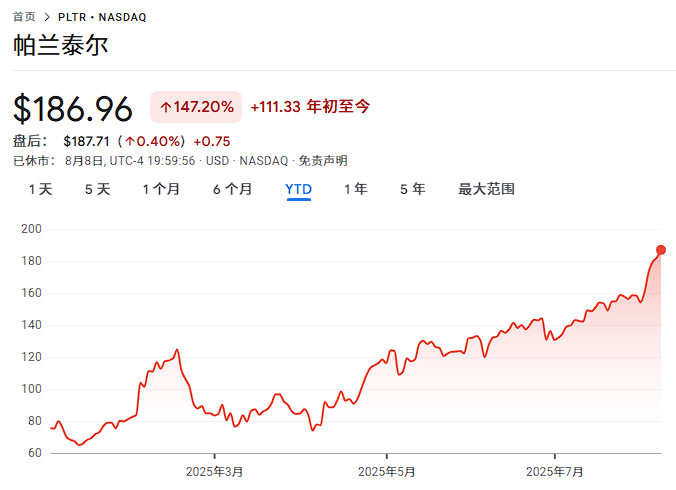
Core Viewpoint - Palantir's stock price has surged nearly 2500% since its IPO in 2021, making it the most expensive company in the S&P 500 with a projected P/E ratio of 245, driven by rapid AI application growth, government contracts, and strong recent earnings [1][3] Valuation Concerns - Analysts express concern over Palantir's high valuation compared to peers, with estimates suggesting the company needs to generate $60 billion in revenue over the next 12 months to align with industry valuation standards [3][4] - Current revenue expectations for fiscal year 2025 and 2026 are significantly lower, at $4 billion and $5.7 billion respectively, indicating a substantial gap between expectations and reality [4] - Analysts warn that if Palantir fails to meet high expectations, it could lead to a decline in stock price, similar to Tesla's recent performance [4][5] Bullish Sentiment - Some investors remain optimistic about Palantir's long-term growth potential, likening it to the trajectory of other tech giants like Netflix, which once had a much higher P/E ratio [6] - Despite valuation concerns, certain portfolio managers view Palantir as a must-hold stock to avoid underperformance relative to peers [6][7] - Piper Sandler raised its target price for Palantir from $170 to $182, maintaining a buy rating based on expectations of continued growth and high free cash flow margins [6][7]

凯德北京投资基金管理有限公司:纳指新高 苹果领跑
Sou Hu Cai Jing· 2025-08-09 04:16
Group 1 - The Nasdaq index has set a new historical record for the fifth time this week, with Apple contributing the largest increase of 13% [2] - The surge in technology stocks is driven by market bets on the new AI era [2] Group 2 - Apple's pre-sale data for Vision Pro exceeded expectations, leading to a revaluation of the company [3] - Revenue from the Greater China region has rebounded, and the market share of iPhone 15 has increased [3] - Apple announced a $110 billion share buyback plan, setting a record in U.S. stock history [3] Group 3 - Major tech giants like Microsoft and Google have exceeded expectations in capital expenditures as AI implementation accelerates [4] - The Federal Reserve has signaled a dovish stance, boosting growth stocks [4] - Seven major tech companies have a free cash flow ratio that meets the S&P 35% benchmark [4] - The Nasdaq's price-to-earnings ratio has risen to 32 times, nearing levels seen during the internet bubble [4] - The short-selling ratio has dropped to a historical low, indicating overheated market sentiment [4] - Retail options trading volume has surged, with call options accounting for 78% [4] - The current market rally is attributed to both the realization of AI benefits and liquidity-driven exuberance [4] - As Apple's market capitalization approaches $3 trillion, investors are cautioned that historical highs do not exempt from risks [4]


估值达到科网泡沫以来新高,美国科技股扛得住吗?
Hua Er Jie Jian Wen· 2025-08-08 01:31
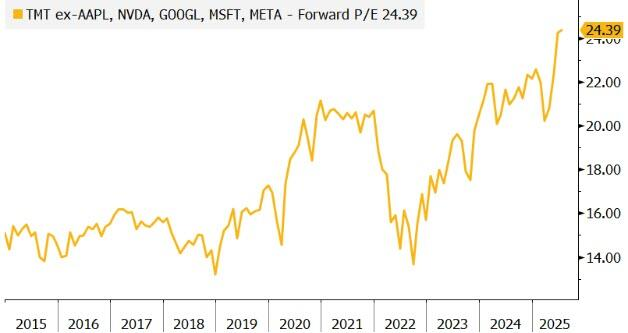
Core Insights - The TMT sector in the U.S. is showing warning signs similar to the 2000 dot-com bubble, with high valuations, market concentration, and rising internal correlations [1][10] Valuation and Growth Expectations - The TMT sector's forward P/E ratio has reached 26.7, the highest since 2009, significantly above the historical average [1][2] - Excluding the "Tech Seven," the remaining companies in the TMT sector show even more severe signs of valuation bubble, with a P/E ratio nearing 24.4, which is 11.7 standard deviations above the 2015-2019 average [2] - The TMT sector's earnings growth has outperformed the S&P 500 since Q3 2023, with expectations of an 11.8% growth rate by H2 2025, which is 1.8 times the overall index growth [5] Market Concentration - The TMT sector accounts for 44.2% of the S&P 500's total market capitalization, approaching the historical peak of 44.7% from February 2000 [1][6] - The sector's market share has increased from 33.8% pre-pandemic, indicating a significant rise in concentration risk [6][8] Internal Correlation and Market Pressure - The internal correlation among TMT stocks has risen, often seen as a precursor to market corrections, currently averaging 0.49, well above the long-term average since 2010 [10][11] - Historical data suggests that previous peaks in correlation have led to market adjustments approximately six months later, indicating potential pressure on the sector in early 2025 [11]
逾300只量化基金净值创历史新高 小微盘“高光”背后有何风险?
Di Yi Cai Jing· 2025-07-30 03:22
Group 1 - The A-share market has recently rebounded, with small-cap stocks outperforming the broader market significantly, leading to a collective rise in the net value of quantitative public funds, with over 97% achieving positive returns this year [1][2][3] - The Wind data shows that as of July 28, 314 out of 652 quantitative public funds have refreshed their historical net value highs, representing over 48% of the total [2][3] - The small-cap stock index reached a historical high of 476,824.12 points on July 29, with a year-to-date return of 50.23%, significantly outperforming larger indices [2][3] Group 2 - Due to the limited capacity of small-cap stocks to absorb funds, several high-performing products have implemented purchase limits, with some reducing the daily purchase limit to as low as 1,000 yuan [3][4] - Approximately 28 quantitative products are currently under restrictions for large purchases, with some tightening their purchase limits further [4] - Fund managers indicate that maintaining a comfortable management scale around 20 billion yuan is crucial for effective strategy execution [4] Group 3 - Despite the strong performance of small-cap stocks, there are emerging risks, including high crowding in small-cap strategies, which could lead to significant downturns if market sentiment shifts [6][7][8] - Analysts have noted that the current rally in small-cap stocks is heavily reliant on sentiment and liquidity rather than solid performance fundamentals, raising concerns about potential valuation bubbles [6][7] - Fund managers have cautioned about the risks associated with high crowding and the need for careful monitoring of market volatility and external uncertainties [7][8]
逾300只量化基金净值创历史新高,小微盘“高光”背后有何风险?
Di Yi Cai Jing· 2025-07-30 03:09
Group 1 - The core viewpoint of the articles highlights the strong performance of small-cap stocks in the A-share market, significantly outperforming larger indices, leading to a surge in public quantitative fund net values, with over 97% of these funds achieving positive returns this year [1][2][3] - The Wind data indicates that as of July 28, 314 out of 652 public quantitative funds have reached historical net value highs, representing over 48% of the total [2][3] - The small-cap stock index reached a historical high of 476,824.12 points on July 29, with a year-to-date return of 50.23%, while the mid-cap indices also showed substantial gains compared to larger indices [2][3] Group 2 - Due to the limited capacity of small-cap stocks to absorb funds, several high-performing products have implemented purchase limits, with some reducing daily purchase limits to as low as 1,000 yuan [3][4] - Approximately 28 quantitative products, including the CITIC Prudential Multi-Strategy Fund, have suspended large purchases, indicating a trend towards tighter purchase limits across the sector [4] - Fund managers suggest that a comfortable management scale for small-cap products is around 20 billion yuan, with a target position maintained between 60% to 80% to manage risks effectively [4] Group 3 - Analysts express concerns about the high "crowding" in small-cap stocks, which could lead to significant risks if market sentiment shifts, although the likelihood of extreme adjustments similar to early 2024 is considered low [6][7][8] - The reliance on sentiment and liquidity in small-cap stocks has raised concerns about their underlying fragility, with many stocks driven by themes rather than solid performance, leading to potential valuation bubbles [6][7] - Fund managers have cautioned about the need to monitor market volatility closely and prepare for potential risks, emphasizing that the current high levels of investment in small-cap stocks may not be sustainable [7][8]
美国非农数据好于预期,美联储降息预期生变如何影响全球市场?
Sou Hu Cai Jing· 2025-07-03 23:20
Group 1 - The divergence between the ADP employment data and non-farm payroll data in June indicates a potential shift in the Federal Reserve's policy direction, with the ADP data unexpectedly contracting [3] - The non-farm payroll data for June showed a seasonally adjusted increase of 147,000 jobs, significantly exceeding market expectations, which diminishes the likelihood of a rate cut by the Federal Reserve in July [4] - The market is now shifting its expectations for a potential rate cut to September, as the strong non-farm data suggests continued high interest rates [4] Group 2 - Despite the Federal Reserve's reluctance to cut rates, the U.S. stock market continues to rise, with indices like the Nasdaq and S&P 500 reaching historical highs, indicating a strong market performance [5] - The high interest rate environment may lead investors to prefer U.S. Treasury securities over equities, as the average dividend yield of listed companies rarely exceeds Treasury yields [5] - The recovery of the stock market after a significant decline earlier in the year suggests a strong rebound, although uncertainties remain regarding the Federal Reserve's future actions [6] Group 3 - The stock market's ability to recover quickly from earlier losses may be attributed to the influence of major technology companies and the resolution of issues like the debt ceiling, which positively affects market risk appetite [5][6] - The market's valuation levels have increased again, raising concerns about the return of valuation bubbles, while the underlying risks remain unaddressed [6] - The ongoing speculation about the Federal Reserve's rate decisions continues to drive market behavior, with potential volatility if unexpected events occur [6]

基金调仓创新药?估值偏差暴露资金“迁徙”,机构紧急提示:短期交易过热
券商中国· 2025-06-30 05:18
Core Viewpoint - The innovative drug sector has shown a sharp upward trend, attracting funds that previously focused on other pharmaceutical segments to increase their positions in innovative drugs [1][3]. Fund Adjustments - Several funds have shifted their focus towards innovative drugs, with notable examples including Huafu Health Entertainment, which previously held stocks like Olin Bio, Mingyue Lens, and others, but has now significantly adjusted its portfolio towards innovative drugs [3]. - The fund manager of Yongying Medical Health expressed optimism about the innovative drug sector, highlighting the upcoming product release cycles and potential business development transactions [4]. Fund Inflows - There has been a notable influx of capital into innovative drug ETFs, with 17 out of 20 ETFs experiencing positive growth in shares, indicating strong investor interest [6]. - New innovative drug-themed funds are being launched, reflecting the ongoing enthusiasm in the sector [6]. Market Sentiment and Risks - Despite the positive sentiment, there are warnings from professionals about potential overvaluation and market overheating in certain stocks within the innovative drug sector [2][8]. - The market is currently experiencing a correction, which some analysts view as a necessary adjustment after a rapid rise in stock prices [8]. Long-term Outlook - Analysts believe that the current innovative drug market dynamics represent a rational correction of previously overly pessimistic expectations, with strong underlying momentum supporting continued performance in the sector [7][8].

稳定币热潮席卷全球市场 “估值泡沫”警报响起
智通财经网· 2025-06-30 04:16
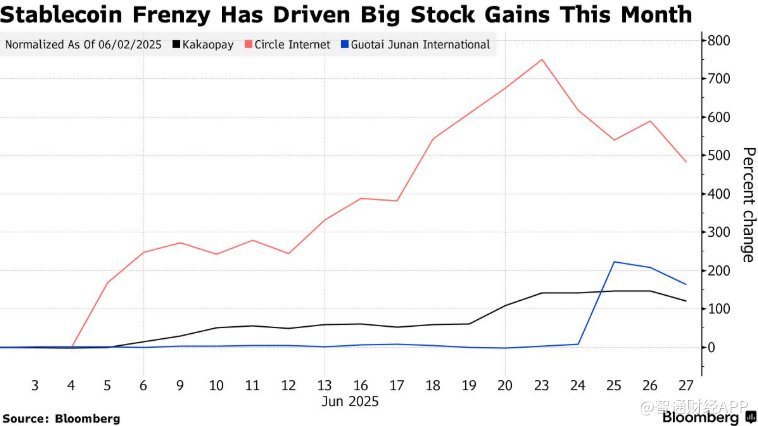
Group 1 - The surge in stablecoin popularity has led to significant stock price increases for related emerging technology companies, with Circle's stock rising approximately 500% since its New York listing three weeks ago [1] - Investors are showing caution as short positions in Circle continue to rise, indicating a potential concern over the sustainability of the stock's rapid increase [1] - In South Korea, both global and local funds are selling Kakaopay Corp. shares, which have doubled in price over the past month, contrasting with the enthusiasm of retail investors [1][3] Group 2 - The development momentum of stablecoins is strong, with legislative progress in the U.S. Senate and Hong Kong, and South Korea's commitment to allowing local companies to issue such tokens [3] - Circle's market capitalization has surpassed $40 billion, exceeding that of more than half of the companies in the S&P 500 index, and its USDC is the second-largest stablecoin by market share [3] - Kakaopay's stock has outperformed all peers in the FTSE Global Fintech and Blockchain Index, with a price increase nearly double that of Robinhood [3][4] Group 3 - Analysts from Citigroup have rated Kakaopay as a "sell," citing concerns over its high valuation despite the long-term potential of the stablecoin opportunity [4] - The rise in stablecoin-related stocks is influencing the stock prices of Kakao and its competitor Naver, as well as U.S. counterparts like Coinbase [4] Group 4 - Despite strong support from leaders like Trump and Lee Jae-myung, risks remain, with warnings from the Bank of Korea about the potential impact of stablecoin adoption on effective monetary policy [5] - The International Bank for Settlements has expressed uncertainty about the future of stablecoins, highlighting concerns over high valuations in related stocks [5] - Kakaopay's stock experienced a 10% drop after a brief trading halt, as regulators advised caution amid rapid price increases [5]

孙正义被告了
创业家· 2025-06-25 10:02
Core Viewpoint - The article discusses the legal dispute between SoftBank and Credit Suisse regarding the bankruptcy of Greensill Capital, highlighting the financial losses incurred by both parties and the implications for the investment landscape [4][18][25]. Group 1: Background of the Dispute - Greensill Capital, founded in 2011, specialized in supply chain finance, providing short-term loans to small and medium-sized enterprises [8]. - SoftBank invested approximately $1.5 billion in Greensill Capital between 2019 and 2020, becoming a major shareholder [9]. - The company faced difficulties during the COVID-19 pandemic, leading to its bankruptcy in 2021, which resulted in significant losses for both SoftBank and Credit Suisse [11][12]. Group 2: Legal Proceedings - Credit Suisse is suing SoftBank for $440 million, claiming it is owed due to Greensill Capital's lending to Katerra, a construction technology company that also went bankrupt [18][19]. - The lawsuit centers around the assertion that SoftBank's actions to protect its investments led to the loss of funds that should have been returned to Credit Suisse [21][22]. - The court proceedings have revealed conflicting narratives, with SoftBank denying responsibility and attributing the losses to Credit Suisse's mismanagement [22][23]. Group 3: Broader Implications - The article emphasizes the trend of high-profile unicorns facing bankruptcy, leading to significant financial repercussions for their investors, including SoftBank and Temasek [25][27]. - It highlights the common characteristics of these failed companies, such as high valuations and rapid financing, which ultimately resulted in unsustainable business models [28][30]. - The current investment climate is marked by increased caution among investors, reflecting a shift towards more prudent and sustainable investment strategies [30][32].


Labubu价格崩盘引爆市场担忧,泡泡玛特高股价“像风一样来,像风一样去”?
Xin Lang Cai Jing· 2025-06-23 10:03
Core Viewpoint - The stock price of Pop Mart (09992.HK) has significantly declined after reaching a historical high of 283.4 HKD, with a notable drop of 14.46% to 239.6 HKD, leading to a market capitalization loss of approximately 38 billion HKD, primarily driven by a sharp decrease in the prices of its flagship product, Labubu [2][9]. Group 1: Stock Price and Market Reaction - Following the news of Labubu's price collapse, Pop Mart's stock experienced a sharp decline, with a drop of over 6% on June 20, closing at 239.6 HKD, marking a 3.62% decrease for the day [2][9]. - The significant drop in stock price is attributed to the drastic reduction in Labubu's market price, which was exacerbated by a large-scale restock by Pop Mart [5][9]. - The market has seen a surge in short-selling activity, with short positions increasing from 1.438 million shares in early April to 3.692 million shares by June 17, a rise of 157% [10][12]. Group 2: Product Pricing and Market Dynamics - The price of Labubu's 3.0 series has plummeted, with the average transaction price dropping by 45% to 2547.84 RMB, and non-hidden variants experiencing a 54% decline [6][9]. - The drastic increase in supply due to Pop Mart's restocking efforts has outpaced market demand, leading to a rapid decline in secondary market prices [5][6]. - The overall market sentiment has shifted, with many consumers expressing dissatisfaction after purchasing Labubu at high prices, only to see their value drop significantly [9]. Group 3: Valuation Concerns - Pop Mart's current price-to-earnings (P/E) ratio stands at 95.34, significantly higher than competitors, raising concerns about a potential market bubble [12][14]. - Analysts have pointed out that the high valuation of Pop Mart, combined with the recent price drops, indicates a possible overvaluation in the current market environment [14][18]. - The company's reliance on IP products, such as Labubu, poses risks due to the cyclical nature of IP popularity and the potential for diminishing returns as the novelty wears off [17][18].