
劳动力市场疲软

Search documents
全球风险资产大跌“吓”出黄金买盘!金价在暴跌后企稳反弹
Zhi Tong Cai Jing· 2025-11-05 02:36
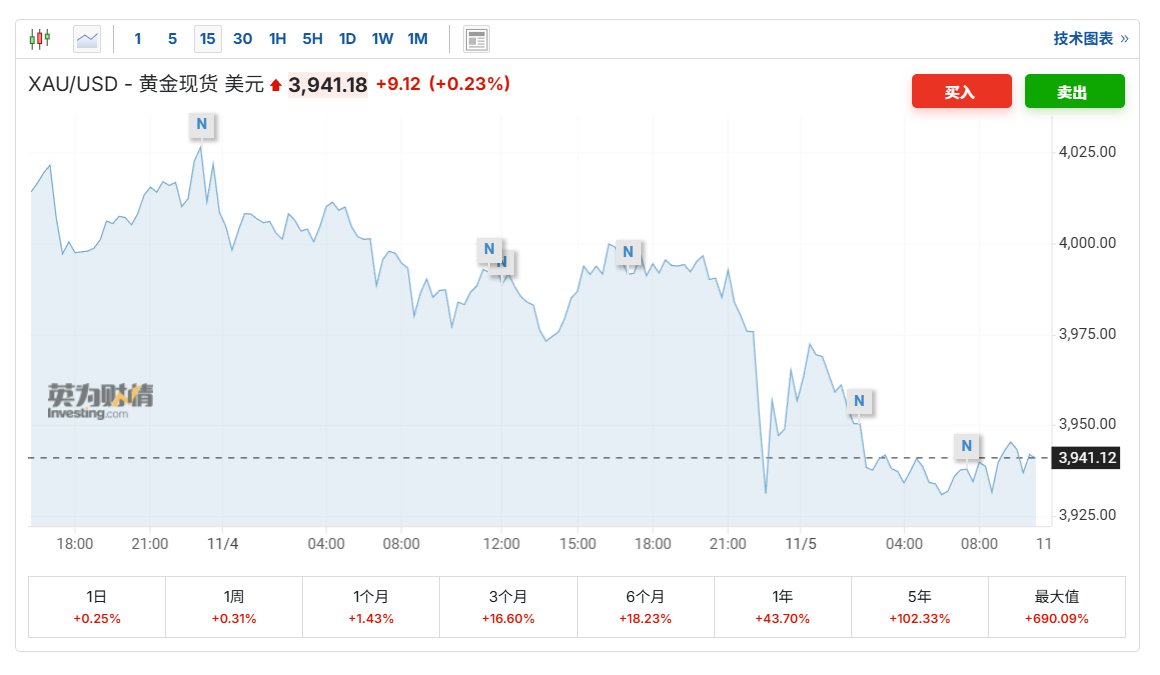
Core Insights - Gold prices rebounded after experiencing the largest single-day drop in over a week, driven by increased demand for safe-haven assets amid widespread market risk aversion [1] - As of the latest report, spot gold prices rose to approximately $3941.18 per ounce, while the dollar index remained stable after reaching its highest level since mid-May [2] - The Federal Reserve officials did not indicate support for further rate cuts in December, as they weigh the dual risks of inflation and a weak labor market [4] Group 1 - Gold prices have seen a cumulative increase of around 50% this year, despite a recent pullback following a historical high [1] - The recent price correction is attributed to concerns over high valuations and outflows from gold ETFs, with traders assessing whether the decline is nearing its end [1] - Factors contributing to the current price range of gold between $3800 and $4050 per ounce include uncertainty regarding the Federal Reserve's rate cut outlook and concerns over Chinese retail demand for gold [1] Group 2 - The prices of silver remained stable, while palladium and platinum experienced declines [2] - Upcoming speeches from Federal Reserve officials, including St. Louis Fed President Bullard and Cleveland Fed President Mester, are expected to provide further insights into the Fed's stance [4]

Job openings in October slumped to the lowest level since early February, Indeed measure shows
CNBC· 2025-11-04 17:41
Core Insights - Employment opportunities have reached their lowest level in over 4.5 years due to the ongoing government shutdown, as reported by Indeed [1] - The Job Postings Index fell to 101.9 as of October 24, marking a 0.5% decline from the start of the month and a 3.5% decrease from mid-August [2] - The Bureau of Labor Statistics (BLS) has not released its monthly Job Openings and Labor Turnover Survey (JOLTS) due to the government shutdown, leaving economists to rely on alternative data [3] Employment Trends - The most recent JOLTS report indicated job openings totaled 7.23 million, unchanged from July but down 7% from January [4] - There has been a pullback in salary offerings, with year-over-year wage growth in Indeed postings decreasing from 3.4% in January to 2.5% in August [4] Federal Reserve Response - The Federal Open Market Committee recently voted 10-2 to lower the benchmark interest rate by a quarter percentage point to a target range of 3.75%-4% due to concerns over a softening labor market [5] - Fed officials are closely monitoring real-time data, indicating a slowdown in hiring and a slight uptick in the unemployment rate over the summer [6] - Economists expect a decline of 60,000 jobs in October and an increase in the unemployment rate to 4.5% based on the anticipated BLS report [6]

美联储理事沃勒:我与贝森特的面试非常顺利,进行得很快。尚未与特朗普总统通话,不清楚是否会通话。再次降息是正确的做法,过去六周
Sou Hu Cai Jing· 2025-10-16 11:46
Core Viewpoint - The Federal Reserve Governor Waller expressed that a further interest rate cut is appropriate, as there has been little change in the economic situation over the past six weeks, with private sector data indicating a weak labor market [1] Group 1: Economic Conditions - The labor market continues to show signs of weakness, as reflected in private sector data [1] - There is uncertainty regarding tariffs and the potential impact of AI on productivity, which affects CEO hiring intentions [1] Group 2: Federal Reserve Actions - Waller emphasized the importance of cautious actions to avoid mistakes in monetary policy [1] - There has been no communication with President Trump regarding future discussions, leaving uncertainty about potential dialogues [1]
Fed's Powell points to persistent labor market weakness as government shutdown delays official reports
Fox Business· 2025-10-14 16:56
Core Viewpoint - The Federal Reserve Chair Jerome Powell indicated that the economy is experiencing a softening labor market, with delays in official jobs and inflation data due to the government shutdown [1][2]. Labor Market Conditions - Despite a low unemployment rate through August, payroll gains have significantly slowed, attributed to a decline in labor force growth from lower immigration and participation [3]. - Available evidence suggests that layoffs and hiring remain low, with both households' perceptions of job availability and firms' perceptions of hiring difficulty showing downward trends [3].

美联储理事鲍曼预计年内还将降息两次 以应对劳动力市场疲软
智通财经网· 2025-10-14 15:45
Core Viewpoint - The Federal Reserve is expected to continue lowering interest rates in the remaining two policy meetings of 2025 to address a slowing labor market and weakening economic growth [1][2] Group 1: Interest Rate Outlook - Federal Reserve Governor Bowman anticipates two more rate cuts before the end of the year, with the current benchmark rate set between 4.00% and 4.25%, marking the first cut since December of last year by 25 basis points [1] - The futures market is betting on a 25 basis point cut in each of the upcoming meetings on October 28-29 and in the second week of December [1] Group 2: Economic Conditions - The labor market is showing signs of weakness, prompting a consensus among Federal Reserve officials for further monetary easing [1] - Philadelphia Fed President Harker supports two additional 25 basis point cuts this year, emphasizing that current policies are still "slightly tight" and that further easing aligns with the latest economic forecasts [2] - Harker warns that the momentum in the U.S. labor market is diminishing, with third-quarter growth above trend but consumer spending increasingly reliant on high-income groups [2]
美联储戴利:劳动力市场疲软和通胀放缓,证明美联储降息合理
Sou Hu Cai Jing· 2025-10-10 09:30
Core Viewpoint - The recent comments from Federal Reserve's Daly indicate that the softening labor market and inflation levels being "far below" previous concerns validate last month's interest rate cut and suggest potential for further cuts in the future [1] Group 1: Economic Conditions - The economy is experiencing a slight slowdown, with consumers depleting their excess savings while facing higher price levels [1] - Restrictive monetary policy is also contributing to the current economic environment [1] Group 2: Labor Market Concerns - Daly emphasizes that the current moment is critical, and without proper risk management, the softening labor market could become more concerning [1]
美联储戴利:劳动力市场疲软和通胀放缓 证明美联储降息合理
Xin Hua Cai Jing· 2025-10-10 03:04
Core Viewpoint - The recent comments from the Federal Reserve's Daly indicate that the softening labor market and lower-than-expected inflation levels justify last month's interest rate cut and suggest the possibility of further rate cuts in the future [1] Group 1: Economic Conditions - The economy is experiencing a slight slowdown, with consumers depleting their excess savings while facing higher price levels [1] - There is a restrictive monetary policy currently in place, which is contributing to the economic conditions [1] Group 2: Labor Market Concerns - The labor market's weakness is a significant concern, and without proper risk management, it could become more troubling [1]
美国纽约联储主席威廉姆斯:支持今年进一步降息
Hua Er Jie Jian Wen· 2025-10-09 09:13
Core Viewpoint - The President of the New York Federal Reserve, Williams, supports further interest rate cuts this year and does not believe the economy is on the brink of recession [1] Group 1: Economic Outlook - Williams expresses concern over the slowing job market, indicating it is worth monitoring [1] - The inflation outlook is not as alarming as it was earlier in the year [1] - A weak labor market could help suppress inflation [1]
【百利好黄金专题】强化降息预期 黄金剑指4000
Sou Hu Cai Jing· 2025-10-09 03:00
Group 1 - Gold prices have been rising since August 22, closing September with a strong bullish trend, indicating robust market momentum [1] - The Federal Reserve lowered interest rates by 25 basis points during the September meeting, with expectations for further rate cuts increasing due to ongoing labor market weakness [1][4] - As of late October, the probability of a rate cut has risen to nearly 100%, with a 99.4% chance of a 25 basis point cut in October [4] Group 2 - The labor market is showing signs of weakness, with non-farm payrolls increasing by only 22,000 in August and a decrease of 32,000 in September's ADP data [3] - Revised data from the Labor Department indicates a reduction of 911,000 in actual non-farm employment over the past year, with an average monthly increase of only 71,000 [3] - Job openings rose to 7.23 million in August, but hiring plans have dropped to the lowest level since June of the previous year, indicating fewer opportunities for job seekers [3] Group 3 - The recent government shutdown on October 1 has raised concerns about delayed data releases, further increasing the likelihood of a dovish shift from the Federal Reserve [4] - Analysts suggest that if unemployment rates rise significantly, the Federal Reserve may need to adopt more aggressive rate cuts, potentially leading to market volatility [4] - Technically, gold is showing a bullish trend on both weekly and monthly charts, with expectations of reaching around $4,000 in the short term [4]

No jobs report today. But there are plenty of other signs the labor market is in bad shape.
Yahoo Finance· 2025-10-03 20:30
Core Insights - The labor market is showing signs of weakness, with private sector job losses and declining job openings indicating a potential slowdown in economic activity [2][7]. Job Market Data - ADP reported a loss of 32,000 jobs in the private sector for September, significantly below expectations [2]. - Job openings fell to 17 million in September, representing a 17.2% decrease year-over-year, marking the lowest level of active job postings in at least three years [3]. - The professional and business services industry experienced the steepest decline in job openings, down 31.4% year-over-year, followed by the government sector and "other services," both down 30.5% year-over-year [4]. Hiring Trends - Employers have announced plans to hire 204,939 workers in 2023, a 58% decrease compared to the same period last year, marking the lowest hiring plans for the first nine months since 2009 [5]. - Seasonal hiring plans are significantly subdued, with only 100,800 seasonal hires planned last month compared to 401,850 in October of the previous year [6]. - The overall hiring slowdown is attributed to lower consumer confidence and tariff pressures, particularly affecting the retail sector as the holiday season approaches [6].