
可回收火箭技术

Search documents
超捷股份:可回收火箭趋势将带动结构件高频制造与维护需求
2 1 Shi Ji Jing Ji Bao Dao· 2026-01-06 10:19
Core Viewpoint - The core value of the reusable technology in rocket first-stage boosters lies in the repeated use of high-value components such as engines, which will create ongoing after-sales demand for the company [1] Group 1 - The maturity of reusable technology is expected to significantly increase launch frequency, driving growth in overall rocket manufacturing demand [1] - The company anticipates benefiting from a dual-driven model of "high-frequency launches + maintenance and updates," leading to more order opportunities and new business growth points [1]
商业航天板块概览
2026-01-05 15:42
Summary of Key Points from the Conference Call on Commercial Aerospace Sector Industry Overview - The commercial aerospace sector in China is rapidly advancing, with private companies exploring low-cost reusable rocket technologies. Despite initial failures in trials, companies like Antarctic Aerospace and New Power are preparing for IPOs to seize market opportunities [1][2] - China Knowledge Network plans to launch approximately 1,200 satellites by 2029, necessitating accelerated development in commercial aerospace [1][2] Core Insights and Arguments - Reusable rocket technology, particularly the recovery of first-stage rockets, can significantly reduce launch costs, with various recovery methods being explored, including legged recovery, chopstick fixtures, and net recovery [1][4] - Learning from SpaceX's experience, Chinese commercial aerospace must focus on engineering validation through continuous testing and improvement of reusable rocket technology [1][5] - The Chinese government needs to increase R&D investment in private enterprises, expedite engineering validation, enhance international cooperation, and establish comprehensive laws and regulations to ensure healthy industry development and close the gap with international leaders [1][8] Innovations and Developments - China has innovated in offshore rocket recovery by employing a net recovery method, which captures rockets using an intercepting net, thus avoiding the risks associated with vertical landings. A dedicated vessel for this method is set for its first test in January 2025 [1][9] - The recent progress in electronic launch technology, with a project awarded to Lianchuang Optoelectronics for high-temperature superconducting components, is expected to be completed by 2028, positioning China ahead of the U.S. in this field [3][12] Financial and Market Dynamics - The cost structure of commercial launches indicates that first-stage rockets account for 60% to 70% of total costs. Successful recovery could reduce overall costs to about 30% of the original [4][15] - The recent capital increase of 396 million yuan in China Aerospace Technology Group's commercial rocket company signifies the state’s formal entry into the commercial aerospace sector, which may facilitate future IPO opportunities and resource integration [3][17] Competitive Landscape - The commercial aerospace sector is characterized by a mix of military and civilian projects, with military aerospace focusing on satellite systems and commercial aerospace relying on private enterprises for development and launch services [1][18] - Major companies in the commercial aerospace sector include Antarctic Aerospace, New Power, and Blue Arrow Space, which are advancing various low-cost, reusable rocket technologies [1][6][28] Future Outlook - The commercial aerospace sector is expected to attract significant capital investment, with projections indicating that the total market value could reach 2 trillion yuan in the next five years, with half attributed to state-owned enterprises and the remainder to private firms [1][34] - The industry is poised for growth as technological advancements and increasing market demand drive further investment and innovation [1][32][34]
从0到1迈入黄金发展期:中国商业火箭产业链全景拆解
Hua Er Jie Jian Wen· 2026-01-05 08:34
Core Insights - China's commercial space industry is at a critical turning point similar to SpaceX in 2015, with the recent test flights of Zhuque-3 and Long March 12A marking the transition of reusable rocket technology from experimental to engineering implementation [1][2] - The opening of the fifth set of standards for the Sci-Tech Innovation Board has cleared obstacles for IPOs of rocket companies, indicating a significant market opportunity driven by the rigid demand for satellite internet and the cost revolution brought by reusable technology [1][10][13] Market Opportunity - The satellite internet construction is expected to create a trillion-dollar market, driven by the rapid deployment of satellite constellations such as GW and G60, which plan to deploy up to 44,816 satellites [1][7][9] - The annual replacement demand for nearly 9,000 satellites will create a substantial capacity gap, further fueling the demand for commercial launches [1][7] Technological Development - Reusable rocket technology is identified as the key to breaking the cost bottleneck in space transportation, with China currently in a phase similar to SpaceX's early technical ramp-up [2][18] - The recent test flights of Zhuque-3 and Long March 12A, despite not achieving complete recovery, signify the start of a concentrated exploration period for reusable rockets in China [2] Cost Advantages - The cost advantages of high-frequency reuse are significant, as demonstrated by SpaceX's Falcon 9, which has achieved a marginal reuse cost of $15 million per launch, compared to the average cost of $110 million to $180 million for expendable rockets [5] - If China's commercial rockets can achieve similar breakthroughs, launch costs could be drastically reduced, supporting the large-scale deployment of satellite internet [5] Investment Focus - Analysts suggest that investment should focus on the most valuable segments of the supply chain, particularly engine manufacturing and rocket structure, which will benefit first from high consumption before reusable technology matures [1][18] - The core components of a typical liquid rocket, such as engines and structures, account for a significant portion of hardware costs, with the first-stage engine and structure comprising 77.8% of the total [14][18] Policy and Capital Market - The improvement of policy frameworks and the opening of capital market exit channels are accelerating the transition of commercial space from a storytelling phase to a performance-driven phase [10][17] - The new IPO guidelines for the Sci-Tech Innovation Board directly pave the way for leading commercial rocket companies like Blue Arrow Aerospace and Interstellar Glory [10][13]

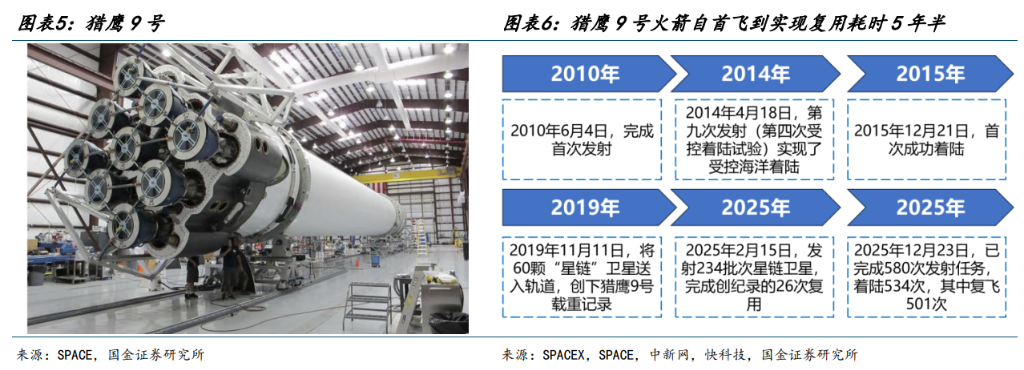
国金证券:2026年商业火箭公司可回收发射元年 看好火箭铲子股及新技术
智通财经网· 2026-01-05 03:34
Core Insights - The report from Guojin Securities emphasizes the strategic importance of seizing space resources for China, highlighting the current bottleneck in rocket capacity and predicting that 2026 will be the year of reusable commercial rockets, while also focusing on key stocks in the rocket sector and investment opportunities arising from new 3D printing technologies [1] Group 1: Urgency in Satellite Launches - The limited resources in low Earth orbit necessitate urgent satellite launches, as per the International Telecommunication Union's "first come, first served" rule, which pressures China to accelerate its satellite launches [2] - The theoretical capacity of near-Earth orbit is estimated to accommodate only about 60,000 satellites, with SpaceX's Starlink already having launched over 10,000 satellites and aiming for a total of 42,000, thereby occupying a significant portion of low Earth orbit resources [2] - Domestic plans, such as those from Xingwang and "G60," aim to deploy nearly 30,000 satellites, with a requirement to complete 10% of the constellation within nine years to avoid losing resources [2] Group 2: Cost Efficiency in Rocket Launches - High costs currently limit rocket launch efficiency, making reusable rockets a crucial technology for cost reduction, as demonstrated by SpaceX's Falcon 9, which has reduced costs by 60% through first-stage rocket reuse [3] - The cost of satellite launches in China has decreased from 115,000 yuan per kilogram in 2020 to 75,000 yuan per kilogram in 2024, indicating a trend towards lower launch costs [3] - The U.S. leads in rocket launches due to lower costs, with SpaceX's Falcon 9 having a per-kilogram launch cost of 14,000 to 18,000 yuan, and the U.S. is projected to conduct 158 rocket launches in 2024 [3] Group 3: Future of Reusable Rockets - The year 2026 is anticipated to mark the beginning of the era of reusable commercial rockets, with both state-owned and private companies making strides in this technology [3] - Recent attempts to launch reusable rockets, such as Long March 12A and Zhuque 3, indicate progress in this area, with future launches from commercial entities like Tianlong 3 and Lijian 2 also planned for 2026 [3] Group 4: Investment Opportunities in Rocket Components - The core components of rockets, including engines and structural elements, account for over 60% of total costs, making companies involved in these areas attractive investment targets [4] - 3D printing technology is seen as a key trend in the engine sector, with domestic companies actively adopting it to reduce costs and improve efficiency [4] - SpaceX's Raptor engine, which utilizes 3D printing, has achieved a 21% increase in thrust and a 40% reduction in weight, showcasing the potential benefits of this technology [4]

商业航天行业点评:新年献词首提商业航天,2026年行业更上一层楼
Guolian Minsheng Securities· 2026-01-04 03:15
Investment Rating - The report maintains a "Recommended" rating for the commercial aerospace industry [4] Core Insights - The commercial aerospace sector is expected to transition from initial scale expansion to a critical development phase focused on quality improvement and efficiency enhancement by 2026, as highlighted in a recent speech by President Xi Jinping [8] - The introduction of the Shanghai Stock Exchange's guidelines for commercial rocket companies is anticipated to accelerate the IPO process for private enterprises in the sector, particularly those with reusable rocket technology [8] - The efficiency of satellite constellation deployment is expected to improve, driven by advancements in rocket capacity and cost control, with reusable rockets playing a crucial role [8] - The concept of space computing is moving towards practical implementation, with SpaceX planning an IPO in 2026, which may influence domestic developments in space computing [8] Summary by Sections - **Rocket Sector**: The report indicates that 2026 will see the listing of main rocket manufacturers and a potential turning point for reusable technology, which is expected to enhance the launch capabilities of private companies [8] - **Satellite Sector**: The report emphasizes that the acceleration of low Earth orbit satellite launches will depend on the management of launch costs and rocket capacity, with reusable rockets being a key driver [8] - **Space Computing**: The report outlines a government-led initiative to develop a multi-core plan for space computing, focusing on specialized computing constellations and the integration of terrestrial and space computing capabilities [8] - **Investment Recommendations**: The report suggests focusing on leading companies in rocket components and satellite operations, which are likely to benefit from increased launch capacity and reduced costs [8]
蓝箭航天科创板IPO获受理:拟募资75亿元押注可回收火箭
Feng Huang Wang· 2025-12-31 13:32
Group 1 - The core point of the article is that Blue Arrow Aerospace Technology Co., Ltd. has officially received acceptance for its IPO application on the Sci-Tech Innovation Board, aiming to raise 7.5 billion yuan for reusable rocket capacity and technology enhancement projects [1] - The IPO application is significantly influenced by recent policy changes, specifically the guidelines released by the Shanghai Stock Exchange on December 26, which aim to promote innovation in the commercial aerospace sector [1] - Blue Arrow Aerospace has not yet achieved profitability, which aligns with the characteristics of the commercial aerospace industry that involves high investment and long cycles, allowing it to apply for listing under the fifth set of standards on the Sci-Tech Innovation Board [1] Group 2 - The company has been active in technical validation, with the recent successful launch of the Zhuque-3 reusable rocket on December 3, which included China's first attempt at recovering a rocket's first stage [1] - This flight validated the structural thermal protection and aerodynamic layout design during the "supersonic re-entry aerodynamic gliding phase," and tested the combined control strategy of the cold gas reaction control system and grid fins [1] - The funds raised from the IPO are intended to accelerate the engineering and commercialization process of the liquid oxygen-methane reusable technology route [1]

新浪财经资讯AI速递:昨夜今晨财经热点一览 丨2025年12月31日
Xin Lang Cai Jing· 2025-12-30 23:49
Currency and Economic Policy - The RMB to USD exchange rate broke the 7.0 mark on December 30, 2025, with an annual appreciation exceeding 4% [1][9] - The Federal Reserve's third interest rate cut of the year has led to a general decline in domestic bank USD deposit rates, with most falling below 3% [1][9] - The combination of currency appreciation and declining interest rates has effectively neutralized the interest income from USD deposits [1][9] Consumer Subsidies - The National Development and Reform Commission announced a new subsidy policy for replacing old household appliances, effective in 2026 [1][10] - Consumers can receive a subsidy of 15% of the sales price for purchasing energy-efficient appliances, with a maximum subsidy of 1500 yuan per item [1][10] Economic Rankings - Indian media reported that India has surpassed Japan to become the world's fourth-largest economy, based on purchasing power parity [1][11] - Predictions indicate that India may surpass Germany within the next three years, potentially becoming the third-largest economy globally [1][11] Market Trends - The domestic futures market experienced significant declines in precious metals and some non-ferrous commodities on December 30, 2025, with platinum and palladium futures hitting the limit down [2][12] - Analysts suggest that the recent downturn is not due to a deterioration in fundamentals but rather a response to previous rapid price increases and regulatory cooling measures [2][12] - The market is expected to enter a period of volatility, with recommendations for investors to adopt a defensive strategy and manage risk carefully [2][12] Household Savings - A new household savings classification system categorizes savings into six levels, with most households falling into the second tier (100,000 to 300,000 yuan) [3][13] - Only 0.37% of households have savings exceeding 500,000 yuan, indicating a concentration of wealth in lower tiers [3][13] Corporate Developments - Moutai announced that its flagship product, the 53-degree 500ml Flying Moutai, will be available on its official self-operated platform "i Moutai" starting in 2026 [3][14] - This move aims to enhance market-oriented transformation and ensure fair access for consumers while stabilizing market dynamics [3][14] Real Estate Taxation - The Ministry of Finance introduced a new regulation requiring individuals to pay a 3% value-added tax on the sale of homes purchased less than two years prior, effective January 1, 2026 [6][15] - Homes held for two years or more will be exempt from this tax, with previous policies being abolished [6][15] Tax Regulations - The State Council released the "Implementation Regulations of the Value-Added Tax Law," effective January 1, 2026, detailing taxpayer obligations and tax rate applications [7][16] - The regulations aim to enhance tax administration and ensure effective implementation of the value-added tax law [7][16]
商业航天新信号 几个关键趋势来了丨每日研选
Shang Hai Zheng Quan Bao· 2025-12-30 01:09
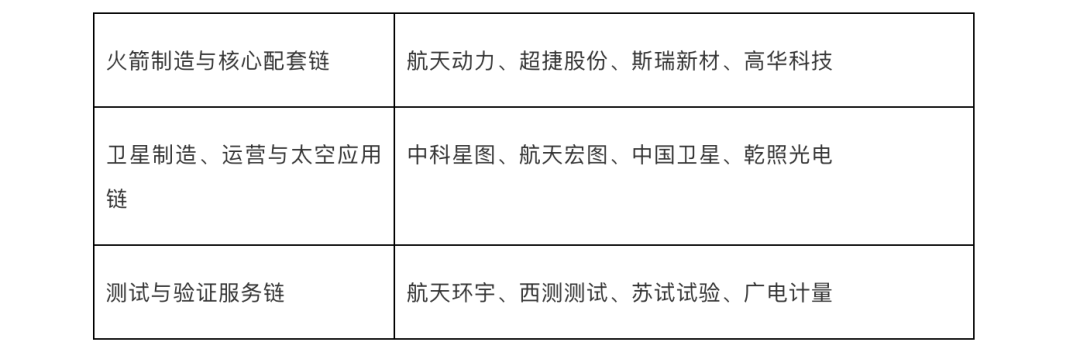
Core Insights - The commercial aerospace sector is experiencing increased interest from major funds, driven by policy breakthroughs and advancements in rocket capacity [1] - The Shanghai Stock Exchange has introduced guidelines for commercial rocket companies to list on the Sci-Tech Innovation Board, providing a clear path for IPOs and reflecting strong national support for the aerospace strategy [1] - Reusable rockets are seen as a key factor in shaping the future competitive landscape of the industry, with significant test flights planned to establish a foundation for low-cost, high-frequency launches by 2026 [2] Policy and Market Developments - The new listing guidelines require commercial rocket companies to demonstrate successful orbital launches using reusable technology, marking a significant regulatory shift [1] - Companies like Blue Arrow Aerospace have completed IPO counseling, indicating a positive trend in capital market engagement for the sector [1] Technological Advancements - The economic viability of rocket launches is heavily influenced by the cost of the first stage, which accounts for 60% of total costs; reusable technology is crucial for cost reduction [2] - The competition for near-Earth orbit resources is intensifying, necessitating improvements in domestic launch capabilities to keep pace with international players like SpaceX [2] Investment Opportunities - The commercial aerospace industry is expected to enter a rapid growth phase, with specific investment opportunities identified in three key areas: - Rocket manufacturing and core supply chain, benefiting companies like Aerospace Power, Superjet, Srey New Materials, and Highhua Technology [3][4] - Satellite manufacturing, operations, and space applications, with potential gains for firms such as China Science and Technology, Aerospace Hongtu, China Satellite, and Qianzhao Optoelectronics [3][4] - Testing and validation services, where demand is expected to rise for companies like Aerospace Hanyu, West Measurement, Su Testing, and Broadcast Measurement [3][4]
商业航天新信号,几个关键趋势来了丨每日研选
Shang Hai Zheng Quan Bao· 2025-12-30 01:00
Core Viewpoint - The commercial aerospace sector is experiencing significant interest from major funds, driven by policy breakthroughs and advancements in rocket reusability, which are expected to enhance the industry's growth potential [2][3]. Policy Developments - The Shanghai Stock Exchange has issued guidelines for commercial rocket companies to apply for the Sci-Tech Innovation Board, marking a significant policy breakthrough that supports the industry [2]. - The new regulations require commercial rocket companies to demonstrate successful orbital launches using reusable technology, providing a clear path for listing and reflecting strong national support for the aerospace strategy [2]. Technological Advancements - Reusable rocket technology is identified as a key factor in reducing launch costs, with first-stage rocket bodies accounting for 60% of total costs [3]. - The successful test flights of reusable rockets like Long March 12 and Zhuque 3 are expected to lay a solid foundation for achieving low-cost, high-frequency launches by 2026, marking a pivotal moment for satellite deployment [2][3]. Investment Opportunities - The commercial aerospace industry is anticipated to enter a rapid development phase, with several investment opportunities identified: - **Rocket Manufacturing and Core Supply Chain**: Increased demand for advanced materials and components due to the development of reusable rockets. Beneficiaries include Aerospace Power, Chaojie Co., Srey New Materials, and Huagao Technology [4][5]. - **Satellite Manufacturing, Operations, and Space Applications**: The rise in rocket capacity will shift focus to mass satellite production and launch, benefiting companies like Zhongke Xingtou, Aerospace Hongtu, China Satellite, and Qianzhao Optoelectronics [4][5]. - **Testing and Verification Services**: The need for complex testing during the development and production phases will drive demand for specialized third-party service providers, with beneficiaries including Aerospace Hanyu, West Measurement, Su Testing, and Guangdian Measurement [4][5].


长征十二甲虽未完全达到预定目标,多款可回收火箭将继续加速验证和实现突破
Orient Securities· 2025-12-30 01:00
Investment Rating - The report maintains a "Positive" outlook on the defense and aerospace industry, indicating a favorable investment environment [7]. Core Insights - The Long March 12甲 rocket, despite not achieving its primary recovery goal, has provided valuable experience and is a crucial step in China's development of reusable rocket technology [10][11]. - The Wenchang International Aerospace Forum has opened, signaling rapid advancement in the commercialization and industrialization of the aerospace sector in China [12]. - The report emphasizes continued optimism for commercial aerospace, unmanned systems, new combat capabilities, and military trade as key growth areas [13]. Summary by Sections 1.1 Long March 12甲 Rocket - The Long March 12甲 rocket's recent launch did not meet the recovery target for the first stage, but it successfully gathered critical data for future missions [10][11]. - The failure is seen as part of the iterative process necessary for achieving reusable technology, similar to the development path of SpaceX's Falcon 9 [11]. 1.2 Wenchang International Aerospace Forum - The forum aims to enhance the aerospace industry in Hainan, focusing on building a comprehensive ecosystem that includes rocket, satellite, and data services [12]. - The government is shifting its focus from merely launching rockets to developing downstream services and applications, indicating a move towards a more integrated aerospace industry [12]. 1.3 Future Outlook - As the 14th Five-Year Plan approaches, the report highlights the importance of new technologies in defense, including unmanned systems and deep-sea technology [13]. - The report suggests that military and civilian sectors will become significant growth drivers, with a focus on expanding military trade and high-end equipment exports [13]. Investment Targets - The report lists several investment targets in the commercial aerospace sector, including: - Aerospace Electronics (600879, Buy) - National Science and Technology Military Industry (688543, Not Rated) - Aerospace Power (600343, Not Rated) [13][14].


