多元化投资

Search documents
顶级投资人丨摩根士丹利投资管理:理解中国机遇 答案在身临其境
Di Yi Cai Jing· 2025-12-09 01:45
《顶级投资人》本期嘉宾是摩根士丹利投资管理新兴市场股票团队主管Amy Oldenburg。摩根士丹利旗 下的摩根士丹利投资管理成立于1975年,在全球拥有超过50年的专业资产管理经验。目前,摩根士丹利 投资管理全球资产管理规模达1.8万亿美元,是全球不多的万亿美元资管俱乐部成员之一。 2023年,摩根士丹利基金由中外合资转为外商独资,成为摩根士丹利投资管理在中国内地全资控股的公 募基金公司。 Amy拥有26年的行业经验。这次是她今年第二次来到中国。她走访了深圳,上海和杭州的中国科技,制 造以及生物医药企业。她对自己看到的一切印象很深,她说,国际投资人应该来中国实地看看,否则将 错过很多机会。 第一财经:Amy,非常感谢你抽出时间参加我们的节目。首先,您此行的目的是什么? Amy Oldenburg:非常感谢您的邀请,很高兴能来到这里。这是我今年第二次来到中国,很 高兴能再次实地走访企业、深入考察市场环境和整体经济状况。我们深感亲临实地进行深度 调研至关重要。 第一财经:您这次打算走访哪些企业? Amy Oldenburg:(我们关注的)领域涉及方方面面,除了重点关注创新、制造业外,我们 也会聚焦深入解读"十五 ...

50亿跨界入股川航,五粮液的“天空梦”与“多元经”
Xi Niu Cai Jing· 2025-12-08 06:51
在宏观经济承压、白酒行业深度调整的背景下,中国白酒行业的巨头们正积极寻求穿越周期的路径。除了深耕主业,对外投资正成为它们平滑业绩波动、寻 找新增长曲线的重要战略。 近日,一则工商变更信息引发了市场广泛关注。国家企业信用信息公示系统显示,四川航空集团有限责任公司(简称"川航集团")11月28日发生工商变更, 新增四川省宜宾五粮液集团有限公司(简称"五粮液集团")为股东,股权占比45.83%,同时川航集团股本从4.17亿元增至约12.19亿元。 公开资料显示,川航集团是聚焦航空运输主业,涵盖航空上下游产业链的综合性航空产业投资集团。据新华财经报道,川航集团负责人曾表示,为了帮助四 川航空尽快走出疫情寒冬,四川省委、省政府,四川省国资委以全局高度统筹来安排推进四川航空的改革和发展,提出了通过增资扩股"化危机为机遇,以 改革求发展"的整体思路,川航集团于2022年底引入五粮液集团增资50.48亿元。 如今,随着川航集团工商登记变更完成,这标志着五粮液集团在2022年底以约50亿元资金入股川航集团的交易,历时近三年,终于正式落定。 五粮液集团入股川航并非一时兴起。早在2023年中秋和2024年4月,双方就联合推出过"云 ...



莱克电气股份有限公司关于参与认购投资基金份额的进展公告
Shang Hai Zheng Quan Bao· 2025-12-04 19:34
Group 1 - The company, Lek Electric, has signed a partnership agreement with Xiamen Zongheng Jinding Private Fund Management Co., Ltd. and other limited partners to establish a venture capital partnership aimed at investing in emerging industries [2] - The total fundraising target for the partnership is RMB 32.05 million, with Lek Electric committing RMB 20 million, representing 62.4025% of the total contributions [2] - The partnership will primarily focus on equity investments, specifically targeting Shenzhen Yunbao Intelligent Co., Ltd. or its future actual listing entity [2] Group 2 - The partnership has completed its business registration and obtained a business license from the relevant authorities, with the partnership named "Gongqingcheng Jintang Venture Capital Partnership (Limited Partnership)" [3] - The partnership is classified as a limited partnership, with Xiamen Zongheng Jinding Private Fund Management Co., Ltd. serving as the executive partner [3] - The partnership's establishment date is August 22, 2025, and it will engage in private equity investment, investment management, and asset management activities [3] Group 3 - This investment allows the company to leverage the expertise and resources of professional investment institutions, enhancing its ability to seize opportunities in emerging industries and diversify its investment channels [4] - The investment is funded by the company's own capital, and the company will only bear limited liability for the partnership's debts, ensuring controllable risk [4] - The investment will not adversely affect the company's cash flow or financial performance, nor will it harm the interests of the company and its shareholders [4]

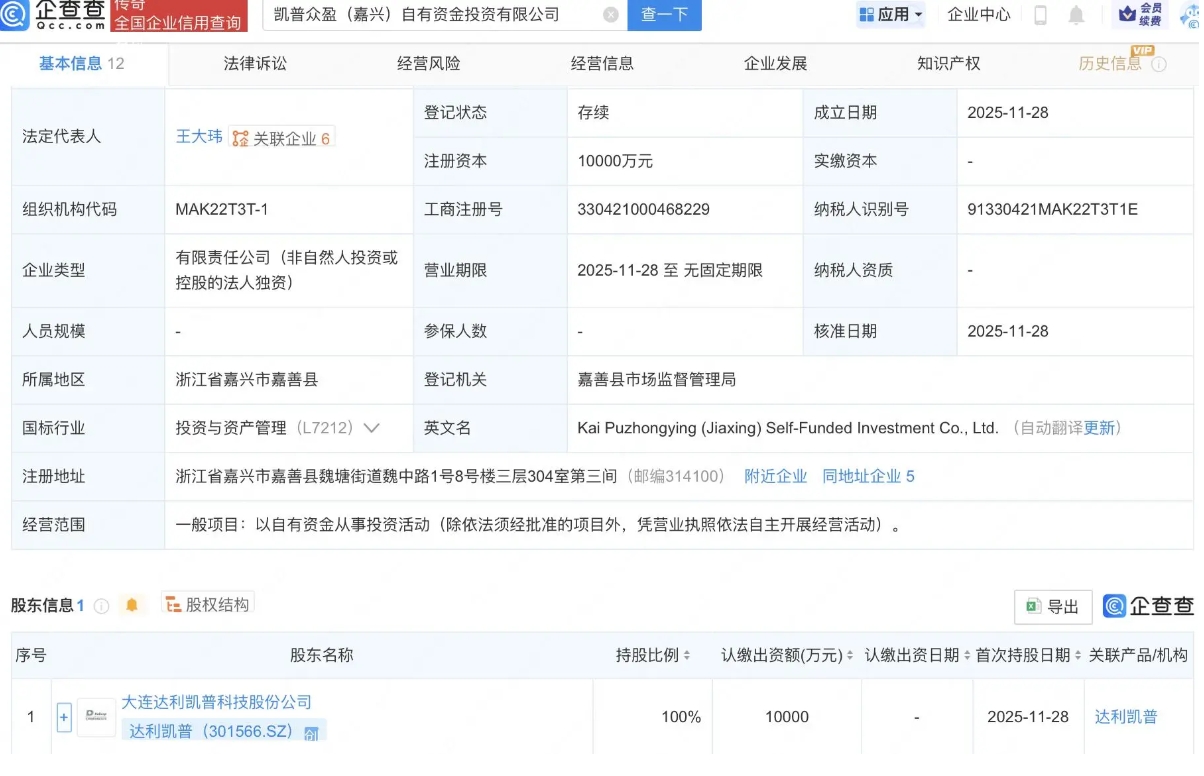
注册资本1亿元!达利凯普在嘉兴设立投资公司
Ju Chao Zi Xun· 2025-12-03 14:59
Core Viewpoint - Dali Kape (301566.SZ) has established a wholly-owned subsidiary, Kai Puzhongying (Jiaxing) Self-Funded Investment Co., Ltd., with a registered capital of 100 million RMB, which will be included in Dali Kape's consolidated financial statements [1][3]. Group 1: Company Structure and Operations - The newly established subsidiary will focus on investment activities using its own funds, without public deposit acceptance or direct public lending [2][3]. - Dali Kape holds 100% ownership of the new company, positioning it as a platform for self-funded investment operations in Jiaxing [2][3]. Group 2: Strategic Implications - The establishment of the investment company allows Dali Kape to manage its own funds within a compliant framework, enhancing capital efficiency through market-oriented operations [3]. - The new investment platform will enable Dali Kape to conduct equity and project investments aligned with its overall strategy, supporting business development and regional expansion [3].
豪掷290亿美元!沙特几乎“完全买下”EA
Hua Er Jie Jian Wen· 2025-12-03 00:06
Core Viewpoint - Saudi Arabia's Public Investment Fund (PIF) is completing a significant acquisition of Electronic Arts (EA), holding 93.4% of the company, marking one of the largest leveraged buyouts in history, primarily funded by Saudi Arabia itself [1][2]. Group 1: Acquisition Structure - The acquisition consortium will invest $36.4 billion in equity and borrow $20 billion in debt, with PIF needing to contribute approximately $29 billion in new funds to achieve the 93.4% ownership stake [2]. - PIF will transfer its existing EA shares, valued at about $5.2 billion based on the acquisition price, into the new structure, while Silver Lake and Affinity Partners will hold 5.5% and 1.1% of the shares, respectively [2]. - This equity distribution is unusual in leveraged buyouts, as sovereign wealth funds typically act as minority investors, but in this case, PIF is shouldering nearly all financial responsibility [2]. Group 2: Financial Pressure - Despite PIF's substantial resources, it faces financial strain due to numerous domestic commitments, including expensive projects like the futuristic city Neom and new sports venues for the World Cup [3]. - The overall fiscal situation in Saudi Arabia is deteriorating, with the budget deficit expected to rise to 5.3% of GDP, the highest level since the pandemic in 2020 [3]. - The ongoing low oil prices, which are a primary revenue source, are weakening Saudi Arabia's fiscal buffer, despite having significant foreign exchange reserves and projected economic growth of 4% [3]. Group 3: Strategic Implications - This transaction signifies a shift in the role of sovereign wealth funds from passive investors to more active controlling investors, indicating a trend in the private equity market [3]. - For EA, being predominantly owned by a single sovereign investor aligns its future strategy closely with Saudi Arabia's long-term economic vision [3]. - This acquisition reflects Saudi Arabia's ambition to diversify its investments and reduce reliance on oil revenues, following significant investments in sports assets [4].

莱克电气股份有限公司关于参与认购投资基金份额的公告
Shang Hai Zheng Quan Bao· 2025-12-01 19:16
Core Viewpoint - The company, Lek Electric, plans to invest RMB 20 million in a venture capital fund, representing 62.4025% of the total committed capital of RMB 32.05 million, to leverage professional investment resources and enhance its competitive strength in emerging industries [2][28]. Investment Details - The investment target is the "Gongqingcheng Jintang Venture Capital Partnership (Limited Partnership)" [2]. - The investment amount is RMB 20 million, which is 62.4025% of the total committed capital [2]. - The investment does not require approval from the company's board of directors or shareholders [3][4]. Partnership Overview - The partnership agreement was signed with Xiamen Zongheng Jinding Private Fund Management Co., Ltd. as the general partner [4]. - The total fundraising target for the partnership is RMB 32.05 million, with Lek Electric contributing RMB 20 million [3][4]. Fund Management - The partnership will primarily focus on equity investments, specifically targeting Shenzhen Yunbao Intelligent Co., Ltd. or its future listing entity [4][10]. - The general partner, Zongheng Jinding, will manage the fund and make investment decisions independently [9][20]. Financial Implications - The investment is expected to enhance the company's ability to seize opportunities in emerging industries and diversify its investment channels [28]. - The company will bear limited liability for the fund's debts, with the maximum loss not exceeding the subscribed investment amount [28]. Risk Management - The company will monitor the fund's operations and the investment target's performance to mitigate investment risks [30].
宁德时代拟5亿元参投基金 拓展跨领域投资版图
Zheng Quan Shi Bao Wang· 2025-12-01 13:54
Core Viewpoint - Ningde Times has signed a partnership agreement to invest 500 million yuan in a private equity fund, marking an extension of its industrial investment strategy [1] Group 1: Investment Details - The fund's total committed capital will reach 4 billion yuan after the first closing, with Ningde Times' investment accounting for 12.497% of the total [1] - The fund will focus on technology, healthcare, consumer goods, and retail sectors, primarily targeting growth and mature stage companies [1] Group 2: Strategic Considerations - The investment aims to leverage the resources and expertise of professional investment institutions to expand investment channels and uncover potential business collaboration opportunities [1] - This move aligns with the company's long-term development plans and interests of all shareholders [1] Group 3: Industry Context - In a competitive battery industry, leading companies are pursuing a "main business + investment" dual strategy [2] - Ningde Times has previously invested in a green fund for carbon neutrality, indicating a diversification strategy beyond the new energy sector [2] Group 4: Financial Performance - For the first three quarters of 2025, Ningde Times reported revenue of 283.072 billion yuan, a year-on-year increase of 9.28%, and a net profit of 49.034 billion yuan, up 36.20% [2] - In Q3 2025, the company achieved revenue of 104.186 billion yuan and a net profit of 18.549 billion yuan, reflecting year-on-year growth of 12.90% and 41.21%, respectively [2] Group 5: Stock Performance - As of December 1, Ningde Times' stock price closed at 382.97 yuan per share, with a cumulative increase of approximately 25% since September [3]

莱克电气(603355.SH):拟出资2000万元参与认购投资基金份额
Ge Long Hui A P P· 2025-12-01 09:29
Group 1 - The core viewpoint of the article is that 莱克电气 (603355.SH) is expanding its investment channels by partnering with Xiamen Zongheng Jinding Private Fund Management Co., Ltd. to seize opportunities in emerging industries [1] - The total fundraising scale of the partnership enterprise is planned to be RMB 32.05 million, with the company contributing RMB 20 million, accounting for 62.4025% of the total subscription amount [1] - The main business of the partnership enterprise will focus on equity investment, specifically targeting Shenzhen Yunbao Intelligent Co., Ltd. or its future actual listing entity for equity investment [1]
富国银行高举看多大旗:多重利好共振,黄金牛市续航力拉满!
Jin Shi Shu Ju· 2025-11-28 00:50
Core Viewpoint - The conditions for gold's next phase of growth are strong due to factors such as potential Federal Reserve interest rate cuts, high uncertainty, a weakening dollar, and a pullback in cryptocurrencies [1][2]. Group 1: Federal Reserve and Interest Rates - The long-term bull market for gold remains intact, with expectations that the Federal Reserve will cut interest rates, possibly as early as December or January [2]. - The potential appointment of Kevin Hassett as the successor to Jerome Powell could lead to a more dovish Fed stance, aiming for interest rates around 2%, which would reduce the opportunity cost of holding non-yielding assets like gold [2]. - A decrease in real interest rates is expected to support gold prices [2]. Group 2: Dollar Dynamics - The dollar index has dropped nearly 15% from 110 points to 96 points, with only a 3-4% rebound, indicating a bearish outlook for the dollar [3]. - It is believed that the dollar will struggle to strengthen significantly from current levels [4]. Group 3: Investment Trends - There is a growing trend of diversification in investments, with gold emerging as a core diversification tool amid high inflation and the Fed's decision to cut rates despite inflation being above 3% [5]. - The relative weakness of gold's strongest competitors, such as AI stocks and cryptocurrencies, is expected to support gold prices [5]. - The high correlation among global stocks, particularly AI-related stocks, limits their effectiveness as a diversification strategy [6]. Group 4: Market Outlook - Despite expectations of a weak labor market and economic slowdown until early 2026, the market has already priced in these negative factors, with only a minor potential pullback of 5-10% anticipated [8]. - The structural logic for gold's rise is reinforced by the Fed's potential shift in focus from inflation to the labor market, which could pressure bonds and lead investors to seek alternative diversification channels like gold [8]. - Central banks are increasingly considering reducing their dollar asset holdings, continuing a trend that began around 2022 due to geopolitical tensions [8].

张近东“净身出户”,为何这么多大佬朋友无人能救苏宁?
Sou Hu Cai Jing· 2025-11-26 23:31
Core Points - Zhang Jindong, once a prominent figure on China's Forbes rich list, has seen his assets wiped out overnight due to the restructuring of Suning Electric Group and its 38 subsidiaries [2][4] - The restructuring plan has been delayed multiple times, with a new vote scheduled for December 14, and requires Zhang and his spouse to transfer all personal assets into a trust [2][3] - Suning's total liabilities amount to 238.7 billion yuan, while its assessed asset value is only 63.7 billion yuan, indicating a significant financial shortfall [4][16] Company Overview - Suning Electric Group, founded by Zhang Jindong in 1990, rapidly expanded and became a leading player in the home appliance retail sector [5][13] - The company went public in 2004, and by 2010, Zhang's net worth reached 38 billion yuan, ranking him fourth on the Forbes list [6][7] - Suning's business model faced challenges with the rise of e-commerce, particularly from competitors like JD.com, leading to a decline in market share [13][16] Financial Situation - The restructuring plan involves creating a bankruptcy trust to manage the assets of the 38 companies, effectively transferring ownership from Zhang and his family [3][4] - Despite the restructuring, there remains a debt gap of over 190 billion yuan, which even Zhang's peak wealth could not cover [4][16] - The company's financial struggles have been exacerbated by failed investments, including significant losses in the real estate and sports sectors [8][10] Strategic Missteps - Zhang's aggressive expansion into various sectors, including sports and e-commerce, did not yield the expected returns and strained the company's finances [8][12] - Suning's late entry into online retail and reliance on traditional retail strategies hindered its ability to compete effectively in the evolving market [13][16] - The company's failure to adapt to digital transformation and maintain technological competitiveness has been a critical factor in its decline [16][17]