
房地产市场调整

Search documents
房地产行业2025年12月统计局数据点评:25年全国商品房销售量价降幅较24年收窄,投资降幅扩大
Bank of China Securities· 2026-01-22 06:03
Investment Rating - The industry investment rating is "Outperform the Market," indicating that the industry index is expected to perform better than the benchmark index over the next 6-12 months [35]. Core Insights 1. **Real Estate Sales**: - In December, the sales area was 93.99 million square meters, with a year-on-year decline of 15.6%, a narrowing of the decline compared to November [2][8]. - The total sales area for 2025 was 881 million square meters, down 8.7% year-on-year, which is a 4.2 percentage point improvement from 2024 [2]. - The average selling price of commercial housing in December was 9,370 yuan per square meter, down 9.5% year-on-year, marking the largest year-on-year decline since May 2024 [10]. 2. **Inventory of Commercial Housing**: - As of the end of 2025, the broad inventory of commercial housing was 1.49 billion square meters, with a year-on-year decrease of 16.9% [7]. - The current housing inventory accounted for 27% of the total inventory, indicating significant pressure [7]. 3. **Developer Financing**: - In December, the total funds received by developers were 797.2 billion yuan, a year-on-year decrease of 26.7% [21]. - The pressure from housing funds was greater than that from non-housing funds, with housing funds decreasing by 28.5% year-on-year [24]. Summary by Sections 1. Sales Performance - December sales area was 93.99 million square meters, down 15.6% year-on-year, with a narrowing decline compared to November [2]. - The total sales amount in December was 880.7 billion yuan, down 23.6% year-on-year [14]. - The average selling price in December was 9,370 yuan per square meter, down 9.5% year-on-year [10]. 2. Inventory Situation - The broad inventory of commercial housing was 1.49 billion square meters, down 16.9% year-on-year [7]. - Current housing inventory was approximately 402 million square meters, with a year-on-year increase of 2.8% [7]. 3. Developer Investment - December developer investment was 419.7 billion yuan, down 35.8% year-on-year, marking the largest single-month decline since 2000 [12]. - The total developer investment for 2025 was 8.28 trillion yuan, down 17.2% year-on-year [7]. 4. Financing Conditions - Developer financing in December was 797.2 billion yuan, down 26.7% year-on-year [21]. - Housing funds accounted for 44% of total financing, with a year-on-year decrease of 16.7% [21].
库存“九连降”与债务重组获突破,房地产市场在调整中夯实底部
Sou Hu Cai Jing· 2026-01-21 13:22
Core Viewpoint - The 2025 real estate market is expected to continue its adjustment trend, with positive progress in inventory reduction and breakthroughs in the debt of distressed real estate companies [2] Market Adjustment and Inventory Reduction - The new residential property price index shows fluctuations, with first-tier cities experiencing slight volatility and second and third-tier cities showing a downward trend. First-tier cities had a stable but declining trend, with a decrease of -0.4% in November after a slight recovery in July and August [3][4] - The second-hand residential price index has a more significant decline than new residential properties, with first-tier cities seeing increased downward pressure in the second half of the year, maintaining a decline of around -1.0% [6] - The overall real estate market remains in a deep adjustment phase, particularly in eastern regions, while inventory reduction is steadily advancing under policy interventions. New residential sales area decreased by 7.8% year-on-year, with sales revenue down by 11.1% [8] - As of the end of November, the inventory of unsold properties decreased for nine consecutive months, indicating effective supply-side adjustments and a gradual alleviation of inventory pressure [8] Sales Trends and Market Dynamics - The sales rhythm throughout the year showed a pattern of "stability followed by weakness," with significant declines in July and August, indicating traditional seasonal weakness [11] - The demand-side recovery remains fragile, with core eastern cities undergoing deep adjustments and a weak sales performance at year-end suggesting a prolonged bottoming period for the market [11] Real Estate Development Investment and Financing - Real estate development investment continued to face pressure, with a cumulative investment of 78,591 billion yuan, down 15.9% year-on-year. Residential investment also saw a decline of 15.0% [14] - The total funds available to real estate developers decreased by 11.9%, with significant declines in foreign investment and personal mortgage loans [18] Debt Restructuring Progress - Several companies, including Sunac, Yuzhou, and Country Garden, have made progress in debt restructuring, with various strategies employed to mitigate debt risks. For instance, Sunac's offshore debt restructuring plan was approved, leading to a significant reduction in its debt [21][22] - Innovative debt restructuring models are emerging, such as Rongsheng's proposal to use a combination of cash and asset-backed debt repayment [23] - Vanke faces challenges with its debt extension proposals being rejected, leading to a downgrade in its credit rating, while its major shareholder has provided substantial loans to support liquidity [23]



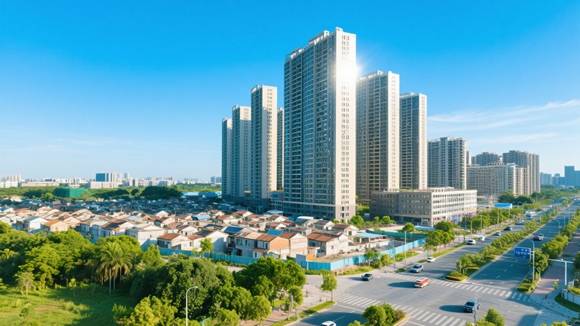
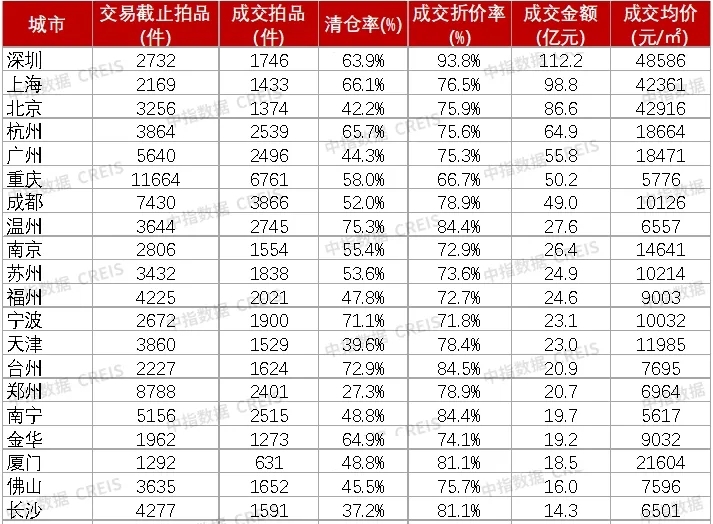
2025年高价法拍房扎堆北上深,频现超亿元成交
Bei Ke Cai Jing· 2026-01-20 13:45
在房地产行业整体调整的背景下,2025年,全国法拍市场呈现"量价齐跌"的整体态势,同时城市分化持续加剧。数据显示,超七成高 价法拍住宅集中在北京、上海、深圳,核心地段稀缺豪宅频现溢价成交,显示出强劲的市场韧性。与此同时,买方策略趋于谨慎理 性,二拍逐渐成为市场主流成交渠道。 北上深高价法拍房"断层"领跑 图/中指研究院 中指研究院发布监测数据显示,2025年全国法拍市场累计挂拍各类房源71.9万套,同比下降6.6%;成交拍品16.9万套,同比下降 4.4%;总成交金额为2536.2亿元,同比下降幅度高达23.6%。市场整体清仓率(成交拍品/交易截止拍品)为23.5%。 相比之下,价格的调整更为明显。2025年各类法拍房源成交均价为4653元/平方米,同比下降12.7%;平均折价率(成交价/评估价) 为74.1%,意味着买家平均能以评估价的约7.4折购入资产。价格走低与房地产市场整体仍处于调整阶段、买方市场特征凸显有关,法 拍房买家普遍持谨慎态度,出价趋于理性。 从物业类型看,住宅依然是法拍市场的绝对核心。2025年,住宅类法拍房源成交11.3万套,成交总金额1315.8亿元,占各物业类型总 成交金额的51.9 ...
2025年12月统计局房地产数据点评:全年销售延续调整态势,房价环比降幅小幅收窄
Tai Ping Yang Zheng Quan· 2026-01-20 10:35
2026 年 01 月 19 日 行业点评报告 中性/维持 房地产 房地产 全年销售延续调整态势,房价环比降幅小幅收窄 2025 年 12 月统计局房地产数据点评 走势比较 (20%) (10%) 0% 10% 20% 30% 25/1/20 25/4/2 25/6/13 25/8/24 25/11/4 26/1/15 子行业评级 | 和运营 | | | --- | --- | | 房 地 产 开 发 房地产服务 | 无评级 无评级 | 相关研究报告 <<太平洋房地产日报(20260114):青 岛土拍收金10.15亿元>>--2026-01- 15 <<太平洋房地产日报(20260113):成 都天府新区 3 宗涉宅用地顺利成 交>>--2026-01-14 <<太平洋房地产日报(20260109):国 常会部署实施财政金融协同促内需 一揽子政策>>--2026-01-11 证券分析师:徐超 电话:18311057693 E-MAIL:xuchao@tpyzq.com 分析师登记编号:S1190521050001 证券分析师:戴梓涵 电话:18217681683 E-MAIL:daizh@tpyzq.com ...
12月一线城市新房成交量大涨
Xin Lang Cai Jing· 2026-01-20 04:49
Core Viewpoint - The 2025 real estate market in China is still undergoing adjustments, but positive factors are accumulating, indicating potential recovery in 2026 [1][8]. Price Trends - In December 2025, new and second-hand home prices in first-tier cities fell by 0.3% and 0.9% month-on-month, with the decline narrowing by 0.1 and 0.2 percentage points compared to the previous month [1][9]. - The first-tier cities are seen as important indicators of the real estate market, with signs of a potential stop in the price decline [3][10]. - Shanghai showed a relatively better performance, with new home prices rising by 0.2% in December 2025, making it the only first-tier city with an increase [3][10]. Sales Performance - In 2025, the sales area of new commercial housing decreased by 8.7%, and sales revenue fell by 12.6% compared to the previous year [5][12]. - The sales growth rate remains negative, but the decline is less severe than in 2024, indicating some support from both supply and demand sides [1][12]. - By the end of 2025, the total unsold housing area was 76,632 million square meters, an increase of 1.6% year-on-year, but a decrease of 1.0% compared to November [12]. Market Expectations - The policy environment is signaling a clear intention to stabilize market expectations, with measures such as extending the housing tax refund policy and lowering commercial property down payment ratios [1][14]. - Analysts expect that the effects of various favorable policies will further be released in 2026, leading to positive adjustments in real estate indicators [1][14]. - The importance of managing market expectations is emphasized, with calls for maintaining policy strength to avoid market volatility [14].
国家统计局:去年12月份70城房价环比总体下降,房地产开发投资全年降幅17.2%
Sou Hu Cai Jing· 2026-01-20 01:51
本报(chinatimes.net.cn)记者李凯旋 北京报道 2025年12月份,房价延续下行的趋势。国家统计局发布的数据显示,70个大中城市商品住宅销售价格环 比总体下降,同比降幅扩大。开发投资方面,2025年,房地产开发投资同比下降17.2%。 《华夏时报》记者注意到,房价跑赢前一年同期的城市已是少数。特别是二手房,70个大中城市房价已 经均不及前一年同期。 二线城市新建商品住宅销售价格环比下降0.4%,降幅扩大0.1个百分点;三线城市环比下降0.4%,降幅 与上月相同。 二手房价格的跌幅依旧高于新房价格。国家统计局发布的数据显示,2025年12月份,一线城市二手住宅 销售价格环比下降0.9%,降幅比上月收窄0.2个百分点。其中,北京、上海、广州和深圳分别下降 1.3%、0.6%、1.0%和0.6%。二、三线城市二手住宅销售价格环比均下降0.7%,降幅扩大0.1个百分点。 58安居客研究院院长张波对《华夏时报》记者表示:"一线城市止跌回暖信号增强。其中,上海新房价 格同环比双涨。其中,144平米以上大户型的热销印证了改善型需求的坚实韧性。二手房市场同样呈现 改善迹象,需求端的观望需求正在逐步消解。" 二 ...
如何认识5%与140万亿
Sou Hu Cai Jing· 2026-01-19 15:18
Group 1 - China's economy demonstrates resilience, achieving a GDP exceeding 140 trillion yuan with a growth rate of 5% for three consecutive years, supported by strong international competitiveness and diversified export markets [2][3] - The economic scale of 140 trillion yuan enhances China's capacity to respond to risks, providing a robust foundation for future growth and contributing significantly to global economic stability [3] - The transition from old to new economic drivers is evident, with the service sector's contribution to GDP rising from 56.8% in 2024 to 57.7% in 2025, and final consumption's contribution increasing from 44.5% to 52% [4] Group 2 - The high-tech and emerging industries are rapidly growing, with significant increases in value-added output in equipment manufacturing (9.2%) and high-tech manufacturing (9.4%), surpassing the overall industrial growth rate of 5.9% [4] - Challenges remain in the real estate market, requiring policy adjustments to stabilize the sector and address liquidity risks among real estate companies [5] - To boost consumption, a long-term mechanism is needed, focusing on income distribution and social security system optimization, alongside fiscal measures to encourage wage increases [5][6]
2025年全国新建商品房销售额8.39万亿元
Mei Ri Jing Ji Xin Wen· 2026-01-19 13:10
Core Insights - The overall real estate market in China is experiencing a downturn, with significant declines in investment, sales area, and sales revenue in 2025 compared to 2024 [1][2][3] Group 1: Market Performance - In 2025, national real estate development investment reached 82,788 billion yuan, a decrease of 17.2% from 2024 [1][2] - The sales area of newly built commercial housing was 88,101 million square meters, down 8.7% year-on-year [1][2] - The sales revenue of newly built commercial housing was 83,937 billion yuan, reflecting a decline of 12.6% compared to the previous year [1][2] Group 2: Price Trends - In December 2025, the new housing prices in 70 large and medium-sized cities showed a month-on-month decline, with only 6 cities experiencing a rise [1][6] - Shanghai's new housing prices increased by 0.2% month-on-month and surged by 4.8% year-on-year, making it the only first-tier city with both month-on-month and year-on-year growth [2][5] - The average price of commercial housing nationwide in 2025 was approximately 9,527 yuan per square meter, indicating a year-on-year decline of 4.1% [2] Group 3: Market Dynamics - The first-tier cities are showing signs of stabilization, with a narrowing decline in second-hand housing prices and a reduction in new listings [4][7] - The trend of "price for volume" in the second-hand housing market remains unchanged, with over 80% of second-hand housing prices in 70 cities below 95 on the index [7] - The demand side is gradually recovering, as indicated by an increase in the proportion of individuals searching for second-hand homes, which rose to an average of 65.4% in 2025 [7] Group 4: Future Outlook - The financial environment is expected to improve in 2026, which may facilitate better inventory management by real estate companies [3] - The government is likely to continue controlling new supply and enhancing social security measures to stabilize the market [3] - The overall market sentiment is shifting towards recovery, with signs of increased activity in the first-tier cities [4][7]
房地产行业点评报告:销售延续调整态势,期待政策显效与市场筑底
KAIYUAN SECURITIES· 2026-01-19 09:11
Investment Rating - The industry investment rating is "Positive" (maintained) [1] Core Insights - The real estate market has shown a significant decline in sales, with a year-on-year decrease in sales area of 8.7% and sales amount down by 12.6% for the year 2025 [4][13] - The trend of "price for volume" is evident, with the average selling price of commercial housing dropping by 4.3% year-on-year [4][13] - New construction area has decreased for four consecutive years, with a decline of 20.4% in 2025 [5][20] - The total investment in real estate development has also seen a significant drop of 17.2% year-on-year [6][24] - The cash flow pressure on real estate companies remains high, with a 13.4% year-on-year decrease in funds available to developers [6][26] Summary by Sections Sales Data - In 2025, the total sales area of commercial housing was 881 million square meters, with a year-on-year decline of 8.7% [4][13] - The sales amount reached 8.39 trillion yuan, down 12.6% year-on-year [4][13] - December 2025 saw a sharp decline in sales area and amount, with year-on-year decreases of 15.6% and 23.6%, respectively [4][13] Construction Data - The new construction area for 2025 was 588 million square meters, reflecting a 20.4% decrease [5][20] - The completion area was 603 million square meters, down 18.1% year-on-year [5][20] Investment Data - Real estate development investment totaled 8.28 trillion yuan in 2025, a decrease of 17.2% [6][24] - The funds available to real estate developers were 9.31 trillion yuan, down 13.4% year-on-year [6][26] Investment Recommendations - Recommended companies include those with strong credit and good urban fundamentals, such as Greentown China, China Overseas Development, and China Resources Land [7][34] - Companies benefiting from both residential and commercial real estate recovery are also highlighted, such as Longfor Group and New City Holdings [7][34] - Quality property management firms with strong service standards are recommended, including China Resources Mixc Life and Greentown Service [7][34]


12月70城房价分化加剧:二手房“以价换量”仍是主流 上海新房同环比双涨领跑
Xin Lang Cai Jing· 2026-01-19 08:57
智通财经1月19日讯(记者 李洁)当前的房地产市场仍处于调整过程中,不过部分一线城市显现出降幅 收窄的积极信号,市场分化特征显著。 数据显示,一线城市销售价格环比下降0.9%,但降幅较上月收窄0.2个百分点,具体而言,北京、上 海、广州和深圳环比分别下降1.3%、0.6%、1.0%和0.6%。 而二、三线城市二手住宅销售价格环比均下降0.7%,且降幅较上月均扩大0.1个百分点。张波认为,这 反映出房东积极调整价格,以促成交易的行情仍在持续。 价格调整也激发了部分需求释放。据58安居客研究院监测,2025年重点城市二手房找房人数占比进一步 上升,市场需求对价格的敏感度进一步增强。成交数据上,12月上海二手房成交量突破2.2万套;北京 二手住宅网签量达1.72万套,环比增长19.1%,创近9个月新高。 值得关注的是,近期从中央到地方,降低贷款利率、优化税费等支持政策密集出台,购房门槛已降至历 史低点。 与此同时,部分开发企业启动创新服务模式,主动参与社区共建,如紫金书院开发企业北京新领域房地 产开发有限公司近日启动"三年陪伴行动",计划投入百万元用于公共空间提质、绿地养护及社区治理机 制优化,推动业主从"居住者" ...