
汇率干预

Search documents
提前大选风险叠加日本央行决议在即,日元下一步拿了什么“剧本”?
第一财经· 2026-01-16 09:23
Core Viewpoint - The article discusses the volatility of the Japanese yen due to the upcoming Bank of Japan meeting and the uncertainty surrounding the early election, highlighting concerns over potential government intervention to support the currency [3][4]. Group 1: Yen Volatility and Government Intervention - The Japanese yen has depreciated to its lowest level against the US dollar in 18 months, reaching 159.45, with the dollar trading around 158.60 [8]. - Prime Minister Sanna Takashi's decision to dissolve the House of Representatives and call for early elections may strengthen her position and allow for increased government spending, contributing to yen depreciation [8]. - Analysts expect continued volatility in the yen, with potential intervention from Japanese authorities if the dollar-yen exchange rate approaches the 161-163 range [9]. Group 2: Market Reactions and Hedge Fund Strategies - Hedge funds are betting on further yen depreciation, with call options on the dollar-yen pair significantly outpacing put options, indicating strong bullish sentiment [11]. - The market is closely monitoring the psychological level of 160, with expectations that substantial intervention may occur if the exchange rate approaches 165 [11][12]. - The divergence between the yen's performance and the Nikkei 225 index, which recently hit a record high, suggests a disconnect between Asian equity markets and currency movements [12][13].


日本财务大臣警告称不排除支持日元的所有选项
Sou Hu Cai Jing· 2026-01-16 05:02
Core Viewpoint - Japan's Finance Minister has reiterated that all options, including direct intervention in the currency market, are available to address the recent weakness of the yen [1] Group 1 - The Finance Minister, Shunichi Suzuki, stated that bold actions will be taken if necessary to support the yen [1] - The comments made by the Finance Minister have positively impacted the yen's value [1] - The Minister downplayed U.S. Treasury Secretary Scott Basset's preference for the Bank of Japan to use policy measures rather than direct market intervention [1] Group 2 - The Finance Minister emphasized that the recent yen movements are excessive and do not reflect the underlying fundamentals [1] - She mentioned her discussions with Basset in Washington, reaffirming her stance on the need for potential intervention [1] - The Minister reiterated that the joint statement on foreign exchange issued by both countries last year grants her the "freedom to act" as needed, including intervention [1]
日本财务大臣警告:不排除支持日元的所有选项
Xin Lang Cai Jing· 2026-01-16 04:52
Core Viewpoint - Japan's Finance Minister warns that all options, including direct intervention in the currency market, are available to address the recent weakness of the yen [1][2][3] Group 1: Minister's Statements - Finance Minister Kato Mitsu has reiterated that bold actions will be taken if necessary to support the yen, which has positively impacted its value [1][2] - Kato downplayed U.S. Treasury Secretary Scott Basset's preference for the Bank of Japan to use policy measures rather than market intervention to support the yen [1][2] Group 2: Market Analysis - Kato stated that the recent market movements are excessive and do not reflect the underlying fundamentals [3] - Prior to Kato's comments, the U.S. Treasury issued a statement emphasizing the importance of formulating and communicating monetary policy due to the inherent adverse effects of excessive currency fluctuations [3] - Kato reaffirmed her belief that last year's joint currency statement between the two countries grants her the "freedom to act" as needed, including intervention [3]
政坛巨震叠加央行议息:日元跌破159后,162“干预红线”再成焦点
智通财经网· 2026-01-16 01:17
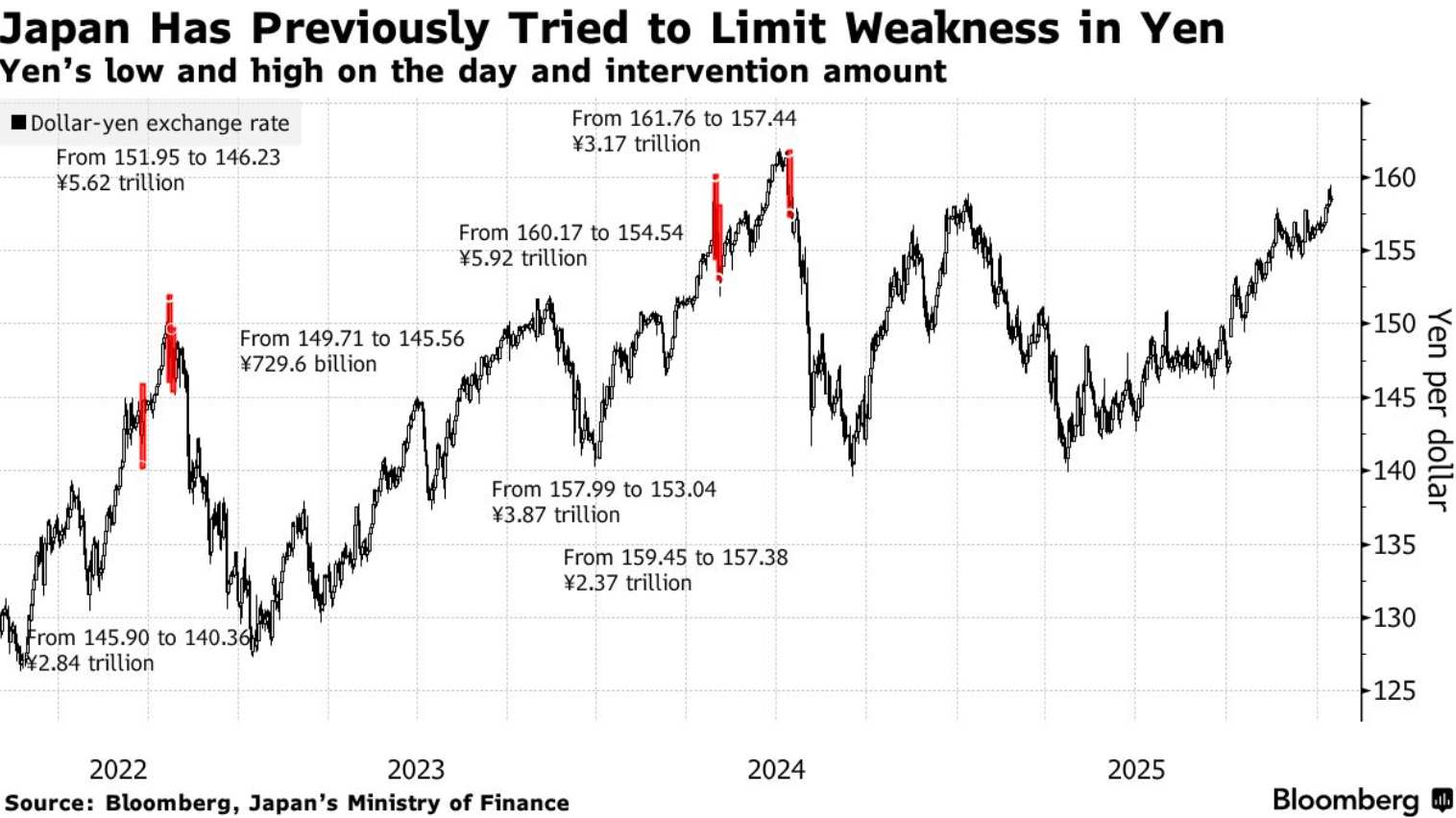
Core Viewpoint - The Japanese yen is experiencing significant volatility due to rising uncertainty surrounding early elections and an upcoming Bank of Japan meeting, with traders on high alert for potential currency fluctuations [1][4]. Group 1: Currency Movements and Market Reactions - The yen fell to an 18-month low against the dollar earlier this week, driven by expectations that Prime Minister Fumio Kishida will call for elections to solidify his position and increase government spending [1]. - The yen briefly dropped to 159.45 and was around 158.65 on Friday morning, with the 160 level being a psychological threshold that the market is closely monitoring [4]. - The recent depreciation of the yen has raised concerns about potential market intervention by the Japanese government to support the currency, with officials focusing more on the magnitude and speed of fluctuations rather than specific levels [1][4]. Group 2: Central Bank and Policy Implications - Investors are keenly awaiting signals regarding interest rate hikes from Bank of Japan Governor Kazuo Ueda in the upcoming policy decision [1]. - The last interest rate hike by the Bank of Japan in December did not provide lasting support for the yen, and officials are increasingly concerned about the yen's impact on inflation, which may influence future rate decisions [4]. - The lack of hawkish comments from the central bank during the last press conference led to a significant weakening of the yen, indicating the market's sensitivity to the Bank's communications [4]. Group 3: Hedge Fund Activities and Market Sentiment - Hedge funds are aggressively buying call options for USD/JPY, betting on a depreciation of the yen to around 165, which they believe would trigger substantial market intervention by Japanese authorities [4][5]. - There is a sustained demand for investment in the high-end structure of USD/JPY, with notable direct option buying and leveraged trading strategies being deployed [5]. - Data from the Depository Trust & Clearing Corporation (DTCC) shows that the volume of call options traded was more than double that of put options, reflecting strong bullish sentiment towards USD/JPY [6].
无视警告!对冲基金狂买美元兑日元看涨期权,豪赌日元贬值至165
智通财经网· 2026-01-15 04:21
Group 1 - Hedge funds are ignoring warnings from Japanese officials about currency intervention and continue to bet on the options market, believing that the yen must fall to around 165 against the dollar for substantial intervention to occur [1] - The yen reached an 18-month low against the dollar, prompting warnings from the finance minister and foreign exchange officials, while the economic security minister announced plans for an early election, reinforcing expectations of a continued rise in the dollar-yen exchange rate [1] - Nomura International's forex options trader noted sustained demand for high-structure investments in dollar-yen, with ongoing direct option buying and leveraged trading structures betting on intervention around the 160-165 exchange rate range [1] Group 2 - Data from the Depository Trust & Clearing Corporation (DTCC) indicated that the volume of call options traded was more than double that of put options for transactions of $100 million or more, reflecting strong bullish sentiment towards the dollar-yen exchange rate [2] - The current exchange rate has rebounded to a key level that was significant during the last intervention by the Japanese finance ministry in July 2024, creating a resonance between "policy intervention memory" and "current market bullish sentiment" [2] Group 3 - The rapid rise of the dollar against the yen and the threat of intervention from the Bank of Japan have led some investors to increase their holdings of put options for hedging or speculation [4] - Barclays' global forex options head noted that some investors are using options to hedge against potential risks of currency intervention due to the rising dollar-yen exchange rate [4]
片山皋月与贝森特齐声担忧 日元汇率依旧持续走低
Xin Lang Cai Jing· 2026-01-13 10:30
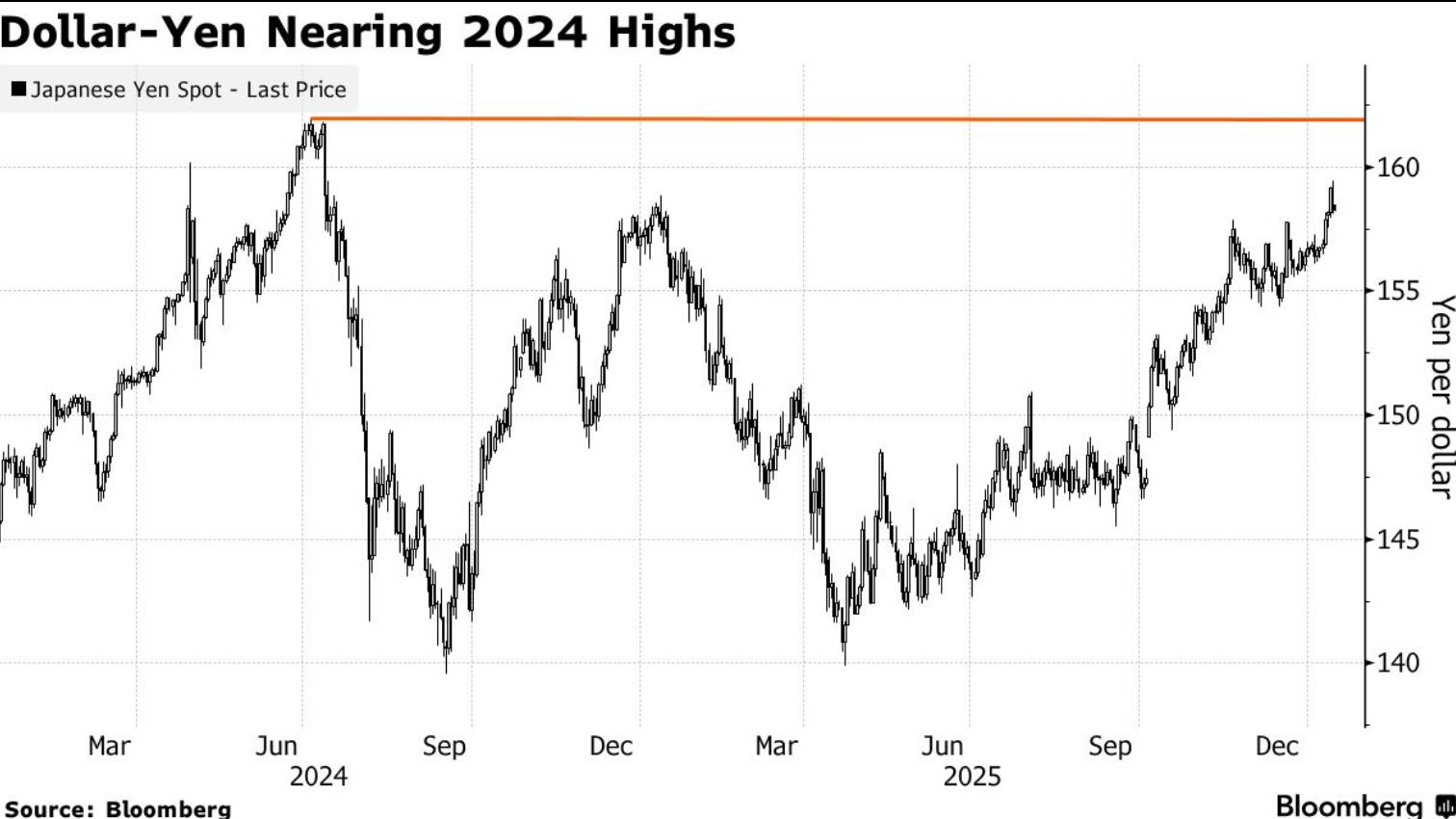
Core Viewpoint - The Japanese yen has depreciated to its lowest level in 18 months, reaching 159.05 yen per dollar, despite concerns from both Japanese and U.S. officials about the currency's decline [1][2][3]. Currency Exchange Rate Dynamics - The yen's exchange rate dropped by 0.6% against the dollar, influenced by reports of Prime Minister Fumio Kishida's intention to call for early elections, which further exacerbated the yen's decline [1][2]. - The Japanese Finance Minister, Shunichi Suzuki, expressed concerns about the "one-sided depreciation" of the yen during a meeting with U.S. Treasury Secretary Janet Yellen, indicating a potential for increased communication on exchange rate trends [1][3]. Market Reactions and Predictions - Market analysts suggest that the possibility of currency intervention may become a focal point, particularly as the dollar approaches the 160 yen mark, which is seen as a critical threshold for intervention [1][2][3]. - The head of the Japan Business Federation, Tokui Nobutaka, emphasized the need for the yen to strengthen, warning that excessive depreciation could necessitate intervention in the foreign exchange market [2][8]. Economic Implications - The depreciation of the yen is expected to increase import costs, potentially leading to higher domestic inflation, prompting the Japanese government to introduce a substantial economic stimulus plan to alleviate rising living costs [3][10]. - The Bank of Japan raised its benchmark interest rate to a 30-year high in December, with expectations that further rate hikes may be accelerated due to the yen's ongoing depreciation [10]. International Relations and Policy - U.S. Treasury Secretary Yellen previously called for the Bank of Japan to raise interest rates as a means to support the yen's value [4][10]. - The recent meeting between Suzuki and Yellen occurred amid concerns regarding potential political interference in U.S. monetary policy, which may impact international economic relations [5][10].
“高市早苗交易”卷土重来!日股强势开盘 日元逼近一年新低
Zhi Tong Cai Jing· 2026-01-13 01:13
Group 1 - The Japanese stock market opened higher after a long weekend, driven by expectations of an early general election and a weaker yen benefiting export companies [1] - The Nikkei 225 index rose by 3.43% to 53,722.76 points, while the broader Topix index increased by 2.17% to 3,590.40 points, with significant contributions from the electronics, banking, and automotive sectors [1] - Analysts from Citigroup noted that the market consensus is forming around the likelihood of the ruling Liberal Democratic Party winning more votes in a potential election, which could lead to a renewed "Kishida trade" benefiting sectors like defense and nuclear power [1][2] Group 2 - The weakening yen, which hovered around 158 yen per dollar, is at its lowest level since January 2025, raising concerns among Japanese officials about its one-sided volatility [3] - Japanese Finance Minister Shunichi Suzuki expressed concerns about the yen's depreciation during a meeting with U.S. Treasury Secretary Scott Pelley, indicating potential future interventions if the market shows disorderly movements [3][4] - The expectation of further fiscal expansion under Prime Minister Kishida could put pressure on the Japanese bond market, with rising long-term bond yields potentially benefiting financial stocks like banks [2]
日元要转向升值了?
日经中文网· 2026-01-12 08:00
Core Viewpoint - The market remains vigilant regarding currency intervention, making it difficult for the yen to depreciate unilaterally. Historical trends indicate that the yen's exchange rate often reverses direction at the beginning of the year, with a strong support expected starting in 2026 [2][6]. Group 1: Yen Exchange Rate Trends - On January 6, the yen appreciated to the range of 156.0-156.5 yen per dollar, marking a 1 yen increase from the previous day's low [4]. - The yen's exchange rate is expected to reverse direction at the beginning of each year from 2023 to 2025, with significant changes anticipated in January [9]. - The chief foreign exchange strategist at Mizuho Securities noted that the yen's trend is likely to shift towards appreciation, especially as concerns about fiscal deterioration under the current administration diminish [9]. Group 2: Factors Influencing Currency Intervention - The Japanese Finance Minister expressed the government's readiness to intervene in the currency market, which has curbed the trend of yen depreciation [6]. - Similar to the yen, the Korean won has also been subject to intervention, with the South Korean authorities actively working to prevent excessive depreciation [5][8]. - The sensitivity of the yen to U.S. interest rate fluctuations is significant, with a 1% change in U.S. long-term rates potentially causing a 12 yen fluctuation in the exchange rate [10]. Group 3: Market Sentiment and Investor Behavior - Recent data from the U.S. labor market is expected to serve as a barometer for the yen's exchange rate against the dollar, as accurate economic data becomes available [11]. - Hedge funds and non-commercial entities have shown a slight net buying position in yen, indicating a shift in investor sentiment towards the yen as they prepare for potential trends in 2026 [11].
法兴银行:日元延续反弹 假期期间干预风险增加
Xin Lang Cai Jing· 2025-12-24 08:57
Group 1 - The Japanese Finance Minister, Shunichi Suzuki, has signaled a potential intervention in the currency market to curb the recent significant depreciation of the yen [1] - Societe Generale strategist Kit Juckes noted that the current exchange rate trends are significantly deviating from observable fundamentals, and the thin market liquidity towards the year-end creates a strong backdrop for intervention [1] - The recent rise of the dollar against the yen is notable, but the increase of the euro against the yen is even more pronounced, highlighting the overall pressure on the yen and reinforcing market expectations for government intervention [1]
诡异的日元:央行喊话干预市场
Sou Hu Cai Jing· 2025-12-24 08:50
Core Viewpoint - The Bank of Japan raised its benchmark interest rate by 25 basis points to 0.75%, marking a 30-year high, yet the yen depreciated against the dollar, indicating a disconnect from fundamental economic conditions [1] Group 1: Interest Rate and Currency Dynamics - The yen depreciated by 1.45% to 157.5 against the dollar following the interest rate hike, despite the increase in bond yields [1] - The Japanese government approved a substantial fiscal stimulus plan of 18.3 trillion yen, which may lead to increased bond issuance and impact the bond market negatively [2] - The yield on Japan's 30-year government bonds rose to 3.452%, while the 10-year yield reached 2.034%, widening the interest rate differential with China [1][2] Group 2: Inflation and Economic Policy - Current market expectations place inflation between 2.5% and 3%, while the nominal interest rate is only 0.75%, resulting in real interest rates between -1.75% and -2.25% [2] - The Bank of Japan's cautious stance on interest rate hikes reflects uncertainty amid persistent inflation pressures and economic recovery fluctuations [3] - The Bank of Japan's communication has been vague, leading to negative market expectations for future rate hikes [3] Group 3: Market Reactions and Future Outlook - The market anticipates potential intervention by the Bank of Japan if the yen approaches the critical level of 160 against the dollar [4] - Concerns in the U.S. regarding rising Japanese bond yields suggest potential financial risks that could affect other markets [5] - The Japanese economy's recovery relies on careful management of both monetary and fiscal policies, with market skepticism about the Bank of Japan's commitment to tightening [5]