港股流动性

Search documents
智通港股早知道 | 央行就《人民币跨境支付系统业务规则(征求意见稿)》公开征求意见 8月1日起美国实施新关税
Zhi Tong Cai Jing· 2025-07-06 23:53
Group 1: Market Overview - The Hong Kong stock market has shown strong performance, with the Hang Seng Index rising 18% last year and a cumulative increase of 20% in the first half of this year, marking the largest half-year gain in history [1] - The growth in the Hong Kong stock market is primarily driven by increased investment in technology stocks, which has also led to a significant rise in trading of related derivative products [1][2] - The number of Exchange-Traded Products (ETPs) in Hong Kong has exceeded 210, with total assets under management reaching approximately HKD 510 billion, a 30% increase since 2020 [1] Group 2: ETP Market Dynamics - The average daily trading volume of ETPs has increased fivefold, reaching about HKD 40 billion, and the market share of ETP trading has grown from less than 5% five years ago to approximately 17% in the first five months of this year [1] - The continuous innovation in the Hong Kong ETP market has provided liquidity and met evolving investment demands, effectively acting as a buffer during market volatility [1] Group 3: Future Developments - The Hong Kong Stock Exchange is actively promoting the listing of more thematic ETFs, including those focused on innovative technology, climate change, renewable energy, and biotechnology, to better direct funds towards high-quality economic development [2] - The aim is to leverage global market resources through institutional and product innovations, reinforcing Hong Kong's position as a preferred ETP hub in the Asia-Pacific region [2] Group 4: Valuation Insights - According to Tianfeng Securities, the Hang Seng Index and Hang Seng Tech Index exhibit significant valuation advantages, with the Hang Seng Index's TTM P/E ratio at 10.68 and a dividend yield of 3.93% [3] - The Hang Seng Tech Index's TTM P/E ratio stands at 20.10, indicating a historically low valuation level, making the Hong Kong market attractive compared to other major global markets [3]
港股流动性直追A股!南向资金持续增配红利资产
券商中国· 2025-06-30 12:12
Core Viewpoint - The article highlights the significant inflow of southbound capital into the Hong Kong stock market, particularly focusing on the banking sector, which has led to improved liquidity and a narrowing of the liquidity gap between Hong Kong and A-shares [1][4][5]. Group 1: Southbound Capital Inflow - Southbound capital has accumulated a net inflow of nearly 730 billion HKD in the first half of the year, marking the highest level for the same period historically [4]. - The continuous inflow of southbound capital has a profound impact on the liquidity and valuation system of the Hong Kong stock market [4]. - The liquidity of the Hong Kong stock market is catching up with that of A-shares, with trading volumes significantly increasing [5]. Group 2: Valuation and Dividend Assets - The AH premium index for Hong Kong and Shanghai stocks fell to 126.91 points on June 12, the lowest since June 2020, indicating a significant decline in the AH premium [6]. - The banking sector has been a major contributor to the decline in AH premium, with banks contributing 6.3 percentage points to the decrease [6]. - The current dividend yield of H-shares is higher than that of A-shares, with 14 H-share banks having valuations lower than their A-share counterparts, presenting a "higher dividend, lower valuation" scenario [8]. Group 3: Investment Trends - The banking sector has become a core allocation direction for southbound capital, with major banks like China Construction Bank and Industrial and Commercial Bank of China seeing significant increases in investment [8]. - Insurance funds have been significant buyers of bank stocks, with 9 out of 19 total stakes taken in banks occurring in the Hong Kong market [9]. - The current yield spread between bank stocks and the 10-year government bond yield remains above 3.5%, indicating that the core logic for the continuation of bank stock performance is still intact [10].


国泰海通|海外策略:港股涨跌更看谁的“脸色”
国泰海通证券研究· 2025-06-25 15:12
Group 1 - The core viewpoint of the article is that the correlation between Hong Kong stocks and A-shares has significantly increased since 2020, while the correlation with US stocks has weakened [1][2][3] - Historically, Hong Kong stocks were more correlated with US stocks, particularly from 1970 to 2020, but since 2020, this correlation has diminished, especially in 2021 and 2023 [1] - The increase in correlation between Hong Kong and A-shares is attributed to a decrease in foreign capital's share in Hong Kong stocks and an increase in domestic liquidity [1][2] Group 2 - Hong Kong stocks have become less dependent on overseas liquidity since 2020, with valuation contributing more to price movements, aligning with the increased correlation with A-shares [2] - The decline in foreign capital's share is influenced by geopolitical factors, currency arbitrage, and changes in the price-performance ratio of Hong Kong stocks [2] - Domestic capital has accelerated its inflow into Hong Kong stocks due to price advantages and scarcity of investment targets, further linking Hong Kong's liquidity to mainland capital behavior [2] Group 3 - The fundamental performance of Hong Kong stocks is increasingly related to mainland China, with over two-thirds of listed companies being Chinese enterprises, contributing 90% of net profits [3] - The proportion of mainland enterprises listed in Hong Kong has risen since 2020, supported by policies aimed at developing Hong Kong's capital market [3] - The correlation between Hong Kong stocks and overseas markets has weakened, with less impact from changes in overseas demand and economic cycles since 2020 [3]


国泰海通证券:AH溢价中枢将趋势性下行
Ge Long Hui· 2025-06-23 01:05
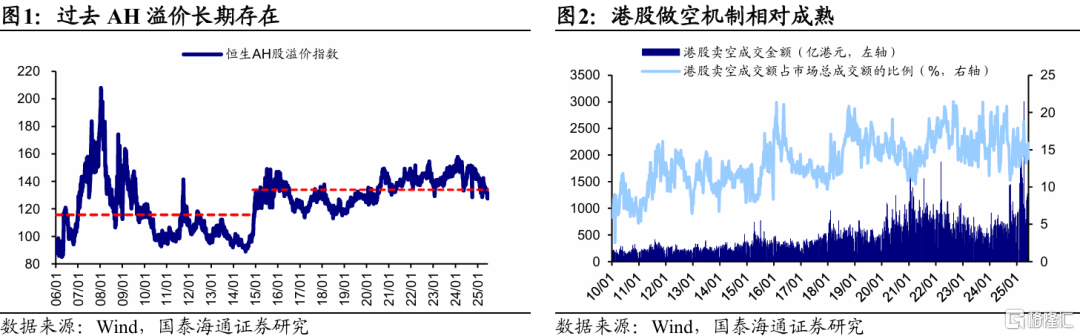
Core Viewpoint - The article discusses the historical and recent trends of the AH premium, indicating a long-term downtrend in the AH premium center due to various factors including market structure, liquidity differences, and the influx of quality assets into the Hong Kong market [1][2]. Group 1: Historical Context of AH Premium - The AH premium has historically existed due to differences in market systems, liquidity, and industry structure, with the premium index fluctuating around 115 before the launch of the Stock Connect in late 2014, and rising to an average of 134 post-launch [2][3]. - The differences in listing systems between A-shares and H-shares, such as the introduction of a registration system in A-shares and a more market-driven pricing mechanism in H-shares, contribute to the persistent AH premium [3][4]. Group 2: Recent Changes in AH Premium - Since early 2024, the AH premium has been on a downward trend, with a notable drop to a new low of 128 as of June 16, 2025, which is the lowest since June 2020 [2][8]. - The issuance discount for new Hong Kong listings from mainland companies has narrowed significantly, with the average discount dropping from 17.6 in 2023 to 6.5 in 2024, indicating a shift in market dynamics [8][9]. Group 3: Factors Influencing the Downtrend - The liquidity gap between Hong Kong and A-share markets is narrowing, with significant inflows of southbound capital into Hong Kong, increasing the proportion of southbound holdings from 13.5% in early 2024 to 20.6% [15][16]. - The concentration of quality assets in the Hong Kong market, driven by policies encouraging mainland companies to list in Hong Kong, is expected to further reduce the valuation gap between A-shares and H-shares [16][18]. Group 4: Future Outlook - The proportion of emerging industries in the Hong Kong market is anticipated to rise, with a notable decline of 19.6 percentage points in the market capitalization-weighted AH premium rate, primarily driven by traditional sectors [18][20]. - The article suggests that even if the AH premium returns to historical averages, the impact on emerging industries represented by the Hang Seng Technology Index will be limited [18].
港股的热闹
投资界· 2025-06-03 07:38
Core Viewpoint - The article discusses the transformation of the Hong Kong stock market, highlighting its resurgence as a capital haven despite previous challenges, driven by significant reforms and an influx of southbound capital from mainland investors [3][6][12]. Group 1: Market Performance and Trends - Xiaomi completed a HKD 4.25 billion placement, marking the third-largest flash placement in Hong Kong's history, following Meituan and BYD [3]. - In 2023, Hong Kong's IPO financing reached HKD 653.25 billion, a year-on-year increase of 691.33%, while total placements surged to HKD 1,242.68 billion, up 853.47% [4]. - The first quarter of 2023 saw a new high of 27% in equity holdings of Hong Kong stocks by actively managed public funds [4]. Group 2: Challenges Faced by the Market - Prior to 2023, Hong Kong stocks faced a four-year decline, with IPO fundraising dropping to HKD 46.3 billion in 2022, an 86% decrease from 2021, making it the lowest in 20 years [3][4]. - The market suffered from liquidity issues, with large-cap stocks contributing 90% of liquidity, while small-cap stocks struggled [9][10]. - The market's challenges were exacerbated by external factors such as aggressive interest rate hikes by the Federal Reserve and geopolitical tensions [8][10]. Group 3: Reforms and Strategic Changes - The new leadership at the Hong Kong Stock Exchange, including CEO Chen Yiting and Chairman Tang Jiacheng, aims to address liquidity issues and attract competitive companies [12][13]. - Reforms include lowering the listing thresholds for companies, with market capitalization requirements for commercialized companies reduced from HKD 60 billion to HKD 40 billion [13]. - The introduction of the FINI platform has improved the efficiency of new stock subscriptions, significantly reducing the time funds are frozen during the process [14][16]. Group 4: Capital Inflows and Market Dynamics - The influx of southbound capital has been a key driver of market resilience, with significant investments in technology and new consumer sectors [18][20]. - Public funds have increased their holdings in major stocks like Tencent and Alibaba, with a notable rise in technology-related ETFs [20][22]. - Insurance funds have actively increased their stakes in high-dividend stocks, contributing to the overall liquidity of the market [23].





港股怎么又热闹起来了
远川投资评论· 2025-05-22 07:01
Group 1 - The article discusses the significant rebound of the Hong Kong stock market, highlighting a surge in IPO financing and a notable increase in capital inflow, particularly from mainland investors [1][2][5] - Xiaomi's recent completion of a HKD 42.5 billion placement is noted as the third-largest in Hong Kong's history, occurring during a period of market recovery [1] - The Hong Kong stock market has seen a dramatic increase in IPO financing, reaching HKD 65.3 billion in the first quarter of the year, a year-on-year growth of 691.33% [1] Group 2 - The article emphasizes the role of new leadership at the Hong Kong Stock Exchange, with a focus on reforms aimed at improving liquidity and attracting competitive companies [19][20] - The introduction of the 18C chapter for listing has lowered the market capitalization threshold for companies, facilitating a broader range of listings [23] - The implementation of the FINI platform has significantly reduced the time funds are frozen during new stock subscriptions, enhancing liquidity and participation in IPOs [24][26] Group 3 - The influx of mainland capital is categorized into three segments: technology asset revaluation, new consumer trends led by specific companies, and increased investments in high-dividend stocks [31] - Public funds have shown a strong preference for major stocks like Tencent and Alibaba, which dominate their portfolios, indicating a strategic shift towards Hong Kong equities [33] - The article notes that the average daily trading volume in the Hong Kong stock market has exceeded HKD 242.7 billion, reflecting improved liquidity conditions [34]

“宁王”刷屏!股价大涨,成交额A股第一,总市值反超比亚迪
2 1 Shi Ji Jing Ji Bao Dao· 2025-05-21 08:59
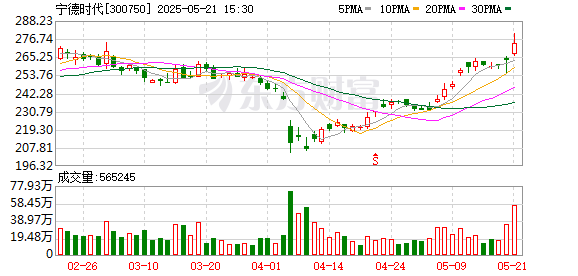
Core Viewpoint - Ningde Times' stock price surged significantly following its listing on the Hong Kong Stock Exchange, reflecting strong market confidence and demand for its shares [3][4]. Group 1: Stock Performance - Ningde Times' stock price rose by 16.43% on its first day of trading and continued to increase by over 12% the following day [3]. - As of the market close, Ningde Times' A-shares were priced at 274.08 CNY per share, while its H-shares were at 337.40 HKD, indicating a rare premium for H-shares over A-shares [4]. Group 2: Market Dynamics - The H-share issuance attracted significant foreign investment, with total institutional subscriptions exceeding 50 billion USD, resulting in a 30-fold oversubscription [4]. - Analysts suggest that the strong demand for Ningde Times' H-shares may signal a shift in how leading companies approach overseas listings, focusing more on "value benchmarking" rather than "discount financing" [4]. Group 3: Company Valuation - Ningde Times' total market capitalization reached 1,244 billion CNY, surpassing BYD's market cap of 1,216 billion CNY, marking a competitive shift in the industry [5]. - This valuation reversal is significant as it occurred only a few months after BYD had overtaken Ningde Times in market capitalization for the first time in nearly seven years [6]. Group 4: Future Prospects - The funds raised from the IPO, totaling 35.657 billion HKD, will primarily be allocated to the construction of projects in Hungary, enhancing the company's international market expansion [8]. - Analysts believe that the Hong Kong listing will bolster Ningde Times' global brand influence and support its international governance structure, facilitating further global expansion [8].

罕见!公募QDII孤军深入,破圈抄底非港股通股票
券商中国· 2025-03-08 05:39
港股流动性的重大改善,使得公募QDII重仓股的覆盖策略,正试探性超越港股通股票的名单范围。 由于港股市场特殊性,股票的流动性定价逻辑在相当程度上可以超越基本面,基于谨慎性原则,公募QDII尽 管未在基金合同上明确约定投资对象的"入港股通名单"条件,但在实际操作中的与强制合同约定"入港股通名 单"的A股基金、港股通基金保持一致,而QDII跟随A股基金与港股通基金的覆盖范围,也存在着避免孤军买 入、股票定价缺乏内资机构帮衬的需求。 但随着港股估值定价压缩严重、南下的"水源"越来越多,以及外资往往在入通名单公布前先行买入拉升现象频 频,由此出现许多"非入港股通"股票上涨背后均有QDII身影的现象,公募QDII这种尝试性的"孤军深入"名单 之外的优秀港股公司,也凸显出它们对港股流动性和定价逻辑重大变化的敏感性。 "非港股通"股票频现QDII 2025年3月10日,新一轮的港股通名单调整正式生效。但对许多A股基金经理、港股通基金经理而言,它们想 低位买入的股票正罕见的被公募QDII先拉了一波。 由于港股市场流动性与估值定价的敏感性,基于谨慎原则,公募QDII基金在香港市场的重仓股选择,向来以 纳入港股通名单作为评价依据 ...