
美国财政赤字

Search documents
半年内的首个看空信号!
鲁明量化全视角· 2025-09-14 04:07
Core Viewpoint - The market is showing its first bearish signal in half a year, with a recommendation to reduce positions in the main board and small-cap sectors to low levels, indicating a potential shift in market dynamics [5]. Market Performance - Last week, the market recorded gains, with the CSI 300 index up 1.38%, the Shanghai Composite Index up 1.52%, and the CSI 500 index up 3.38%. Speculative funds became active again, pushing various sector indices to their highs before August [3]. Economic Indicators - The domestic economy is showing signs of weakening while inflation is rising. Recent import and export data showed significant weakness, which has hindered the enthusiasm of some institutional investors. Financial data released last Friday appeared stable but is actually weakening, with expectations of a slowdown in year-on-year growth in the coming months. Meanwhile, CPI and PPI data have shown a rebound, indicating a temporary stagflation cycle in the Chinese economy [3][4]. Technical Analysis - There is a deepening divergence in the funding landscape. While the market has been driven by funds since June, institutional funds have shown a more decisive reduction in positions, while speculative funds are attempting a final upward push. The strength of technical signals has weakened [4]. Sector Positioning - The main board's market-driving forces are becoming increasingly differentiated, shifting from fundamentals to funds, and then to speculative funds. This indicates that market volatility is likely to increase further. The recommendation is to reduce positions in the main board to low levels, marking the first sell signal in half a year. The small-cap sector also showed slight advantages due to speculative activity, but overall differentiation has increased, suggesting a balanced style for the time being [5]. Short-term Focus - The short-term momentum model suggests focusing on the communication industry [5].


中美会谈结束后,不到24小时,特朗普就收到噩耗,美联储拒绝降息(2)
Sou Hu Cai Jing· 2025-08-23 06:35
Group 1 - The Federal Reserve announced to maintain interest rates and emphasized that a rate cut in September is premature, which is unfavorable for Trump [1] - Trump's pressure on Fed Chairman Powell has not yielded results, indicating his limited influence over monetary policy [1] - The trade war has significantly impacted the U.S. economy, disrupting international trade and contributing to a soaring fiscal deficit of $36 trillion [1] Group 2 - There is a growing consensus that the U.S. is approaching bankruptcy unless substantial measures to curb the deficit are implemented [1] - The failure of government efficiency reforms leaves Trump with limited options, primarily relying on tax increases [1] - International investors are increasingly pessimistic about U.S. Treasury bonds, leading to rising yields and further discouraging the Fed from cutting rates [1]
美元资产走弱,金价无惧议息会议放鹰,大幅反弹
Mei Ri Jing Ji Xin Wen· 2025-08-21 01:25
Core Viewpoint - The market is experiencing increased demand for safe-haven assets, leading to a significant rebound in gold prices, influenced by a decline in U.S. stock markets, a weaker dollar, and falling U.S. Treasury yields [1] Group 1: Market Reactions - As of the market close, COMEX gold futures rose by 1.00% to $3,392.20 per ounce [1] - The gold ETF Huaxia (518850) decreased by 0.3%, while the gold stock ETF (159562) increased by 1.39% [1] Group 2: Federal Reserve Insights - The Federal Reserve's July meeting minutes revealed that nearly all decision-makers supported maintaining interest rates, with only two dissenting [1] - There are divisions among Fed officials regarding inflation and employment risks, with a consensus that inflationary risks outweigh those related to employment [1] - Several officials noted that the impact of tariffs on inflation will take time to fully materialize [1] Group 3: Economic Analysis - Analysts from Shenwan Hongyuan Futures indicated that while the Fed decided to keep rates unchanged, there is a split in internal opinions influenced by personnel appointments made by Trump [1] - Trade negotiations show some progress, but the overall trade environment continues to deteriorate [1] - The implementation of the "Big and Beautiful" plan is expected to further increase U.S. fiscal deficit projections [1] - The People's Bank of China is continuously increasing its gold reserves, providing long-term support for gold prices, although current high levels may lead to hesitation in upward movement [1] - The overall trend for gold and silver may exhibit volatility as expectations for interest rate cuts rise [1]
金荣中国:特朗普关税获标普认可,金价扩大跌幅空头逐步增强
Sou Hu Cai Jing· 2025-08-20 02:49
Market Overview - International gold prices fell again on August 19, with an opening price of $3335.57 per ounce, a high of $3345.29, a low of $3320.92, and a closing price of $3322.60 [1] News Analysis - Trump criticized Jerome Powell on social media, claiming that his actions are severely harming the real estate industry and that there are no signs of inflation, suggesting a significant rate cut is necessary [2] - S&P confirmed the U.S. sovereign rating at "AA+/A-1+" with a stable outlook, indicating that while the fiscal deficit may not improve significantly in the coming years, it also will not worsen [2] - S&P projects that U.S. government net debt will exceed 100% of GDP over the next three years, with an average deficit of 6% of GDP from 2025 to 2028, down from 7.5% last year [2] - The probability of the Federal Reserve maintaining interest rates in September is 13.9%, while the probability of a 25 basis point cut is 86.1% [6] Geopolitical Developments - Trump is arranging a meeting between Putin and Zelensky, emphasizing that the U.S. will assist Ukraine in defense but will not deploy ground troops [4] - Discussions are ongoing about providing Ukraine with security guarantees, although NATO membership is off the table [4] - A potential summit in Budapest involving U.S., Russian, and Ukrainian leaders is being planned, with security concerns regarding the location due to historical context [5] Technical Analysis - Gold prices showed a downward trend, with a significant drop leading to a short-term bottom reversal, and the market is expected to maintain a bearish outlook [9] - The short-term gold price trend indicates a strong downward movement, with the possibility of a correction due to oversold conditions [9]

21评论丨美联储要“被动”降息了吗?
2 1 Shi Ji Jing Ji Bao Dao· 2025-08-13 22:36
Core Viewpoint - The article discusses the potential for the Federal Reserve to initiate a small interest rate cut in September, influenced by rising inflation data and pressure from the White House, despite the current economic indicators not supporting a large-scale reduction [1][4]. Economic Indicators - The latest Consumer Price Index (CPI) data shows a year-on-year increase of 2.7% in July, with the core CPI rising by 3.1%, indicating that inflation remains above the Fed's target of 2% [1]. - The Personal Consumption Expenditures (PCE) price index, which the Fed closely monitors, recorded a June value of 2.6%, up from 2.4% in May and 2.2% in April, justifying the Fed's decision to maintain interest rates [2]. Employment Metrics - The unemployment rate in July was reported at 4.2%, unchanged for three consecutive months, and significantly lower than the peak of 14.8% in April 2020, suggesting a stable labor market [3]. Fiscal Concerns - The U.S. government is approaching a "technical default," with projections indicating that 30% of government revenue in fiscal year 2025 will be allocated to debt interest payments, exacerbating the fiscal deficit [4]. - The ongoing high-interest payments on national debt create a paradox with the Fed's high interest rates, leading to concerns about the sustainability of U.S. fiscal policy and potential market reactions [4]. Market Reactions - Since April, there has been a notable sell-off of ten-year U.S. Treasury bonds, reflecting growing market anxiety over the U.S. debt repayment crisis and the sustainability of government revenue [4].
美联储要“被动”降息了吗?
2 1 Shi Ji Jing Ji Bao Dao· 2025-08-13 22:31
Core Viewpoint - The article discusses the potential for the Federal Reserve to initiate a small interest rate cut in September, influenced by rising inflation data and pressure from the White House, despite the current economic indicators not supporting a large-scale reduction [1][4]. Economic Indicators - The latest Consumer Price Index (CPI) for July shows a year-on-year increase of 2.7%, with the core CPI rising by 3.1%, indicating that inflation remains above the Fed's target of 2% [1]. - The Personal Consumption Expenditures (PCE) price index, which the Fed closely monitors, was reported at 2.6% for June, up from 2.4% and 2.2% in previous months, justifying the Fed's decision to maintain interest rates [2]. - The unemployment rate in July was stable at 4.2%, a significant decrease from the peak of 14.8% in April 2020, suggesting a recovery in the labor market [3]. Government Debt and Fiscal Concerns - The U.S. government is approaching a "technical default," with projections indicating that 30% of government revenue in fiscal year 2025 will be allocated to debt interest payments, exacerbating the fiscal deficit [4]. - The ongoing high-interest payments on national debt create a paradox with the Fed's high interest rates, leading to concerns about the sustainability of U.S. fiscal policy and potential market reactions [4]. Market Reactions - Since April, there has been a notable sell-off of ten-year U.S. Treasury bonds, reflecting growing market anxiety regarding the U.S. debt repayment crisis and the sustainability of government revenue [4].
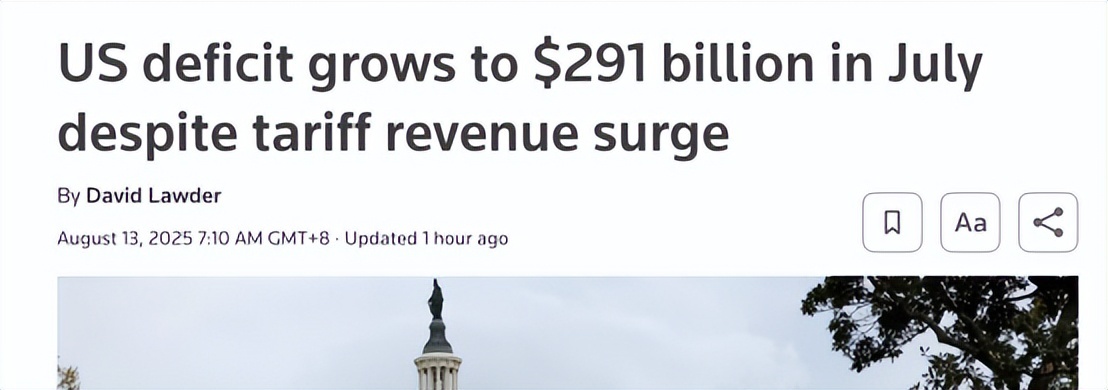
美国7月关税收入激增但赤字仍居高不下 财政压力持续凸显
Huan Qiu Wang· 2025-08-13 05:11
Core Insights - The overall increase in spending is attributed to various factors, including rising public debt interest payments, increased social security expenditures, and other costs [1] - The U.S. is facing another significant annual deficit, with the budget deficit exceeding $1.6 trillion over the past ten months as of the end of the fiscal year in September [1] - Treasury Secretary Basent previously projected that tariff revenues could reach $300 billion in fiscal year 2025, with potential for higher revenues in 2026 [1] - Structural pressures, including public debt interest and welfare spending, are seen as key determinants of the U.S. fiscal outlook [1] - One of the most severe challenges for U.S. finances is the rising debt interest, with interest payments reaching $91.9 billion in July, leading to a cumulative interest expenditure exceeding $1 trillion in the first ten months of the fiscal year [1] - Total interest on U.S. national debt has become the second-largest expenditure category for the government, following social security [1]
没能让中国让步,36万亿美债填不上,特朗普“枪口”瞄准自己人
Sou Hu Cai Jing· 2025-08-07 05:48
Core Viewpoint - The article discusses how Trump's policies have shifted from targeting illegal immigration to imposing financial burdens on both American citizens and foreign nationals, indicating a desperate attempt to generate revenue amid a fiscal crisis [1][5][10]. Group 1: Policy Changes - Trump's introduction of the "Gold Card" program, priced at $5 million, aimed to provide benefits similar to those of U.S. citizens, but was soon followed by a more direct requirement for all entrants to pay a security deposit ranging from $15,000 to $50,000 [1][3]. - The rationale behind these fees is framed as a matter of "national security," particularly targeting individuals from economically disadvantaged countries, which raises questions about the legitimacy of this justification [3][5]. Group 2: Economic Context - The article highlights the current fiscal challenges faced by the U.S., with a national debt nearing $40 trillion and interest payments on this debt surpassing defense spending at $1.3 trillion [10]. - It notes that the U.S. economy is no longer able to attract global capital as it once did, leading to a decline in tax revenues while national debt continues to rise [7][10]. Group 3: Future Implications - The article suggests that the "security deposit" policy is a form of taxation aimed at filling fiscal gaps, which may become increasingly stringent over time [8][10]. - It warns that if the current trend continues, the U.S. could face a severe economic crisis, as the interest on national debt may soon exceed total fiscal revenues [10].

美元“死猫跳”?双线资本:或将大幅贬值,开启“数年下行周期”
智通财经网· 2025-08-05 13:11
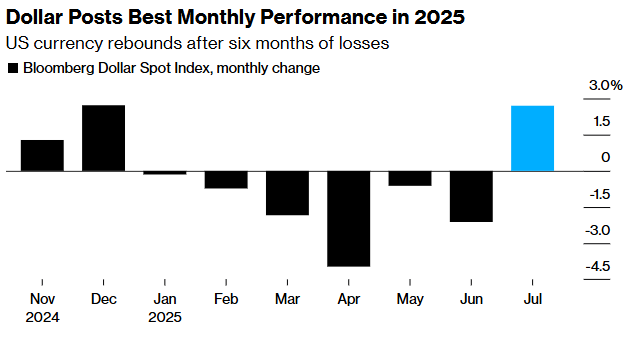
Group 1 - The core viewpoint is that the US dollar is expected to depreciate significantly, especially if the new Federal Reserve Chairman takes swift action to lower interest rates [1][4] - As of September 2024, the assets managed by DoubleLine Capital amount to $95 billion [1] - The dollar has entered a multi-year downtrend due to investor concerns over the US's large fiscal deficit, leading to a shift in investments to other regions [1][4] Group 2 - A major negative factor for the dollar is President Trump's push to lower borrowing costs, which raises questions about the independence of the Federal Reserve [4] - Recent economic data indicates a weaker labor market than previously expected, and inflation indicators favored by the Federal Reserve have risen, putting additional pressure on the dollar [4] - The Bloomberg Dollar Spot Index has seen a cumulative decline of over 7% this year, despite a recent 0.2% increase [4] Group 3 - The biggest threat to the theory of dollar depreciation is the potential return of "exceptionalism" policies in the US, which could boost demand for US assets [5] - The investment manager is closely monitoring commitments from trade partners, including the EU and Japan, to invest billions into the US, which could offset capital outflows [5] - The speed of global savings returning to the US is expected to be slower than in the past, aside from trade agreements [5]
分析师:特朗普的全球关税平均水平约为18%
news flash· 2025-08-01 11:37
Core Insights - The average global tariff rate imposed by the U.S. is estimated to be around 18% according to BlueBay Asset Management [1] - The projected annual revenue from U.S. tariffs is approximately $450 billion, with an expected increase to $770 billion in 2024, representing 1.25% of GDP [1] - This tariff revenue is anticipated to help reduce the U.S. fiscal deficit to slightly below 7% of GDP in the coming year [1]