
金融安全

Search documents
海保人寿携手海南省肿瘤医院、海南成美医院开展联合党建活动
Zhong Guo Fa Zhan Wang· 2026-01-08 03:17
Core Viewpoint - The article highlights the collaborative efforts of Haibao Life Insurance Co., Ltd. and local hospitals to enhance public health services and support rural revitalization through the "Hui Qiong Bao" health insurance initiative, aligning with national policies on social security and public service improvement [1][2][14]. Group 1: Health Insurance Initiative - Starting in 2024, Haibao Life has committed to providing "Hui Qiong Bao" health insurance to Beida Village, with a total coverage amount of 115 million yuan, continuing its support for rural communities [2][5]. - The initiative includes an additional 60 million yuan in coverage from Hainan Provincial Tumor Hospital and Hainan Chengmei Hospital, demonstrating a commitment to building a comprehensive social security system [2][5]. Group 2: Medical Services - The event featured a team of experts from Hainan Provincial Tumor Hospital and Hainan Chengmei Hospital, providing face-to-face health consultations to villagers, enhancing their health literacy and access to quality medical services [6][9]. - This initiative aims to promote the sinking of quality medical resources into rural areas, contributing to the construction of "healthy villages" [9]. Group 3: Financial Education - The event included a financial knowledge segment, where volunteers educated villagers on preventing financial risks such as illegal fundraising and telecom fraud, using accessible language [10][11]. - This effort is part of a broader initiative to enhance financial consumer education and protect the financial interests of rural residents, particularly the elderly [11]. Group 4: Integration of Party Building and Business - The joint party-building activity represents an effective practice of integrating party leadership with business operations, providing comprehensive services that address community needs [13][14]. - Haibao Life aims to continue innovating service models while fulfilling its social responsibilities, contributing to the development of Hainan Free Trade Port and rural revitalization [14].


存取现金超5万元不需再登记体现对个人尊严的尊重
Sou Hu Cai Jing· 2026-01-03 13:07
Core Viewpoint - The new "Management Measures for Customer Due Diligence and Customer Identity Information and Transaction Record Keeping" will take effect on January 1, 2026, eliminating the requirement for individuals to register the source of funds for cash withdrawals exceeding 50,000 yuan, thus balancing security and convenience while respecting personal dignity [1][2]. Group 1: Regulatory Changes - The previous regulation mandated that cash withdrawals over 50,000 yuan required documentation of the source and purpose of funds, which was criticized for infringing on personal rights and causing inconvenience [2][3]. - The new measures allow banks to assess the risk level of transactions and decide whether to inquire further about the source of funds, rather than applying a blanket rule [1][2]. Group 2: Impact on Banking Practices - Data from the central bank indicates that cash transactions over 50,000 yuan account for only 2% of total transactions, suggesting that the stringent measures had limited practical impact but significant psychological effects on customers [2]. - The new regulations aim to respect individual privacy and dignity while still allowing banks to conduct enhanced due diligence in high-risk situations [2][3]. Group 3: Legal Framework - The current Commercial Banking Law emphasizes the protection of depositors' rights and the principles of voluntary deposits, free withdrawals, interest on deposits, and confidentiality [3]. - Revisions to the Commercial Banking Law are underway to address changes in the financial landscape and to alleviate public concerns regarding personal dignity and rights [3].
壹快评|存取现金超5万元不需再登记体现对个人尊严的尊重
第一财经· 2026-01-02 12:56
Core Viewpoint - The new "Management Measures for Customer Due Diligence and Customer Identity Information and Transaction Record Keeping" aims to balance security and convenience by eliminating the requirement for individuals to register the source of funds for cash withdrawals exceeding 50,000 yuan, while still allowing banks to conduct enhanced investigations in high-risk situations [3][4]. Group 1: Regulatory Changes - The previous regulation requiring registration of cash withdrawals over 50,000 yuan was introduced to combat financial crimes such as telecom fraud and money laundering, but faced criticism for causing inconvenience and infringing on personal rights [3][4]. - The new measures allow banks to assess risk levels and decide whether to inquire further about the source of funds, moving away from a one-size-fits-all approach [3][4]. Group 2: Impact on Personal Rights - The removal of the cash withdrawal registration requirement is seen as a respect for personal dignity, as the previous rule implied a presumption of guilt and forced individuals to prove the legitimacy of their funds [4][5]. - Data from the central bank indicates that cash transactions over 50,000 yuan account for only 2% of total transactions, suggesting that the stringent measures had a limited practical impact but a significant psychological effect on the public [4]. Group 3: Legal Framework - The current Commercial Banking Law mandates that banks protect depositors' rights and adhere to principles of voluntary deposits, freedom of withdrawals, interest on deposits, and confidentiality [5]. - Revisions to the Commercial Banking Law are underway to address changes in the financial landscape and public concerns, particularly regarding personal dignity and the balance between security and convenience [5].

壹快评|存取现金超5万元不需再登记体现对个人尊严的尊重
Di Yi Cai Jing Zi Xun· 2026-01-02 12:33
Core Viewpoint - The new "Management Measures for Customer Due Diligence and Customer Identity Information and Transaction Record Keeping" will take effect on January 1, 2026, eliminating the requirement for individuals to register the source of funds for cash withdrawals exceeding 50,000 yuan, thus balancing security and convenience [1][2]. Group 1 - The previous regulation requiring registration for cash withdrawals over 50,000 yuan was aimed at combating financial crimes such as telecom fraud and money laundering, but faced criticism for causing inconvenience and infringing on personal rights [1][2]. - The new measures allow banks to assess the risk level of transactions and decide whether to inquire further about the source of funds, rather than applying a blanket rule [1][2]. - Data from the central bank indicates that cash transactions over 50,000 yuan account for only 2% of total transactions, suggesting that the stringent measures had a limited impact on the majority of customers, but the psychological impact was significant [2][3]. Group 2 - The revision of the Commercial Banking Law is underway to better align with current needs and public concerns, emphasizing the protection of depositors' rights and the principles of voluntary deposits, freedom of withdrawal, interest on deposits, and confidentiality [3]. - The new management measures reflect a respect for personal dignity, which is considered equally important as security and convenience [2][3].
数字人民币时代来临:揭秘2026年金融革命,重塑你的钱包和生活!
Sou Hu Cai Jing· 2026-01-01 21:40
Core Viewpoint - The official launch of the digital renminbi on January 1, 2026, marks a significant milestone in China's financial development, transitioning from a trial phase to a fully integrated payment method in daily economic life [1]. Group 1: Definition and Characteristics - The digital renminbi is a state-issued currency with the same legal status as physical cash, fundamentally different from speculative cryptocurrencies like Bitcoin [3]. - It operates as a digital wallet linked to bank accounts, allowing users to access their funds directly, which can also accrue interest [3]. Group 2: Strategic Importance - The digital renminbi is designed to enhance financial stability and prepare for potential future risks, ensuring that basic economic transactions can continue even in extreme situations, such as natural disasters [4]. - It provides a new payment channel that reduces reliance on Western-dominated payment systems, enhancing China's position in global trade and finance [5]. Group 3: Economic Management Tool - The digital renminbi's programmable features allow for more effective government subsidies, ensuring funds reach their intended targets without loss through intermediaries [7]. - It can protect consumer rights through smart contracts, ensuring that funds are only released under specific conditions, thus preventing fraud [7]. Group 4: Integration with Existing Systems - Digital renminbi will coexist with existing payment platforms like WeChat and Alipay, enhancing their functionality by allowing transactions directly from digital wallets [8]. - It features a controllable anonymity design, protecting user privacy during small transactions while enabling regulatory oversight for serious crimes [9]. Group 5: Societal Impact - The digital renminbi will facilitate smarter management and resource allocation, allowing the government to better understand market dynamics and consumer needs [11]. - It aims to enhance financial security for individuals, preventing fraud and theft while promoting better personal financial management through its features [11].

工、农、建、交、邮储,国有大行集体官宣→
新华网财经· 2025-12-31 09:57
Core Viewpoint - Starting from January 1, 2026, major Chinese banks including Industrial and Commercial Bank of China, Agricultural Bank of China, China Construction Bank, Bank of Communications, and Postal Savings Bank of China will pay interest on the balances of real-name digital RMB wallets at the same rate as current deposit rates, with interest calculation rules aligned with those of current deposits [2] Group 1: Digital RMB Wallets - The announcement specifies that interest will not be paid on balances in four types of personal non-real-name wallets, which are typically used for small anonymous payments and require only mobile phone verification for activation [2] - Real-name wallets (types one, two, and three) require varying degrees of identity verification, highlighting a strengthened emphasis on real-name systems and financial security [2] - Consumers are advised to understand the type of wallet they hold, the interest calculation rules, and the limits and security of their funds [2]




大荔法院 | 高效执行护金融 90万元案款执行到位
Xin Lang Cai Jing· 2025-12-21 07:18
Group 1 - The core viewpoint of the article emphasizes the importance of financial security as a foundation for stable economic operations, highlighting the role of courts in safeguarding the legitimate rights of financial institutions and assisting in loan recovery [1][3] - The Dali Court successfully executed the recovery of overdue loans amounting to 900,000 yuan, which is crucial for maintaining the normal financial order and ensuring the healthy operation of the financial institution involved [1][3] - The Dali Court plans to leverage cross-execution as an opportunity to focus on resolving disputes in the financial sector, increasing enforcement efforts to ensure a better financial environment that supports the real economy [3]

美元霸权风险凸显,中国连续13个月囤金,藏着金融安全大战略?
Sou Hu Cai Jing· 2025-12-20 04:35
Core Viewpoint - The article discusses China's increasing gold purchases as a strategic move to enhance financial security and stabilize the value of the Renminbi amidst global uncertainties [1][3][21]. Group 1: China's Gold Strategy - China has been buying gold for 13 consecutive months, not in large quantities at once, but consistently [1]. - The country ranks sixth globally in gold reserves, but the proportion of gold backing its foreign reserves is relatively low compared to the U.S. [3]. - The shift in global dynamics, including conflicts and sanctions, has made gold a more attractive asset compared to fiat currencies [5][10]. Group 2: Importance of Gold - Gold is viewed as a reliable asset, especially when the stability of fiat currencies is in question [7][8]. - The increasing reliance on the U.S. dollar poses risks, as seen in the case of Russia, highlighting the need for gold as a safeguard [10][11]. - Accumulating gold is seen as a way to secure a financial safety net and enhance the credibility of the Renminbi [11][21]. Group 3: Investment Advice for Individuals - Individuals are advised to adopt a cautious approach to gold investment, focusing on long-term accumulation rather than speculative gains [15][17]. - Regular, small investments in gold ETFs or accumulated gold are recommended to average out costs over time [17]. - Gold should only constitute a small portion of an individual's assets, and high-return gold investment schemes should be approached with caution due to inherent risks [19].

办信用卡抵物业费,都市左岸鼓励业主“薅银行羊毛”
Xin Lang Cai Jing· 2025-12-19 12:49
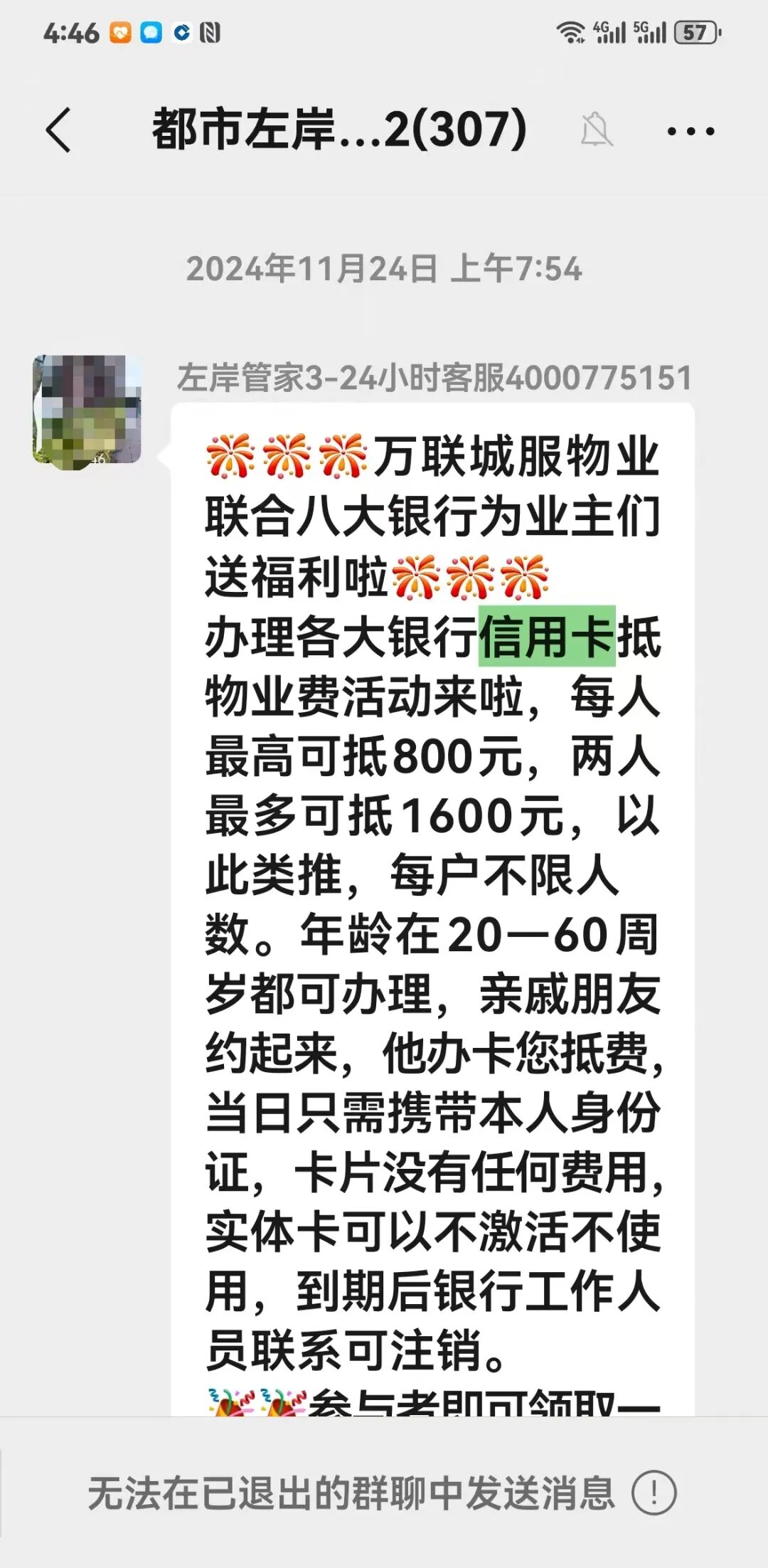
Core Viewpoint - The property management of the Urban Left Bank community has partnered with multiple banks since 2022 to promote a "credit card fee deduction" program, raising concerns among residents about financial security and personal credit risks [1][3][9]. Group 1: Program Details - The community collaborates with eight to nine banks annually, encouraging residents to apply for specific credit cards to receive a deduction of 100 yuan from their property fees for each card obtained [1][11]. - Residents can apply for credit cards from multiple banks, with some families reportedly obtaining over ten cards collectively [1][11]. Group 2: Resident Concerns - While many residents find the program beneficial, there are growing concerns regarding personal information security and the potential for credit damage due to mismanagement of credit cards [3][9]. - Some residents have reported their concerns to local regulatory authorities, leading to a directive for the property management to cease promoting the program in resident groups [3][9]. Group 3: Regulatory Response - The local financial regulatory authority indicated that only one of the banks involved is under their direct supervision, and residents would need to seek recourse at the bank's location in case of disputes [5][11]. - The property management claims that the program is voluntary and does not provide any financial benefit to them, as the fees deducted are properly invoiced [11][12]. Group 4: Credit Card Management - Bank representatives stated that residents can apply for credit cards over the phone without visiting bank branches, and clarified conditions regarding card cancellation and annual fees [11][12]. - Legal experts warn that while the program appears advantageous, it may carry hidden risks, such as negative impacts on credit scores from excessive credit card applications and potential difficulties in future credit approvals [6][12].
AI手机助手查银行卡余额,真的能绕过银行核验吗?
Xin Lang Cai Jing· 2025-12-17 02:56
Core Viewpoint - The introduction of the Doubao AI assistant raises questions about its ability to bypass bank app identity verification, highlighting public concerns over the security of AI technology in financial applications [1][6]. Group 1: Technology and Security Mechanisms - The Doubao AI assistant operates under a "dual authorization mechanism," requiring users to grant access within the bank app and confirm via biometric authentication, ensuring a two-layer security process [2][7]. - The AI assistant is assigned a "digital certificate" and a "temporary access token" that refreshes every hour, minimizing the risk of long-term misuse [2][7]. - Data transmission between the AI assistant, mobile system, and bank servers is encrypted, preventing the AI from storing or accessing sensitive data directly [2][7]. Group 2: Financial System Risks - Although the AI assistant has not caused significant financial security issues, its integration into the financial system poses potential risks, especially given the high volume of transactions processed [3][8]. - Recent incidents of AI being exploited for fraudulent activities underscore the need for banks to implement stringent security measures [3][8]. - Financial institutions face challenges in balancing user privacy, service experience, and the need for robust AI risk management [3][8]. Group 3: Innovation and Regulation - The demand for security should not hinder innovation; banks must develop a balanced mechanism that allows for efficient AI integration while maintaining safety [4][9]. - Banks are encouraged to categorize AI operations by risk level and apply corresponding protective measures, avoiding blanket bans on AI tools [4][9]. - Establishing clear agreements with AI tool providers regarding data security and operational boundaries is essential for safe implementation [4][9]. Group 4: User Awareness and Responsibility - Users are advised to enhance their security awareness, carefully granting financial permissions to third-party tools and regularly reviewing account authorizations [5][10]. - The discussion surrounding the Doubao AI assistant serves as a critical opportunity for the industry to reflect on the balance between technological advancement and security [5][9].
