大模型

Search documents
Seedance 2.0之后,字节发布豆包大模型2.0
Nan Fang Du Shi Bao· 2026-02-14 06:54
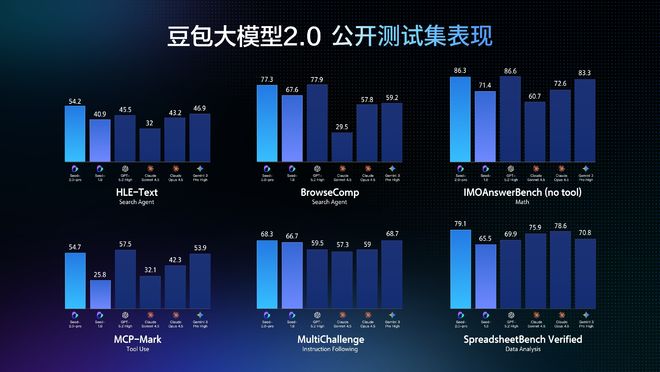
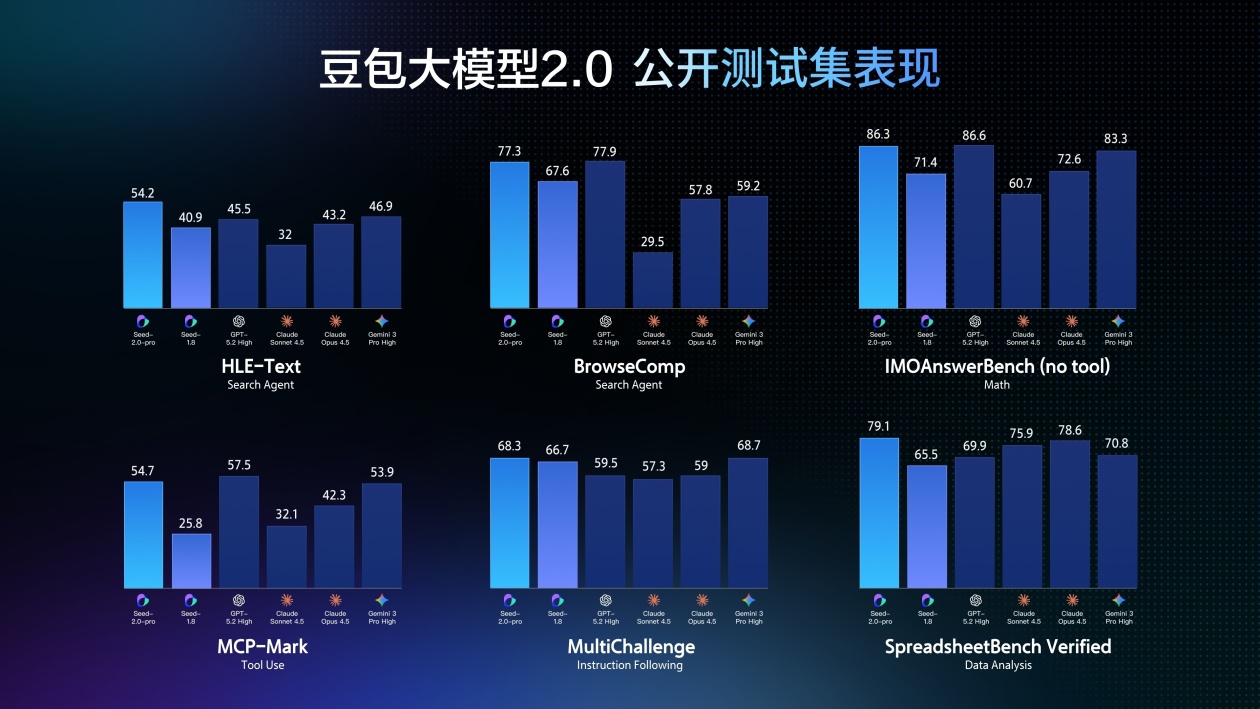
Core Insights - ByteDance launched Doubao-Seed-2.0 series on February 14, enhancing its large model capabilities for complex real-world tasks [1] - Doubao-2.0 Pro flagship version achieved top scores in IMO, CMO math competitions, and ICPC programming contests, surpassing Gemini 3 Pro in Putnam benchmark tests [1] - The model has improved knowledge coverage in niche areas and performed well in scientific knowledge tests, ranking comparably with Gemini 3 Pro and GPT 5.2 [1] - Doubao-2.0 has upgraded its multimodal understanding capabilities, excelling in visual reasoning, spatial perception, and long-context understanding tests [1] Application and Features - Doubao-2.0 enhances understanding of time series and motion perception, enabling real-time video analysis and environmental interaction for applications in fitness guidance, fashion advice, and companionship [2] - The model's agent capabilities achieved top scores in instruction following, tool invocation, and Search Agent evaluations, with a record score of 54.2 in HLE-Text [4] - Doubao-2.0 Pro is available on Doubao App, PC client, and web version, with a cost-effective pricing model based on input length [4] - The pricing for Doubao-2.0 Pro is set at 3.2 yuan per million tokens for inputs under 32k and 16 yuan per million tokens for outputs, offering a significant cost advantage over Gemini 3 Pro and GPT 5.2 [4] - Doubao-2.0 Lite offers high cost-performance, with input pricing at only 0.6 yuan per million tokens, surpassing the previous generation model Doubao-1.8 [4]

豆包大模型2.0发布 包含三款通用Agent模型和Code模型
Feng Huang Wang· 2026-02-14 06:51
Core Insights - ByteDance announced the release of Doubao Model 2.0, which includes Pro, Lite, Mini, and Code models, optimized for large-scale production environments to enhance multimodal understanding, complex instruction execution, and long-range task processing capabilities [1] Group 1: Model Features - Doubao 2.0 Pro targets deep reasoning and long-chain tasks, competing with GPT 5.2 and Gemini 3 Pro [1] - Doubao 2.0 Lite surpasses the previous main model Doubao 1.8 in overall capabilities [1] - Doubao 2.0 Mini is designed for low latency, high concurrency, and cost-sensitive scenarios [1] - The Code model is specifically developed for programming scenarios and can integrate with AI programming product TRAE [1] Group 2: Performance Metrics - Doubao 2.0 has achieved state-of-the-art (SOTA) levels in multimodal understanding, excelling in visual reasoning, perception, spatial reasoning, and long-context understanding tasks [1] - In dynamic scene evaluations like TVBench and EgoTempo, Doubao 2.0 outperformed human benchmarks [1] - The model demonstrated excellent performance in long video understanding across multiple streaming real-time question-answering benchmarks [1] Group 3: Competitive Edge - Doubao 2.0 Pro scored higher than GPT 5.2 in scientific evaluations such as SuperGPQA and HealthBench [1] - The model achieved gold medal results in IMO, CMO mathematics competitions, and ICPC programming contests [1] - The reasoning cost of Doubao 2.0 Pro is approximately an order of magnitude lower than that of leading industry models [1] Group 4: Availability - Doubao 2.0 Pro is now available on Doubao App, desktop, and web versions, with users able to experience it in "Expert" mode [2] - The Code model has been integrated into the Chinese version of TRAE [2] - Volcano Engine has launched API services for the Doubao 2.0 series models for enterprise and developer use [2]
字节跳动发布豆包大模型2.0,主打真实世界复杂任务执行力
Huan Qiu Wang· 2026-02-14 06:36
Core Insights - ByteDance has launched the Doubao-Seed-2.0 series, optimizing for large-scale production environments to handle complex real-world tasks [1] - The Doubao-2.0 Pro flagship version has achieved top-tier performance in various competitions, surpassing Gemini 3 Pro in mathematical reasoning and problem-solving capabilities [1] - The model has enhanced knowledge coverage in niche areas and performed well in scientific knowledge tests, ranking alongside Gemini 3 Pro and GPT 5.2 [1] - Doubao-2.0 has upgraded its multimodal understanding capabilities, achieving industry-leading results in visual reasoning and complex document comprehension [1] Performance Enhancements - The model has improved its understanding of time series and motion perception, enabling real-time video analysis and environmental interaction for applications in fitness guidance and companionship [2] - Doubao-2.0 Pro has demonstrated top-level performance in instruction following and tool usage, achieving a score of 54.2 in the HLE-Text evaluation, significantly outperforming other models [4] Market Positioning - Doubao-2.0 Pro is available on the Doubao App, desktop client, and web version, with a pricing model based on input length, offering a cost advantage over Gemini 3 Pro and GPT 5.2 [4] - The Doubao-2.0 Lite version provides high cost-performance, with input pricing at 0.6 yuan per million tokens, outperforming the previous generation model Doubao-1.8 [4]
字节跳动:豆包大模型2.0正式发布
Xin Lang Cai Jing· 2026-02-14 06:29
Core Insights - ByteDance officially launched Doubao Model 2.0, which includes Pro, Lite, Mini, and Code models, designed to adapt flexibly to various business scenarios [1][6][4] Model Specifications - Doubao 2.0 Pro targets deep reasoning and long-chain task execution, directly competing with GPT 5.2 and Gemini 3 Pro [1][6] - Doubao 2.0 Lite balances performance and cost, surpassing the capabilities of the previous main model, Doubao 1.8 [1][6] - Doubao 2.0 Mini is optimized for low latency, high concurrency, and cost-sensitive scenarios [1][6] - The Code version (Doubao-Seed-2.0-Code) is specifically designed for programming tasks and works best in conjunction with the AI programming product TRAE [1][6] Availability and Integration - Doubao 2.0 Pro is now available on the Doubao App, desktop, and web versions, allowing users to experience it in 'expert' mode [1][6] - Doubao 2.0 Code has been integrated with the AI programming product TRAE, and the Volcano Engine has launched API services for the Doubao 2.0 series aimed at enterprises and developers [1][6]
豆包大模型2.0正式发布
财联社· 2026-02-14 06:28
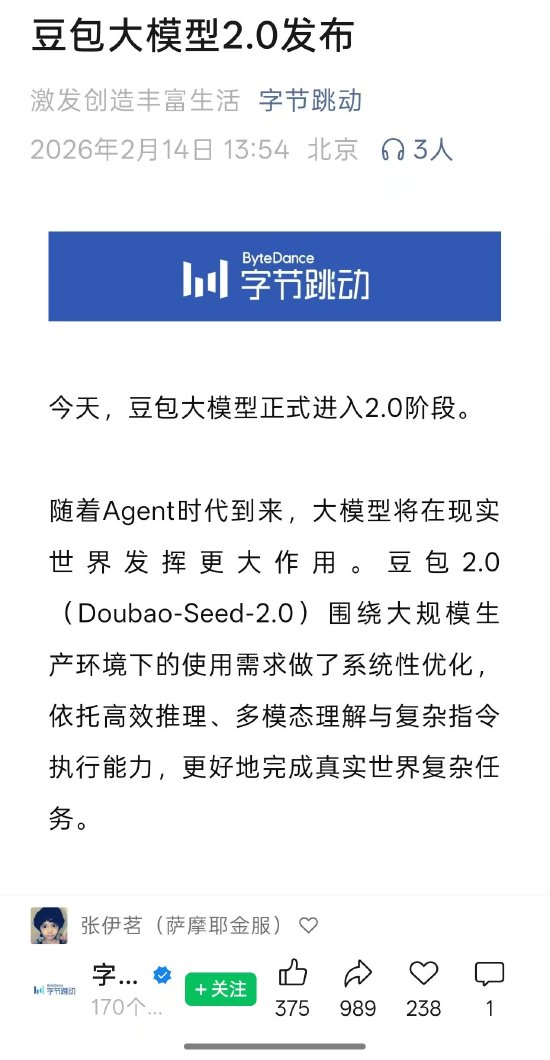
Core Insights - Doubao 2.0 has officially entered its second phase, focusing on systematic optimizations for large-scale production environments, enhancing capabilities in efficient inference, multimodal understanding, and complex instruction execution to better tackle real-world complex tasks [1] Product Overview - The Doubao 2.0 series includes three general-purpose agent models (Pro, Lite, Mini) and a Code model, designed to flexibly adapt to various business scenarios: - Doubao 2.0 Pro targets deep reasoning and long-chain task execution, fully competing with GPT 5.2 and Gemini 3 Pro [2] - Doubao 2.0 Lite balances performance and cost, with comprehensive capabilities surpassing the previous generation model Doubao 1.8 [2] - Doubao 2.0 Mini is aimed at low latency, high concurrency, and cost-sensitive scenarios [2] - The Code version (Doubao-Seed-2.0-Code) is specifically designed for programming scenarios, showing enhanced performance when used in conjunction with TRAE [2]

豆包大模型2.0正式发布
Xin Lang Cai Jing· 2026-02-14 06:18
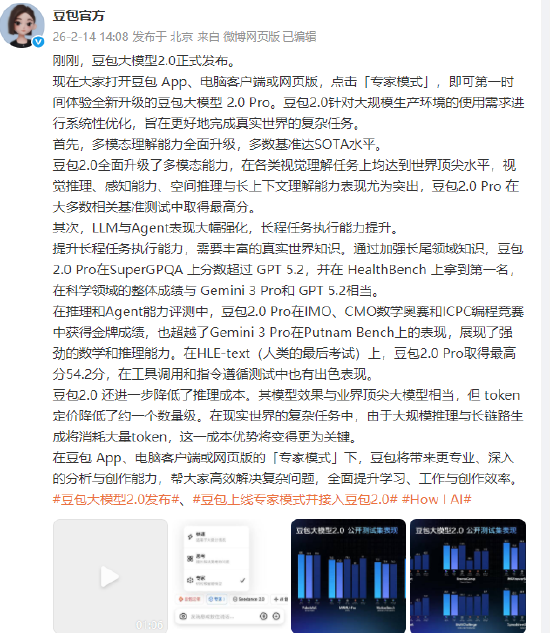
2月14日消息,据豆包官方微博,刚刚,豆包大模型2.0正式发布。 现在大家打开豆包 App、电脑客户端或网页版,点击'专家模式',即可第一时间体验全新升级的豆包大 模型 2.0 Pro。豆包2.0针对大规模生产环境的使用需求进行系统性优化,旨在更好地完成真实世界的复 杂任务。 首先,多模态理解能力全面升级,多数基准达SOTA水平。 豆包2.0全面升级了多模态能力,在各类视觉理解任务上均达到世界顶尖水平,视觉推理、感知能力、 空间推理与长上下文理解能力表现尤为突出,豆包2.0 Pro 在大多数相关基准测试中取得最高分。 其次,LLM与Agent表现大幅强化,长程任务执行能力提升。 提升长程任务执行能力,需要丰富的真实世界知识。通过加强长尾领域知识,豆包2.0 Pro在SuperGPQA 上分数超过 GPT 5.2,并在 HealthBench 上拿到第一名,在科学领域的整体成绩与 Gemini 3 Pro和 GPT 5.2相当。 在推理和Agent能力评测中,豆包2.0 Pro在IMO、CMO数学奥赛和ICPC编程竞赛中获得金牌成绩,也超 越了Gemini 3 Pro在Putnam Bench上的表现,展现了强 ...
港股收评:恒生指数跌1.72% 半导体板块领涨
2 1 Shi Ji Jing Ji Bao Dao· 2026-02-14 06:01
有色金属板块走弱,佳鑫国际资源跌超10%,中国有色矿业、力勤资源跌超8%。 医疗设备与服务板块走强,GUANZE MEDICAL涨超40%,健康之路涨近14%,万嘉集团涨超12%。 | 代码 | 名称 | 现价 | 涨跌幅 ▼ | 涨跌 | 换手率 | 5分钟涨跌幅 | 5日涨跌幅 | 王力 | | --- | --- | --- | --- | --- | --- | --- | --- | --- | | 2427 | GUANZE MEDICAL | 1.950 | 40.29% | 0.560 | 2.10% | 0.00% | 25.00% | | | 2587 | 健康之路 | 5.090 | 13.87% | 0.620 | 13.90% | 0.59% | 14.90% | | | 0401 | 万嘉集团 | 0.120 | 12.15% | 0.013 | 0.00% | 0.00% | 53.17% | | | 0932 | 顺腾国际控股 | 0.037 | 12.12% | 0.004 | 0.48% | 0.00% | 8.82% | | | 2252 | 微创机器人-B | 29.0 ...

云知声股价大幅波动,大模型业务成增长引擎
Jing Ji Guan Cha Wang· 2026-02-14 04:31
Core Viewpoint - The recent stock price volatility of Cloud Wisdom (09678.HK) is driven by high growth expectations in its large model business, technological breakthroughs, and commercial progress, despite ongoing losses and cash flow pressures [1][5]. Stock Performance - Cloud Wisdom's stock experienced significant fluctuations in February 2026, with a single-day increase of 16.77% on February 12, closing at HKD 345.40, followed by a 1.45% rise on February 13, closing at HKD 350.40 [1]. - Over the last five trading days, the cumulative increase was 20.33%, and over the last twenty trading days, it was 25.05%, although the stock is down 13.35% year-to-date [1]. - The stock exhibited a daily volatility of 11.58% on February 12, with a range volatility of 39.33% [1]. Business Progress - Cloud Wisdom has made significant advancements in the medical AI sector, with its "Shan Hai. Zhi Yi" large model achieving top rankings in three categories during the MedBench 4.0 evaluation [3]. - On February 6, 2026, the company entered a strategic partnership with Jia Hui Medical to expand into the high-end medical market [3]. - The company released the "Shan Hai. Zhi Yin Model 2.0," which supports full-duplex interaction and has achieved an accuracy rate of over 90% in recognizing complex background sounds [3]. Financial Situation - On February 13, 2026, the net outflow of funds was HKD 466.42 million from institutional investors and HKD 337.91 million from retail investors [4]. - The current price-to-earnings ratio (TTM) is -47.17, and the price-to-book ratio is 17.59, indicating a high market valuation expectation [4]. - Zhongsheng Group has set a target price of HKD 750.58 based on a 25x price-to-sales ratio for 2026 [4]. Future Development - The company faces risks related to slower-than-expected R&D progress and insufficient cash flow, with cash reserves projected to be only HKD 1.56 billion by the end of 2024, against a net loss of HKD 4.54 billion for that year [5]. - The customer retention rate in the medical business has declined from 70.4% in 2022 to 53.3% in 2024, indicating a need for improved customer stability [5].
科大讯飞2025年经营回款超270亿元
Zheng Quan Ri Bao Wang· 2026-02-14 03:45
Core Insights - The conference held by iFlytek on February 13, 2026, focused on the theme "Courageous Progress, Vast Sky" and reviewed the company's achievements in 2025 while outlining strategic directions for 2026 [1] Financial Performance - In 2025, iFlytek achieved over 27 billion yuan in operating revenue, with operating cash flow reaching a record high of 3 billion yuan, representing a year-on-year growth of 28% [1] - The company's profit scale increased by 40% year-on-year, reaching 7 billion yuan [1] Industry Applications and International Market - iFlytek's medical large model achieved industry-leading key performance indicators, with its intelligent medical assistant completing over 1.1 billion diagnoses [1] - The company's overseas revenue surpassed 1 billion yuan [1] Strategic Focus for 2026 - For 2026, iFlytek has identified four key initiatives: maintaining strategic focus, enhancing systematic innovation, deepening project-based approaches, and accelerating talent development [1] - A transformation management committee has been established to drive AI-driven organizational efficiency upgrades [1] AI and Workforce - The chairman emphasized that AI will not replace humans but will eliminate those who do not adapt their work methods [1] - iFlytek aims to invest in tools, training capabilities, and talent development mechanisms to provide growth opportunities for every employee [1]

36氪精选:中国大模型第一股「智谱」,到底是谁?
日经中文网· 2026-02-14 03:31
Core Viewpoint - The listing of Zhipu marks a significant milestone for China's AI industry, being recognized as the first stock of a large model company in the country, reflecting the culmination of three years of anticipation in the sector [6][11]. Company Background - Zhipu was founded in June 2019 by a team from Tsinghua University's Computer Science Department, focusing on natural language processing (NLP) and knowledge graphs, and secured 40 million in angel funding in its founding year [7][8]. - The company made a pivotal decision to develop its own architecture, creating the General Language Model (GLM) instead of following the prevalent GPT and BERT paths, which led to the development of GLM-130B, a bilingual model with a scale of hundreds of billions of parameters [8][9]. Product Development and Market Position - Zhipu's GLM-130B was recognized as the only Asian model in a major evaluation by Stanford University in November 2022, shortly before the global surge of ChatGPT [9]. - Following the release of ChatGPT, Zhipu launched ChatGLM on March 14, 2023, which became a popular tool for developers in China, sparking a wave of interest in deploying large models [9][10]. - By the time of its listing, Zhipu's GLM model was already operational in 12,000 enterprises globally, including nine of the top ten internet companies in China, as well as sectors like government, healthcare, and education [10]. Financial Performance and Future Outlook - Despite rising revenues, Zhipu faces increasing R&D expenditures and significant losses, a common scenario among independent large model companies in Silicon Valley [11]. - The company secured over 2.5 billion RMB in funding in 2023, indicating strong investor interest and support, with a diverse group of investors joining its funding rounds [11]. - The listing of Zhipu is seen as a "coming of age" for China's AI sector, but it also brings the challenge of meeting market expectations and scrutiny in the future [11][12].