
人民币汇率

Search documents
多因素支撑人民币汇率走强,双向波动仍将是常态
Sou Hu Cai Jing· 2025-12-29 00:24
钛媒体App 12月29日消息,近期,人民币对美元汇率走势颇受市场关注。离岸人民币对美元汇率在12月 25日短暂升破7.0元关口后,围绕7.0元关口展开拉锯;在岸人民币对美元汇率在12月25日创下2024年10 月以来新高后回调。专家表示,美元指数走弱、年底企业结汇需求提升等因素支撑人民币汇率走强。展 望未来,美元指数存在走升可能,在外部环境反复多变、本外币利差明显倒挂的背景下,人民币汇率单 边走势不可持续,双向波动仍将是常态。 (中证报) ...
时报观察丨汇率没有单边走势 双向波动是常态
证券时报· 2025-12-29 00:22
Core Viewpoint - The recent appreciation of the RMB against the USD has attracted market attention, with strong bullish sentiment; however, there is divergence regarding whether the RMB will continue to strengthen, indicating that two-way fluctuations in the exchange rate will be the norm [1] Group 1: RMB Exchange Rate Dynamics - The RMB has appreciated nearly 1.7% against the USD since mid-October, driven by factors such as the Federal Reserve's interest rate cuts and seasonal demand for currency settlement [1] - Despite the typical year-end peak in currency settlement, the latest data shows that the foreign exchange market in China remains balanced, with stable bank settlement and sales, and the surplus in currency settlement is similar to October [1] - The 7.0 level is a critical point for the RMB/USD exchange rate, and given the current significant interest rate differential between the RMB and USD, it is expected that settlement demand will not remain high [1] Group 2: Market Influences and Central Bank Actions - The RMB's short-term exchange rate is influenced not only by domestic supply and demand but also by the trend of the USD index; with the Fed's interest rate cuts, the downward pressure on the USD may ease in the coming months [2] - The CFETS RMB index, which measures the RMB against a basket of currencies, has remained relatively stable over the past two months, indicating that while the USD weakens, the RMB remains at a reasonable equilibrium level [2] - The central bank is likely to take measures to prevent unilateral expectations and self-reinforcing "herd behavior" in the exchange rate market, especially if the RMB appreciates too quickly [2]


中金:人民币汇率并未明显低估
Xin Lang Cai Jing· 2025-12-29 00:16
Core Viewpoint - The financial cycle, characterized by the interplay between housing prices and credit, influences the current account and currency exchange rates, with upward cycles lowering the current account but raising the domestic currency value, while downward cycles have the opposite effect [1] Group 1: Financial Cycle Insights - The financial cycle is defined as a long-term cycle where housing prices and credit reinforce each other [1] - The relationship between the financial cycle and exchange rate trends is acknowledged, suggesting that exchange rates may still be influenced by the financial cycle [1] Group 2: Real Estate Investment Attributes - The investment attributes of real estate in China have weakened in recent years, while its consumption attributes have strengthened [1] - The significance of the housing price-to-income ratio and the difference between rental yields and mortgage rates has increased in assessing the financial cycle [1] Group 3: Currency and Market Performance - The report indicates that the RMB exchange rate is not significantly undervalued, and the Chinese stock market has performed well [1] - The weakening of the US dollar contributes to a reasonable phase of mild recovery in the RMB exchange rate [1]
金属期货领涨,碳酸锂、沪铜均创年内新高
2 1 Shi Ji Jing Ji Bao Dao· 2025-12-28 23:59
Group 1: Commodity Market Overview - The domestic commodity futures market experienced a general increase, with notable highs in silver, copper, and lithium carbonate [2] - In the energy and chemical sector, fuel oil rose by 4.23% and crude oil by 3.56% [2] - Lithium carbonate futures reached a new high, with prices exceeding 130,000 yuan/ton, marking a 65.02% increase for the year [2][3] Group 2: Lithium Carbonate Insights - Lithium carbonate prices continued to rise, with spot prices reported at 111,900 yuan/ton, a significant increase of 14.59% [3] - Supply remains tight, with a decrease in imports from Chile by 26.84% in November [3] - Demand is expected to grow, particularly in the energy storage sector, with a projected growth rate of 40%-50% by 2026 [3] Group 3: Copper Market Dynamics - Copper futures saw a 5.95% increase, closing at 98,720 yuan/ton, breaking the 100,000 yuan mark [5] - Supply constraints are evident, with a significant reduction in processing fees expected by 2026 [6] - Demand from the electric grid and the electric vehicle sector is expected to support copper prices [6][7] Group 4: Industrial Profit Trends - In November, industrial profits for large enterprises fell to a year-on-year decline of 13.1%, a drop of 7.6 percentage points from October [8] - The mining sector saw a profit decline of 21.2%, while high-tech manufacturing profits increased by 10% [8][9] - The overall profit margin for industrial enterprises is under pressure, with an asset-liability ratio reaching a near ten-year high [9] Group 5: Currency and Economic Outlook - The offshore RMB broke the 7.0 mark against the USD, with a 4% appreciation year-to-date [11] - Factors driving this appreciation include a weaker USD, stronger Chinese stock market, and increased demand for currency conversion by export enterprises [11] - Predictions suggest the RMB may maintain a strong position against the USD, with a potential target of 6.8 [12][13]

十大券商一周策略:A股跨年行情启动,人民币汇率与春季躁动行情有望共振,新主线浮出水面
Jin Rong Jie· 2025-12-28 23:58
Group 1 - The market is expected to maintain structural opportunities driven by liquidity easing, policy expectations, and a strengthening yuan, with consensus on sectors like technology manufacturing, resource products, and beneficiaries of yuan appreciation [1][4][5] - A total of 39 out of 360 industry/theme ETFs reached new highs in December, with established sectors like telecommunications and non-ferrous metals leading, alongside emerging sectors like commercial aerospace [2][3] - The focus remains on sectors with low heat and high long-term ROE potential, such as chemicals, engineering machinery, and new industries like commercial aerospace, while also tracking the trend of yuan appreciation [3][4] Group 2 - The spring market conditions remain favorable, supported by liquidity and investor expectations, with a potential for volatility in early 2026 due to upcoming events like the Spring Festival and the Two Sessions [4][10] - The yuan's appreciation is expected to enhance domestic purchasing power and attract foreign capital back to Chinese assets, creating significant potential for asset revaluation [5][6] - Key sectors to watch include AI investments, global manufacturing recovery, and consumer sectors benefiting from increased domestic demand, such as aviation, hotels, and food and beverage [9][11][12] Group 3 - The current market is characterized by a lack of clear bull market signals, but the foundation remains solid with improving fundamentals and capital inflows [7][12] - The market is likely to experience a structural and rapid rotation of sectors, with a focus on technology themes and non-bank financial sectors [16][15] - The upcoming spring market is anticipated to show upward momentum, with opportunities for low-positioning strategies and sector switching rather than aggressive trend-following [16][14]
中金:人民币并未明显低估
中金点睛· 2025-12-28 23:55
Core Viewpoint - The article argues that the Chinese yuan is not significantly undervalued, challenging the traditional view that assesses exchange rates primarily through commodity pricing, which is seen as disconnected from modern financial realities [2][4][6]. Group 1: Exchange Rate Assessment Perspectives - The mainstream economic view (neoclassical) evaluates exchange rates based on commodity pricing, suggesting that trade surpluses should lead to currency appreciation [4][5]. - In contrast, post-Keynesian economics emphasizes the role of capital flows and expectations in determining exchange rates, arguing that asset prices are more influential than traditional economic indicators [6][7]. Group 2: Financial Cycles and Exchange Rates - Financial cycles significantly impact the relationship between current accounts and exchange rates, with evidence showing that during financial upturns, trade deficits widen, while downturns lead to narrowing deficits [9][11]. - The article highlights that recent trends in China's trade surplus and yuan depreciation are results of financial cycle adjustments, rather than direct causation between trade surplus and currency value [13][15]. Group 3: Real Estate Market Dynamics - The investment attributes of real estate in China have diminished, with a notable decrease in the correlation between housing prices and transaction volumes, indicating a shift towards consumption attributes [30][32]. - The article discusses how changes in the real estate market affect the financial cycle, influencing the motivations for asset allocation between real estate and equities [34][36]. Group 4: Income and Economic Growth - The relationship between income growth and economic performance is emphasized, with projections indicating that if nominal GDP growth rebounds, disposable income growth will also improve [40][41]. - The article suggests that understanding income trends is crucial for predicting real estate market movements and, consequently, exchange rate dynamics [41].

时报观察:汇率没有单边走势 双向波动是常态
Xin Lang Cai Jing· 2025-12-28 23:33
Core Viewpoint - The recent appreciation of the Renminbi (RMB) against the US dollar has sparked market interest, with bullish sentiment peaking. However, there is a divergence in market opinions regarding the future strength of the RMB, indicating that fluctuations in the exchange rate will likely become the norm [1] Summary by Relevant Sections - The current strengthening of the RMB can be traced back to mid-October, with an appreciation of nearly 1.7% against the US dollar to date [1] - Factors contributing to the recent RMB strength include the Federal Reserve's interest rate cuts leading to a weaker US dollar index and increasing year-end settlement demand, which are seen as short-term and seasonal influences [1] - There is caution against assuming that the RMB will enter a sustained unilateral appreciation phase, as significant uncertainty remains regarding its future exchange rate movements [1]
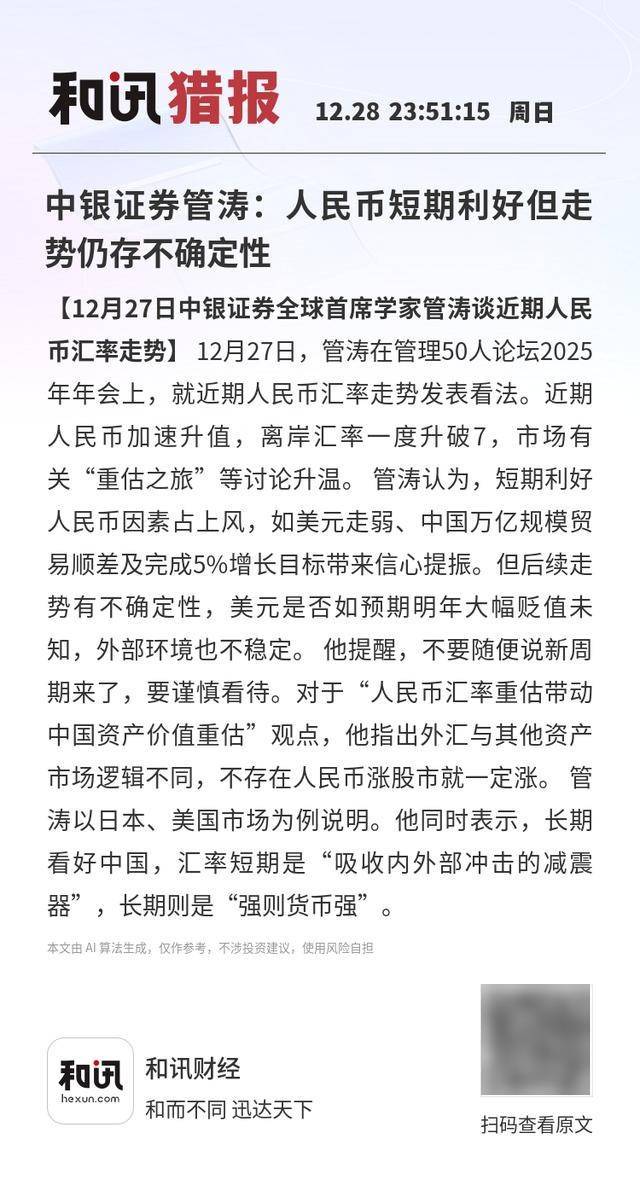
中银证券管涛:人民币短期利好但走势仍存不确定性
Sou Hu Cai Jing· 2025-12-28 23:25
Group 1 - The core viewpoint is that the recent appreciation of the Renminbi (RMB) is influenced by favorable short-term factors, including a weaker US dollar, a trade surplus of over 1 trillion, and confidence from achieving a 5% growth target [1] - There is uncertainty regarding the future trajectory of the RMB, particularly concerning the expected significant depreciation of the US dollar next year and the instability of the external environment [1] - The notion that a revaluation of the RMB will lead to a revaluation of Chinese assets is cautioned against, as the logic of foreign exchange differs from that of other asset markets, with no guarantee that an increase in the RMB will result in a rising stock market [1] Group 2 - The long-term outlook for China remains positive, with the RMB serving as a "shock absorber" for internal and external impacts in the short term, while in the long term, a strong currency reflects a strong economy [1]

时报观察 汇率没有单边走势 双向波动是常态
Zheng Quan Shi Bao Wang· 2025-12-28 23:18
Core Viewpoint - The recent appreciation of the RMB against the USD has sparked market interest, but there are differing opinions on whether this trend will continue, with expectations of two-way fluctuations in the exchange rate being the norm [1][2] Group 1: RMB Exchange Rate Trends - Since mid-October, the RMB has appreciated by nearly 1.7% against the USD, influenced by factors such as the Federal Reserve's interest rate cuts and seasonal demand for currency settlement [1] - The exchange rate is currently at a critical point around 7.0, which is seen as a battleground for bullish and bearish sentiments [1] - Despite the typical year-end surge in currency settlement, recent data shows that the foreign exchange market remains balanced, with stable bank settlement and sales [1] Group 2: Market Dynamics and Future Outlook - The RMB's appreciation is not solely driven by domestic supply and demand but is also affected by the trends in the USD index [2] - The CFETS RMB index has remained relatively stable, indicating that while the RMB has strengthened, it is still at a reasonable equilibrium level [2] - The central bank is likely to intervene if the RMB appreciates too quickly to prevent one-sided market expectations and self-reinforcing "herd effects" [2] Group 3: Risk Management for Market Participants - Market participants, including enterprises and financial institutions, should be cautious about blindly following exchange rate trends and should adopt a risk-neutral approach [2] - Utilizing foreign exchange derivatives such as options and futures is recommended for effective currency risk management [2]
人民币对美元中间价年内涨幅超一千五百基点,专家提醒——汇率双向波动是常态
Sou Hu Cai Jing· 2025-12-28 23:00
今年以来,全球汇市波动加剧,而人民币对美元走势稳中偏强。从人民币对美元汇率中间价来看,年内 涨幅超过1500个基点,并于近日升至2024年9月以来最高。这引发市场广泛讨论,其间不乏"人民币会继 续升值"的猜想。就此,记者采访了有关专家。 近日召开的中国人民银行货币政策委员会2025年第四季度例会强调,增强外汇市场韧性,稳定市场预 期,防范汇率超调风险,保持人民币汇率在合理均衡水平上的基本稳定。专家认为,近年来,在应对多 轮外部冲击的过程中,我国外汇市场的监管部门积累了丰富的经验,也有充足的政策工具储备,有经 验、有能力、有信心应对各种冲击和挑战,维护我国外汇市场的稳定运行。(经济日报记者 姚 进) 接下来,人民币汇率是否会呈现单边升值态势?专家认为,对此还需客观、理性看待。"美联储面临通 胀和就业的艰难平衡,进一步降息面临的约束不少,并不像部分媒体所说的明年会超预期大幅降息,目 前市场预期明年会降息2次。近期美元指数跌幅较大,未来存在回调走升的可能。"中国民生银行首席经 济学家温彬说。 作为货币之间的比价,汇率双向波动是常态。温彬提醒,未来人民币汇率走势仍存在较大不确定性,企 业和金融机构切忌盲目跟风、赌汇率 ...