戴维斯双击

Search documents
香港交易所(0388.HK):资产资金双重共振、业绩估值向上持续
Ge Long Hui· 2025-08-06 19:19
Core Viewpoint - The Hong Kong Stock Exchange (HKEX) is expected to experience significant profit growth and an upward shift in valuation due to a thriving primary and secondary market, supported by favorable policies, leading to a potential "Davis Double Play" [1][3]. Group 1: Market Position and Strategy - HKEX is a globally leading exchange group, uniquely positioned as the only exchange platform in Hong Kong, encompassing the Stock Exchange, Futures Exchange, and London Metal Exchange, which creates a comprehensive service ecosystem [1]. - The strategic direction of HKEX focuses on connecting China with the world, capital with opportunities, and the present with the future, leveraging its unique regional and regulatory resources to enhance innovation and international expansion [1]. Group 2: Financial Performance and Business Model - The company's light capital structure ensures high profit margins and return on equity (ROE), with trading fees and system usage fees contributing significantly to revenue, accounting for 53% of total income [2]. - HKEX maintains a net profit margin and EBITDA margin around 58% and 75%, respectively, while the median ROE over the past decade has reached 23% [2]. Group 3: Valuation Drivers - The dual resonance of assets and funds is driving the valuation of HKEX upward, with improved asset structure and favorable policies supporting the listing of A-share companies in Hong Kong [3]. - The influx of southbound funds, driven by the valuation discount of Hong Kong stocks and the anticipated near-term interest rate cuts by the Federal Reserve, is expected to sustain market liquidity and activity [3]. Group 4: Profit Forecast and Investment Rating - The projected net profit for HKEX from 2025 to 2027 is estimated at HKD 153 billion, 166 billion, and 178 billion, reflecting year-on-year growth rates of +17%, +9%, and +7% respectively [3]. - Given the regional monopoly advantages and high shareholder return attributes, HKEX is assigned a PE valuation of 50 times, with a target price of HKD 515, indicating a potential upside of 23% from current levels [3].

混合类理财也分红:兴银理财“阿尔法2号”交出一份亮眼成绩单
2 1 Shi Ji Jing Ji Bao Dao· 2025-08-06 12:21
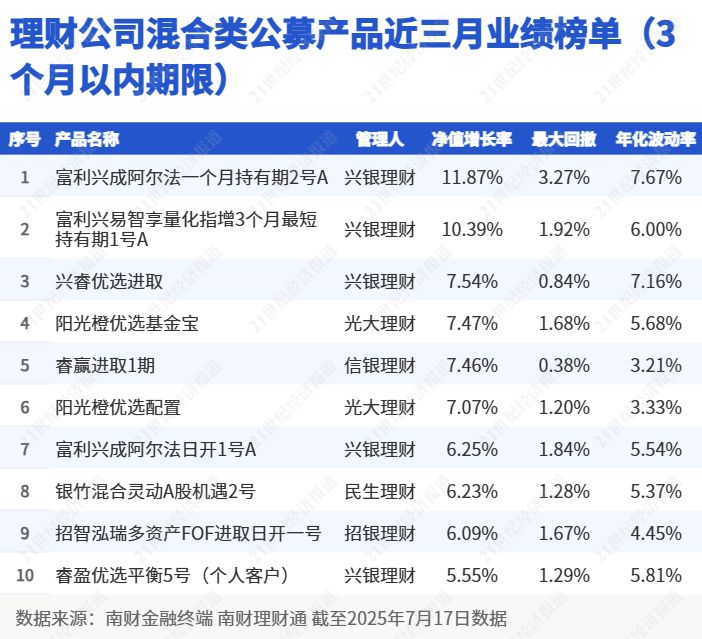
Group 1 - The investment enthusiasm in the equity market has been reignited this year, with major indices showing significant gains, including the Hang Seng Index and the Hang Seng Tech Index, which rose by 23.5% and 22.05% respectively [1] - Mixed-asset financial products have seen a notable increase in returns due to the stock market rally, with several companies announcing cash dividends for their mixed-asset products [1] - The "Fuli Xingcheng Alpha One Month Holding Period No. 2" product announced a cash dividend of 0.03 yuan per unit, achieving a cumulative net value increase of 18.92% as of July 30 [1][4] Group 2 - Xingyin Wealth Management has adapted to the complex internal and external environment by innovating products and diversifying investment strategies, leading to initial success in its equity investment business [2] - The company has transitioned from a single strategy to a diversified strategy system, covering absolute and relative returns, self-management and co-management, direct stock investment and FOF investment, among others [2] - The "Fuli Xingcheng Alpha One Month Holding Period No. 2" product has a maximum drawdown of only 3.27% since its inception, indicating effective execution of its absolute return strategy [4][6] Group 3 - The "Fuli Xingcheng Alpha One Month Holding Period No. 2" product employs a low valuation value investment strategy, focusing on stocks with low price-to-book ratios and high return on equity [4] - The product manager's compensation is linked to investor interests, as no management fees are charged when the net value falls below 1, and there are no subscription or redemption fees [6] - The "Alpha 1" product, which also follows a low valuation stock selection strategy, achieved a cumulative net value increase of 22.2% as of July 30, 2025 [4][6]

沪指收盘价再创年内新高!“冲锋旗手”证券ETF龙头(560090)收涨近1%,喜提两连阳!7月A股新开户数同比增长71%,释放什么信号?
Xin Lang Cai Jing· 2025-08-05 10:12
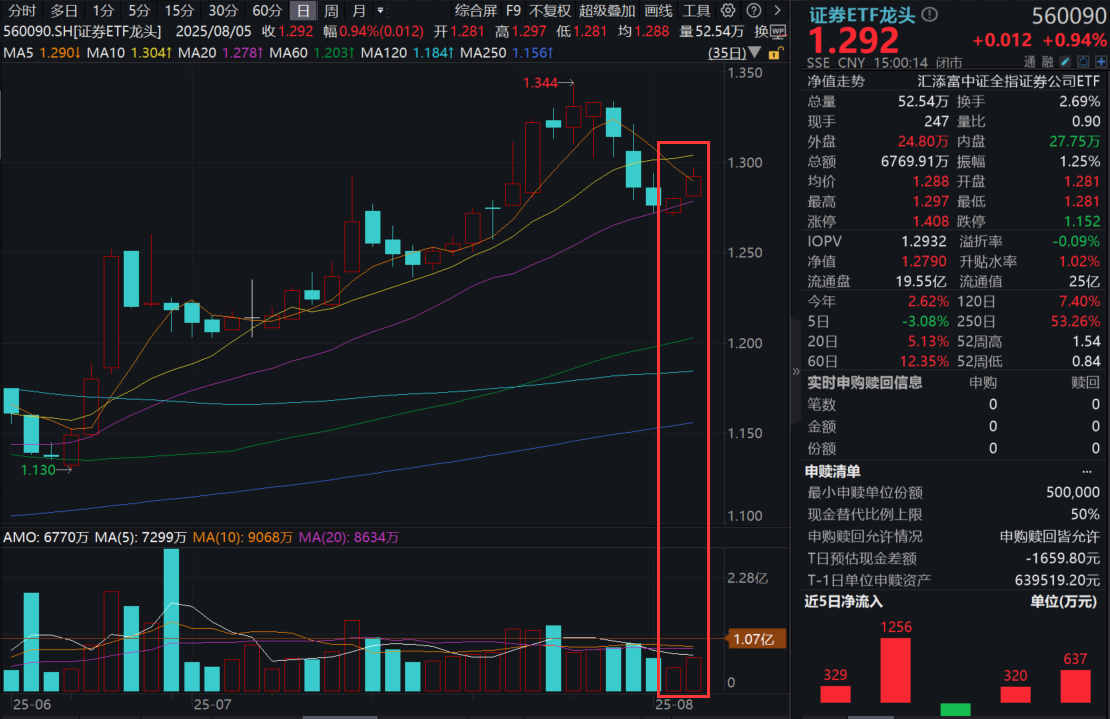
Core Viewpoint - The A-share market is experiencing significant growth in new investor accounts, indicating a positive outlook for the capital market and a shift towards equity investments, which is beneficial for the securities sector [6][7]. Group 1: Market Performance - On August 5, the Shanghai Composite Index rose nearly 1%, reaching a new high for the year, with over 3,900 stocks gaining in value, driven by strong performance from heavyweight stocks [1]. - The leading securities ETF (560090) has seen a 0.94% increase, marking two consecutive days of gains and attracting over 13 million yuan in net inflows over the past five days [1][3]. Group 2: Securities Sector Growth - The component stocks of the leading securities ETF (560090) almost all experienced gains, with notable increases such as a 6% rise in Xinda Securities and over 3% in Hongta Securities [3]. - The top ten component stocks of the securities ETF include companies like Dongfang Caifu and CITIC Securities, with trading volumes and estimated weights indicating strong market interest [4]. Group 3: Investor Behavior and Market Dynamics - In July 2025, new A-share accounts reached 1.96 million, a 71% increase compared to July 2024, reflecting a significant rise in investor participation [6]. - The increase in new accounts is associated with a positive shift in investor sentiment towards the capital market, as evidenced by a notable rise in the proportion of household savings allocated to A-shares [6][7]. - The market is entering a phase characterized by increased activity and liquidity, with a strong feedback loop of capital inflow driving market growth [7][9]. Group 4: Future Outlook for Securities Firms - The securities sector is expected to benefit from the increase in new accounts, leading to enhanced liquidity and potential performance improvements for brokerage firms [9]. - Positive policy developments and market conditions are anticipated to support the growth of brokerage firms' earnings and valuations, with a focus on both short-term and long-term opportunities [9].





百望股份数据智能战略驱动首度盈利,海量交易数据迎价值重估
Zhong Guo Jin Rong Xin Xi Wang· 2025-08-05 02:35
Core Viewpoint - Baiwang Co., Ltd. is expected to achieve a historic turnaround with a net profit forecast of 3 to 5 million RMB for the first half of 2025, driven by a significant revenue increase of 17%-35% year-on-year, reaching 330 to 380 million RMB, with AI business contributing 58 to 63 million RMB [1] Group 1: Financial Performance - The company anticipates a substantial increase in revenue, with AI business becoming a core growth engine [1] - Gross margin is projected to rise to 45%-50%, validating the effectiveness of the company's "loss reduction and profit increase" strategy [1] Group 2: Strategic Transformation - Baiwang is transitioning from a traditional tax SaaS provider to a leader in data intelligence, successfully converting vast data resources into commercial value [1][2] - The company is focusing on a dual-engine strategy of "AI Intelligent Body × Data Intelligence" to enhance operational quality and build technical barriers [2] Group 3: Leadership Change - The appointment of a new CEO, Fu Yingbo, a seasoned AI leader, signals the company's commitment to its AI strategic transformation [3] Group 4: Market Potential and Competitive Advantage - Multiple institutions are optimistic about Baiwang's data monetization potential, highlighting the rarity of its government-level data infrastructure projects [4] - Baiwang's core competitiveness stems from its unparalleled data asset endowment, having processed invoice transaction amounts exceeding 95.35 trillion RMB, which is about seven times the nominal GDP of China in 2024 [4] Group 5: Customer Base Growth - The number of group clients served by Baiwang increased by 29.9% from 2051 to 2664, while the number of small and medium-sized clients grew by 18.8% [5] - The total number of taxpayer identification numbers served surged by 81.2%, indicating strong market penetration and influence [5] Group 6: Capital Operations and Incentives - Baiwang has submitted an application for the conversion of domestic unlisted shares to H-shares, which will significantly enhance its capital operation space and financing capabilities [6] - The introduction of an equity incentive plan in early 2025 aims to bind AI talent with the company's innovation direction, boosting market confidence and supporting the development of data intelligence technology [6]
百亿私募大幅加仓,看好这些方向!
天天基金网· 2025-08-04 05:42
Core Viewpoint - The article highlights the optimistic sentiment among private equity firms regarding the stock market, with a notable increase in their positions and a focus on specific investment opportunities in the second half of the year [1][2][3]. Group 1: Private Equity Positioning - As of July 25, 2025, the stock private equity position index is at 75.85%, up 0.76% from the previous week, with large private equity firms showing the most significant increase [1]. - Nearly 60% of stock private equity firms are fully invested, with 57.23% having positions over 80%, while 62.24% of large private equity firms are also fully invested [1]. - The average return of subjective long positions among private equity firms is 14.86% year-to-date, significantly outperforming the market index return of 6.61% [1]. Group 2: Investment Focus Areas - Major private equity firms maintain a positive long-term outlook for the stock market, supported by ample liquidity and improving fundamentals [2]. - Key investment directions identified include the revaluation of quality Chinese assets, globalization of advantageous industries, and opportunities in self-sufficient technology sectors [2]. - The focus also includes potential gains from economic-sensitive assets that may benefit from marginal improvements or new policies [2]. Group 3: Research and Analysis - Private equity firms are intensifying their research on quality listed companies, with 651 A-share companies being investigated by institutions as of July 31, involving 11,554 participating institutions [3]. - The most researched sectors by institutional investors are electronics, pharmaceuticals, computers, and machinery, while private equity firms focus on computers, pharmaceuticals, electronics, and power equipment [3]. Group 4: Quantitative vs. Subjective Private Equity - The number of billion-dollar quantitative private equity firms has surpassed that of subjective private equity firms for the first time, with 41 quantitative firms compared to 40 subjective firms as of July 10 [4]. - This marks an increase of 8 quantitative firms and a decrease of 6 subjective firms since the end of last year [4].

戴维斯双击本周超额基准3.76%
Tianfeng Securities· 2025-08-03 04:43
Group 1: Davis Double Strategy - The Davis Double strategy involves buying stocks with growth potential at a lower price-to-earnings (PE) ratio, waiting for growth to manifest, and then selling for a multiplier effect, achieving returns from both earnings per share (EPS) and PE increases [7][10] - The strategy has achieved an annualized return of 26.45% during the backtest period from 2010 to 2017, exceeding the benchmark by 21.08% [10] - Year-to-date, the strategy has a cumulative absolute return of 29.82%, outperforming the CSI 500 index by 21.30%, with a weekly excess return of 3.76% [10][14] Group 2: Net Profit Gap Strategy - The Net Profit Gap strategy focuses on selecting stocks based on fundamental and technical resonance, where "net profit" refers to earnings surprises, and "gap" indicates a significant upward price jump on the first trading day after earnings announcements [12][14] - Since 2010, this strategy has achieved an annualized return of 29.83%, with an annualized excess return of 27.67% over the benchmark [14] - The current year's cumulative absolute return for the strategy is 35.44%, exceeding the benchmark index by 26.93%, with a weekly excess return of 0.43% [14] Group 3: Enhanced CSI 300 Portfolio - The Enhanced CSI 300 portfolio is constructed based on investor preferences, including GARP (Growth at a Reasonable Price), growth, and value investing styles, utilizing PB-ROE and PE-growth factors to identify undervalued stocks with strong earnings potential [16] - The strategy has shown stable excess returns historically, with a year-to-date excess return of 17.08% relative to the CSI 300 index, and a weekly excess return of 0.45% [16] - The portfolio's performance for the current year reflects a 20.13% absolute return, with a 17.08% excess return over the benchmark [16]
百亿私募大幅加仓,看好这些方向
Zheng Quan Shi Bao· 2025-08-02 23:54
Group 1 - Recent data shows a slight recovery in stock private equity positions, with the private equity position index at 75.85%, up 0.76% from the previous week [1] - The highest increase is observed in large private equity firms, with their position index at 78.47%, a significant rise of 5.69% [1] - Nearly 60% of stock private equity firms are fully invested, with 57.23% having positions over 80% [1] Group 2 - The subjective long-only strategy of private equity has performed well this year, with an average return of 14.86%, significantly outperforming the market index return of 6.61% [1] - Major private equity firms maintain an optimistic view on the long-term market trend, supported by ample liquidity and ongoing fundamental recovery [1] Group 3 - The well-known private equity firm, Dushuquan, highlights three key investment directions for the second half of the year: value reassessment of quality Chinese assets, globalization of advantageous Chinese industries, and investment opportunities arising from technological self-sufficiency [2] - Danyu Investment's core strategy focuses on internet-based assets, seeking growth stocks with reasonable valuations and positive industry expectations [2] Group 4 - As of July 31, a total of 651 A-share companies have been investigated by institutions, with private equity firms researching 306 companies [3] - The most researched industries by institutional investors include electronics, pharmaceuticals, computers, and machinery, while private equity firms focus on computers, pharmaceuticals, electronics, and power equipment [3] - The number of billion-dollar quantitative private equity firms has surpassed that of subjective private equity firms for the first time, with 41 quantitative firms compared to 40 subjective firms [3]
北美云商财报大超预期,全面看好AI产业链
Changjiang Securities· 2025-08-01 05:48
Investment Rating - The report maintains a positive outlook on the AI industry chain, indicating a "Davis Double-Click" moment for the AI sector, with expectations for accelerated monetization and increased PE valuations [10]. Core Insights - Recent quarterly earnings reports from Microsoft and Meta have exceeded expectations, driven by AI, leading to significant revenue and performance growth, alongside accelerated Capex investments [4][7]. - The AI commercial cycle is evolving rapidly, with cloud service providers entering a high-intensity phase of computing power investment [7]. Summary by Relevant Sections Communication - AI is driving revenue and Capex acceleration for North American cloud service providers, becoming a core driver for the AI commercial cycle. The report recommends focusing on the optical module and optical device sectors, highlighting companies such as Zhongji Xuchuang, Xinyisheng, Tianfu Communication, and Shijia Photon, while paying attention to Taicheng Technology and Yuanjie Technology [10]. Electronics - The report suggests focusing on two growth directions in PCB: HDI for high-density wiring and high data processing efficiency, and orthogonal backplane PCBs for high-density computing clusters. Recommended companies include Industrial Fulian for server assembly and Shenghong Technology, Hudian Co., Pengding Holdings, and Dongshan Precision for PCBs [10]. Computers - AI applications and overseas capital expenditures are creating a positive feedback loop, with cloud and advertising sectors exceeding growth expectations. The report recommends focusing on infrastructure, AI application scenarios, and domestic computing power [10]. Machinery - The evolution of PCB towards higher complexity and performance is driving demand for upstream equipment and materials. The report recommends focusing on PCB drilling needles, drilling equipment, exposure equipment, and other leading companies in the supply chain [10]. Building Materials & Military Industry - The trend in electronic cloth is clear, with a focus on optimizing structures and achieving simultaneous volume and price increases. Key recommendations include Zhongcai Technology and Feilihua [10]. Chemicals - The report highlights the high-frequency and high-speed resin direction, with an expected increase in demand for high-end CCL. Companies to watch include Dongcai Technology and Shengquan Group [10]. Electric New Energy - In copper foil, the need for low Dz, high peel strength, and low transmission loss is emphasized, with recommendations for manufacturers with high-end product technology and capacity reserves. In electrical equipment, the report suggests potential supply chain opportunities related to next-generation DC architecture [10].


基金经理:超额收益并非短期现象
Zhong Guo Zheng Quan Bao· 2025-07-31 21:02
Group 1 - The core viewpoint of the articles highlights the strong performance of innovative drug ETFs, with several funds achieving over 100% returns this year, indicating a significant interest in the sector [1][2][3] - The innovative drug sector is transitioning from a defensive investment strategy to an offensive growth strategy, driven by policy support, international breakthroughs, and increased capital inflow [3][4] - Fund managers express optimism about the long-term growth potential of innovative drugs, anticipating a harvest period starting from 2025, following a decade of investment [2][4] Group 2 - Several innovative drug ETFs have shown remarkable performance, with three specific ETFs achieving over 100% returns as of July 31 [2] - The active equity funds focused on innovative drugs have also seen rapid growth, with one fund exceeding 140% returns since the beginning of the year [2] - Despite the positive outlook, there are concerns about potential valuation bubbles in the innovative drug sector, as increased funding may overlook the inherent risks and challenges of drug development [3][4] Group 3 - The innovative drug sector is expected to experience a "Davis Double Play" effect, benefiting from policy dividends and improved global competitiveness [3] - The assessment of innovative drug companies should focus on their global competitiveness and domestic commercialization capabilities, with a preference for products ranked among the top three globally [4] - Companies need to balance pipeline advancement with cash flow management and enhance their research efficiency to navigate the competitive landscape effectively [3][4]
近一个月吸金超百亿元!这类ETF火了
Zhong Guo Zheng Quan Bao· 2025-07-31 12:12
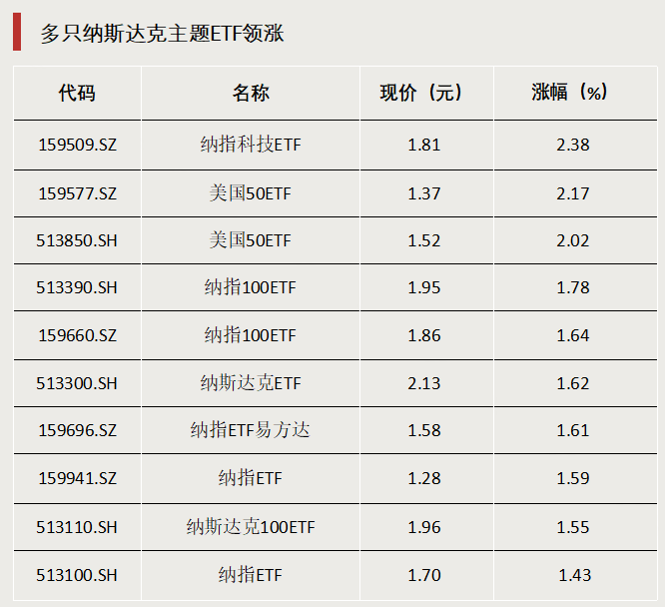
Group 1: ETF Market Performance - Multiple Nasdaq-themed ETFs saw gains exceeding 1.5% on July 31, with the Nasdaq Technology ETF (159509) rising by 2.38% and over 12% year-to-date [3][4] - Significant increases were observed in various technology-themed ETFs, including those focused on chips, cloud computing, and artificial intelligence, driven by the ongoing development of AI technology and improved fundamentals in innovative pharmaceuticals [5][6] - The real estate and commodity sectors experienced notable adjustments, with the Hang Seng Consumer ETF dropping over 7% and several related ETFs declining more than 3% [8][9] Group 2: Fund Flows - On July 30, the E Fund ChiNext ETF and E Fund CSI AAA Technology Innovation Corporate Bond ETF saw net inflows exceeding 1 billion yuan each, with a total of over 10 billion yuan in inflows for these two ETFs [2][10] - In the past month, four public fund institutions, including Huaxia Fund and Jiashi Fund, reported net inflows exceeding 10 billion yuan into their technology bond ETFs [2][10] Group 3: Investment Opportunities - The ChiNext Index is expected to enter a new phase of "Davis Double Play," characterized by low valuations, industrial transformation, and supportive policies, indicating significant investment opportunities [12] - The chemical sector is highlighted as having strong potential for price recovery and performance elasticity due to its current low valuation and the presence of leading companies with competitive advantages [12]