
美元贬值

Search documents
AI技术扩散与万亿融资缺口:大摩描绘下一阶段全球经济图景
智通财经网· 2025-07-23 08:35
Group 1: AI Technology and Investment Opportunities - Morgan Stanley's report highlights the expanding impact of AI technology across over 3,600 global stocks, indicating significant alpha opportunities in relative returns and earnings revisions [1] - The report recommends focusing on four categories of stocks: those with increased AI importance and exposure, stocks where AI is a core investment logic, AI adopters with pricing power, and stocks with the highest AI importance and pricing power [1] Group 2: Global Data Center Growth - Global data center capacity is projected to grow by 23% annually by 2030, with the U.S. contributing 60% of this growth, while the UAE and Saudi Arabia are expected to expand their capacities by 6-7 times [1] - Major U.S. tech companies' AI capital expenditures are expected to see a compound annual growth rate of 19% from 2024 to 2029, driven by four major cloud service providers, although challenges such as energy supply and GPU availability remain [1] Group 3: AI Financing and Semiconductor Market - By 2028, global data center investments are expected to reach $2.9 trillion, with a financing gap of $1.5 trillion that will primarily be filled by the credit market, including $800 billion from private credit [2] - The easing of export restrictions on lower-end AI GPUs by the U.S. is expected to benefit companies like Nvidia, AMD, and Broadcom in the Chinese market, with Nvidia's revenue in China projected to reach $25-35 billion by 2025 [2] Group 4: U.S. Economic and Taxation Outlook - The Inflation Reduction Act's tax provisions may significantly lower U.S. corporate cash tax rates, potentially bringing overall cash tax rates down to single digits due to immediate deductions [2] - Tariffs are impacting core commodity prices, with significant price increases observed in categories like appliances and furniture, leading to an expected rise in core PCE inflation by approximately 60 basis points by 2025 [2] Group 5: Currency Strategy and Chinese Economic Forecast - The U.S. dollar is expected to depreciate further, with potential increases in the euro/dollar exchange rate if hedging ratios return to historical averages [3] - China's GDP growth forecast for 2025 has been adjusted upward by 30 basis points to 4.8%, although a slowdown is anticipated in the second half of the year [3]
美元强势不再?期权市场信号预警美元面临新压力
Sou Hu Cai Jing· 2025-07-22 14:00
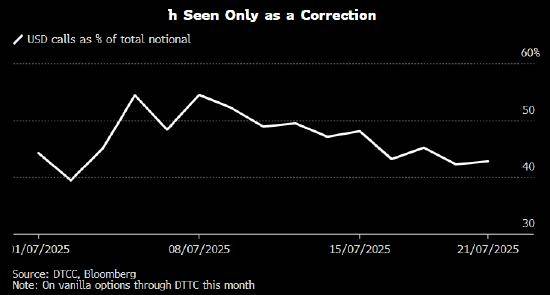
资金流动数据也为这一趋势提供了佐证。根据美国存管信托与结算公司的最新名义交易量数据,过去两 周内,投资者对主要货币对中美元贬值风险的敞口需求有所增加,这表明市场普遍看空美元的情绪正在 回归。 值得注意的是,波动率偏度指标已经从6月的反弹期间更为明确地转向负值,这进一步表明期权交易者 正在为美元下行趋势的重启做准备。 从技术分析的角度来看,美元仍然处于看跌趋势的通道之中。尽管近期出现了一定程度的反弹,但这一 反弹动能与今年的整体模式相符,即在大约2%的涨幅后逐渐减弱。此次反弹再次受阻于55日移动均 线,这一关键阻力位多次成为价格上升的天花板。持续无法突破这一水平进一步强化了市场对美元走强 仅是暂时调整的看法,而非新一轮上涨趋势的开始。 来源:http://www.cnu.com.cn/cellphone/202507/105926.html 外汇期权市场动态揭示了美元可能面临的新一轮贬值压力,尤其是在即将步入8月之际,多重风险因素 正悄然聚集,可能对美元汇率构成不利影响。 近期,彭博美元即期指数的一个关键市场情绪指标——1个月风险逆转指标,自两周以来首次跌入负值 区间,这一转变预示着市场参与者开始倾向于为美元潜 ...

华尔街到陆家嘴精选丨为何投资者对美股强劲财报无动于衷?美股七巨头财报将定调美股走向?AI融资窟窿有多大?
Di Yi Cai Jing· 2025-07-22 06:03
Group 1: U.S. Stock Market and Earnings Reports - The current earnings season shows that good performance is no longer sufficient to support stock prices, with high valuations acting as a constraint [1] - Major banks like JPMorgan and Bank of America reported solid earnings, but stock price increases were limited, indicating a low tolerance for mistakes among investors [1][2] - The S&P 500's expected earnings growth for Q2 is 10%, down from 13% in Q1, with technology, communications, and healthcare sectors expected to lead growth [1][3] Group 2: Banking Sector Performance - Six major U.S. banks benefited from a rebound in trading activities, with notable increases in investment banking revenues: JPMorgan up 7% to $2.5 billion, Citigroup up 13% to $1 billion, and Goldman Sachs up 26% to $2.191 billion [2][3] - Some banks are increasing loan loss provisions in anticipation of potential economic downturns, with Citigroup's provisions up 16% and JPMorgan's up 25% [3] Group 3: Semiconductor Industry Insights - NXP Semiconductors reported Q2 revenue of $2.93 billion, down 6% year-over-year, but the decline is slowing compared to a 9% drop in Q1 [5][6] - The automotive chip business generated $1.73 billion, halting a five-quarter decline, but the overall outlook remains cautious due to weak demand in automotive and industrial sectors [5][6] Group 4: Technology Sector Outlook - The upcoming earnings reports from major tech companies are expected to significantly influence the market, with anticipated earnings growth of 14.1% for the tech giants [8][9] - A weaker dollar is expected to benefit U.S. stocks, particularly tech companies, as over half of their revenue comes from overseas [8] Group 5: AI and Technology Financing - Morgan Stanley highlights a $1.5 trillion financing gap for AI development, with significant capital expenditure expected in data centers, projected to reach $2.9 trillion by 2028 [10][11] - The demand for funding in the tech sector is rising, with large tech firms facing a $1.5 billion financing gap despite strong cash flows [11]


美国商务部长卢特尼克:鲍威尔将利率维持在过高水平”实在太久”。美元某种程度的贬值削弱了关税冲击。按揭贷款利率比合理水平高出2个百分点。鲍威尔维持高利率每年给美国造成7000亿美元损失。
news flash· 2025-07-20 15:02
Core Viewpoint - U.S. Commerce Secretary Raimondo criticizes Powell for maintaining high interest rates for too long, which has significant economic implications [1] Group 1: Economic Impact - The prolonged high interest rates are estimated to cost the U.S. economy $700 billion annually [1] - Mortgage loan rates are currently 2 percentage points above reasonable levels, affecting housing affordability [1] Group 2: Currency and Tariffs - The depreciation of the dollar has somewhat mitigated the impact of tariffs [1]
德商银行:美元的下行趋势在最近的缓和后保持不变
news flash· 2025-07-18 11:50
Core Viewpoint - The recent mild recovery of the US dollar may indicate a pause in its depreciation rather than a reversal of the trend [1] Group 1 - Analyst Volkmar Baur from Deutsche Bank suggests that the intensity and speed of the dollar's depreciation in the first half of the year could lead to a slight rebound in recent weeks [1] - The issues facing the dollar have not disappeared, and it may become a focal point again next week [1] - The deadline for US tariffs on August 1 is approaching rapidly, which could impact the dollar's performance [1] Group 2 - Concerns regarding the independence of the Federal Reserve are also highlighted as a potential risk for the dollar [1]
PIMCO:投资者预计将继续撤离美国资产
news flash· 2025-07-18 09:59
Group 1 - The core viewpoint of the report from Pacific Investment Management Company (PIMCO) indicates that the trend of investors withdrawing from U.S. assets and the steepening of the U.S. Treasury yield curve is expected to continue in the second half of this year [1] - PIMCO anticipates that the investment narrative for the first half of 2025 will remain relevant in several aspects, including the continued depreciation of the U.S. dollar and the widening gap between short-term and long-term U.S. Treasury yields [1] - The company believes that global markets will continue to outperform the U.S. market [1] Group 2 - PIMCO favors global short-term and medium-term bonds in its investment strategy [1] - The report suggests that the extent of interest rate cuts by central banks may exceed expectations [1]
君諾外匯:贸易战引发全球衰退被视为最大尾部风险
Sou Hu Cai Jing· 2025-07-17 02:49
Group 1 - The core concern among investors is the potential for a global economic recession triggered by trade wars, with 38% identifying it as the largest tail risk event [1][3] - Trade tensions have escalated, leading to increased tariffs and a slowdown in global trade flow, which directly impacts import and export businesses and affects supply chains across various industries [3] - The potential chain reaction from trade wars could lead to production shrinkage, job losses, and decreased demand globally, ultimately resulting in an economic downturn [3] Group 2 - 20% of investors view inflation hindering the Federal Reserve's ability to cut interest rates as the second-largest tail risk event, complicating the global inflation landscape [4] - Persistent high inflation could prevent the Federal Reserve from implementing rate cuts, increasing corporate financing costs and putting pressure on economic growth [4] - The inability to lower interest rates could lead to significant market reactions, particularly affecting high-valuation growth stocks and emerging markets facing capital outflow risks [4] Group 3 - 14% of investors consider the depreciation of the dollar due to capital outflows as the third-largest tail risk event, highlighting the dollar's critical role in the global financial system [5][6] - A weakening dollar could increase the cost of dollar-denominated commodities, exacerbating global inflation pressures, and raise debt servicing costs for emerging markets with significant dollar-denominated debt [6] - Historical precedents show that tail risk events, while low in probability, can have far-reaching impacts, emphasizing the need for investors to remain vigilant [6] Group 4 - The current global economic landscape is characterized by intertwined challenges such as trade disputes, inflation pressures, and monetary policy adjustments, increasing the likelihood and potential impact of tail risks [6] - The survey results serve as a warning for investors to manage risks effectively through diversified asset allocation and hedging strategies [6] - Policymakers are encouraged to enhance international cooperation to resolve trade disputes and maintain a balance between inflation control and economic growth [7]
市值突破4万亿,小心背后的风险!
大胡子说房· 2025-07-16 12:25
Core Viewpoint - Nvidia has reached a market capitalization of $4 trillion, making it the first company to achieve this milestone, surpassing the total market capitalization of several countries [1][2] Group 1: Market Context - The current economic environment is characterized as a global downturn, making it crucial to focus on risk management rather than chasing bubble assets [2][6] - Nvidia's stock is viewed as a bubble asset rather than a quality safe-haven asset, which is a critical distinction in the current market [1][2] Group 2: Pricing Logic - The concept of pricing logic is emphasized, where many investors fail to understand the underlying monetary value behind asset prices [2][3] - The U.S. dollar has entered an era of unanchored currency since the 1970s, leading to a continuous devaluation of money, which affects the perceived value of assets like Nvidia [3][4] Group 3: Inflation and Asset Valuation - Inflation is linked to the decreasing real value of currency, which means that even if asset prices rise, their actual value may not have increased significantly [4][5] - Using gold as a benchmark, the dollar has depreciated by approximately 94.6% since the abandonment of the gold standard in 1971, indicating a significant loss in purchasing power [5][6] Group 4: Future Outlook - The expansion of U.S. debt and the potential for further dollar devaluation could lead to inflated asset prices, including Nvidia's market cap, which may not reflect true value [6][7] - The ongoing transition in the global monetary system poses risks to dollar-denominated assets, suggesting that a shift away from dollar dominance could lead to a significant correction in asset values [6][7]

DWS:中国股市仍是亚洲市场中的首选之一 对印度股市前景审慎
Zhi Tong Cai Jing· 2025-07-16 10:48
Group 1 - Emerging market stocks have performed well this year, with the MSCI Emerging Markets Index rising approximately 15% [1] - DWS remains optimistic about the Chinese stock market, despite significant gains since early 2025, while being cautious about the Indian market due to high valuations [1] - DWS anticipates further downward adjustments in corporate earnings for Q2, although technology and financial companies may be less affected [1] Group 2 - European equities are still a preferred choice for DWS, with long-term potential driven by fiscal support and international capital inflows, despite ongoing political and geopolitical uncertainties [2] - The 10-year U.S. Treasury yield has recently increased but remains below early 2025 levels, with expectations of a slight rise to around 4.50% by June 2026 [2] - The U.S. dollar has depreciated approximately 13% against the euro, and DWS expects the dollar to remain weak due to the U.S. government's inclination towards a weaker dollar policy [2]
资管巨头GMO再喊话:新兴市场债券“世代难遇”的机会还没走完
Hua Er Jie Jian Wen· 2025-07-15 06:44
Group 1 - The attractiveness of emerging market assets is increasing as global investment managers seek alternatives due to uncertainty in U.S. policies [1] - GMO's portfolio manager Victoria Courmes emphasizes that emerging market bonds present a "once-in-a-generation" investment opportunity, driven by the trade and economic policies of the Trump administration [2] - Since GMO first highlighted this opportunity in January 2024, the index tracking emerging market bond returns has risen over 10%, outperforming investment-grade bonds which increased by about 5% during the same period [2] Group 2 - Courmes believes that the Trump administration's policies are key catalysts for the potential depreciation of the U.S. dollar, which would enhance the relative value of emerging market local currencies [2] - Currently, interest rates in emerging markets have returned to average levels seen between 2004 and 2011, offering total return potential that exceeds spot currency appreciation [2] - The opportunity to acquire a combination of cheap currency and high interest rates is rare and typically does not last long [3] Group 3 - Goldman Sachs also shares a positive outlook on emerging market bonds, indicating that their prospects will become more constructive in the second half of the year [3] - Analyst Tadas Gedminas from Goldman Sachs suggests that as the Federal Reserve approaches interest rate cuts and considering the expectation of further declines in oil prices, the outlook for local rates in emerging markets will become more optimistic in the latter half of the year [4]