
PMI

Search documents
反内卷情绪降温,工业硅大幅回落
Tong Guan Jin Yuan Qi Huo· 2025-08-04 01:46
1. Report Industry Investment Rating - Not provided in the given content. 2. Core Viewpoints of the Report - Last week, the price of industrial silicon dropped significantly due to the cooling of the anti - involution sentiment in China, the active capacity contraction in the photovoltaic downstream industry chain squeezing the demand for silicon materials, and the implementation of US reciprocal tariffs dragging down the economic growth prospects and global total demand for industrial products. The supply side continued to shrink, while the demand side showed different trends in different sectors of the photovoltaic industry. Technically, the futures price was expected to continue the downward trend in the short term [2][6][10]. 3. Summary According to Relevant Catalogs Market Data - From July 25th to August 1st, the industrial silicon main contract price decreased from 9725 yuan/ton to 8500 yuan/ton, a decline of 12.60%. The prices of various spot grades of industrial silicon also showed different degrees of decline, except for the unchanged price of non - oxygenated 553. The price of polysilicon dense material increased by 4.76% to 44 yuan/ton, and the industrial silicon social inventory rose to 540,000 tons, an increase of 0.93% [4]. Market Analysis and Outlook - **Reasons for price decline**: Cooling of anti - involution sentiment, capacity contraction in the photovoltaic downstream industry, and US reciprocal tariffs [2][6][10]. - **Supply side**: Xinjiang's operating rate remained at 48%, the operating rate in Sichuan and Yunnan rebounded to around 30%, and the production in Inner Mongolia and Gansu was weakly stable. The overall supply continued to shrink [2][6][10]. - **Demand side**: The polysilicon market mainly had historical order replenishment transactions with stable prices. The silicon wafer market raised prices but couldn't cover costs. The photovoltaic cell market had limited price increase space, and the component market had a situation of high prices but low sales. Only HJT large - size components had relatively high premiums and strong shipments [2][6][10]. - **Macro - aspect**: China's official manufacturing PMI in July was 49.3, with a marginal decline in manufacturing demand. The non - manufacturing business activity index remained in the expansion range [7]. - **Supply - demand situation**: As of July 25th, the weekly output of industrial silicon was 78,600 tons, a year - on - year decrease of 23.4%. The overall furnace - opening rate rose slightly to 32.9%. The photovoltaic downstream market demand was expected to enter a deceleration cycle [8]. - **Inventory situation**: As of August 1st, the national social inventory of industrial silicon rose to 540,000 tons. The exchange - registered warehouse receipt volume continued to increase, and the pressure on warehouse receipt inventory decreased due to the continuous decline in domestic production [9]. Industry News - The Ministry of Industry and Information Technology issued the notice of the 2025 special energy - saving supervision task list for the polysilicon industry, requiring local departments to organize implementation and report results by September 30th, 2025 [11]. - The Guangzhou Futures Exchange adjusted the trading limits of some contracts of industrial silicon, polysilicon, and lithium carbonate futures starting from August 1st, 2025 [12]. Relevant Charts - The report provided multiple charts including industrial silicon production, export volume, domestic social inventory, Guangzhou Futures Exchange warehouse receipt inventory, production of main producing areas, production of organic silicon DMC, production of polysilicon, and spot prices of various grades of industrial silicon and related products [13][16][17].
7月PMI:反内卷的“悖论”?
赵伟宏观探索· 2025-08-01 16:03
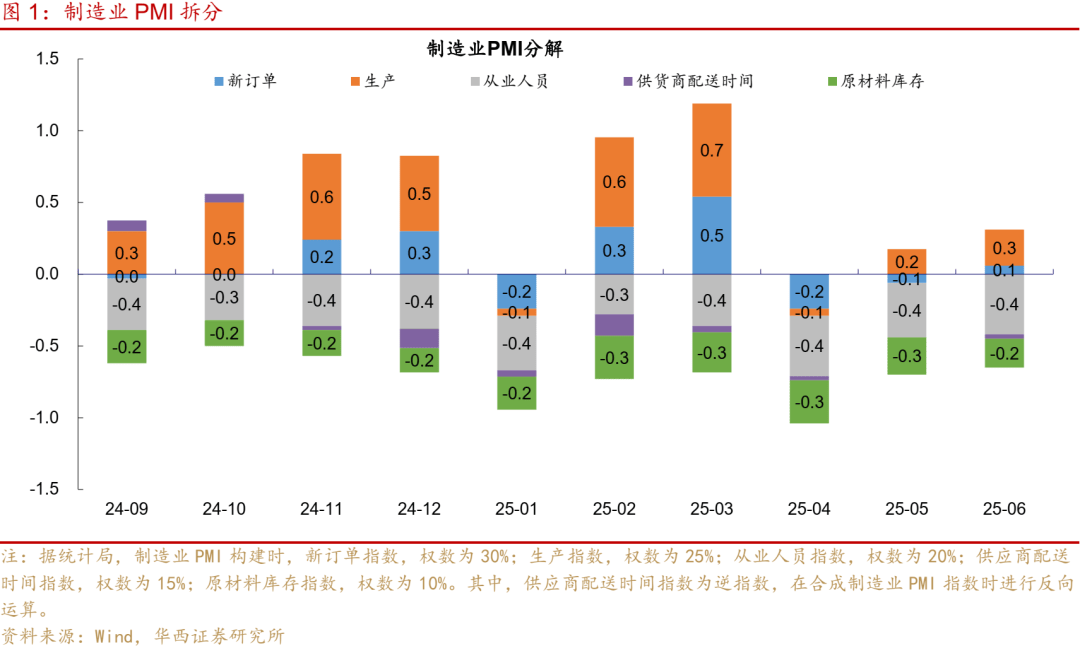
Core Viewpoints - The "anti-involution" policy has boosted prices, but supply and demand performance appears counterintuitive [3][8] - The manufacturing PMI decreased by 0.4 percentage points to 49.3%, exceeding the average decline since 2017 [3][8] - The increase in commodity prices is reflected in the raw material purchase price index (+3.1 percentage points to 51.5%) and the factory price index (+2.1 percentage points to 48.3%) [3][8] Manufacturing Sector - The manufacturing PMI has marginally declined, with production and new order indices both decreasing [5][34] - The production index fell by 0.5 percentage points to 50.5%, while the new order index dropped by 0.8 percentage points to 49.4% [5][34] - The new export order index decreased by 0.6 percentage points to 47.1%, indicating a slowdown in market demand [5][38] Non-Manufacturing Sector - The non-manufacturing PMI fell by 0.4 percentage points to 50.1%, primarily due to a significant decline in the construction PMI [45] - The construction PMI decreased by 2.2 percentage points to 50.6%, with the new order index dropping sharply by 2.2 percentage points to 42.7% [6][61] - The service sector PMI showed a slight decline, with the new order index remaining weak at 46.3% [49] Key Industries - High-energy-consuming industries have shown production strength despite price increases, with the steel industry PMI rising by 4.6 percentage points [4][21] - The equipment manufacturing and consumer goods industries experienced declines in PMI, falling by 1.1 and 0.9 percentage points to 50.3% and 49.5%, respectively [4][21] - Investment demand has weakened significantly, contrasting with the strong production performance in high-energy-consuming sectors [24][72] Future Outlook - The political bureau meeting in July emphasized the need for further implementation of the "anti-involution" policy, particularly focusing on the downstream effects and marginal changes in domestic demand [30][72] - The current situation indicates that the "anti-involution" policy in the upstream sectors still requires further advancement [30][72]

流动性月报:资金会有“二次收紧”吗-20250801
SINOLINK SECURITIES· 2025-08-01 13:49
Group 1: Report Industry Investment Rating - Not mentioned in the provided content Group 2: Core Views of the Report - The capital rate in July continued to decline, and the capital market was relatively friendly. It is expected that the capital rate in August will likely maintain a stable and slightly loose pattern [2][6] Group 3: Summary of July Review - Most term capital rates declined in July. The operating centers of DR007 and DR014 decreased by 6bp and 8bp respectively, and those of R001, R007, and R014 decreased by 4bp, 10bp, and 12bp respectively. The deviation of DR007 from the policy rate also narrowed [2][12] - The number of days when DR007 dropped below "policy rate + 10bp" increased significantly in July, rising from 5% in previous months to 45% [2][13] - The central bank continued to support the capital market in July. The total capital injection through reverse repurchase, MLF, and outright reverse repurchase was 48.8 billion, with the net injection scale being the second - highest in the same period since 2018. The capital injection during the tax period was the highest in the same period since 2018, and a large - scale reverse repurchase was carried out after the unexpected tightening of capital rates on July 24 [2][14] - The rapid decline in the bill rediscount rate may indicate poor credit demand in July. Banks may use bill financing to increase credit scale, which reduces the consumption of excess reserves and benefits the capital market [3][19] - The yield of inter - bank certificates of deposit fluctuated. The R007 - DR007 spread reached a new low in the same period since 2019 [21] Group 4: Summary of August Outlook - The market's expectation for further loosening of the capital market in the future is not strong, but the capital rate in August may still maintain a stable and slightly loose pattern [4][6] - Whether the capital market will experience "secondary tightening" is crucial for the bond market. The current bond market adjustment is mainly driven by price increase expectations. If the capital follows and tightens, it will form an additional negative factor [4][32] - Historically, commodity price increases do not necessarily lead to synchronous increases in capital prices. There were cases in 2017, 2018, and 2021 where the building materials composite index rose while the capital rate remained flat or declined [4][33] - The current social financing and exchange rate situations are different from those in the first quarter. Social financing is likely to decline in the second half of the year, and the exchange rate pressure has significantly eased [5][39] - The PMI indicates that the current fundamentals are weaker than those in the first quarter. Since 2024, the capital rate has been more sensitive to fundamental changes. The recent decline in high - frequency fundamental signals suggests that there is no upward risk for the capital rate [5][43] - The net financing pressure of government bonds in August will increase slightly compared to July, but the overall liquidity gap will narrow. Assuming the central bank conducts equal - amount roll - overs of maturing monetary tools, the estimated excess reserve ratio in August will decline [44][47]
X @外汇交易员
外汇交易员· 2025-08-01 07:09
瑞霆狗(RatingDog)宣布与标普全球达成协议,获得“标普全球中国PMI”(原财新PMI)的独家冠名权,指数将正式更名为“RatingDog中国PMI”。更名后的指数将继续于每月首个工作日(制造业PMI)和第三个工作日(服务业PMI)发布。🗒️Ratingdog第一大股东为中证信用,由东吴证券、国泰君安、广发证券、安信证券等35家机构合资成立。外汇交易员 (@myfxtrader):中国7月标普全球制造业PMI录得49.5,预期50.4,前值50.4。(财新7月起终止对标普中国PMI的冠名)标普全球市场:中国制造业自2023年10月后第二次录得产量下降,调查企业反映新订单增速放缓,厂商相应减产。厂商反映外需疲软,新出口订单已连续4个月收缩,且较6月加剧。https://t.co/4eWCWIpcNz https://t.co/2px2vIDPvj ...
7月份制造业PMI回落 经济总体产出保持扩张
Jing Ji Ri Bao· 2025-08-01 07:04
Group 1: Manufacturing Sector - In July, the Manufacturing Purchasing Managers' Index (PMI) dropped to 49.3%, a decrease of 0.4 percentage points from the previous month, indicating a contraction in manufacturing activity [1] - The new orders index for manufacturing was at 49.4%, down 0.8 percentage points from last month, reflecting weakened market demand [1] - Despite the short-term slowdown, the production index remained at 50.5%, indicating expansion for three consecutive months [1] Group 2: Non-Manufacturing Sector - The Non-Manufacturing Business Activity Index was at 50.1%, down 0.4 percentage points from the previous month, but still above the critical point [4] - The construction sector experienced a slowdown, with the business activity index at 50.6%, a decrease of 2.2 percentage points [4] - Service sector activity remained stable, with the business activity index at 50%, a slight decline of 0.1 percentage points [4] Group 3: Price Trends - The main raw materials purchasing price index rose to 51.5%, an increase of 3.1 percentage points, marking the first rise above the critical point since March [2] - The ex-factory price index was at 48.3%, up 2.1 percentage points, indicating an overall improvement in manufacturing market prices [2] Group 4: Business Expectations - Manufacturing enterprises showed optimism for future market conditions, with the production and business activity expectation index at 52.6%, an increase of 0.6 percentage points from last month [3] - Non-manufacturing enterprises maintained a stable optimistic outlook, with the business activity expectation index at 55.8%, up 0.2 percentage points [4]
固收事件点评:量减价升,反内卷影响初现
East Money Securities· 2025-08-01 06:36
Group 1 - The manufacturing PMI for July recorded at 49.3%, a decrease of 0.4 percentage points, indicating a continued contraction in the manufacturing sector [5][6][10] - The non-manufacturing PMI stood at 50.1%, also down by 0.4 percentage points, with the construction sector PMI declining significantly by 2.2 percentage points to 50.6% [5][17] - The overall PMI output index decreased to 50.2%, reflecting a 0.5 percentage point drop from the previous month [5][6] Group 2 - Both supply and demand sides of the manufacturing PMI showed marginal weakening, but prices improved significantly due to anti-involution policies, leading to a situation of reduced volume but increased prices [4][10][11] - New orders, production, and material inventory all contributed negatively to the PMI, with new orders dropping 0.8 percentage points to 49.4% [6][11][20] - The price index for factory output and major raw material purchases increased by 2.1 percentage points and 3.1 percentage points respectively, indicating substantial improvement [11][20] Group 3 - The construction sector's PMI was adversely affected by weather conditions and a weak real estate market, leading to a notable decline [17][20] - The service sector PMI remained relatively stable at 50.0%, supported by seasonal improvements in industries such as aviation and dining due to holiday travel [17][20] - The overall economic outlook remains weak, with both internal and external demand showing signs of fatigue, which continues to support long-term interest rates [20]
“反内卷”后的首个PMI
CAITONG SECURITIES· 2025-08-01 05:46
Price Index Insights - In July, the main raw material purchase price index and the factory price index were 51.5% and 48.3%, respectively, increasing by 3.1 and 2.1 percentage points from the previous month[8] - The main raw material purchase price index returned above the threshold for the first time in five months, indicating a strong response from enterprises to price expectations under the "anti-involution" policy[8] - The black metal smelting and rolling industry had the highest factory price index at 88.9%, with a month-on-month increase of 80.1 percentage points and a year-on-year increase of 74.5 percentage points[14] PMI Performance by Sector - The comprehensive PMI for "anti-involution" industries recorded 48% in July, up from 47.8% in the previous month, but still below the critical point[21] - Non-"anti-involution" industries maintained a PMI of 50.1%, down from 50.9%, indicating continued expansion[21] - Different enterprise sizes showed varied performance, with large, medium, and small enterprises' PMI at 50.3%, 49.5%, and 46.4%, respectively, reflecting a decline for large and small enterprises while medium enterprises improved[25] Policy and Seasonal Effects - The July Politburo meeting calibrated market expectations for the "anti-involution" policy, suggesting that the manufacturing PMI may remain below the threshold in August[26] - Extreme weather conditions, including record rainfall in Hebei and Inner Mongolia, are expected to further impact production in July and August, leading to a weaker PMI outlook[39] - The "anti-involution" policy's first month showed a divergence in PMI across sectors and enterprise types, influenced by both policy and seasonal effects[25] Risk Factors - Potential risks include domestic policy effectiveness falling short of expectations and unexpected changes in international geopolitical situations[45] - Measurement errors in PMI indicators related to "anti-involution" industries may arise due to incomplete industry self-regulation[45]
固定收益点评报告:极端天气与反内卷致量价反向波动
Huaxin Securities· 2025-08-01 04:05
2025 年 08 月 01 日 极端天气与反内卷致量价反向波动 分析师:罗云峰 S1050524060001 luoyf2@cfsc.com.cn 分析师:杨斐然 S1050524070001 yangfr@cfsc.com.cn 事件 受制造业进入传统生产淡季,部分地区高温、暴雨洪涝灾害 等因素影响,7 月制造业 PMI 为 49.3,环比下降 0.4,连续 4 个月低于枯荣线,7 月为 4 个月以来最低;非制造业 PMI 为 50.1,环比下跌 0.4;综合 PMI 产出指数为 50.2,环比下降 0.5 个百分点。 7 月份中国战略性新兴产业 EPMI 为 46.8,比上月回落 1.1 个 百分点。服务业健康医疗服务业、新材料产业表现最好。 投资要点 ▌ 制造业:极端天气影响生产 极端天气与反内卷共同作用下,供需两端边际回调,生产指 数扩张幅度下降 0.5 至 50.5,新订单指数大幅下降 0.8,重 回荣枯线以下(49.4),其中新出口订单指数下降 0.6 至 47.1,一定程度受前期抢出口的影响,内需下滑或有 618 的 影响。企业生产经营活动更趋谨慎:进口指标保持 47.8;原 材料库存下降 0 ...
7月PMI ,淡季偏淡
Sou Hu Cai Jing· 2025-08-01 03:35
7月31日, 统计局发布7月PMI。制造业PMI 49.3%,预期49.7%,前值49.7%。非制造业PMI 50.1%,前值50.5%。关注以下几个方面: 第一,制造业生产和新订单均回落。7月制造业新订单环比下降0.8个百分点至49.4%,生产回落0.5个百分点至50.5%,分别拖累制造业PMI下滑0.24、0.13 个百分点,是7月制造业PMI下滑的主要拖累因素。对比往年同期降幅,2016-2024年(剔除2020/2022)新订单和生产的平均降幅分别为0.14、0.37个百分 点。由于PMI在数据处理过程中已剔除季节性,今年7月相对更弱的表现,指向制造业放缓可能受到常规季节性因素之外的影响,一方面是6月对美出口修 复带来的环比高基数,另一方面是部分地区高温、暴雨洪涝灾害的规模可能超出往年同期。 第二,外需也回落。7月制造业新出口订单回落0.4个百分点至47.1%(6月反弹0.2个百分点),略低于上半年平均值47.3。结合韩国出口旬度数据来看,7 月前20天出口同比-2.2%,这说明6月抢出口可能未在7月延续。7月9日是对等关税截止时点,尽管后来推迟到8月1日,但企业可能已经尽量安排在7月9日 之前出口。 ...
行业景气度系列五:去库压力仍存
Hua Tai Qi Huo· 2025-08-01 03:27
Report Industry Investment Rating No relevant content provided. Core Viewpoints Manufacturing - Overall: In July, the manufacturing PMI's five - year percentile was 25.4%, with a change of - 18.6%. Seven industries had their manufacturing PMI in the expansion range, an increase of 1 month - on - month and 5 year - on - year [4]. - Supply: It slightly rebounded. The 3 - month average of the manufacturing PMI production index in July was 50.7, a 0.2 - percentage - point increase month - on - month. Nine industries improved month - on - month, while 6 declined [4]. - Demand: It slightly improved. The 3 - month average of the manufacturing PMI new orders in July was 49.8, a 0.1 - percentage - point increase month - on - month. Nine industries improved month - on - month, while 6 declined [4]. - Inventory: De - stocking slowed down. The 3 - month average of the manufacturing PMI finished - goods inventory in July remained unchanged at 47.3, with 7 industries seeing inventory increases and 8 seeing decreases. The raw - material inventory in March increased by 0.2 percentage points to 47.7, with 6 industries seeing inventory increases and 8 seeing decreases [4]. Non - manufacturing - Overall: In July, the non - manufacturing PMI's five - year percentile was 15.2%, with a change of - 15.3%. Eleven industries had their non - manufacturing PMI in the expansion range, unchanged month - on - month and a decrease of 1 year - on - year [5]. - Supply: Employment slowed down. The 3 - month average of the non - manufacturing PMI employee index in July remained unchanged at 45.5. The service industry decreased by 0.1 percentage points, while the construction industry increased by 1 percentage point [5]. - Demand: It recovered. The 3 - month average of the non - manufacturing PMI new orders in July was 46.1, a 0.3 - percentage - point increase month - on - month. The service industry's new orders increased by 0.1 percentage points, and the construction industry's increased by 1 percentage point [5]. - Inventory: De - stocking slowed down. The 3 - month average of the non - manufacturing PMI inventory in July remained unchanged at 45.4. The service industry remained unchanged, and the construction industry increased by 0.2 percentage points [5]. Summary by Directory Overview - Manufacturing PMI: In July, the manufacturing PMI's five - year percentile was 25.4%, with a change of - 18.6%. Seven industries had their manufacturing PMI in the expansion range, an increase of 1 month - on - month and 5 year - on - year [10]. - Non - manufacturing PMI: In July, the non - manufacturing PMI's five - year percentile was 15.2%, with a change of - 15.3%. Eleven industries had their non - manufacturing PMI in the expansion range, unchanged month - on - month and a decrease of 1 year - on - year [10]. Demand: Focus on the Improvement of General Equipment and Construction Installation and Decoration - Manufacturing: The 3 - month average of the manufacturing PMI new orders in July was 49.8, a 0.1 - percentage - point increase month - on - month. Nine industries improved month - on - month, while 6 declined [17]. - Non - manufacturing: The 3 - month average of the non - manufacturing PMI new orders in July was 46.1, a 0.3 - percentage - point increase month - on - month. The service industry's new orders increased by 0.1 percentage points, and the construction industry's increased by 1 percentage point. By industry, 8 industries improved month - on - month, while 7 declined [17]. Supply: Focus on the Contraction of Non - ferrous Metals, Automobiles, and Textiles - Manufacturing: The 3 - month average of the manufacturing PMI production index in July was 50.7, a 0.2 - percentage - point increase month - on - month. Nine industries improved month - on - month, while 6 declined. The manufacturing PMI employee index in March remained unchanged at 48.0. Six industries improved month - on - month, while 9 declined [24]. - Non - manufacturing: The 3 - month average of the non - manufacturing PMI employee index in July remained unchanged at 45.5. The service industry decreased by 0.1 percentage points, and the construction industry increased by 1 percentage point. By industry, 4 industries improved month - on - month, while 11 declined [24]. Price: Focus on the Pressure of Non - ferrous Metals and Textiles - Manufacturing: The 3 - month average of the manufacturing PMI ex - factory price index in July was 46.4, a 1.2 - percentage - point increase month - on - month. Nine industries saw price improvements, while 6 declined. In terms of profit, the profit trend in March decreased by 1.4 percentage points, and the overall profit continued to converge [31]. - Non - manufacturing: The 3 - month average of the non - manufacturing charge price index in July was 48.0, a 0.4 - percentage - point increase month - on - month. The service industry increased by 0.4 percentage points, and the construction industry increased by 0.7 percentage points. By industry, 8 industries improved month - on - month, while 6 declined. In terms of profit, the profit in March decreased by 0.6 percentage points. The service industry decreased by 0.4 percentage points, and the construction industry decreased by 1.3 percentage points [31]. Inventory: Focus on the Low Levels of Postal Services and Textile and Apparel - Manufacturing: The 3 - month average of the manufacturing PMI finished - goods inventory in July remained unchanged at 47.3. Seven industries saw inventory increases, and 8 saw decreases. The raw - material inventory in March increased by 0.2 percentage points to 47.7. Six industries saw inventory increases, and 8 saw decreases [40]. - Non - manufacturing: The 3 - month average of the non - manufacturing PMI inventory in July remained unchanged at 45.4. The service industry remained unchanged, and the construction industry increased by 0.2 percentage points. By industry, 6 industries saw inventory increases, and 9 saw decreases [40]. Main Manufacturing Industry PMI Charts - The report provides multiple charts showing data such as the manufacturing and non - manufacturing PMI in July, new orders, production, prices, and inventory, along with their changes and five - year percentiles [8]. - Tables present detailed PMI data for various manufacturing industries, including general equipment, automobiles, computers, and others, covering aspects like new orders, production, employment, prices, and inventory [51][56][60].