
高端化

Search documents
全球智能手机营收在 2025 年第三季度同比增长 5%,创下九月季度历史新高
Counterpoint Research· 2025-11-06 07:03
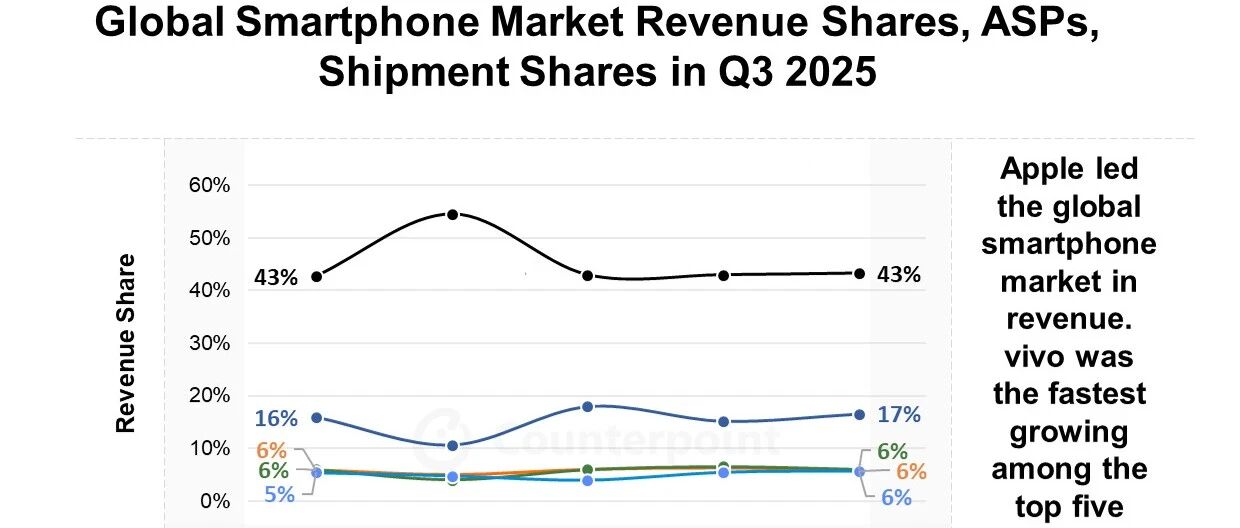
Core Insights - The global smartphone market revenue grew by 5% year-on-year in Q3 2025, reaching $112 billion, marking the highest level for Q3 in history [4][5] - The global smartphone shipment volume also saw a moderate 4% year-on-year increase, totaling 320 million units [5] - The average selling price (ASP) of smartphones reached a record high for Q3 at $351, driven by an expanding mature user base upgrading to more expensive devices [5][8] Company Performance - Apple led the market with a 43% revenue share and a 6% year-on-year growth, achieving its best-ever Q3 revenue [8][11] - Samsung experienced a 9% year-on-year revenue growth, supported by strong sales of the Galaxy S series and foldable devices, with its ASP increasing by 2.9% to $304 [5][11] - Vivo was the fastest-growing brand among the top five, with a 12% year-on-year revenue growth, driven by strong shipments in India and Southeast Asia [5][11] - OPPO achieved the highest ASP increase among the top five brands, growing by 3.4% to $254, thanks to strong performance in higher price segments [5][11] - Xiaomi held a 14% market share with a 2% year-on-year growth, benefiting from mid-to-high-end smartphone demand in emerging markets [11] Market Trends - The ongoing trend of premiumization in the smartphone market is expected to continue, with increasing adoption of foldable smartphones further driving ASP and revenue growth [8] - The introduction of trade-in offers, financing options, and bundled sales has lowered the upgrade barrier, particularly in emerging markets [5]



林武在日照临沂调研并主持召开钢铁产业提质升级专题座谈会
Da Zhong Ri Bao· 2025-11-06 01:05
Core Viewpoint - The focus is on upgrading the steel industry in Shandong province towards high-end, intelligent, and green development, aiming to create a nationally competitive advanced steel industry base [1][2]. Group 1: Industry Development Strategy - The provincial government emphasizes the need to implement Xi Jinping's directives to accelerate the transformation and upgrading of the steel industry, achieving positive results in recent years [2]. - The strategy includes focusing on high-end product supply, extending the industrial chain, and enhancing overall efficiency through intelligent development [2]. - A commitment to reducing carbon emissions and pollution is highlighted, with a push for green and low-carbon transformation in the industry [2]. Group 2: Key Initiatives - The government aims to strengthen industrial bases, promote project advancement, and enhance enterprise cultivation as part of the upgrade process [2]. - There is a focus on optimizing product structure, leading technological advancements, and controlling production levels [2]. - The integration of artificial intelligence with the steel industry is prioritized to enhance operational efficiency [2]. Group 3: Market Expansion and Safety - The government plans to explore both domestic and international markets to increase consumption potential and effective demand [2]. - Safety production measures are to be strictly implemented to prevent major accidents in the industry [2]. - A high-quality development plan for the steel industry in the province is to be formulated, emphasizing responsibility and support [2].
第二增长“铝”程 明泰铝业的高端化破局之路
Shang Hai Zheng Quan Bao· 2025-11-05 18:41
Core Viewpoint - Ming Tai Aluminum has established itself as a leader in the recycled aluminum industry by focusing on high-end, green, and intelligent manufacturing processes, achieving significant cost savings and environmental benefits through its closed-loop production system [1][2][3]. Group 1: Green Initiatives - Ming Tai Aluminum has developed a closed-loop production system for recycled aluminum, significantly reducing energy consumption to only 5% of that required for primary aluminum production, saving over 3 tons of standard coal and reducing solid waste by 20 tons for every ton of recycled aluminum produced [2][3]. - The company has built China's first green ecological resource utilization production line for aluminum dross, achieving harmless and high-value recycling without generating wastewater, waste gas, or solid waste [2]. Group 2: Production Capacity and Achievements - Ming Tai Aluminum has surpassed a production capacity of 1 million tons in the recycled aluminum application sector, becoming the largest recycled aluminum recovery enterprise in China [3]. - The company has received the GRS 4.0 global recycling standard certification and completed SGS carbon footprint assessments for several products, facilitating its entry into international markets [3]. Group 3: High-End Product Development - The company has launched a new production line for automotive aluminum sheets, with a capacity of 20,000 tons for automotive aluminum and 5,500 tons for other high-end aluminum materials, enhancing its ability to meet high-end market demands [4]. - Ming Tai Aluminum has developed advanced aluminum foil that can withstand high temperatures and meet the complex requirements of solid-state batteries, as well as lightweight aluminum materials for drones and robots [4]. Group 4: Financial Performance - In the third quarter, Ming Tai Aluminum achieved sales of approximately 396,900 tons and revenue of about 8.9 billion yuan, reflecting a year-on-year growth of 6.39%, with net profit increasing by approximately 36% to 464 million yuan [5]. Group 5: Digital Transformation - The company has invested billions in building a digital factory, enhancing operational efficiency and decision-making through real-time monitoring of energy consumption, costs, and profits, while enabling dynamic adjustments to production plans based on market demand [6]. - Ming Tai Aluminum aims to become a globally leading green aluminum processing enterprise by focusing on high-end intelligent manufacturing and low-carbon circular economy initiatives [6].

赛力斯张兴海:在全球范围内打造高端车新赛道
Zheng Quan Shi Bao Wang· 2025-11-05 14:58
Core Insights - The article highlights the successful IPO of Seres Group, raising a net amount of 14.016 billion HKD, marking it as the largest IPO for a Chinese car company to date and the largest globally since 2025 [1][2] - Seres aims to establish itself as a leader in the luxury electric vehicle market, emphasizing its brand positioning of "redefining luxury through intelligence" [1] - The company has delivered over 800,000 units of its AITO brand, with the M9 model being the best-selling vehicle in its price segment in China for 19 consecutive months [1] Funding Allocation - Approximately 70% of the funds raised from the IPO will be allocated to research and development, while 20% will be used for diversifying new marketing channels, overseas sales, and charging network services [2] - The focus on "high-end" and "globalization" includes global product development, marketing services, and necessary production capacity [2] Global Expansion - Seres has expanded its global footprint to cover multiple countries across Europe, the Middle East, the Americas, and Africa, with significant presence in key European markets such as Norway, Germany, the UK, and Switzerland [2] - The company is exploring the integration of artificial intelligence in its products, aiming to transform into a technology-driven enterprise [2] Investor Support - The IPO saw overwhelming interest, with a subscription rate exceeding 133 times and total financing subscriptions surpassing 170 billion HKD, attracting 22 cornerstone investors [2] - The company expresses gratitude for investor support and aims to leverage Hong Kong's financial hub advantages to enhance its global competitiveness [3]

小米集团-W(01810):手机加速高端化,汽车交付量提升
GOLDEN SUN SECURITIES· 2025-11-05 12:11
Investment Rating - The report maintains a "Buy" rating for Xiaomi Group [3][5]. Core Views - Xiaomi is accelerating its high-end smartphone offerings, with the recent launch of the Xiaomi 17 series achieving record sales within minutes of release. The company aims to mitigate storage cost pressures through product structure optimization [1]. - The automotive segment is showing promising growth, with 400,000 units delivered within a year and monthly deliveries exceeding 40,000 units in September and October 2025. The company is expected to achieve breakeven in quarterly automotive operations [2]. - Despite a slowdown in national subsidies for IoT products, Xiaomi's competitive edge in the IoT sector remains strong due to product quality and supply chain management [2]. Financial Projections - Revenue is projected to grow from 270.97 billion CNY in 2023 to 748.7 billion CNY by 2027, with year-on-year growth rates of -3%, 35%, 29%, 31%, and 22% respectively [4][10]. - Non-GAAP net profit is expected to increase from 19.27 billion CNY in 2023 to 79.53 billion CNY in 2027, with significant growth rates of 126%, 41%, 55%, 46%, and 29% [4][10]. - The company anticipates maintaining a gross margin of approximately 11% for Q3 and Q4 2025, despite rising storage costs [1]. Market Position - Xiaomi holds a 14% market share in the global smartphone market, ranking among the top three manufacturers. In China, it has a 15% market share, placing it fourth [1]. - The company has successfully entered the high-end smartphone market, with the Xiaomi 17 Pro Max leading sales in the new series [1]. Automotive Business - Xiaomi has delivered 400,000 vehicles since the launch of its automotive products, with a strategy to provide tax subsidies to enhance consumer benefits [2]. - The automotive division is expected to reach a quarterly breakeven point as delivery volumes increase [2]. IoT and Consumer Products - The IoT business is projected to maintain robust competitiveness despite reduced national subsidies, supported by Xiaomi's product quality and supply chain capabilities [2].
常宝股份(002478) - 002478常宝股份投资者关系管理信息20251105
2025-11-05 09:40
Financial Performance - The company achieved a net profit attributable to shareholders of 3.92 billion CNY for 2025 [2] - In the first three quarters of 2025, the company reported an operating income of 42.84 billion CNY and a net profit of 3.53 billion CNY after deducting non-recurring gains and losses [2] - The operating cash flow net amount was 2.49 billion CNY, indicating stable production and sales [2] Strategic Development - The company focuses on long-termism, value management, and brand management to build core competencies in niche markets [2] - Future strategies include advancing high-end, brand-oriented, and segmented development, with an emphasis on product and market structure transformation [2][3] Market Expansion Plans - The company aims to strengthen its position in the special-purpose pipe segment, particularly in high-end products like nickel-based alloy oil pipes and high-end stainless steel boiler pipes [4] - Plans to target high-tech markets such as new energy, fine chemicals, and marine equipment, while promoting high-end products with stringent technical requirements [4] Employee Incentives - The company has implemented restricted stock incentive plans in 2021 and 2023, along with an employee stock ownership plan in 2023 to enhance team motivation [5] - Future optimization of incentive mechanisms will be considered in line with development strategies and regulatory requirements [5] Product Development and Market Position - The HRSG (Heat Recovery Steam Generator) product line has become a key feature, with a leading market share in the industry [7] - The company plans to enhance HRSG product capacity and structure, focusing on stainless steel and nickel-based products to improve competitiveness [7] Capital Expenditure and Dividend Plans - Future capital expenditures will focus on technology upgrades and automation to respond flexibly to market demands [7] - The company maintains a tradition of dividends and aims to balance business development with shareholder returns, guided by a three-year shareholder return plan from 2024 to 2026 [7]

迈瑞医疗(300760):2025年三季报点评报告:收入同比回正,看好业绩修复
ZHESHANG SECURITIES· 2025-11-04 13:04
Investment Rating - The investment rating for the company is "Buy" [6] Core Insights - The company reported a revenue of 25.8 billion yuan for the first three quarters of 2025, a year-on-year decline of 12%, but Q3 revenue showed a positive growth of 1.5% year-on-year [1] - The net profit attributable to the parent company for the first three quarters was 7.6 billion yuan, down 29% year-on-year, with Q3 net profit at 2.5 billion yuan, a decline of 19% year-on-year [1] - The company’s overseas revenue in Q3 grew by 12% year-on-year, indicating an accelerating trend [1] Revenue Growth - The international business saw a 12% year-on-year growth in Q3, with Europe performing particularly well, exceeding 20% growth [2] - The minimally invasive surgery segment experienced over 25% growth, while the international life information and support line achieved double-digit growth [3] - The in-vitro diagnostics segment saw a 2.81% decline in Q3 revenue, but international sales in this segment grew by double digits [3] Profitability Analysis - The gross margin for the first three quarters of 2025 was 62.0%, a decrease of 2.9 percentage points year-on-year, while Q3 gross margin improved to 62.5%, up 0.79 percentage points year-on-year [4] - The net profit margin for 2025 was 30.2%, down 6.1 percentage points year-on-year, with Q3 net profit margin at 28.4%, down 6.5 percentage points year-on-year [4] Financial Forecast and Valuation - Revenue projections for 2025-2027 are 35.728 billion, 38.171 billion, and 42.879 billion yuan, with year-on-year growth rates of -2.72%, 6.84%, and 12.33% respectively [5] - The net profit attributable to the parent company is forecasted to be 10.563 billion, 11.760 billion, and 13.615 billion yuan for the same period, with corresponding year-on-year growth rates of -9.48%, 11.34%, and 15.77% [5] - The estimated EPS for 2025-2027 is 8.71, 9.70, and 11.23 yuan, with a PE ratio of 21 times for 2026 [5]

山东钢铁专项推进“AI+钢铁”战略
Zheng Quan Ri Bao Wang· 2025-11-04 12:13
Core Insights - The steel industry is undergoing a deep adjustment period driven by policies, capital, and market factors, presenting new opportunities and requirements for listed companies like Shandong Steel [1] - Shandong Steel achieved a total profit of 632 million yuan and a net profit of approximately 140 million yuan in the first three quarters of this year, with the third quarter marking the highest quarterly profit in nearly 11 quarters, fulfilling its goal of turning losses into profits [1][2] Group 1: Cost Control and Operational Strategy - Shandong Steel has implemented a three-tier cost control system, achieving a reduction of over 60 yuan per ton of steel, establishing a solid cost "moat" for the company [2] - The company employs a "grasp both ends and control the middle" operational strategy, enhancing collaboration in procurement and sales, resulting in an increase of 288 yuan/ton at the Jinan Steel City base and 225 yuan/ton at the Rizhao base compared to last year [2] Group 2: Product Development and Market Expansion - The steel industry is trending towards high-end, green, and digital development, with Shandong Steel focusing on high-end products such as bearing steel, pipeline steel, automotive sheets, low-temperature resistant steel, and high-strength wear-resistant steel, increasing the proportion of high-end products by 5.4 percentage points compared to 2024 [2][3] Group 3: Technological Innovation and Digitalization - Shandong Steel has established an AI Intelligence Department to advance its "AI + Steel" strategy, aiming to optimize production processes and improve management efficiency through the application of AI technology [3] - The shift towards smart manufacturing is reshaping the value metrics of the steel industry, with increasing quality demands from downstream industries driving steel companies to enhance technological innovation and supply chain collaboration [3] Group 4: Capital Operations and Policy Environment - Shandong Steel plans to acquire 100% of Laiwu Steel Group Yingshan Type Steel Co., Ltd. for 714 million yuan, which will address competition issues and further enhance the company's performance and product structure [4] - The steel industry is currently experiencing a significant policy opportunity period, with various supportive policies being introduced to promote quality upgrades in the steel industry [4]

雷军的顺为资本为何“看上”高梵:羽绒服增长的尽头,是高端化
Sou Hu Cai Jing· 2025-11-04 10:34
Core Viewpoint - The domestic down jacket brand "Gaofan" has completed a new round of financing led by Shunwei Capital, founded by Lei Jun, indicating a strategic interest in the high-end market segment of the down jacket industry [1][3]. Group 1: Investment Logic of Shunwei Capital - Shunwei Capital focuses on structural growth opportunities in technology, consumer goods, and new brands, particularly in sectors experiencing new consumer segmentation or supply disruptions [3]. - The down jacket market has seen rapid expansion and intense competition, leading to a significant reduction in profit margins for many traditional brands [3]. - Gaofan's strategic pivot to high-end goose down jackets has positioned it uniquely in a market where low-cost competition has intensified, allowing it to escape the price war that has plagued many competitors [4]. Group 2: Market Positioning and Product Strategy - Gaofan's decision to eliminate its duck down product line and focus on high-end goose down jackets has resulted in a nearly sixfold increase in average transaction value and over tenfold profit growth, with GMV exceeding 50 billion [4]. - The brand has established a clear price and value gap by offering products priced between 1,000 to over 5,000 yuan, positioning itself against international luxury brands while maintaining a competitive edge [4]. - Gaofan is also expanding its product offerings to include outdoor items tailored for specific activities such as sailing and skiing, leveraging its expertise in goose down technology [4]. Group 3: Technological and Supply Chain Capabilities - Shunwei Capital is attracted to Gaofan not only for its market positioning but also for its technological and supply chain capabilities, particularly its partnership with a leading smart manufacturing facility [6]. - The collaboration with the world's first "lighthouse factory" enables Gaofan to implement data-driven production management, ensuring product quality and transparency throughout the supply chain [6]. Group 4: Brand Image and Quality Control - Gaofan's high-end strategy is closely tied to its brand image and product quality, which have been enhanced through collaborations with international designers and celebrity endorsements [7]. - Despite efforts to elevate brand awareness, some consumer feedback indicates quality issues with certain products, highlighting the need for consistent quality to support its premium positioning [7]. - The ability to maintain high product quality is crucial for Gaofan to achieve its high-end brand strategy and sustain consumer trust and market competitiveness [7]. Group 5: Conclusion - Gaofan's growth illustrates that high-end positioning is becoming a new growth engine in the down jacket industry, as the demand for quality and functionality increases [8]. - Shunwei Capital recognizes Gaofan's strategic value in addressing market gaps, leveraging technology and supply chain capabilities, and pursuing a clear high-end brand strategy [8].

中粮科工(301058) - 301058中粮科工投资者关系管理信息20251104
2025-11-04 09:16
Group 1: Company Overview and Market Position - COFCO Technology is a leading comprehensive technology service provider and equipment manufacturer in the grain and oil food and cold chain logistics sectors, offering specialized services such as design consulting, mechanical and electrical delivery, equipment manufacturing, and operational services [2]. - The company is influenced by industry policies, technological advancements, and the conditions of downstream clients in the grain and oil processing and storage logistics sectors [2]. - COFCO Technology aims to focus on "high-end, intelligent, and green" development directions to maintain its industry position and competitive advantage [2]. Group 2: Financial Health and Capital Structure - As of Q3 2025, the company's asset-liability ratio stands at 49.36%, indicating that it remains within a reasonable range and is managing its operations and debt repayments effectively [3]. - The company has experienced cash outflows exceeding inflows from fundraising activities, particularly in debt repayment and interest payments, raising concerns about financial pressure [3]. Group 3: Investment Strategy and Future Directions - The company has reduced investments in Q3 2025, resulting in a small net inflow, primarily due to the recovery of some financial products and allocation of funds for committed investment projects [3]. - Future business development directions include: - Advancing intelligent equipment research and development in the equipment manufacturing sector [3]. - Enhancing cold chain logistics engineering services through digital technology [3]. - Expanding into international markets and building integrated marketing channels [3]. - Innovating operational service models to create a comprehensive lifecycle service system for grain and oil processing equipment [3].