
加息

Search documents
日本央行副行长重申可能加息的立场 但并未暗示时机
Xin Hua Cai Jing· 2025-09-02 05:18
Core Viewpoint - The Deputy Governor of the Bank of Japan, Masayoshi Amamiya, reiterated the stance of raising the benchmark interest rate when conditions allow, but did not indicate when such a hike might occur, leading to a depreciation of the yen [1] Group 1 - Amamiya stated that it is appropriate for the Bank of Japan to continue raising policy rates and adjusting monetary easing as economic activity and prices improve [1] - Following Amamiya's remarks, the yen weakened against the US dollar, indicating market reactions to the lack of hawkish signals [1] - Chidu Narayanan, Chief Asia-Pacific Strategist at Wells Fargo in Singapore, noted that while the next action from the central bank is likely to be a rate hike, the timing remains uncertain, leading to a slight decrease in market expectations for a rate increase this year [1]
日本经济复苏路途坎坷
Guo Ji Jin Rong Bao· 2025-09-01 03:50
Economic Overview - Japan's economy has shifted from a year of stagnation to a rapid expansion phase in 2023, but faces significant risks from U.S. tariff policies, weak consumer resilience, and global economic slowdown [1] - Despite a positive overall economic performance, structural imbalances are evident, with manufacturing experiencing 13 consecutive months of contraction while the service sector expands [3] Economic Forecasts - Approximately 60% of economists predict negative growth for Japan's economy in Q3, with an average forecast of a 0.1% quarter-on-quarter decline, translating to an annualized drop of 0.6% [2] - The Japanese government has revised its economic growth forecast for FY2025 from 1.2% to 0.7% due to unprecedented pressure on the economy [2] Export Challenges - Japan's export strategies, such as increasing exports and lowering prices, are deemed unsustainable, with the U.S. tariff policy being a major variable affecting Japanese exports [4] - The U.S. has increased tariffs on Japanese goods, significantly raising the tariff on automobiles and parts from 27.5% to 42.5% and on beef from 26.4% to 41.4% [5] Impact on Key Industries - Japan's automotive exports, which account for nearly 30% of total exports, have seen a significant decline, with July exports to the U.S. dropping by 28.4% year-on-year [5] - The Japanese government has lowered its export growth forecast for FY2025 from 3.6% to 1.2% due to the impact of U.S. tariffs [6] Monetary Policy and Inflation - The Bank of Japan has raised interest rates three times in the past year, but the overall economic outlook remains uncertain, making further rate hikes challenging [7] - Core inflation in Japan has exceeded the Bank of Japan's target of 2% for over three years, with the latest inflation forecast for FY2025 adjusted from 2.2% to 2.7% [7][8] Labor Market Dynamics - The "wage-price" spiral mechanism is becoming more pronounced, with labor costs increasingly contributing to inflation, but real wages have been declining for 42 months [9] - The potential for further interest rate hikes may conflict with the pressures from U.S. tariffs, which could exacerbate the challenges faced by Japanese exporters [9][10] External Influences - External pressures, including comments from U.S. Treasury officials, suggest that Japan may need to raise interest rates to strengthen the yen and support U.S. economic interests [10] - The balance between maintaining economic growth and addressing inflation is critical for the Bank of Japan, as premature rate hikes could hinder recovery [10]
东京8月CPI因补贴降温但仍高于目标 日本央行加息路径不改
智通财经网· 2025-08-29 02:13
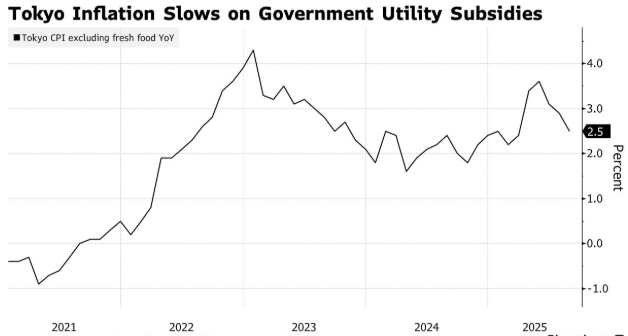
Core Insights - Tokyo's inflation rate significantly decreased in August, attributed to government utility subsidies, yet remains above the Bank of Japan's target, prompting continued interest in rate hikes [1][2] - The core CPI in Tokyo, excluding fresh food, rose by 2.5% year-on-year in August, down from 2.9% in July, marking the slowest increase since March [1][3] - A key price indicator, excluding energy prices, increased by 3%, slightly down from 3.1%, with energy prices negatively impacting overall inflation by 0.29 percentage points [2] Economic Indicators - Economists expect the Bank of Japan to maintain its current policy during the upcoming meeting on September 19, despite challenges in accurately assessing inflation due to temporary factors [3] - The Japanese government reinstated utility subsidies from July to September, which is reflected in the August consumer price index data [3] - Rising food prices, particularly rice, which surged by 67.9% year-on-year, have been a significant driver of inflation, although the rate of increase has slowed from 81.8% in July [3] Price Trends - Food prices, excluding fresh products, increased by 7.4%, consistent with July's growth, while service prices rose by 2%, slightly down from 2.1% in the previous month, indicating stable underlying inflation pressures [3]

日本央行再有高层放风:目前加息环境较4月更加成熟
Hua Er Jie Jian Wen· 2025-08-28 09:21
Core Viewpoint - The Bank of Japan (BOJ) is considering further interest rate hikes if economic and inflation conditions meet expectations, as indicated by BOJ policy committee member Nakagawa Junko [1][2]. Group 1: Economic Conditions - Nakagawa stated that the current economic environment is more favorable for interest rate hikes compared to April [1]. - The market's expectation for a rate hike has risen to approximately 60% by the end of October, up from 40% in early August [1][2]. Group 2: Inflation and Monetary Policy - Japan's core consumer price index reached 3.3% in June, exceeding the BOJ's 2% target for over three years, prompting calls for a shift to a more hawkish policy stance [2]. - Nakagawa emphasized that the BOJ will continue to support the economy through current monetary easing until there is more certainty regarding inflation and economic performance [1][3]. Group 3: Labor Market Dynamics - The strong labor market is seen as a key reason supporting the case for interest rate hikes, with wage growth expanding from large enterprises to small and medium-sized businesses [4]. - Nakagawa noted that companies are increasingly inclined to raise wages and prices, reflecting expectations of continued labor market tightness [5].
日本央行委员:10月短观调查对评估贸易战影响至关重要
智通财经网· 2025-08-28 07:23
Core Viewpoint - The ongoing uncertainty from U.S. tariff policies may dampen business and household confidence, potentially dragging down both the Japanese and global economies [1]. Group 1: Economic Impact - Junko Nakagawa, a member of the Bank of Japan's Policy Board, emphasized that despite trade agreements between Japan and the U.S. and progress in negotiations among other major economies, significant uncertainties remain [1]. - The potential impact of these uncertainties could lead to a decline in global business and household confidence, which may adversely affect domestic and international economic conditions [1]. Group 2: Monetary Policy Outlook - Nakagawa reiterated that if economic trends align with expectations, the Bank of Japan will continue to raise interest rates, but she stressed the need for cautious data assessment amid increasing uncertainties [1]. - The upcoming "Tankan" business sentiment survey results are highlighted as crucial for evaluating the impact of major economic negotiations on Japanese businesses, with the next survey scheduled for release on October 1 [1]. - Following a decade of large-scale stimulus, the Bank of Japan raised interest rates to 0.5% in January, believing Japan is on the verge of achieving its 2% inflation target [1]. Group 3: Inflation and Wage Pressure - Nakagawa pointed out that upward pressure on wages may continue to drive prices higher, which could affect household confidence and inflation expectations [2]. - An August survey indicated that nearly two-thirds of economists expect the Bank of Japan to raise the key interest rate by at least 25 basis points later this year, a notable increase from just over half of economists a fortnight earlier [2].
就不降息!鲍威尔甩了懂王一记耳光?
Sou Hu Cai Jing· 2025-08-27 20:30
Core Viewpoint - The Federal Reserve has maintained interest rates between 4.25% and 4.50% for the fifth consecutive time this year, which has implications for political and economic dynamics, particularly for Trump as he seeks to present a thriving economy ahead of the midterm elections [1][3]. Group 1: Federal Reserve's Decision - The Federal Reserve's decision to keep interest rates steady reflects a cautious approach amid economic uncertainties, particularly influenced by Trump's economic policies [4][6]. - The Fed's stance is driven by concerns over inflation and employment risks, indicating a lack of confidence in the current administration's economic direction [4][6]. Group 2: Political Implications - Trump's pressure for rate cuts is linked to his need for a strong economic narrative to support his re-election campaign, as lower rates could boost the stock market and make loans cheaper [3][4]. - The internal dynamics of the Federal Reserve are shifting, with factions emerging that either support immediate rate cuts or advocate for a wait-and-see approach based on economic data [7][10]. Group 3: Future Outlook - The upcoming September meeting is anticipated to be critical for the Fed's independence and decision-making, as internal divisions may influence the outcome [6][9]. - The political landscape suggests that regardless of the Fed's actions, the economic narrative will be shaped by Trump's influence, potentially leading to a scenario where the Fed's credibility is challenged [9][10].
海外市场追踪:日央行加息:美联储之外的“暗流”
Minsheng Securities· 2025-08-27 13:20
Group 1: Economic Context - The current economic dilemma in Japan includes a tight labor market, expected fiscal expansion, a weak yen, and a lagging Bank of Japan (BOJ) monetary policy, leading to persistent inflation and inflation expectations[2] - Japan's 20-year bond yield has reached its highest level since 1999, while the 30-year bond yield has hit an all-time high, indicating significant volatility in long-term bonds[1] - The U.S. Treasury Secretary has called for a U.S. rate cut and a Japanese rate hike, highlighting the interconnectedness of global monetary policies[1] Group 2: Monetary Policy and Inflation - Despite high inflation, the BOJ has maintained a dovish stance since a 25 basis point rate hike in January, resulting in a monetary policy that is lagging behind the curve[2] - The BOJ's cautious approach is influenced by concerns over tariff uncertainties and the impact on export profits, which have led to increased economic risks[2] - Recent data shows that Japan's real GDP annualized growth rate for Q2 exceeded expectations at 1%, up from a previous -0.2%[27] Group 3: Future Outlook and Risks - The conditions for a BOJ rate hike are becoming more favorable, especially with the potential reduction of tariff uncertainties and improving domestic economic data[27] - The upcoming Jackson Hole meeting may provide a favorable window for the BOJ to raise rates, particularly in September and October[3] - Key risks include aggressive U.S. policies leading to stagflation, unexpected tariff expansions causing global economic slowdowns, and the BOJ's monetary policy adjustments falling short of expectations[3]
日本长期国债收益率升至约17年高位
Xin Hua She· 2025-08-27 12:44
Group 1 - The core point of the article is that Japan's 10-year government bond yield reached a new high of 1.625% on August 27, the highest level since October 2008 [1] - The rise in Japan's 10-year government bond yield is influenced by multiple factors, including the announcement by U.S. President Trump regarding the dismissal of Federal Reserve Board member Lisa Cook, which led to an increase in U.S. long-term bond yields [1] - The market anticipates that the Bank of Japan will raise interest rates, contributing to the selling of Japanese government bonds and the subsequent rise in yields [2] Group 2 - The Bank of Japan maintained its policy rate at around 0.5% during its monetary policy meeting on July 31, indicating a cautious approach despite rising yields [2]
2025年8月27日大公:美下月料减息,日圆上望146
光大新鸿基· 2025-08-27 07:01
Group 1: US Federal Reserve Actions - Federal Reserve Chairman Jerome Powell's recent speech at the Jackson Hole Summit hinted at a potential interest rate cut, surprising the market[1] - Market expectations for a 0.25% rate cut in September have risen to nearly 90% according to Bloomberg interest rate futures[1] - The US Dollar Index fell nearly 1% following the dovish comments from Powell, indicating potential opportunities for other currencies[1] Group 2: Japanese Economic Outlook - Japan's Q2 GDP growth accelerated to an annualized 1%, surpassing market expectations of 0.4%[2] - The Bank of Japan maintained its short-term interest rate at 0.5% during the July meeting, aligning with market forecasts[2] - The Bank of Japan raised its core consumer inflation forecast for the fiscal year from 2.2% to 2.7%, reflecting ongoing food price increases[2] - There are indications from Bank of Japan officials that a rate hike may occur before the end of the year, influenced by the US Federal Reserve's dovish stance[2] Group 3: Currency Trends - The Japanese Yen previously fell to approximately 150.92 against the US Dollar, marking a new low since March, but has since recovered to around 147.6[2] - With the Federal Reserve potentially cutting rates and the Bank of Japan considering tightening, the interest rate differential between the two currencies is expected to narrow, making the Yen attractive for buying at lower levels[2]
日经、韩综指收涨:日本或加息,韩国或10月降息
Sou Hu Cai Jing· 2025-08-25 07:50
Group 1 - The Nikkei 225 index rose by 0.4% to 42,807.82 points, led by gains in metal and machinery stocks [1] - The South Korean Composite Stock Price Index increased by 1.3% to 3,209.86 points, following the upward trend in US stocks [1] - The Bank of Japan's Governor Ueda Kazuo indicated that a tight labor market will continue to exert upward pressure on wages, suggesting a potential stabilization of inflation [1] Group 2 - Ueda's comments may fuel speculation of another interest rate hike this year, although he did not directly address monetary policy [1] - Nomura's global market research team noted that Fed Chair Powell's dovish remarks could provide more downward space for the USD/JPY exchange rate, increasing the likelihood of a rate cut in September [1] - Nomura is confident in shorting the USD/JPY trade, targeting 142.00 yen per dollar by the end of October [1] Group 3 - The South Korean won weakened, and the yield on South Korean benchmark bonds fell [1] - The Bank of Korea is expected to maintain interest rates unchanged for the second consecutive time in its upcoming policy meeting [1] - A survey indicated that 20 economists expect rates to remain unchanged, while 7 predict a rate cut [1]