
A股市场

Search documents
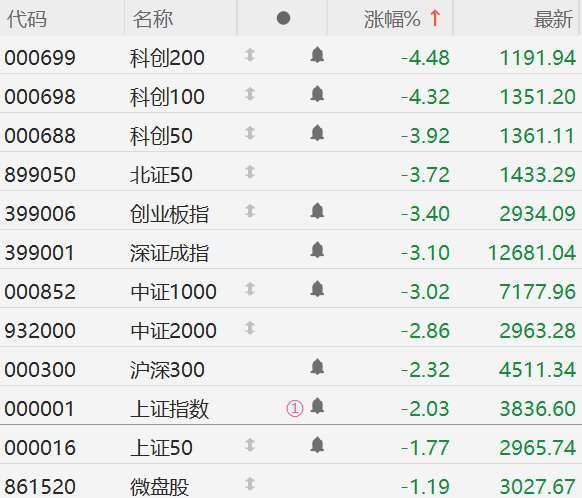
A股持续下跌,沪指跌超2%,深证成指跌超3%,创业板指跌3.4%,北证50、科创50跌近4%,科创100、科创200跌超4%
Ge Long Hui· 2025-10-17 07:18
Core Points - The A-share market has experienced a significant decline, with the Shanghai Composite Index dropping over 2%, the Shenzhen Component Index falling more than 3%, and the ChiNext Index decreasing by 3.4% [1] - The North Star 50 and Sci-Tech 50 indices both fell nearly 4%, while the Sci-Tech 100 and Sci-Tech 200 indices dropped over 4% [1] Index Performance Summary - The Sci-Tech 200 index decreased by 4.48%, closing at 1191.94 [2] - The Sci-Tech 100 index fell by 4.32%, ending at 1351.20 [2] - The Sci-Tech 50 index dropped by 3.92%, with a closing value of 1361.11 [2] - The North Star 50 index declined by 3.72%, closing at 1433.29 [2] - The ChiNext Index decreased by 3.40%, ending at 2934.09 [2] - The Shenzhen Component Index fell by 3.10%, closing at 12681.04 [2] - The CSI 1000 index dropped by 3.02%, with a closing value of 7177.96 [2] - The CSI 2000 index decreased by 2.86%, ending at 2963.28 [2] - The CSI 300 index fell by 2.32%, closing at 4511.34 [2] - The Shanghai Composite Index dropped by 2.03%, ending at 3836.60 [2] - The CSI 50 index decreased by 1.77%, closing at 2965.74 [2] - The micro-cap stocks index fell by 1.19%, ending at 3027.67 [2]


建信期货股指日评-20251017
Jian Xin Qi Huo· 2025-10-17 06:16
Group 1: Report Information - Report type: Stock index daily review [1] - Date: October 17, 2025 [2] - Researchers: Nie Jiayi, He Zhuoqiao, Huang Wenxin [3] Group 2: Market Review and Outlook Market Review - On October 16, the Wind All A index declined with shrinking volume, down 0.44%, and over 4,000 stocks fell. CSI 300 and SSE 50 rose 0.26% and 0.59% respectively, while CSI 500 and CSI 1000 fell 0.86% and 1.09% respectively. Blue - chip stocks performed better. In index futures, IF and IH rose 0.30% and 0.72% respectively, while IC and IM fell 1.10% and 0.96% respectively [6] Market Outlook - The US intends to extend the suspension of tariffs on China in exchange for China delaying rare - earth export controls. China has stated its stance. Before the APEC meeting, Sino - US game intensifies. China's September export data shows resilience, but exports to the US decline. Due to the high base last year, export year - on - year data may face pressure in Q4. The low - valuation advantage of A - shares has disappeared, and the high valuation of the technology sector brings risks. Tariff disturbances may not end soon, and market volatility may continue. In the short term, an arbitrage strategy of long large - cap blue - chips and short small - cap growth stocks can be used. In the short - term, attention can be paid to defensive sectors such as banks, gas, and power, as well as new infrastructure and domestic substitution sectors. As the Fourth Plenary Session approaches, the market style may turn to technology growth [7] Group 3: Industry News - On October 16, the central bank conducted 236 billion yuan of 7 - day reverse repurchase operations at an interest rate of 1.40%, with a net withdrawal of 376 billion yuan. The Ministry of Commerce will work on releasing policy effectiveness, promoting trade, and deepening trade cooperation, including implementing existing policies, providing services to foreign - trade enterprises, and preparing new policies [30]
【机构策略】预计四季度A股市场震荡上行的方向未发生改变
Zheng Quan Shi Bao Wang· 2025-10-17 01:28
Group 1 - A-share market experienced slight fluctuations with strong performance in banking, automotive, communication equipment, and coal sectors, while precious metals, small metals, wind power equipment, and steel sectors underperformed [1] - Market policy expectations are rising, and the potential for interest rate cuts by the Federal Reserve this year is expected to support the market [1] - The upcoming third-quarter reports are anticipated to show a rebound in profit growth across most industries due to a low base from last year, which will strengthen market confidence [1] Group 2 - A-share market saw a pullback after reaching highs, with increased recession expectations in the U.S. due to government "shutdown" and missing key economic data, raising the probability of interest rate cuts in October [2] - Domestic indicators show a continuous expansion in the core CPI for five months, and a decline in social financing and credit growth compared to last year, indicating signs of economic weakness in Q3 [2] - The market is expected to maintain an upward trend amidst a backdrop of improving economic fundamentals in Q4, although recent trading volumes have decreased, suggesting a cautious shift in funding [2] Group 3 - A-share market showed reduced trading volume and fluctuations, with a focus on dividend stocks, while the storage chip sector remained active despite adjustments in other sectors like precious metals and semiconductors [3] - The ongoing global AI investment trend, domestic "anti-involution" leading to performance improvement expectations, and increased liquidity from household savings entering the market are key factors supporting the current bull market [3] - The expectation for the A-share market to trend upwards in Q4 remains unchanged, bolstered by improved global liquidity conditions from potential Federal Reserve rate cuts [3]
北向资金持仓市值连续三个季度增长 外资齐声“唱多”A股
2 1 Shi Ji Jing Ji Bao Dao· 2025-10-17 00:47
Group 1 - As of the end of Q3, northbound funds held A-shares worth 2.58 trillion yuan, marking a year-to-date increase of over 380 billion yuan, with continuous growth for three consecutive quarters [1][2] - The top five industries by northbound fund holdings are power equipment, electronics, pharmaceuticals, banking, and food and beverage, with respective holdings of 443.8 billion yuan, 391.5 billion yuan, 183.9 billion yuan, 173.7 billion yuan, and 162.3 billion yuan [2] - In Q3, northbound funds increased their positions in nine industries, with the electronics sector seeing the largest increase of 1.82 billion shares, followed by basic chemicals and automotive [3] Group 2 - Northbound funds reduced their holdings in 22 industries, with the largest reductions in banking, construction decoration, non-bank financials, transportation, and public utilities [3] - The trend of increasing northbound fund holdings reflects a positive sentiment towards the A-share market, particularly in technology growth sectors [4][5] - Global investment firms have expressed optimism about the A-share market, with Morgan Stanley reporting a net inflow of 4.6 billion USD in September, the highest since November 2024 [4][5] Group 3 - Analysts highlight that the current conditions for A-shares are better than before, with expected earnings growth in major indices remaining in the mid-to-high single digits for this year and next [5] - Foreign investment institutions emphasize technology stocks as a key investment theme in the A-share market, citing China's leadership in electric vehicles, batteries, and robotics [6][7] - The overall sentiment among foreign investors is driven by economic recovery, attractive valuations, and supportive policies in China [7]
北向资金持仓市值连续三个季度增长,外资齐声“唱多”A股
2 1 Shi Ji Jing Ji Bao Dao· 2025-10-16 12:23
Core Viewpoint - Northbound capital has shown a positive trend in A-share holdings, with a significant increase in market value and a focus on technology growth and high-dividend assets [1][3][4]. Group 1: Northbound Capital Holdings - As of the end of Q3, Northbound capital held A-shares worth 2.58 trillion yuan, marking an increase of over 380 billion yuan year-to-date, with continuous growth for three consecutive quarters [1][2]. - The market value of Northbound capital increased by 12.9% from Q2, 15.59% from Q1, and 17.35% from the end of last year [1]. - The top five industries by Northbound capital holdings are power equipment, electronics, pharmaceuticals, banking, and food and beverage, with respective holdings of 443.8 billion yuan, 391.5 billion yuan, 183.9 billion yuan, 173.7 billion yuan, and 162.3 billion yuan [1]. Group 2: Sector Trends - In Q3, Northbound capital increased holdings in nine industries, with electronics seeing the largest increase of 1.82 billion shares, followed by basic chemicals, automobiles, and others [2]. - Conversely, 22 industries experienced a reduction in holdings, with the banking sector seeing the largest decrease of 6.97 billion shares [2]. - The significant increases in holdings for the power equipment and electronics sectors were 162.34 billion yuan and 158.21 billion yuan, respectively [2]. Group 3: Foreign Investment Sentiment - Morgan Stanley reported a net inflow of foreign capital into the Chinese stock market of 4.6 billion USD in September, the highest monthly figure since November 2024 [3]. - In the first nine months of 2025, passive foreign funds saw a cumulative net inflow of 18 billion USD, surpassing last year's total of 7 billion USD [3]. - Global asset management firms have expressed optimism about the A-share market, with Goldman Sachs predicting an 8% potential upside for A-shares over the next 12 months [4]. Group 4: Focus on Technology Stocks - Many foreign institutions view technology stocks as the most important investment theme in the A-share market, highlighting China's leadership in electric vehicles, batteries, and robotics [5]. - UBS's CEO noted that China's macro policies and rapid development in high-tech sectors are boosting market confidence [5]. - Domestic investment professionals believe that foreign capital is attracted to China's economic recovery, low valuations, and supportive policies [5][6].
市场分析:金融汽车行业领涨,A股小幅上行
Zhongyuan Securities· 2025-10-16 11:41
Market Overview - On October 16, the A-share market experienced slight fluctuations, with the Shanghai Composite Index facing resistance around 3931 points[2] - The Shanghai Composite Index closed at 3916.23 points, up 0.10%, while the Shenzhen Component Index closed at 13086.41 points, down 0.25%[9] - Total trading volume for both markets was 19,489 billion yuan, slightly lower than the previous trading day[3] Sector Performance - Strong performers included banking, automotive, communication equipment, and coal industries, while precious metals, small metals, wind power equipment, and steel sectors lagged[3] - Over 70% of stocks in the two markets declined, with coal, insurance, shipping ports, banking, and education sectors showing the highest gains[8] Valuation Metrics - The average price-to-earnings (P/E) ratios for the Shanghai Composite and ChiNext indices are 16.00 times and 48.45 times, respectively, above the median levels of the past three years, indicating a suitable environment for medium to long-term investments[3] - Recent trading volumes have consistently exceeded 20 trillion yuan, reflecting a shift of household savings towards capital markets, providing a continuous source of incremental funds[3] Future Outlook - The market is expected to remain stable with slight upward trends, influenced by upcoming policy changes and external market conditions[3] - Investors are advised to remain cautious and avoid blind chasing of high prices, focusing instead on structural optimization to seize market opportunities[3] Risk Factors - Potential risks include unexpected overseas economic downturns, domestic policy changes, and macroeconomic disturbances that could impact recovery[4]

A股,突迎变局
Zheng Quan Shi Bao· 2025-10-16 06:23
Core Insights - The A-share market is experiencing a contraction in the breadth of its upward movement, with less than 1500 stocks rising in early trading on October 16, indicating a concentration of funds towards core assets [1] - The market's driving forces have shifted, with M1 and M2 growth rates showing significant changes, reflecting a more resilient credit environment despite a slight decline in new social financing and RMB loans [1][2] Financial Data Analysis - M1 and M2 growth rates are reported at 7.2% and 8.4% respectively, with M2 slightly down from previous values due to reduced government bond issuance and a cooling of RMB appreciation expectations [2] - The increase in M1 is attributed to a low base effect and improved corporate liquidity, with a notable increase in household deposits by 760 billion yuan year-on-year [2] E-commerce and Logistics Sector - The China E-commerce Logistics Index reached a new high of 112.7 points in September, indicating a robust growth in e-commerce logistics, particularly in rural areas [2] - The total business volume index for e-commerce logistics also increased to 132.5 points, reflecting a strengthening internal economic momentum [2] Market Participation and Trends - Recent data shows a net inflow of 66.336 billion yuan into the A-share market, with significant contributions from margin financing and ETF subscriptions, suggesting increased market activity [4] - The trading volume reached 5.21 trillion yuan with a turnover rate of 4.26%, indicating heightened market participation [4] Investor Behavior and Market Volatility - Investor sentiment is influenced by external shocks such as tariffs, leading to irrational trading behaviors and increased volatility in the market [5] - The current market environment may encourage a shift from value investing to short-term emotional trading, increasing risk exposure for investors [5]
A股,突迎变局!
券商中国· 2025-10-16 04:03
Market Overview - The A-share market is experiencing a contraction in the number of rising stocks, with less than 1500 stocks rising in early trading on October 16, indicating a concentration of funds towards core assets [1] - The market's driving forces have changed, with M1 and M2 growth rates at 7.2% and 8.4% respectively, both exceeding market expectations [1][2] Internal Driving Forces - The internal driving forces for the A-share market's rise are shifting, with September 2025 financial data showing a slight decline in new social financing and RMB loans, yet still above market expectations, indicating resilience in the credit sector [2] - M2 growth slightly decreased to 8.4%, while M1 increased to 7.2%, suggesting a correlation between M1 recovery and equity market performance [2] Financial Data Analysis - The decline in M2 is attributed to a slowdown in government bond issuance and a decrease in the willingness of enterprises to convert foreign currency, while M1's increase is influenced by a low base effect and improved corporate liquidity [5] - The e-commerce logistics index in China reached a new high of 112.7 points in September, indicating a strengthening of economic internal dynamics [5] Market Activity - A net inflow of capital into the A-share market was observed, totaling 663.36 billion, with significant contributions from margin financing and ETF subscriptions, reflecting increased market participation [8] - The overall trading volume in the A-share market reached 5.21 trillion, with a turnover rate of 4.26%, indicating heightened trading activity [8] Investor Behavior - Market volatility often leads to irrational investor behavior, such as "chasing highs and selling lows," which can diminish investment returns and increase risk exposure [9] - It is recommended that investors establish a system to smooth out volatility and capture long-term returns amidst uncertainty [9]

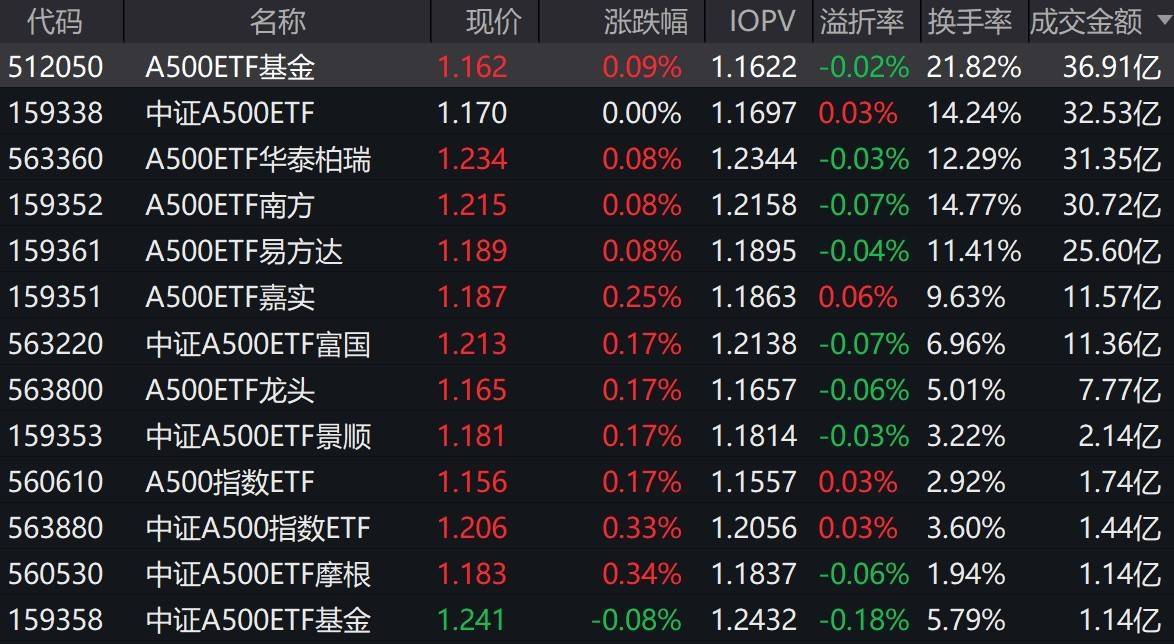
市场早盘震荡拉升,中证A500指数上涨0.19%,3只中证A500相关ETF成交额超31亿元
Sou Hu Cai Jing· 2025-10-16 04:00
Market Overview - The market experienced fluctuations in the early session, with the CSI A500 Index rising by 0.19% [1] - The semiconductor sector showed strength, particularly in storage chips, while the pharmaceutical sector continued its strong performance [1] - Conversely, stocks related to controlled nuclear fusion saw a collective decline [1] ETF Performance - As of the morning close, ETFs tracking the CSI A500 Index exhibited mixed results, with 13 ETFs having transaction volumes exceeding 100 million yuan, and 3 surpassing 3.1 billion yuan [1] - Specific transaction volumes for A500 ETFs included 3.691 billion yuan for A500 ETF Fund, 3.253 billion yuan for CSI A500 ETF, and 3.135 billion yuan for A500 ETF Huatai-PB [1] Earnings Outlook - Analysts predict that the upcoming third-quarter reports will show a rebound in profit growth across most industries due to a low base from the previous year, which is expected to bolster market confidence [1] - There is a noted shift of household savings towards the capital market, creating a sustained source of incremental funds [1] - The short-term outlook for the A-share market is expected to be characterized by steady fluctuations upward, with close attention needed on policy, funding, and external market changes [1]
建信期货股指日评-20251016
Jian Xin Qi Huo· 2025-10-16 02:03
Group 1: Report General Information - Report type: Stock Index Daily Review [1] - Date: October 16, 2025 [2] - Researchers: Nie Jiayi, He Zhuoqiao, Huang Wenxin [3] Group 2: Market Review and Outlook Market Review - On October 15, the Wind All A index rose 1.49% with over 4300 stocks up. The CSI 300, SSE 50, CSI 500, and CSI 1000 closed up 1.48%, 1.36%, 1.38%, and 1.50% respectively. Small and medium - cap stocks performed better. Index futures were stronger than spot, with IF, IH, IC, and IM main contracts up 1.54%, 1.32%, 1.86%, and 1.81% respectively [6] Market Outlook - International: Tensions between China and the US have eased, but near the APEC meeting, the game between the two sides has intensified. Trump's statements show the complexity of the situation. - Domestic: China's export data in September showed resilience, but exports to the US declined. Exports in Q4 may face pressure due to the high - base effect of last year's end - of - year rush exports. - For the A - share market: The previous low - valuation advantage has disappeared, and the high valuation of the technology sector brings higher risks. Tariff disturbances may not end soon, and market volatility may continue. The technology sector's rebound drove the Shanghai Composite Index back to 3900, but the shrinkage of the whole - market up - trend needs to be observed for sustainability. In operation, short - term arbitrage strategies can be used, and in terms of market style, short - term attention can be paid to defensive sectors and policy - beneficiary sectors, and the style may turn to technology growth near the Fourth Plenary Session [8][9] Group 3: Data Overview - The data sources are Wind and the Research and Development Department of CCB Futures, including domestic main index performance, market style performance, industry sector performance, trading volume and open interest of various indexes and futures [11][12][13] Group 4: Industry News - China's CPI in September decreased by 0.3% year - on - year, and PPI decreased by 2.3% year - on - year. The National Bureau of Statistics said the consumer market was stable, and PPI's decline narrowed. The Chinese Foreign Ministry responded to the US threat of 100% tariffs, urging the US to correct its wrong actions and resolve issues through dialogue [30]