海洋经济

Search documents
无人机放牧,AI机器鱼巡逻,广东智慧海洋牧场大揭秘
2 1 Shi Ji Jing Ji Bao Dao· 2025-08-14 03:10
Group 1 - The core viewpoint emphasizes Guangdong's strategic initiatives to enhance its marine economy, including the implementation of the "Regulations on Promoting High-Quality Development of the Marine Economy" and the focus on modernizing the marine industry [1] - Guangdong's marine production value is projected to exceed 2 trillion yuan in 2024, maintaining its position as the national leader for 30 consecutive years, accounting for approximately one-fifth of the national marine production value and one-seventh of the provincial GDP [1] - The development of advanced technologies such as AI fish and intelligent detection drones is crucial for Guangdong's advancement in deep-sea aquaculture [1][2] Group 2 - Traditional fishing and aquaculture methods are insufficient to meet the growing demand for seafood, leading to the innovative solution of "blue granaries" in marine ranching, which addresses ecological issues and reduces farming costs [6][23] - The establishment of artificial reefs and deep-water cages enhances fish habitats and protects coastal ecosystems, making Guangdong an ideal location for such initiatives due to its extensive coastline and marine area [8][11] - High-tech solutions, including AI monitoring systems and environmental sensors, are revolutionizing fish farming practices, ensuring efficient management and sustainability [13][15] Group 3 - The marine ranching approach not only increases seafood production but also contributes to the economic well-being of fishermen, leading to improved livelihoods [19] - The marine ranching initiatives are also focused on restoring marine environments and protecting biodiversity, positioning China as a leading country in aquaculture surpassing wild catch [21] - The national push for marine economic development aims to balance industrial optimization with ecological protection, transitioning from traditional reliance on marine resources to a more sustainable and integrated marine economy [23]


中信建投:AI商业化加速,关注算力主线和政策性机遇
Ge Long Hui A P P· 2025-08-14 00:25
Core Insights - The SW communication equipment sector has seen a 31.4% increase in points since the beginning of the year, outperforming the broader market [1] - The computing power chain remains a key investment theme in the market, influenced by factors such as the release of DeepSeek R1, reciprocal tariffs, and North American AI expectations [1] - Since mid-April, capital expenditures from major overseas cloud service providers have exceeded expectations, leading to a recovery from the "computing power deflation" narrative, with core suppliers' stock prices reaching new highs [1] Industry Trends - There is an increasing certainty in the growth of domestic and international computing power chain demand [1] - The importance of networks in AIDC (Artificial Intelligence Data Center) is expected to rise [1] - The acceleration of AI applications, such as Agents, is anticipated [1] - The "14th Five-Year Plan" policy guidance highlights areas of interest including digital infrastructure, marine economy, and military communication [1]

中金2025下半年通信设备行业展望:AI商业化加速 关注算力主线和政策性机遇
智通财经网· 2025-08-14 00:11
Core Insights - The report from CICC highlights the expected surge in AI hardware demand driven by the increasing capabilities of large models and diverse application scenarios by the second half of 2025 [1] - Key trends to watch include the growing certainty of domestic and international computing power chain demand, the rising importance of networks in AIDC, and the accelerated deployment of AI applications such as Agents [1] Group 1: AI Hardware Demand - The demand for AI hardware is anticipated to grow significantly as AI inference computing power requirements continue to rise [1] - The SW communication equipment sector saw a 31.4% increase as of August 8, 2025, outperforming the broader market [1] - The computing power chain remains a primary investment theme, influenced by factors such as the release of DeepSeek R1 and expectations surrounding North American AI [1] Group 2: Investment Directions - Three main investment directions in AI are suggested: 1. New hardware technologies, with a focus on AI ASICs that offer lower costs and better power efficiency [2] 2. Domestic production, with the resumption of H20 deliveries and the ongoing improvement of the domestic AI chip supply chain [2] 3. AI applications, particularly the acceleration of terminal innovations and the growth of IoT device connectivity [2] Group 3: Telecom Capital Expenditure - Telecom capital expenditures are increasingly directed towards computing networks, with a projected 9.1% year-on-year decrease to 289.8 billion yuan in 2025 [3] - The cumulative mobile internet traffic reached 186.7 billion GB in the first half of 2025, marking a 16.4% year-on-year increase [3] - Key areas of opportunity include the accelerated deployment of 5G-A, advancements in 6G technology, and the growing demand for new types of optical fibers driven by AI [3]
中金2025下半年展望 | 通信设备:AI商业化加速,关注算力主线和政策性机遇
中金点睛· 2025-08-13 23:51
Core Viewpoint - The communication equipment sector has shown strong performance, with a 31.4% increase since the beginning of the year, driven by the growth in AI hardware demand and the development of domestic and overseas computing chains [2][6][20]. Group 1: Market Overview - As of August 8, 2025, the SW communication index has risen by 21.4% since the start of the year, indicating a robust market performance [6]. - The capital expenditure of the three major telecom operators is projected to decrease by 9.1% year-on-year to 289.8 billion yuan, with a continued focus on computing networks [5][19]. - The mobile internet traffic reached 186.7 billion GB in the first half of 2025, reflecting a year-on-year growth of 16.4% [5]. Group 2: AI Hardware Trends - The demand for AI hardware is expected to grow significantly, driven by advancements in large model capabilities and the increasing number of application scenarios [2][20]. - The introduction of new AI ASIC technologies is anticipated to enhance the penetration rate of cost-effective and low-power AI chips [4][29]. - The global AI server market is projected to reach approximately $300 billion in 2025, with a year-on-year growth rate of 46.1% [31]. Group 3: Domestic and Overseas Computing Chains - The domestic computing chain, primarily serving local cloud service providers, is expected to see substantial growth, with capital expenditures in data centers projected to reach nearly 400 billion yuan by 2025 [18][19]. - The overseas computing chain has also shown resilience, with major cloud service providers exceeding capital expenditure expectations, indicating a recovery in AI hardware demand [7][13]. Group 4: Policy and Strategic Opportunities - The upcoming "15th Five-Year Plan" is expected to emphasize digital infrastructure and the digital economy, which will drive growth in sectors such as marine economy and military communication [21][22]. - The marine economy is gaining strategic importance, with government support for offshore wind power and submarine cable construction [23][24]. - The military communication sector is poised for growth due to accelerated satellite internet deployment and increased demand for information technology in defense [26][27]. Group 5: Technological Advancements - The penetration of silicon photonics technology is expected to increase significantly, enhancing the performance and efficiency of optical modules [38][39]. - Co-Packaged Optics (CPO) technology is anticipated to gain traction, providing higher bandwidth and lower power consumption, although challenges remain before widespread adoption [41].


“向海图强”大有可为
Zheng Quan Ri Bao· 2025-08-13 16:21
Group 1 - The core viewpoint highlights the resilience and growth potential of China's marine economy, with a reported marine GDP of 5.1 trillion yuan in the first half of 2025, reflecting a year-on-year growth of 5.8%, outpacing the national GDP growth rate [1] - The marine economy's growth is supported by an increase in marine resource supply capabilities, with 167,000 hectares of newly approved marine and island areas activating over 500 billion yuan in investments [1] - Traditional marine industries continue to play a stabilizing role, with the marine shipbuilding industry maintaining a leading international market share and marine tourism showing strong performance [1] Group 2 - Policy support is guiding the direction of marine economic development, with the 2025 Government Work Report emphasizing the application of new technologies and the promotion of deep-sea technology as a strategic emerging industry [2] - Local governments, such as Shanghai, Guangdong, and Fujian, have introduced policies to support marine economic development, indicating a coordinated effort to enhance the sector [2] Group 3 - The digital transformation of the marine economy is unlocking new potential, with digital technologies enhancing efficiency and quality across traditional marine industries [3] - Innovations such as digital twin platforms in shipbuilding and smart logistics models are significantly improving operational efficiency and reducing costs [3] Group 4 - Active investment and financing are crucial for the expansion of the marine economy, which is characterized by high capital intensity and long project cycles [4] - In 2024, marine-related IPO financing is projected to reach 11.4 billion yuan, accounting for 17% of total IPO financing, indicating a robust investment climate [4] - Local initiatives, such as the establishment of industry funds in cities like Fuzhou and Xiamen, are further supporting marine economic development [4]
资金“爆买”!连续9日,融资余额超1.8万亿元!
Zheng Quan Shi Bao Wang· 2025-08-13 05:51
Group 1 - The core point of the news is that leveraged funds are actively participating in the A-share market, with the financing balance exceeding 1.8 trillion yuan for nine consecutive days, indicating a significant increase compared to previous months [1][2]. - The financing balance reached a peak of 1.816659 billion yuan on June 18, 2023, and has shown fluctuations throughout the year, with a notable rise from 1.3 trillion to 1.5 trillion yuan from February to September 2024 [2]. - Daily buying momentum from leveraged funds has been strong, with daily buy amounts exceeding 100 billion yuan for nine consecutive trading days, peaking at 126.75 billion yuan on June 10 [2]. Group 2 - The pharmaceutical and biotechnology sector has been the most favored by leveraged funds, with a net buying amount of 1.318 billion yuan in the week from June 16 to June 20, 2023 [3]. - The pharmaceutical sector's net buying amount for the month has reached 6.244 billion yuan, leading all 31 sectors, driven by policy support for innovative drug development [3]. - The electricity equipment sector followed with a net buying amount of 843 million yuan, while the oil and petrochemical and computer sectors had net buying amounts of 610 million yuan and 603 million yuan, respectively [3]. Group 3 - Securities firms are optimistic about the performance of Chinese equity assets in the second half of 2025, expecting a gradual upward shift in the market's oscillation center [4]. - Factors contributing to this positive outlook include a weak dollar trend, supportive capital market policies, and overall improvement in liquidity [4]. - Key investment areas suggested include innovative drugs, consumer services, artificial intelligence, humanoid robots, banking, non-banking sectors, transportation, public utilities, and non-ferrous metals [4][5].

中国经济圆桌会丨海洋经济是人才的密集型经济
Xin Hua Wang· 2025-08-13 04:02
【纠错】 【责任编辑:赵文涵】 新华社音视频部制作 国家海洋信息中心副主任、研究员李双建在"中国经济圆桌会"节目中表示,海洋经济是人才的密集 型经济。 ...
低空经济在海岛“起飞”
Zhong Guo Zi Ran Zi Yuan Bao· 2025-08-13 01:51
Core Viewpoint - The development of low-altitude economy on islands is emerging as a new business model within the marine economy, driven by the need to overcome geographical isolation and enhance connectivity, thereby improving the quality of life and economic prospects for island residents [2][4]. Group 1: Low-altitude Economy and Island Development - The low-altitude economy is seen as a key force in breaking the development constraints faced by islands, which are characterized by "scattered, remote, and small" geographical features [2]. - The establishment of the Zhuhai Wanshan Marine Development Experimental Zone aims to create the first national "comprehensive application demonstration zone for low-altitude economy on islands" [2]. - Low-altitude economy is transforming the narrative of island development, moving from survival-based growth to innovative leaps [4]. Group 2: Multi-dimensional Demands of Island Development - The development challenges of islands stem from spatial isolation, which creates systemic contradictions that the low-altitude economy can address [4]. - Low-altitude economy enhances public service accessibility for island residents, improving their quality of life by reconstructing transportation and logistics networks [4][5]. - Traditional industries on islands, such as fishing and tourism, face challenges of low efficiency and high competition; low-altitude economy can enhance these sectors through innovations like drone logistics and low-altitude tourism products [4][5]. Group 3: Governance and Coordination - Islands face unique governance needs, including marine ecological protection and disaster prevention; low-altitude technology can enhance monitoring and response capabilities [5][8]. - The low-altitude economy can help mitigate issues like talent loss and industrial hollowing by creating new job opportunities in drone operation and maintenance [5]. - Coastal provinces are implementing supportive policies for low-altitude economy, with pilot projects already underway in various island counties [5]. Group 4: Practical Applications and Innovations - The integration of low-altitude economy with island characteristics has led to the development of replicable and scalable application scenarios [7]. - Emergency medical services are being enhanced through the use of drones for rapid transport of medical supplies, significantly reducing response times [7][8]. - The logistics sector is seeing rapid growth, with over 140 new low-altitude logistics routes established in 2024, although interprovincial routes remain limited [10]. Group 5: Tourism and Economic Growth - Low-altitude tourism is becoming a new highlight for island economies, with various aerial sightseeing projects being launched across the country [11]. - The market for low-altitude economy is projected to exceed 1.5 trillion yuan by 2025, indicating significant growth potential [11]. - Islands are well-positioned to develop diverse low-altitude tourism products, enhancing the overall tourism experience [11]. Group 6: Technological Advancements - Islands provide an ideal testing ground for low-altitude technology, facilitating innovations in airspace management and operational models [12]. - Low-altitude vehicles are being utilized in offshore wind farm operations and oil drilling platforms, improving safety and efficiency [12]. - The integration of traditional industries with low-altitude economy is leading to more efficient production methods, such as precision feeding in aquaculture [12]. Group 7: Future Outlook - The future of islands is expanding into a three-dimensional space, driven by technological advancements and innovative development concepts [13].

告别A股!中国重工601989今起停牌
Guan Cha Zhe Wang· 2025-08-13 00:40
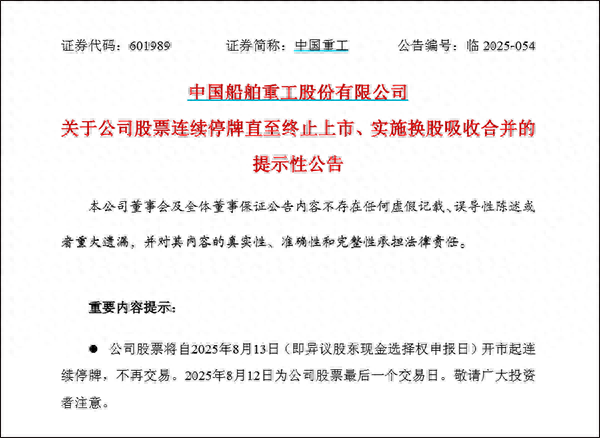
今天开始,中国船舶、中国重工股票将开始停牌,A股史上最大规模交易——中国船舶(600150)吸收 合并中国重工(601989)将再进一步。 根据此前公布的方案,中国船舶将以37.84元/股的发行价向中国重工股东发行A股,换股比例调整为每1 股中国重工股票换0.1339股中国船舶股票,交易金额达1151.50亿元。 8月11日晚间,中国重工发布《关于公司股票连续停牌直至终止上市、实施换股吸收合并的提示性公 告》,公告显示,公司股票将自2025年8月13日(即异议股东现金选择权申报日)开市起连续停牌,不 再交易。2025年8月12日为公司股票最后一个交易日。 根据公告,现金选择权实施完成及公司终止上市后,公司股东持有的公司A股股票将按照公司于2025年 7月19日发布的《中国船舶工业股份有限公司换股吸收合并中国船舶重工股份有限公司暨关联交易报告 书》中确定的换股比例转换为中国船舶为本次换股吸收合并所发行的A股股票,并在上海证券交易所上 市流通。 此外,公司特别提醒,中国重工换股股东取得的中国船舶股票应当为整数,如其所持有的中国重工股票 数量乘以换股比例后的数额不是整数,则按照其小数点后尾数大小排序,向每一位股东依 ...


外媒关注中国造船业“大动作”,“与美国竞争将促使他们飞速升级”
Guan Cha Zhe Wang· 2025-08-12 15:50
Group 1 - The recent merger between China Shipbuilding and China State Shipbuilding aims to create the world's largest shipbuilding company, enhancing China's competitiveness in the global market and responding to external pressures from the U.S. [1][3] - The merger is valued at 115.15 billion yuan and is seen as a strategic move to integrate military and civilian shipbuilding resources, aligning with national policies on high-quality development of the marine economy [1][3][4]. - Following the merger, the combined company will have over 530 ship orders, totaling a deadweight tonnage of 54 million tons, and an estimated annual revenue of approximately 18 billion dollars [3][4]. Group 2 - China has established a dominant position in the global shipbuilding industry, accounting for over 55% of the world's total tonnage, while the U.S. holds less than 0.05% [4][6]. - The U.S. shipbuilding industry is struggling to recover from decades of decline, with President Trump's efforts to revitalize it facing significant challenges, including high port fees imposed on Chinese vessels [4][6]. - Competitors from Japan and South Korea are attempting to reclaim market share, with Japan aiming to increase its market share from about 9% to 20% by 2030 through government support and industry consolidation [6][7]. Group 3 - Despite external challenges and competition, China's shipbuilding industry is expected to maintain its leading position, with experts asserting that the competition with the U.S. will drive rapid upgrades in technology and capabilities [7][8]. - The U.S. has been criticized for its protectionist policies, which have contributed to its loss of competitive advantage in shipbuilding, and these measures are likely to increase global shipping costs and disrupt supply chains [7][8].