
智能汽车

Search documents
手握100万辆车销售命脉:华为不造车,如何卖好车?
2 1 Shi Ji Jing Ji Bao Dao· 2025-09-25 00:18
Core Insights - Huawei has established a significant presence in the automotive industry, evolving from a cautious entry to becoming a key player with a comprehensive sales and service model [3][26][30] - The company has developed a standardized operational methodology for its automotive sales, ensuring a consistent customer experience across various channels [25][21] - Huawei's strategy has shifted towards a more integrated approach, consolidating control over sales, delivery, and service processes within its automotive ecosystem [10][12][11] Group 1: Sales and Distribution Strategy - Huawei's automotive sales model has transitioned from a fragmented approach to a more unified system, with the establishment of the "Hongmeng Intelligent Travel" user centers [11][12] - The company has implemented a detailed and standardized operational framework for its dealerships, including specific guidelines for store layout, staff training, and customer interaction [22][23] - The sales channels have evolved to include various types of stores, such as direct sales stores, authorized experience stores, and user centers, each with distinct functions [19][18] Group 2: Market Position and Partnerships - Huawei has expanded its partnerships with multiple domestic and international automotive manufacturers, significantly increasing its influence in the market [2][26] - The company has successfully penetrated the market with over 930,000 vehicles equipped with its technology, showcasing its growing footprint in the automotive sector [2] - The shift in Huawei's role from a technology provider to a brand co-builder indicates a strategic move to deepen its involvement in the automotive industry [26][30] Group 3: Challenges and Adaptations - Early challenges in the automotive sales process highlighted the complexities of managing sales and service across different entities, leading to a reevaluation of its operational model [9][10] - The company has faced pressure to maintain customer satisfaction amid rapid sales growth, necessitating the establishment of additional service points and user centers [16][17] - Huawei's approach to automotive sales reflects a broader trend of adapting to market feedback and continuously iterating on its business model to optimize performance [20][32]

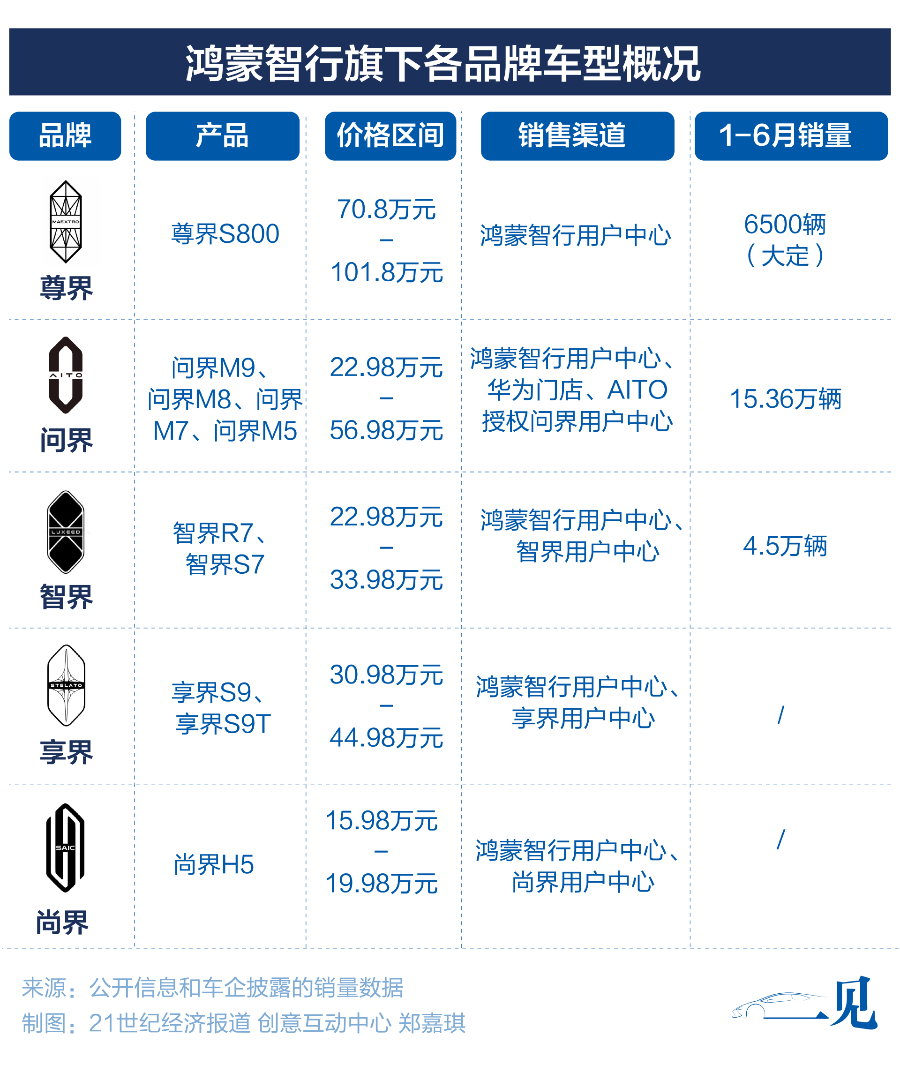
调查|手握100万辆车销售命脉:华为不造车 如何卖好车?
2 1 Shi Ji Jing Ji Bao Dao· 2025-09-25 00:13
Core Insights - Huawei is evolving its automotive strategy, transitioning from a technology provider to a more integrated role in vehicle sales and management, particularly through its "Hongmeng Zhixing" user centers [26][30][32] - The company has established a significant presence in the automotive market, with its technology integrated into over 1 million smart vehicles, showcasing its ambition to build a comprehensive automotive ecosystem without manufacturing cars itself [3][30] Group 1: User Center Development - The "Shangjie" user center in Shanghai is preparing for its opening, with a notable increase in customer interest, receiving over 30 groups of visitors in a single day prior to the launch of the Shangjie H5 model [1][4] - The user centers are designed to follow strict operational guidelines set by Huawei, including specific requirements for vehicle display and customer interaction to enhance the user experience [20][23] Group 2: Sales and Distribution Strategy - Huawei's sales strategy has evolved from a fragmented approach to a more unified model, consolidating control over sales, delivery, and service through the establishment of "Hongmeng Zhixing" user centers [10][12][21] - The company has shifted from a dual-channel system with separate responsibilities for sales and after-sales to a more integrated approach, allowing for better customer experience and operational efficiency [10][11][12] Group 3: Market Position and Partnerships - Huawei has expanded its partnerships with eight major state-owned automotive companies, positioning itself as a key player in the automotive industry, leveraging its technology and market insights [2][3][30] - The company is focusing on high-end market segments, utilizing its experience in consumer electronics to better understand and meet the needs of middle-class consumers in China [24][30] Group 4: Operational Control and Standardization - Huawei maintains strict control over the operations of its user centers, dictating sales policies, staff performance metrics, and operational standards to ensure a consistent customer experience across all locations [20][22] - The company emphasizes a standardized operational methodology, which includes detailed training for sales personnel and a focus on customer engagement through scenario-based marketing [22][25] Group 5: Future Directions - Huawei is positioning itself as a "super supplier" rather than a traditional car manufacturer, focusing on providing comprehensive solutions for smart vehicles, including intelligent driving and cockpit systems [30][32] - The company is exploring new collaborative models with automotive partners, indicating a potential shift towards a more flexible and competitive landscape in the automotive sector [30][31]
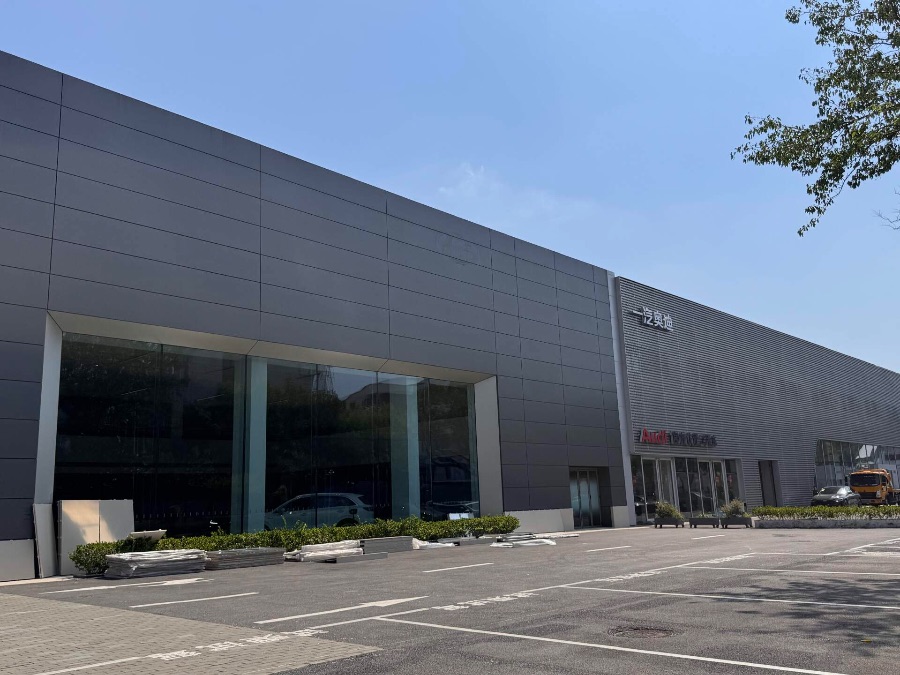
21调查|手握100万辆车销售命脉:华为不造车,如何卖好车?
2 1 Shi Ji Jing Ji Bao Dao· 2025-09-25 00:09
Core Insights - Huawei is evolving its automotive strategy by establishing a comprehensive sales and service network under the "Hongmeng Intelligent Travel" brand, which integrates sales, delivery, and after-sales services [1][10][12] - The company has shifted from a traditional partnership model with car manufacturers to a more centralized control approach, enhancing its influence over the sales process and customer experience [8][10][17] - Huawei's focus is on becoming a "super supplier" in the automotive industry rather than a traditional car manufacturer, leveraging its technology and expertise in smart systems [23][21] Group 1: Sales and Distribution Strategy - Huawei's new user centers, such as the Shangjie center, are designed to enhance customer engagement and streamline the sales process, with a focus on creating a welcoming environment for potential buyers [1][2] - The company has implemented a standardized operational methodology across its sales channels, ensuring a consistent customer experience and adherence to Huawei's branding and service standards [13][15] - The sales model has evolved from a dual-channel system to a more integrated approach, allowing for better management of customer interactions and service delivery [9][10] Group 2: Partnerships and Market Position - Initially, Huawei faced skepticism from traditional automakers but has since formed partnerships with eight major state-owned car manufacturers, expanding its influence in the automotive sector [2][4] - The company has transitioned from a "behind-the-scenes" role to a more prominent position in the automotive market, taking on responsibilities for marketing, sales, and service management [8][19] - Huawei's strategy includes a focus on high-end consumer needs, leveraging its experience in consumer electronics to better understand and meet the demands of the automotive market [16][22] Group 3: Challenges and Adaptations - Early challenges in the sales process highlighted the complexities of managing customer experience across different sales channels, leading to a reevaluation of the operational structure [7][10] - The company has recognized the need for rapid expansion of service networks to meet increasing customer demand, particularly during peak times [11][12] - Huawei's iterative approach to its automotive strategy reflects a willingness to adapt and refine its business model based on market feedback and operational challenges [18][23]
上汽贾健旭四句话总结尚界H5
2 1 Shi Ji Jing Ji Bao Dao· 2025-09-24 13:04
上汽集团(600104)总裁贾健旭现身鸿蒙智行秋季新品发布会,并用"GL8的舒适、桑塔纳的素质、华 为的智能、余承东的要求"总结尚界H5。 ...

55.98万起售!问界M9四座布局重塑高端出行尊享仪式感
Qi Lu Wan Bao· 2025-09-24 11:44
Core Viewpoint - The launch of the new color "Silver Purple" for the AITO M9 SUV enhances its luxury and technological appeal, while the introduction of the "Respect Four-Seat" configuration aims to meet diverse consumer needs in the high-end SUV market [1][18]. Design and Aesthetics - The "Silver Purple" color features a contrasting design with silver accents on the roof and pillars, creating a sophisticated visual effect that emphasizes the vehicle's luxury [2][4]. - The M9 now offers five exterior color options, with the addition of "Silver Purple" expanding its color palette and enhancing its visual diversity [4]. Technological Features - The M9 is equipped with advanced features such as a dual-million-pixel smart projection headlights and various scenario-based lighting options, enhancing the user experience [6]. - The vehicle includes the HarmonyOS 4 smart cockpit, which supports multi-screen connectivity and features a 32-inch retractable screen for an immersive in-car entertainment experience [11]. - The M9 is equipped with the HUAWEI ADS 4 driver assistance system, featuring 36 sensing hardware components, including a 192-line lidar for high-precision environmental perception [11]. Comfort and Health - The new model incorporates the Harmony ALPS cockpit with eco-friendly materials and an air purification system to ensure a healthy in-car environment [8]. - The "Respect Four-Seat" configuration includes zero-gravity seats designed for maximum comfort, with adjustable angles for relaxation during travel [12][14]. Market Position and Sales - The AITO M9 has achieved significant market success, with over 240,000 units delivered since its launch, maintaining a leading position in the large SUV segment for 18 months [9]. - The introduction of over 50 functional upgrades aims to enhance the vehicle's intelligence and convenience, further solidifying its competitive edge in the high-end automotive market [15][18].
小米布局汽车芯片,旗下基金入股旗芯微半导体!
Sou Hu Cai Jing· 2025-09-24 08:38
Core Insights - Xiaomi has invested in Qichip Microelectronics, a company specializing in automotive high-end controller chips, indicating a strategic move to strengthen its position in the automotive sector [1][5] - The automotive controller chip is crucial for various functions in smart vehicles, including battery management and decision-making for autonomous driving, highlighting the increasing demand for advanced chip technology in the automotive industry [3][5] - By acquiring a stake in Qichip Microelectronics, Xiaomi aims to secure a stable supply of chips for its future vehicle models, ensuring better control over costs and technology development [5][7] Industry Context - The smart automotive market has seen exponential growth in the past two years, with increasing requirements for chip performance and stability, particularly for levels of automation from L2 to L4 [3] - There are limited domestic companies capable of producing high-end automotive controller chips, making Qichip Microelectronics a valuable player in this niche market [3][5] - Xiaomi's investment reflects a broader trend in the tech industry where companies are integrating vertically to maintain control over core technologies, from research and development to supply chain management [5][7]
智能汽车ETF(159889)上涨1.5%,行业需求稳健与政策利好共振
Mei Ri Jing Ji Xin Wen· 2025-09-24 08:21
Group 1 - The core viewpoint indicates that the automotive industry is experiencing robust growth, with a projected sales volume of approximately 2.857 million vehicles in August 2025, reflecting a month-on-month increase of 10.1% and a year-on-year increase of 16.4% [1] - New energy vehicle sales are expected to reach around 1.395 million units, achieving a market share of 48.8%, driven by supportive policies and increasing demand for electric vehicles [1] - The trend towards smart vehicles is significant, with companies like Huawei collaborating with automakers such as BAIC and GAC to develop high-end smart car brands, enhancing technologies like intelligent driving and smart cockpits [1] Group 2 - The electric and intelligent components sector is gaining attention, particularly in the AIDC liquid cooling supply chain, with companies like Joyson Electronics receiving substantial fixed-point orders, highlighting opportunities for technological upgrades in the industry [1] - The Smart Car ETF (159889) tracks the CS Smart Car Index (930721), which selects listed companies involved in smart driving and vehicle networking from the A-share market, covering the entire industry chain from hardware to software [1]
【兴证计算机】2025年度研究成果巡礼
兴业计算机团队· 2025-09-24 08:04
AI Computing Series Reports - The rise of domestic AI chips is becoming mainstream, indicating a significant shift in the computing landscape [2] - Major AI companies are expanding their capital expenditures (Capex), leading to accelerated performance in domestic computing [2] - The ecosystem investment opportunities are being dissected from Alibaba's advancements in AI [2] - Huawei's industrial chain opportunities are highlighted ahead of the upcoming Full Connection Conference [2] - The upgrade of large models and applications is accelerating, with a continued positive outlook on the domestic computing chain [2] - Insights from the Volcano Force Original Power Conference reveal the AI ecosystem of major companies [2] - The synergy between industry prosperity and policy dividends continues to resonate within the computing sector [2] - Opportunities in the computing industry are being assessed based on insights from NVIDIA's GTC and major companies' expenditures [2] - The inference computing market space and investment opportunities driven by DeepSeek are explained [2] - A comprehensive analysis of investment opportunities influenced by DeepSeek in cloud computing is provided [2] - The expansion of computing expenditures is accelerating, marking a breakout year for AI agents [2] - The introduction of "thinking chains" by OpenAI o1 is leading to sustained increases in computing demand [2] AI Application Series Reports - Palantir's evolution from a big data giant to an agent benchmark is discussed [3] - The top-level design for AI applications is being implemented, accelerating the commercialization process [3] - Financial reports from overseas giants and the validation of GPT-5 indicate a high level of prosperity in the sector [3] - Major companies are competing vigorously, leading to accelerated growth in AI applications [3] - The evolution of AI glasses is highlighted as a rapidly advancing entry point for edge AI [3] - ByteDance's AI ecosystem is thoroughly explained [3] - The acceleration of large model applications in both domestic and international markets is noted [3] - The domestic AI ecosystem's rapid growth is observed from the WAIC 2025 perspective [3] - The concentrated upgrades of large models are emphasized, with a focus on WAIC 2025 [3] - Data and scenarios are deemed crucial, with large models driving acceleration [3] - The demand for AI learning machines is surging, with a sales peak anticipated [3] - The AI industry is entering a "deep thinking" phase with large models [3] Financial Technology Series Reports - The securities IT sector is experiencing a sustained upward trend, driven by stablecoins initiating a new wave of innovation [4] - The recovery in downstream sectors is ongoing, with Web 3.0 financial innovations accelerating [4] - The stablecoin industry is approaching a policy turning point, with three major beneficiary segments identified [4] - The securities IT sector is expected to continue its upward trajectory, supported by three driving forces [4] - A review of the securities IT sector indicates that the bull market's leading stocks still have room to grow [4] eCall/Smart Vehicle Series Reports - The official release of national standards for eCall is accelerating industry development [4] - The potential market size for eCall is explored in detail [4] - The orderly advancement of the national standard AECS for eCall indicates significant market potential [4] - The momentum of intelligent driving is strong, with expectations for accelerated integration of vehicle-road-cloud systems [4] Trust Innovation Series Reports - The demand for trust innovation is rapidly increasing, with a thriving ecosystem [4] - A retrospective study on trust innovation suggests potential for excess growth [4] - The changing international environment presents growth opportunities for trust innovation [4] - The evolving geopolitical landscape is expected to accelerate industry development [4] - Internal and external factors are resonating, leading to an upward trend in industry prosperity [4] - The most certain direction for advancement in trust innovation is identified [4] - The upcoming release of Harmony OS for PCs is expected to peak ecosystem expansion [4] - The RISC-V open-source ecosystem is rapidly emerging as a domestic alternative [4] - Core software in databases is expected to benefit significantly from the rising prosperity of trust innovation [4] - Huawei's computing industry is poised for accelerated ecosystem development ahead of the Full Connection Conference [4] - Investment opportunities in trust innovation are being assessed based on Intel's business in China [4] Investment Strategy Reports - The mid-term outlook for 2025 emphasizes capitalizing on alpha opportunities, focusing on AI and domestic innovation [5] - The 2025 annual investment strategy highlights technological self-reliance and resilience [5] - The computer industry is experiencing steady recovery, with AI as a core growth engine, as summarized in the mid-year report [5] - The recovery trend is becoming evident, as indicated in the financial report summaries for 2024A and 2025Q1 [5] - The ongoing differentiation in the market suggests a focus on leading companies in improving sectors, as noted in the Q3 2024 report summary [5] - The bottoming out of performance indicates a left-side layout for leading companies in improving sectors, as summarized in the mid-year report for 2024 [5] Key Individual Stock Reports - Unisplendour is positioned as a leader in the ICT stack, serving as a key player in the era of large models [6] - Hengsheng Electronics is entering a new era as a leader in financial technology [6] - Haiguang Information is merging with Zhongke Shuguang to create a domestic chip giant [6] - Weihan Co., Ltd. is experiencing rapid growth in performance, benefiting from the progress of national standards for eCall [6] - Newland's net profit reached a record high in Q1 2025, significantly benefiting from digital payment and identity solutions [6] - Hand Information is enhancing profitability, with agents expected to become a new growth engine [6] - Gallen Electronics is achieving stable revenue growth through a combination of acquisitions and organic development [6] - Compass is realizing high growth in performance while continuously improving its wealth management landscape [6] - Tonghuashun is experiencing rapid growth, with promising prospects for AI and ETF development [6] - Zhongke Shuguang is maintaining stable profit growth while deepening its computing ecosystem [6]
从清华学子到中国芯片首富,1600亿巨头进入英伟达供应链,眼光长远
Sou Hu Cai Jing· 2025-09-24 06:32
Core Viewpoint - The news highlights that OmniVision Technologies, referred to as a major player in the CIS (Camera Image Sensor) market, has officially entered NVIDIA's supply chain, indicating a significant partnership in the AI chip sector [1][11]. Company Overview - OmniVision is recognized as a leading domestic CIS manufacturer, supplying sensors to major Chinese smartphone brands like Huawei and Xiaomi [1]. - The company's CEO, Yu Renrong, is noted for his entrepreneurial spirit and strategic vision, having transitioned from a sales manager to founding multiple successful companies in the semiconductor industry [5][9]. Strategic Moves - Yu Renrong founded Well Semiconductor in 2007, using profits from distribution to fund research and development, which allowed the company to maintain high-quality standards [9][11]. - The acquisition of OmniVision by Well Semiconductor was a strategic move that capitalized on the potential of image sensors, particularly during the U.S.-China chip conflict [11]. Market Position and Growth - OmniVision has successfully pivoted towards the automotive sector, with revenue from automotive chips surpassing that from mobile devices by 2025, showcasing rapid growth and adaptability [13]. - The company is set to launch new automotive chips in 2026, further bolstered by its partnership with NVIDIA, enhancing its market position [13]. Philanthropic Efforts - Yu Renrong has committed significant resources to charitable causes, including a donation of 5.3 billion yuan to support chip talent development, positioning his investments as a long-term strategy for the industry [15]. Industry Implications - The partnership between OmniVision and NVIDIA is seen as a milestone for the Chinese semiconductor industry, reflecting a shift from following global trends to leading in certain areas [15].


2025年全球智能汽零市场规模将突破千亿美金,“启境”品牌正式官宣 | 投研报告
Zhong Guo Neng Yuan Wang· 2025-09-24 02:57
Core Viewpoint - The automotive industry is entering a peak consumption season, with strong promotional activities from dealers and an expected increase in consumer demand, leading to a forecast of 2.2 million units in passenger car sales for September [1][3]. Market Review - The automotive sector saw a weekly increase of 3.50%, with the auto parts sub-sector performing the best at +5.25%. In comparison, the overall A-share market declined by 0.33% [2]. - The average daily wholesale volume for domestic passenger car manufacturers from September 8 to September 14 was 66,600 units, a year-on-year decrease of 1.00%, while the average daily retail volume was 61,100 units, a year-on-year increase of 1.00% [2]. Weekly Insights - The China Automobile Dealers Association predicts that September's total passenger car sales will reach 2.2 million units, driven by the "Golden September and Silver October" consumption peak and the dual holiday effect of the Mid-Autumn Festival and National Day [3]. - The Ministry of Industry and Information Technology is soliciting public opinions on mandatory national standards for intelligent connected vehicles, which aims to enhance safety requirements for these vehicles [4]. - The global market for intelligent driving components and systems is expected to exceed $100 billion this year, with China's market projected to reach around $50 billion [4]. Investment Recommendations - Companies involved in intelligent vehicle technology and those with potential overseas sales should be considered for investment [6]. - Recommended vehicle manufacturers include BAIC Blue Valley, Great Wall Motors, and GAC Group, while recommended auto parts companies include Songyuan Safety, Zhejiang Xiantong, and Lingyun Co., among others [7].