高股息

Search documents
看好中国股票,韩国掀“买入热潮”
Huan Qiu Shi Bao· 2025-07-22 22:49
Group 1 - Korean individual investors are increasingly enthusiastic about Chinese stocks, with a shift in focus from Japanese and American markets to Chinese markets, driven by the recovery of the Chinese economy and strong performance of tech stocks in Hong Kong [1][2] - The trading volume of Korean investors in Chinese stocks has surged, reaching a cumulative amount of $5.514 billion as of July 17, 2023, surpassing the total for the entire year of 2024 [2][3] - The Hang Seng Index has risen over 16% since the beginning of the year, outperforming both the Korean Composite Index and major U.S. indices, attracting significant capital reallocation [2][3] Group 2 - The preferred stocks among Korean investors include Xiaomi, BYD, and CATL, with net purchases of $160 million, $62.44 million, and $60.85 million respectively as of July 17 [3][4] - A new investment strategy has emerged among Korean investors, focusing on a combination of technology, consumption, and finance sectors, with notable investments in companies like Lao Pu Gold and ICBC [3][4] - The battery sector, particularly CATL, is gaining attention due to perceived technological advancements over local competitors, with investors viewing CATL as a core asset for long-term investment [4][5] Group 3 - Investors are optimistic about the growth potential of Hong Kong stocks, particularly in technology and consumer sectors, as they anticipate more domestic stimulus policies from the Chinese government [5][6] - Korean investors have achieved an average return of 8.62% on Chinese stocks from January 1 to March 14, 2023, the highest among major overseas markets [5][6] - Analysts predict that the second half of the year will see more policy benefits released in China, enhancing the attractiveness of related investment sectors [7]



中国宏桥20250722
2025-07-22 14:36
Summary of Key Points from the Conference Call Industry Overview - The conference call primarily discusses the aluminum and alumina industry, with a focus on the performance and outlook of specific companies, particularly China Hongqiao [2][3][4]. Core Insights and Arguments - **Market Dynamics**: The upcoming autumn peak season is expected to exacerbate supply-demand tensions in the lithium market, despite anticipated declines in orders for photovoltaic and new energy vehicles [2][3]. - **Alumina Pricing**: The alumina market lacks strong fundamental support; however, prices have risen due to financial and policy stimuli, benefiting related companies' performance [4]. - **Investment Logic**: The selection logic for non-ferrous metals includes high dividends, high yields, high earnings elasticity, and high growth potential. Recommended stocks include Hongqiao, Hongchuang, Zhongfu, and Zhonglv for high dividends, and Chalco, Yun Aluminum, Shenhuo, and Hongqiao for high earnings elasticity [2][6]. Company-Specific Insights - **China Hongqiao's Advantages**: The company boasts significant profit elasticity, high resource self-sufficiency, and a strong dividend policy, with a projected dividend payout ratio of 62% for 2024 [7][8]. - **Revenue Breakdown**: In 2024, revenue from aluminum alloy is expected to account for 66%, alumina 24%, and aluminum processing 10%, with respective gross margins of 60%, 30%, and 10% [8]. - **Resource Supply**: Hongqiao has secured bauxite supply in Guinea, providing approximately 60 million tons annually to the domestic market. The company has an alumina production capacity of 19.5 million tons, with an additional 2 million tons in Indonesia [10]. - **Cost Efficiency**: The average annual C1 cost for electrolytic aluminum is about 10% lower than the market average, showcasing the company's cost advantages [13]. Risks and Challenges - **Supply Risks**: China's alumina supply faces risks due to uneven mineral resource distribution and increasing environmental regulations, leading to high dependence on imported minerals, particularly from Guinea [5][19]. - **Global Supply Challenges**: The global electrolytic aluminum supply growth is declining, with overseas expansions hindered by regulatory approvals and high costs [16][17]. Future Outlook - **Performance Projections**: Zhonghuaxiang's net profits are projected to be 24.4 billion RMB and 25.1 billion RMB for 2025 and 2026, respectively, with earnings per share of 2.63 RMB and 2.7 RMB [21]. - **Dividend Yield and Growth Potential**: The current dividend yield for Zhonghuaxiang is 8%, with potential for a 30-40% price increase if the yield compresses to 5% [22]. The company is expected to benefit from macroeconomic recovery and rising aluminum prices [22][23]. Additional Noteworthy Points - **Sustainability Initiatives**: The company is actively pursuing a circular economy and modernizing projects to support carbon neutrality goals [11][15]. - **Innovative Transportation**: Hongqiao has developed a new transportation model for resource development in Guinea, significantly reducing logistics time [12]. This summary encapsulates the key points discussed in the conference call, highlighting the dynamics of the aluminum industry, specific company advantages, risks, and future outlooks.
中字头发力,煤炭板块拉升!高股息ETF(159207)、央企创新ETF(515600)等红利相关ETF一度涨超2%
Xin Lang Cai Jing· 2025-07-22 06:46
Group 1 - The core viewpoint of the news highlights a significant rally in state-owned enterprises (SOEs) and coal-related stocks, driven by strong performance in the coal futures market and expectations of price increases in coke [1][2] - Major SOEs such as China Communications Construction and China Railway Construction saw substantial gains, indicating a positive market sentiment towards these companies [1] - The coal sector is identified as a high-dividend area, with leading companies expected to attract long-term investment due to stable cash flows and dividend capabilities [2] Group 2 - The report mentions that the Central State-Owned Enterprises Dividend 50 ETF (560700) has a market size of 682 million yuan, leading its category, and has shown a price increase of over 1% [1][3] - The High Dividend ETF (159207) has increased by over 15% since its launch in April, indicating strong investor interest in high-yield assets [1][3] - The report also notes that the Central State-Owned Enterprises Innovation ETF (515600) saw a price increase of over 2%, reflecting positive market dynamics for innovative SOEs [1][4] Group 3 - The coal industry is expected to benefit from government policies aimed at stabilizing growth, with large infrastructure projects like the Yarlung Tsangpo River hydropower project set to support physical work volume [2] - The report emphasizes that the coal sector's profitability is stabilizing, and the risks associated with the industry have been sufficiently mitigated, enhancing its investment appeal [2] - The introduction of long-term assessments for insurance funds is expected to further boost the allocation preference for high-dividend assets, particularly in the coal sector [2]
险资三季度权益投资信心指数回升 重点布局高股息、高科技板块
Zheng Quan Ri Bao· 2025-07-18 16:10
Core Viewpoint - The insurance asset management industry in China shows a significant rebound in investment confidence for equity investments, with the confidence index rising from 50.12 in Q2 to 56.11 in Q3 2025, indicating a more optimistic outlook for the market [1][2]. Investment Confidence Index - The confidence index for equity investments among insurance institutions is reported at 56.11, a notable increase from 50.12 in the previous quarter [2]. - Predictions for equity investment styles indicate a slight increase or stability in growth style (51% and 31%), value style (51% and 41%), large-cap style (49% and 42%), and small-cap style (40% and 35%) [2]. Factors Influencing Confidence - The deepening of the long-cycle assessment mechanism for insurance funds is a crucial factor in the increased confidence, as highlighted by industry experts [2]. - The Ministry of Finance's recent notification adjusts performance evaluation indicators for state-owned commercial insurance companies, enhancing the tolerance for market fluctuations and boosting confidence in equity investments [2]. Market Conditions and Trends - The continuous decline in market interest rates poses challenges to traditional investment models for insurance companies, making equity assets more attractive for stable long-term returns [3]. - As of the end of Q1, the stock holdings of life insurance companies reached a market value of 2.65 trillion yuan, with long-term equity investments around 2.60 trillion yuan, both exceeding 8% of their total assets [3]. Investment Focus Areas - High dividend and high-tech sectors are identified as key areas for equity investment by insurance funds, driven by the nature of liability funds and the current policy direction [4]. - Insurance funds have shown a preference for stable dividend-paying stocks, particularly in the banking sector, where holdings reached approximately 265.8 billion yuan by the end of Q1 [4]. Policy Support for Technology Investments - Recent policies encourage insurance funds to increase support for technology sectors, including artificial intelligence and semiconductors, with investment limits raised for venture capital funds [5]. - The strategic focus on high dividend and technology growth sectors is reflected in the extensive research conducted by insurance institutions on over 1,400 A-share listed companies [5].
大佬Q2作业终于披露了!
Zheng Quan Zhi Xing· 2025-07-18 08:35
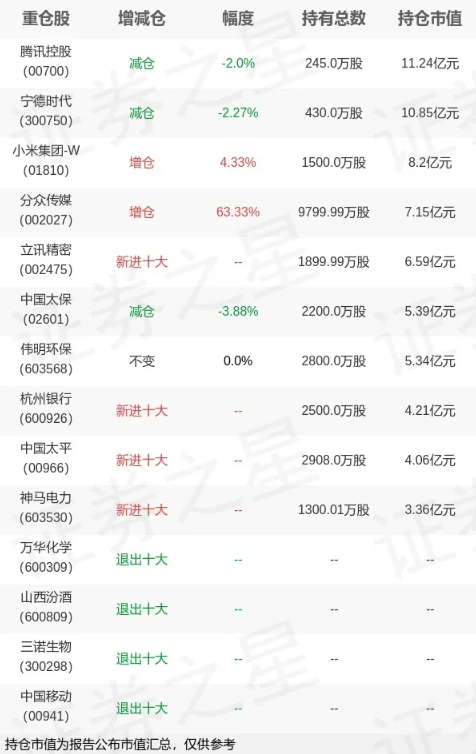
Group 1 - Zhao Feng increased his holdings in consumer electronics, advertising, banking, insurance, and electric power sectors during Q2 [3][4] - Major new positions include Xiaomi Group, Focus Media, Luxshare Precision, Hangzhou Bank, China Taiping, and Shenma Electric Power [4] - The top three holdings by market value as of Q2 2025 are Tencent Holdings, CATL, and Xiaomi Group-W [4] Group 2 - Zhao Feng's strategy involved reducing positions in high-valuation and uncertain-profitability stocks while increasing positions in lower-valuation stocks with high free cash flow returns [6][7] - Zhao Feng believes the equity market's positive foundation remains solid, with potential recovery in corporate profitability due to structural economic adjustments [7] - High-dividend companies continue to attract capital, as their static dividend yields exceed risk-free rates, making them scarce assets [7][8] Group 3 - Fu Pengbo's Q2 holdings showed significant changes, focusing on sectors with high market sentiment [9][10] - New positions include Xinyisheng, increased stakes in Cambrian Technology, Giant Star Technology, and Luxshare Precision, while reducing positions in Tencent, CATL, China Mobile, and others [10][11] - The top three holdings by market value for Fu Pengbo are Shenghong Technology, Tencent Holdings, and CATL [11] Group 4 - Fu Pengbo's strategy for Q2 emphasized electronic, internet technology, precision manufacturing, and pharmaceutical sectors [12] - The PCB industry saw significant gains, leading to an increased allocation in Fu Pengbo's portfolio, while traditional energy companies saw a decrease in net value contribution [12] - Fu Pengbo plans to assess existing holdings' operational status and future development while actively seeking industries and companies with upward trends in sentiment [12]



高温天叠加“反内卷”:煤炭走强,红利ETF国企(530880)飘红0.59%
Sou Hu Cai Jing· 2025-07-18 07:57
Group 1 - The core viewpoint of the articles highlights the strong performance of coal-related stocks and the positive outlook for coal prices due to seasonal demand and policy adjustments [1][2] - The "anti-involution" policy aims to eliminate low-price competition and optimize resource allocation, benefiting leading companies with cost advantages and high dividend capabilities [1] - The dividend ETF tracking the Shanghai National Enterprise Dividend Index has a high dividend yield of 5.2%, making it attractive for investors seeking income [2] Group 2 - The coal market is experiencing a robust trend supported by high electricity demand during peak seasons, with expectations for price increases in thermal coal [1] - The report from Guosen Securities indicates that coal prices have bottomed out in the first half of the year, with an anticipated improvement in supply-demand dynamics in the second half [1] - The historical trend shows that A-shares typically enter a dividend peak period from May to July, making high-dividend sectors a focal point for capital allocation [1]




傅鹏博二季度新进新易盛,赵枫新进立讯精密、杭州银行、中国太平、神马电力
Ge Long Hui A P P· 2025-07-18 07:44
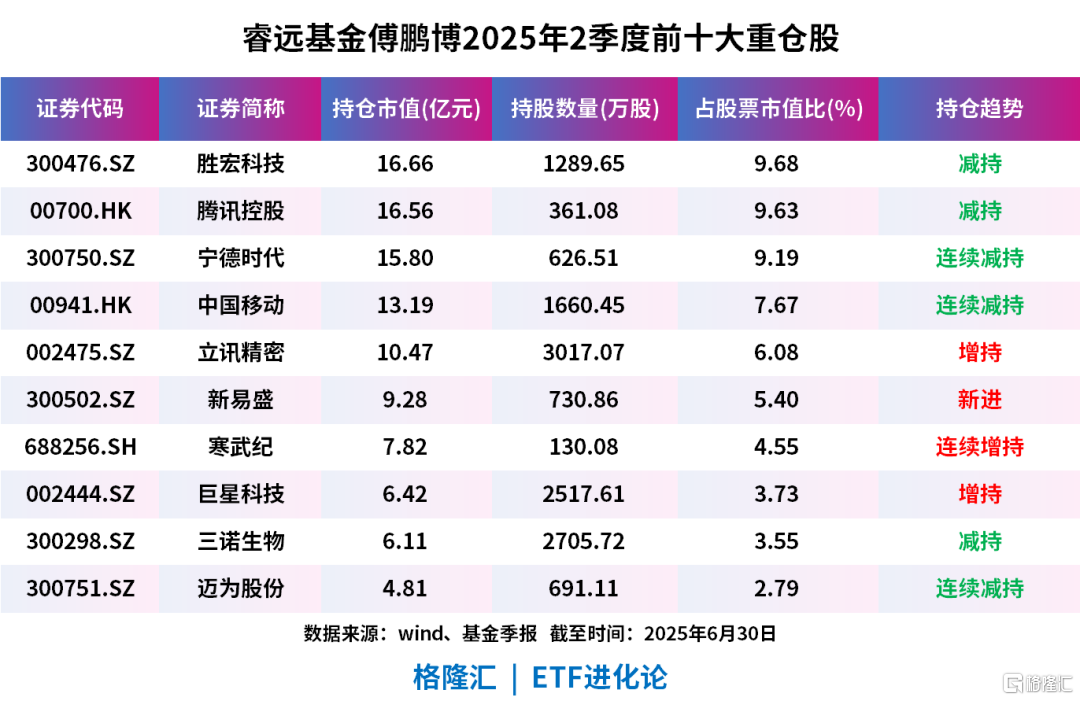
Group 1 - The core viewpoint of the news is the significant changes in the holdings of public funds, particularly focusing on the investment strategies of prominent fund managers like Fu Pengbo and Zhao Feng [1][7]. - Fu Pengbo's fund has increased its position in Xinyi Technology, which has seen a stock price increase of 1502.9% since the beginning of 2023, making it the second-highest in the market [2][3]. - The earnings forecast for Xinyi Technology for the first half of 2025 is projected to be between 3.7 billion to 4.2 billion yuan, representing a year-on-year growth of 327.7% to 385.5% [3]. Group 2 - Fu Pengbo's top ten holdings include Shenghong Technology, Tencent Holdings, CATL, China Mobile, Luxshare Precision, Xinyi Technology, Cambricon, Giant Star Technology, Sanofi, and Maiwei [3][5]. - In the second quarter, Fu Pengbo reduced his holdings in Shenghong Technology, Tencent Holdings, CATL, China Mobile, Sanofi, and Maiwei, while increasing his positions in Luxshare Precision, Cambricon, and Giant Star Technology [3][5]. - Zhao Feng's top ten holdings include Tencent Holdings, CATL, Xiaomi Group, Focus Media, Luxshare Precision, China Pacific Insurance, Weiming Environmental Protection, Hangzhou Bank, China Taiping, and Shenma Power [7][9]. Group 3 - The report indicates a shift in investment strategy, with a reduction in traditional energy companies and an increase in the healthcare sector, particularly in innovative drugs and traditional medicine benefiting from AI [7]. - The market outlook remains positive, driven by economic recovery and structural adjustments, with expectations for corporate profitability to gradually improve [10]. - High-dividend companies continue to attract investment due to their static dividend yields exceeding risk-free rates, indicating a strong demand for equity assets [10].



热点交替出现 股指走势偏强
Qi Huo Ri Bao· 2025-07-18 03:21
Group 1 - The semiconductor and domestic computing power sectors are benefiting from favorable conditions for IM and IC contracts, indicating a strong short-term trading opportunity [1][4] - The stock index has shown strong performance, with the Shanghai Composite Index reaching a high of 3555.22 points, supported by multiple factors, including the recent approval of the "Stablecoin Regulation" in Hong Kong [1][2] - The "anti-involution" sector is becoming active, with the central government's emphasis on promoting product quality and orderly competition, positively impacting various industries [2] Group 2 - The approval of the H20 chip sales to China by the U.S. is expected to alleviate previous supply restrictions, potentially leading to a recovery in the AI sector as demand increases [4] - The long-term outlook for the stock index remains optimistic, despite uncertainties surrounding U.S.-China tariffs, with expectations of improved market sentiment and potential fiscal policy support in the fall [3][4] - The stablecoin market is anticipated to grow, with the U.S. pushing for legislation that could enhance the dominance of the U.S. dollar, while the development of the RMB stablecoin is seen as inevitable, starting with trials in Hong Kong [2]
策略日报:百家争鸣-20250717
Tai Ping Yang Zheng Quan· 2025-07-17 14:42
Group 1: Macro Economic Overview - The report indicates that the 10-year government bond futures index is fluctuating around the half-year line, consistent with previous assessments, suggesting that the weak adjustment in the stock market and the sluggish fundamentals will support high-level fluctuations in the bond market until the stock market strengthens again [4][16]. - Positive developments in US-China trade negotiations, such as the lifting of restrictions on Nvidia chips and partial easing of rare earth exports, combined with expectations of inflation stabilizing due to anti-involution policies, suggest a trend where stocks rise and bonds fall [4][16]. Group 2: Stock Market Analysis - The A-share market has seen trading volumes return above 1.5 trillion, with various sectors like banking, AI, innovative pharmaceuticals, and military industry experiencing significant rallies, reflecting a "hundred schools of thought" phenomenon [5][20]. - The report maintains that the upward trend in the index is not over, with expectations that it will surpass the high point from October 8 of the previous year, and identifies 3420 points as a strong short-term support level for the index [5][20]. - Key observation points for potential trend reversals include oil price peaks, sustained trading volume, and the stability of the RMB exchange rate [5][20][21]. Group 3: Sector Performance - The report highlights three main sectors for investment: anti-involution policies leading to recovery in sectors like photovoltaics, live pigs, and glass; significant turning points in industries such as solid-state batteries and innovative pharmaceuticals; and high-dividend sectors, particularly coal, which benefits from anti-involution policies [21][22]. - The report notes that the military industry stocks are performing well, with companies like AVIC Shenfei reaching historical highs, and the innovative pharmaceutical sector seeing a nearly 3% increase [21][22]. Group 4: Foreign Exchange Market - The onshore RMB against the USD was reported at 7.1806, showing an increase of 15 basis points from the previous day, with the offshore RMB breaking its downward trend [6][31]. - The report anticipates that the RMB will perform better than most non-USD currencies due to favorable trade negotiation outcomes compared to Europe and Japan [6][31]. Group 5: Commodity Market Insights - The Wenhua Commodity Index has completed a bottom breakout, with a recommendation to adopt a buy-on-dips strategy, particularly in anti-involution related sectors [7][35]. - The report warns investors to be cautious of strong commodities like polysilicon due to potential short squeeze risks, while suggesting that geopolitical uncertainties may lead to continued volatility in oil and related products [7][35].
高股息热潮下的冷思考!从默默无闻到清盘终结,国联智选红利基金经历了什么?
Sou Hu Cai Jing· 2025-07-17 13:22
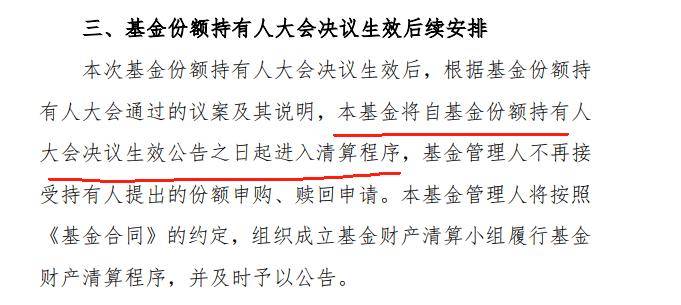
Core Viewpoint - The Guolian Smart Dividend Fund has announced its liquidation, surprising many as high-dividend funds are currently popular in the market [1][8]. Fund Performance and Comparison - The fund was established in March 2018, during a time when the market was not as enthusiastic about dividend strategies, leading to its underperformance compared to peers [3]. - Year-to-date performance shows a gain of 4.10%, while the average of similar funds is 9.12% [4]. - Over the past year, the fund has gained 11.74%, but this is significantly lower than the average of 21.19% for similar funds [4]. - The fund's total assets were only 0.11 billion yuan as of the end of Q1 this year, which is considered a critical threshold for public funds [7]. Fund Liquidation Process - From June 5 to July 8, Guolian Fund held a meeting with fund shareholders, which resulted in the approval of the fund contract termination [8]. - The liquidation process does not mean total loss for existing investors, as they will be redeemed at the net asset value at the time of liquidation [10]. Market Context and Implications - The current popularity of dividend-themed funds contrasts sharply with the fate of the Guolian Smart Dividend Fund, highlighting the importance of actual performance and effective marketing in the fund industry [9]. - The situation serves as a warning to investors that not all products with popular labels are worth investing in, emphasizing the need to consider the fund company's strength and historical performance [9].