
慢牛行情

Search documents
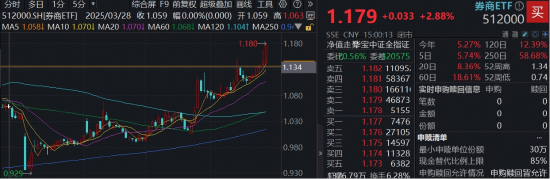
牛市看券商,主力爆买近百亿,东财再登顶!顶流券商ETF(512000)连涨6日,续探年内新高
Xin Lang Ji Jin· 2025-07-24 12:14
Core Viewpoint - The A-share market is experiencing a bullish trend, with the leading brokerage ETF (512000) showing significant gains, marking a six-day consecutive rise and reaching a new high for the year [1][2]. Group 1: Market Performance - The brokerage ETF (512000) opened strong, closing up 2.88% and achieving a six-day winning streak [1]. - The median increase among 49 brokerage stocks in the A-share market was 2.45%, with notable performers including Jinlong Co., which hit the daily limit, and Zhongyin Securities, which rose over 7% [2][3]. - The main funds have continuously flowed into the securities sector, with a net inflow of 9.721 billion CNY, marking the second consecutive day of leading industry inflows [3][4]. Group 2: Historical Context - Historical data shows that during the "924 rebound" last year, the brokerage ETF (512800) tracked the CSI All Share Securities Companies Index, which recorded a 60.81% increase, outperforming the Shanghai Composite Index and CSI 300 by over 30 percentage points [5][6]. - The CSI All Share Securities Companies Index has shown significant fluctuations over the past five years, with a notable increase of 27.26% in 2024 [6]. Group 3: Future Outlook - The current market is characterized as a "slow bull" trend, with investors shifting from trading strategies to holding strategies, indicating a potential for sustained growth in the brokerage sector [7]. - The brokerage ETF (512000) and its associated funds are designed to track the CSI All Share Securities Companies Index, providing exposure to 49 listed brokerage stocks, with a focus on top-tier brokerages while also considering smaller firms for their high growth potential [7].


A股又蹦迪!万亿成交藏玄机?内资跑路是假象,这才是真相
Sou Hu Cai Jing· 2025-07-23 13:50
Group 1 - The core viewpoint of the article highlights the current state of the A-share market, where despite a new high in indices, retail investors are experiencing anxiety and uncertainty, leading to a phenomenon where they fear selling at losses only to see the market rebound shortly after [1][3] - The article discusses the significant outflow of 40 billion from domestic institutions, which has caused panic among investors, but argues that this is not a sign of fleeing capital but rather a strategic repositioning of funds within different sectors [2][4] - It emphasizes that the current market dynamics reflect a "slow bull" trend rather than a "crazy bull," indicating that while there are fluctuations, the overall sentiment remains positive due to economic recovery and increased participation from retail investors [5][7] Group 2 - The article notes that the market is employing a "bumping-up strategy," where gaps in price are intentionally left unfilled to create a sense of urgency among investors, prompting them to buy at higher prices [4][6] - It points out that the trading volume has significantly increased, with estimates reaching 1.7 trillion, suggesting that new retail investors are entering the market, contrary to the belief that capital is fleeing [4][5] - The article provides practical advice for retail investors, recommending cautious positioning, avoiding chasing hot stocks, and maintaining a long-term perspective to navigate the current market volatility [8][9]

三个月涨超500点,沪指盘中突破3600点关口:“慢牛”行情能否持续?
经济观察报· 2025-07-23 13:04
Core Viewpoint - The Shanghai Composite Index has shown a "slow bull" trend, rising from approximately 3040 points to nearly 3600 points over the past three months, with an increase of over 500 points, leading to heightened investor expectations for a bull market [1][6]. Market Performance - On July 23, the Shanghai Composite Index broke through the 3600-point mark for the first time since October 8, 2024 [2]. - As of the market close, the Shanghai Composite Index rose by 0.01% to 3582.3 points, while the Shenzhen Component Index fell by 0.37% and the ChiNext Index remained unchanged. The total trading volume in A-shares was maintained at a high level, reaching 1.9 trillion yuan [3]. Sector Highlights - The "Yajiang Hydropower" concept has gained significant traction, with companies like China Power Construction, Poly United, Tibet Tianlu, and Xining Special Steel experiencing three consecutive trading limit increases. The Yarlung Tsangpo River downstream hydropower project, led by the newly established China Yajiang Group, has a total investment of approximately 1.2 trillion yuan, making it the largest infrastructure project globally [4]. Market Outlook - The potential for a sustained "slow bull" market is under scrutiny. Liu Jipeng, former dean of the School of Business at China University of Political Science and Law, noted that the market's recent rise could face significant adjustment risks as it approaches the 3600-3700 point range, which historically has led to prolonged consolidation phases [9]. - If the market can effectively break through the 3700-3800 point range, it may enter a sustained slow bull phase. However, if it fails to surpass 3700 points, it may be premature to declare the emergence of a bull market [10]. Investment Dynamics - Incremental capital has become a key signal for market uptrends. Central Huijin Investment Co., Ltd. has significantly increased its holdings in various ETFs, with a total investment exceeding 190 billion yuan [12]. - Foreign investment in RMB assets has remained stable, with foreign holdings of domestic RMB bonds exceeding 600 billion USD, indicating a positive trend in foreign investment in the domestic stock market [13]. Market Sentiment - The market has shown strong performance since June, with the Shanghai Composite Index reaching new highs for the year. The current environment is characterized by a balance between fundamental pressures and policy support, leading to increased market divergence [15].

三个月涨超500点,沪指盘中突破3600点关口:“慢牛”行情能否持续?
Jing Ji Guan Cha Wang· 2025-07-23 12:37
Group 1 - The Shanghai Composite Index broke through the 3600-point mark for the first time since October 8, 2024, closing at 3582.3 points with a slight increase of 0.01% [2] - The A-share market maintained high trading volume, reaching 1.9 trillion yuan, slightly down from the previous day's 1.93 trillion yuan [2] - The "Yaxiashuidian" concept stocks, related to the newly established China Yajiang Group and its major hydropower project, saw significant gains, with several stocks achieving three consecutive trading limit ups [2] Group 2 - The newly launched Yarlung Tsangpo River hydropower project has a total investment of approximately 1.2 trillion yuan, making it the largest infrastructure project globally, with a planned capacity of about 60 million kilowatts, 2.7 times that of the Three Gorges Project [2] - The construction period for the Yaxiashuidian project is estimated to be around 10 years, with an annual investment of approximately 120 billion yuan, expected to boost infrastructure investment by about 0.8% annually [2] - The project is projected to generate a GDP increment of approximately 2.04 trillion yuan over 10 years, averaging an annual increase of about 0.15% [2] Group 3 - The market has shown a "slow bull" trend, with the Shanghai Composite Index rising over 500 points from around 3040 points to nearly 3600 points in the past three months [3][4] - Investor sentiment is increasingly optimistic about the potential for a bull market, with discussions around the significance of the 3600-point level [3][4] - Analysts suggest that if the market can effectively break through the 3700 to 3800-point range, it may enter a sustained slow bull market [4] Group 4 - Incremental capital is identified as a key driver for market growth, with significant investments from Central Huijin Investment Co., which has increased its holdings in various ETFs by over 190 billion yuan [5] - The influx of foreign capital into RMB assets has been stable, with foreign holdings of domestic RMB bonds exceeding 600 billion USD, indicating a positive trend in foreign investment in the Chinese stock market [6] - The market is currently characterized by a structural opportunity driven by policy support and profit recovery, with institutional investors focusing on undervalued sectors such as banks and brokerages [7]

减持潮撞上3500点!A股慢牛格局生变?
Sou Hu Cai Jing· 2025-07-21 22:21
A股市场:慢牛行情下的结构性转变与潜在风险 A股市场近期在3500点附近震荡巩固,创业板指更是一举突破年内新高,深成指也距离年内高点仅一步之遥,即将突破11045.96点。然而,在指数突破的表 面平静下,多家上市公司股东减持公告密集发布,市场资金的流入与流出正进行着微妙的博弈。 这种看似矛盾的现象,实际上反映了A股市场正在经历一场 深刻的结构性转变。 减持潮:计划内、比例可控、合规先行 7月17日晚间,竞业达股东张爱军减持142.38万股,占总股本的0.62%,减持后持股比例降至7.76%。几乎同时,宝兰德软件股东易东兴及一致行动人赵艳兴 合计减持比例达0.64%,持股比例从12.56%降至11.92%。斯菱股份高管徐元英与监事李留勇的减持计划也顺利完成。 这些减持行为呈现三大显著特征:首先,均为计划内操作,例如竞业达股东的减持严格遵循了6月21日预披露计划,减持价格区间锁定在21-21.35元/股,仅 有极少量股票未交易;其次,减持比例均被严格控制在较低水平,最大不超过总股本的0.64%;最后,所有公司均强调减持行为严格遵守了《证券法》《上 市公司股东减持股份管理暂行办法》等相关法规,并重申减持不会影响公司 ...
A股趋势与风格定量观察:低波上涨环境下慢牛可期
CMS· 2025-07-20 11:23
Quantitative Models and Construction Methods 1. Model Name: Low Volatility Uptrend Environment Model - **Model Construction Idea**: The model categorizes market environments based on rolling 60-day annualized return and volatility percentiles, defining six distinct market states: low-volatility uptrend, medium-volatility uptrend, high-volatility uptrend, low-volatility downtrend, medium-volatility downtrend, and high-volatility downtrend[5][16] - **Model Construction Process**: 1. Calculate the rolling 60-day annualized return and volatility for the CSI 300 and CSI 800 total return indices since 2010[5][16] 2. Define return > 0 as an uptrend and return ≤ 0 as a downtrend[5][16] 3. Categorize volatility percentiles: - Low volatility: below the 20th percentile - Medium volatility: between the 20th and 80th percentiles - High volatility: above the 80th percentile[5][16] 4. Combine return and volatility categories to form six market states[5][16] - **Model Evaluation**: The low-volatility uptrend environment demonstrates superior performance in terms of future returns, win rates, and payoff ratios, indicating a higher probability of sustained "slow bull" markets[5][16] 2. Model Name: Short-Term Quantitative Timing Model - **Model Construction Idea**: The model integrates macroeconomic, valuation, sentiment, and liquidity signals to generate short-term market timing recommendations[18][19][20] - **Model Construction Process**: 1. **Macroeconomic Signals**: - Manufacturing PMI percentile (44.92%): Neutral signal - Long-term loan growth percentile (0.00%): Cautious signal - M1 growth percentile (94.92%): Optimistic signal[18][22] 2. **Valuation Signals**: - PE percentile (95.70%): Neutral signal - PB percentile (79.32%): Neutral signal[19][22] 3. **Sentiment Signals**: - Beta dispersion percentile (40.68%): Neutral signal - Volume sentiment score percentile (87.76%): Optimistic signal - Volatility percentile (0.58%): Optimistic signal[19][22] 4. **Liquidity Signals**: - Money market rate percentile (33.90%): Optimistic signal - Exchange rate expectation percentile (40.68%): Neutral signal - 5-day average net financing percentile (94.04%): Neutral signal[20][22] 5. Combine signals to derive overall timing recommendations[18][19][20] - **Model Evaluation**: The model has consistently outperformed its benchmark since 2012, with an annualized return of 16.81% and a maximum drawdown of 27.70%, demonstrating robust performance[20][24] 3. Model Name: Growth-Value Style Rotation Model - **Model Construction Idea**: The model evaluates macroeconomic, valuation, and sentiment factors to recommend overweighting growth or value styles[29] - **Model Construction Process**: 1. **Macroeconomic Signals**: - Profit cycle slope (4.17): Favorable for growth - Interest rate cycle level (9.17): Favorable for value - Credit cycle change (-3.33): Favorable for value[31] 2. **Valuation Signals**: - PE spread percentile (16.36%): Favorable for growth - PB spread percentile (36.82%): Favorable for growth[31] 3. **Sentiment Signals**: - Turnover spread percentile (29.45%): Favorable for value - Volatility spread percentile (17.44%): Favorable for balance[31] 4. Combine signals to derive style rotation recommendations[29][31] - **Model Evaluation**: The strategy has delivered an annualized return of 11.71% since 2012, outperforming the benchmark by 4.80% annually[30][33] 4. Model Name: Small-Cap vs. Large-Cap Style Rotation Model - **Model Construction Idea**: The model evaluates macroeconomic, valuation, and sentiment factors to recommend overweighting small-cap or large-cap styles[34] - **Model Construction Process**: 1. **Macroeconomic Signals**: - Profit cycle slope (4.17): Favorable for small-cap - Interest rate cycle level (9.17): Favorable for large-cap - Credit cycle change (-3.33): Favorable for large-cap[36] 2. **Valuation Signals**: - PE spread percentile (78.86%): Favorable for large-cap - PB spread percentile (96.59%): Favorable for large-cap[36] 3. **Sentiment Signals**: - Turnover spread percentile (72.56%): Favorable for small-cap - Volatility spread percentile (62.60%): Favorable for large-cap[36] 4. Combine signals to derive style rotation recommendations[34][36] - **Model Evaluation**: The strategy has delivered an annualized return of 12.38% since 2012, outperforming the benchmark by 5.31% annually[35][38] 5. Model Name: Four-Dimensional Style Rotation Model - **Model Construction Idea**: Combines growth-value and small-cap-large-cap rotation models to recommend allocations across four styles: small-cap growth, small-cap value, large-cap growth, and large-cap value[39] - **Model Construction Process**: 1. Integrate signals from the growth-value and small-cap-large-cap models 2. Recommend allocations based on combined signals: - Small-cap growth: 12.5% - Small-cap value: 37.5% - Large-cap growth: 12.5% - Large-cap value: 37.5%[39][40] - **Model Evaluation**: The strategy has delivered an annualized return of 13.29% since 2012, outperforming the benchmark by 5.82% annually[39][40] --- Model Backtest Results 1. Low Volatility Uptrend Environment Model - **Annualized Return**: 18.23% (CSI 300), 10.13% (CSI 800) - **Win Rate**: 63.65% (CSI 300), 55.42% (CSI 800) - **Payoff Ratio**: 1.77 (CSI 300), 1.48 (CSI 800)[5][16][17] 2. Short-Term Quantitative Timing Model - **Annualized Return**: 16.81% - **Annualized Volatility**: 14.55% - **Maximum Drawdown**: 27.70% - **Sharpe Ratio**: 1.0033 - **Monthly Win Rate**: 69.74% - **Quarterly Win Rate**: 69.23%[20][24] 3. Growth-Value Style Rotation Model - **Annualized Return**: 11.71% - **Annualized Volatility**: 20.81% - **Maximum Drawdown**: 43.07% - **Sharpe Ratio**: 0.5409 - **Monthly Win Rate**: 58.28% - **Quarterly Win Rate**: 60.78%[30][33] 4. Small-Cap vs. Large-Cap Style Rotation Model - **Annualized Return**: 12.38% - **Annualized Volatility**: 22.69% - **Maximum Drawdown**: 50.65% - **Sharpe Ratio**: 0.5408 - **Monthly Win Rate**: 60.93% - **Quarterly Win Rate**: 58.82%[35][38] 5. Four-Dimensional Style Rotation Model - **Annualized Return**: 13.29% - **Annualized Volatility**: 21.55% - **Maximum Drawdown**: 47.91% - **Sharpe Ratio**: 0.5951 - **Monthly Win Rate**: 59.60% - **Quarterly Win Rate**: 62.75%[39][40]
A股已连涨四周 创业板指“偷偷”领跑 “慢牛”剧本接下来怎么写?
Mei Ri Jing Ji Xin Wen· 2025-07-20 04:09
Market Overview - The A-share market has shown a "slow bull" trend with four consecutive weeks of gains, with over 3,100 stocks rising during the last week [2] - The Shanghai Composite Index is approaching its second-highest level since the "9.24" market rally last year, with approximately 140 points left to reach the next target [3] Index Performance - Various indices have made progress in recovering from previous declines, with the CSI 2000 and Northbound 50 indices having already rebounded, while others like the STAR 50 and CSI 1000 have not yet done so [4][5] - The performance of small-cap stocks, represented by the CSI 2000 index, has been strong, but recent weeks have seen the ChiNext index outperforming it [7] Sector Performance - The top-performing sectors include telecommunications, with a 7.56% increase, and automotive, with a 3.28% increase, while sectors like media and coal have shown declines [9] - The market is experiencing rapid rotation among leading sectors, with banks showing signs of adjustment after previously supporting the index [9] Market Sentiment and Predictions - Analysts suggest that the market is shifting towards a trend of gradual increases rather than short-term speculative trading, favoring stocks with solid industrial logic [10] - Institutional perspectives indicate a continued mild upward trend in the market, with expectations for indices to break above last year's highs [12][13] Earnings Forecasts - As of July 18, 1,542 A-share companies have disclosed their mid-year earnings forecasts, with industries like construction materials and non-bank financials showing strong growth potential [19] - Notable stocks with expected strong performance include companies like Pengding Holdings and Shanghai Pharmaceuticals [19] Upcoming Events - Key upcoming events include the release of the July LPR and the publication of important economic reports, which may influence market dynamics [21][22][23]

沪指再创年内新高!盘中这一重要变化 你发现了吗?
Mei Ri Jing Ji Xin Wen· 2025-07-18 07:59
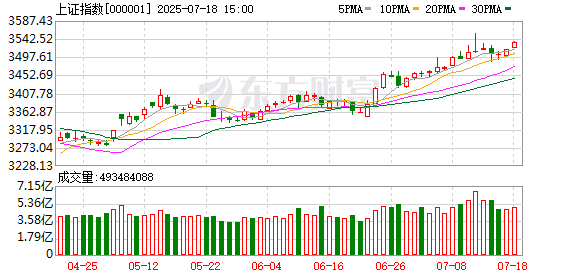
Market Overview - The market experienced fluctuations on July 18, with the Shanghai Composite Index reaching a new closing high for the year, while the ChiNext Index hit a new high before retreating. The Shanghai Composite Index rose by 0.5%, the Shenzhen Component Index increased by 0.37%, and the ChiNext Index gained 0.34% [2] - The trading volume in the Shanghai and Shenzhen markets was 1.57 trillion yuan, an increase of 31.7 billion yuan compared to the previous trading day [2] Sector Performance - Sectors such as rare earth permanent magnets, lithium mining, non-ferrous metals, and coal saw significant gains, while sectors like gaming, photovoltaics, CPO, and consumer electronics experienced declines [2] - The banking sector, which had declined for three consecutive days, stabilized and rebounded, contributing to the overall market performance [5] Investment Trends - Institutional funds showed consistent large-scale buying, while funds from major players, retail investors, and others exhibited noticeable outflows, with a slight return of funds at the end of the trading day [8] - The report from Xiangcai Securities suggests that the market will maintain a "slow bull" trend, with long-term funds focusing on dividend-related sectors such as banking and insurance [13] Rare Earth Sector Insights - The rare earth permanent magnet sector experienced notable activity, driven by three main positive factors: 1. The National Security Department's announcement to cut illegal export channels for rare earth-related items, enhancing resource and national security [17] 2. The discovery of a new rare earth mineral named "Ned Yellow River" in Inner Mongolia [18] 3. The increasing demand for rare earths in humanoid robots, which is a significant application area [19] - Companies in the rare earth sector, such as Huahong Technology and Northern Rare Earth, reported substantial profit increases, with Northern Rare Earth expecting a net profit growth of 1883% to 2015% year-on-year for the first half of the year [19]

2025.07月中旬市场点评:当下行情依然属于“慢牛”范畴
Xiangcai Securities· 2025-07-17 09:36
Group 1 - The current market is characterized as a "slow bull" phase, with the Shanghai Composite Index fluctuating around 3500 points, indicating a lack of potential for a "crazy bull" market [1][2][8] - The market is in the sixth cycle since 2005, showing a disconnection between the Shanghai Composite Index and macroeconomic short cycles, reflecting a weak macroeconomic backdrop [10][20] - The management is actively working to prevent a repeat of the brief "crazy bull" markets seen in 2006-2007 and 2014-2015, which could lead to prolonged bear markets [10][20] Group 2 - The outlook for 2025 suggests a prolonged "slow bull" market, with a focus on time over height, influenced by long-term capital inflows, particularly in dividend-related sectors like banking and insurance [4][20] - The investment logic for upstream industries is challenging due to weak PPI, while downstream industries are expected to perform better, aligning with domestic consumption policies [4][20] - The consumer sector may face significant differentiation, with new consumption segments likely to attract more capital, depending on the strength of policy support [20][21] Group 3 - The 2025 market is expected to operate under a combination of the new "National Nine Articles" and a "four trillion" investment trend, with a high probability of a "slow bull" market [21] - Key areas of focus for 2025 include technology, green initiatives, consumption, and infrastructure, as highlighted in the government work report [21] - The market is anticipated to experience slight upward fluctuations in July, supported by long-term capital inflows, particularly in dividend sectors [21]
廖市无双:轻舟已过3500,后市可为空间几何?
2025-07-14 00:36
廖市无双:轻舟已过 3500,后市可为空间几何? 20250613 摘要 市场短期阻力与长期潜力:上证指数在 3,555 点附近面临技术阻力,但 多头均线排列和强劲的市场情绪预示着未来仍有上行潜力,或在四季度 前挑战 3,674 点。 筹码结构分析:天朗 50 筹码结构显示,筹码密集区位于 3,350 点附近, 当前点位偏离平均成本,短期存在调整压力,但密集筹码支撑市场迅速 反弹。 板块轮动与风格变化:金融与科技板块齐飞,顺周期板块如房地产和基 建开始走强。金融和成长风格表现突出,消费和稳定风格出现触底迹象, 主题投资成为超额收益的关键。 银行板块投资逻辑:银行板块受益于资产荒和稳定资金流入,周期性上 涨仍有空间,建议逢低配置,但需警惕估值过高或快速上涨的情况。 券商板块投资策略:券商板块反弹显著,但部分个股仍有上涨空间。建 议进行高低切换,将涨幅较大的换成前期涨幅较小的券商股票,优化投 资组合。 Q&A 当前市场走势如何,未来可能会出现哪些变化? 自 6 月 24 日市场选择向上以来,至 7 月 11 日市场表现强劲。我们在 6 月 24 日翻多,并预测市场短期内会上涨。实际情况显示,市场在 7 月 11 ...