财政政策

Search documents
11月份新增专项债券发行环比高增
Zheng Quan Ri Bao· 2025-11-30 16:27
Core Viewpoint - The issuance of new special bonds by local governments has surged significantly in November, providing strong financial support for project construction and contributing to economic growth [1][2]. Group 1: Bond Issuance Trends - As of November 30, the issuance of new special bonds reached approximately 492.19 billion yuan in November, a 71% increase from October's 287.36 billion yuan [1]. - The overall pace of special bond issuance has accelerated throughout the year, with 9.60 billion yuan issued in Q1, 120.04 billion yuan in Q2, and 151.66 billion yuan in Q3, completing 83.6% of the annual target of 4.4 trillion yuan [1]. Group 2: Characteristics of Bond Issuance - The issuance and allocation of special bonds this year exhibit three main characteristics: expanded scale, optimized rhythm, and innovative allocation, reflecting a more proactive fiscal policy [2]. - The acceleration and expansion of special bond issuance send positive signals to the market, enhancing confidence in economic development and stabilizing market expectations [2]. Group 3: Allocation of Special Bonds - Special bonds continue to be directed towards traditional infrastructure projects, such as municipal and industrial park infrastructure and transportation, which are crucial for improving the infrastructure system and public service levels [2]. - There has been a notable increase in the issuance of land reserve special bonds, totaling approximately 503 billion yuan, which helps alleviate local government debt pressure and stabilize the real estate market [3]. - The allocation of special bonds has also shifted towards government investment funds, increasing support for technological innovation and future industries, indicating a structural change in the use of special bonds [3].
2025年市场回顾与2026年展望:宏观继续稳增长,利率延续震荡市
Ge Lin Qi Huo· 2025-11-30 02:24
宏观与金融衍生品分册 中国期货衍生品市场年报 宏观继续稳增长,利率延续震荡市 ——2025 年市场回顾与 2026 年展望 格林大华期货研究院 刘 洋 交易咨询资格:Z0016580 摘要 1 证监许可【2011】1288 号 2025 年国债期货主力品种在 1 月和 2 月初创出高点,然后连续下跌至 3 月中旬止跌反 弹。4 月上旬,因美方宣布加征对等关税消息国债期货上涨,随后横向震荡。7、8 月 A 股强势连续上涨,推动资本市场风险偏好上升,国债期货合约价格整体回落。9 月 国债期货主力合约中短期品种宽幅震荡,超长期 30 年期国债期货主力合约继续较大 幅度下跌。国庆节后,A 股股指在高位震荡缓步回落,国债期货反弹。央行行长 10 月 27 日在金融街论坛年会上宣布,将恢复公开市场国债买卖操作,助力国债期货反弹, 进入 11 月国债期货有所回落。 2025 年前三季度中国 GDP 累计同比增长 5.2%,预期全年增长大概率可以实现全年目标 5%。5 月央行宣布,下调金融机构存款准备金率 0.5 个百分点,同时将公开市场 7 天 逆回购利率调降 10 个基点,降至 1.4%,全年货币政策总体保持流动性宽松。 ...
2026年财政政策展望:“开门红”下的积极续力
Guoxin Securities· 2025-11-28 14:57
证券研究报告 | 2025年11月28日 2026年财政政策展望 ——"开门红"下的积极续力 经济研究 · 宏观专题 0755-81982035 S0980524090003 S0980525110002 证券分析师:田地 证券分析师:王奕群 tiandi2@guosen.com.cn wangyiqun1@guosen.com.cn 请务必阅读正文之后的免责声明及其项下所有内容 请务必阅读正文之后的免责声明及其项下所有内容 收入端:税收收入逆势回暖 今年财政运行特征:前高后低 图:税收回暖,非税下滑 图:印花税表现较好,四大主要税种都在正增长 资料来源:Wind、国信证券经济研究所整理 资料来源:Wind、国信证券经济研究所整理 请务必阅读正文之后的免责声明及其项下所有内容 • 目前财政收入处于回升通道,1-10月增速0.8%,高于预算(0.1%)。 • 税收收入持续回暖,与经济数据有所分化。税收收入的增速今年整体呈现波动回升的趋势,到10月累计同比来到1.7%。 其中个人所得税11.5%,增值税4.0%,消费税2.4%,企业所得税1.9%。 • 非税收入持续下行。一是激励,去年基数较高,主要是缺口较大,地 ...
高市早苗执政联盟众议院获微弱多数,确保追加预算与财政对策推进
Zhi Tong Cai Jing· 2025-11-28 09:13
Group 1 - The ruling coalition led by Prime Minister Sanna Takashi has increased its seats in the House of Representatives from 230 to 233, ensuring a slim majority ahead of two key budget votes [1][2] - The coalition, formed by the Liberal Democratic Party (LDP) and the Japan Innovation Party, now holds a total of 233 out of 465 seats in the House of Representatives, which is crucial for legislative stability [1][2] - This development is expected to facilitate the passage of the supplementary budget announced on Friday and the annual budget scheduled for December [2] Group 2 - The Japanese government has finalized a comprehensive economic strategy with a total scale of approximately 21.3 trillion yen (about 965.6 billion yuan), primarily funded by the supplementary budget for fiscal year 2025 [2] - The supplementary budget is projected to have general account expenditures of about 18.3 trillion yen, with over 11 trillion yen in new government bonds issued to raise funds [2] - Despite efforts to control borrowing, the new debt issuance is significantly higher than the 6.7 trillion yen required under the previous administration's economic plan, marking a 75% increase [2] Group 3 - Concerns about Japan's long-term fiscal situation under Prime Minister Takashi continue to unsettle investors, with long-term government bond yields reaching over 20-year highs and the yen remaining weak [3] - As of the latest report, the USD/JPY exchange rate is at 156.362, with the 20-year government bond yield at 2.83% and the 30-year yield at 3.347% [3] - To stabilize market sentiment, Prime Minister Takashi indicated that the total amount of government bonds issued this fiscal year will be lower than the previous year, with a total issuance of 40.3 trillion yen projected for fiscal year 2025, a reduction of about 4.3% from the previous year [3]
2026年度展望:财政政策&货币政策
2025-11-28 01:42
Summary of Key Points from Conference Call Records Industry Overview - The records primarily discuss the fiscal and monetary policies in China for the year 2026, focusing on the implications for the economy and financial markets. Core Insights and Arguments 1. **Fiscal Policy Outlook for 2026** - Fiscal policy is expected to remain proactive, with a projected growth rate of approximately 1.9% in broad fiscal expenditure, despite a slight decline due to high base effects. Actual physical broad fiscal expenditure is anticipated to increase by over 1 trillion [1][4][3] 2. **Deficit and GDP Growth** - The narrow deficit rate is projected to remain around 4%, with nominal GDP growth needing to reach 4.9% to maintain this rate. The actual nominal GDP growth for the first three quarters of 2025 was about 4.1%, indicating potential discrepancies [3][4] 3. **Monetary Policy Goals** - The monetary policy for 2026 will focus on stabilizing growth, promoting inflation, and preventing risks. Expected actions include 1-2 interest rate cuts and reserve requirement ratio reductions [8][9][11] 4. **Banking Sector Challenges** - The net interest margin for banks has been under pressure, recorded at approximately 1.42% as of Q3 2025. Future stability in this margin is crucial for effective monetary policy transmission [15][17] 5. **Government Debt Management** - The management of local government debt is critical, with a focus on stabilizing the macro tax burden to ensure repayment capabilities. The macro tax burden is expected to slightly decline to 12.7% in 2026 [6][7] 6. **Investment Strategies** - Local government industrial guidance funds are shifting investment strategies from tax reductions to equity support, promoting a transition from land finance to equity finance [5][6] 7. **Yield Curve and Credit Premium** - A steep yield curve and positive credit premium are necessary to stabilize market expectations and enhance economic growth confidence. The 10-year government bond yield is expected to range between 1.7% and 2.0% in 2026 [2][19] 8. **Inflation and Economic Risks** - Key macroeconomic risks include inflation, liquidity flow, and regulatory policy changes. The CPI is projected to grow by 0.5% in 2025, with PPI showing a range of -0.5% to 1.0% [20] Other Important Insights 1. **Unified Market Construction** - The establishment of a unified market is essential for addressing issues related to chaotic local investment and overcapacity, which have been exacerbated by declining macro tax burdens [6] 2. **Liquidity Management** - The central bank has implemented various liquidity management tools, including open market operations, to ensure stable liquidity supply [10][11] 3. **Interest Rate Corridor Adjustments** - Changes in the interest rate corridor mechanism have been noted, with a focus on enhancing the central bank's policy rate influence [12][13] 4. **Loan and Bond Yield Relationship** - The average after-tax return on loans is currently aligned with the 10-year government bond yield, indicating limited room for further rate cuts without disrupting this balance [14] 5. **Future of Monetary Policy** - The monetary policy stance is expected to remain supportive, with potential adjustments to the 7-day reverse repurchase rate to facilitate further interest rate cuts [11][18] This summary encapsulates the critical aspects of the fiscal and monetary policy outlook for 2026, highlighting the anticipated challenges and strategies within the Chinese economy.
2026 年外汇展望报告:看空美元,看多贝塔资产-FX 2026 Outlook Presentation_ Bearish Dollar, Bullish Beta. Tue Nov 25 2025
2025-11-27 05:43
Summary of Key Points from the Conference Call Industry Overview - The conference call focuses on the **Global FX (Foreign Exchange) Market** outlook for 2026, emphasizing a **bearish dollar** and a **bullish beta** environment. Core Insights and Arguments 1. **Bearish Dollar Outlook**: The dollar is expected to have a bearish bias in the first half of 2026 due to factors such as Federal Reserve asymmetries, twin deficits, and a global recovery, although its weakness may be constrained by US economic resilience [6][8][17]. 2. **Currency Predictions**: Key currency forecasts include EUR/USD at 1.20, USD/JPY at 164, and USD/CNY at 7.05 [6][8]. 3. **Global Economic Recovery**: The macroeconomic landscape in 2026 is characterized by procyclicality, synchronized central bank inactivity, and a focus on fiscal policy and AI adoption impacts [6][8][36]. 4. **High Beta/Yielding Currencies**: Preference is given to high beta and yielding currencies, with expectations that DM (Developed Markets) high-yielders like NOK and AUD will benefit from growth pick-up [6][8][36]. 5. **FX Carry Trades**: FX carry trades are anticipated to perform well amid low volatility and central bank inactivity, with a focus on carry-efficient hedges for risk markets [6][8][36]. 6. **US Policy Risks**: US policy remains a significant source of FX risk, with a shift in focus from tariffs to fiscal policy and the Fed's framework [6][8][64]. 7. **AI Impact**: The adoption of AI is expected to influence FX markets, with carry trades linked to AI commodity exporters like AUD and CLP [6][8][52]. 8. **Fiscal Differentiation**: Fiscal differentiation is highlighted as a critical factor, with CHF showing the best fiscal metrics among reserve currencies [49][132]. Additional Important Insights 1. **Historical Context**: The dollar's performance has historically correlated with net foreign direct investment (FDI) rather than net equity inflows, indicating a complex relationship between currency strength and investment flows [54][90]. 2. **Market Sentiment**: FX volatility is expected to remain subdued, but historical patterns suggest limited further downside from current low levels [44][46]. 3. **Trade Recommendations**: Specific trade recommendations include maintaining USD shorts, buying AUD/USD, and various options strategies involving EUR/GBP and NOK/JPY [9][8][17]. 4. **Growth Forecasts**: The growth forecasts for 2026 are skewed to the upside, driven by the lagged effects of prior global monetary easing and easier financial conditions [18][19]. 5. **Structural Issues**: The US faces unresolved macro issues, such as the divergence between resilient GDP growth and a softening labor market [30][32]. This summary encapsulates the key points discussed in the conference call, providing a comprehensive overview of the anticipated trends and risks in the FX market for 2026.

高盛闭门会-脉动中国-2026政策预期
Goldman Sachs· 2025-11-26 14:15
Investment Rating - The report maintains a GDP growth forecast of 5% for the year and 4.5% for Q4 2025, indicating a stable outlook for the industry [5][8]. Core Insights - China's fiscal spending growth is below expectations, primarily due to strong export growth, which allows for a 5% annual growth target to be achievable. This has led to a tightening of fiscal policy in October, but some policy space is reserved for 2026 to ensure a strong start [5][8]. - The focus of China's economic policy for the coming year will be on stabilizing domestic demand, supporting high-tech manufacturing, and stabilizing the real estate market, with key discussions expected in upcoming political meetings [8][12]. - The labor market shows slight improvement but remains at historical lows, limiting consumer recovery. Consumer confidence has improved slightly, influenced by the stock market, but overall consumer spending remains weak [9][10]. Summary by Sections Fiscal Policy - In October, fiscal spending growth was lower than market expectations, leading to an unexpected tightening of broad fiscal indicators. However, the report maintains a GDP growth forecast of 5% for the year [5][6]. Consumer Market - October retail sales data showed accelerated growth in categories like cosmetics and jewelry due to the Double Eleven shopping festival, but this is expected to decline in November. Sales of home appliances and automobiles, supported by trade-in subsidies, have lagged behind other categories, indicating that price promotions and temporary subsidies cannot sustain durable goods consumption [6][7]. Labor Market and Consumer Confidence - The labor market remains weak, with historical low employment levels limiting consumer recovery. Consumer confidence showed slight improvement, potentially due to stock market performance, but overall consumer spending is still weak [9][10]. Fixed Asset Investment (FAI) - FAI growth has significantly slowed, dropping to approximately -11% in October. The decline in real estate investment, along with reductions in infrastructure and manufacturing investments, has contributed to this downturn. The report suggests that only 40% of the decline can be attributed to known factors, with the remaining 60% possibly due to statistical adjustments [13][14]. Policy Recommendations - To stimulate household consumption, the report suggests measures such as creating job opportunities, increasing minimum wage standards, and enhancing service consumption supply. Specific policies include subsidies for the service industry and labor-intensive sectors, as well as relaxing restrictions on high-end consumption [12][16]. Investment Opportunities - The report identifies 35 policy-supported industries that account for approximately 60% of the total market capitalization of listed companies. These industries are expected to provide better investment returns based on the analysis of the Fifteenth Five-Year Plan [15][16].
2026年度展望:中国宏观
2025-11-26 14:15
Summary of Conference Call Notes Industry Overview - **Macro Economic Outlook for China**: The actual GDP growth target for 2026 is expected to be around 5%, reflecting government confidence and policy strength. Over the next decade, GDP growth must not be lower than 3.5% to reach the level of moderately developed countries [1][4] - **Fiscal Policy**: The fiscal policy is expected to remain expansionary, with a fiscal deficit rate maintained at around 4%. Special government bonds may increase to 2 trillion, and special bonds could reach 4.6 trillion [1][5][6] - **Investment and Consumption**: Investment is anticipated to achieve positive growth in 2026, while export growth is expected to remain strong but slightly decrease to 3.5%-4%. Consumption is influenced by subsidy uncertainties and needs further analysis [1][7] Key Points - **New Economy Contribution**: The new economy's share of GDP has risen to approximately 18%, with high-tech investment accounting for 12% of total investment. The new economy has surpassed the traditional economy in scale, significantly driving economic growth [1][12] - **Impact of Artificial Intelligence**: AI significantly affects energy demand, with data centers' electricity consumption continuously increasing, driving demand for energy storage and raw materials like copper, aluminum, silicon, and rare earths [1][13] - **Consumer Market Performance**: In 2025, consumer growth reached its best level in 20 years, but sales of subsidized goods have declined. Internal consumption momentum is rising, with significant contributions from daily necessities, services, and cultural education products [1][14] Additional Insights - **Real Estate Market Trends**: Although the real estate market is still experiencing negative growth, the rate of decline is slowing, indicating stabilization. Policy support is crucial, and adjustments to mortgage rates are necessary to stabilize housing demand [2][21][23] - **Price Trends**: CPI is expected to return to around 0.5% in 2026, while PPI may also recover but is projected to remain negative. This indicates potential improvements in industrial profit margins and boosts confidence in listed companies' earnings [2][24][26] - **Future of Capital Markets**: The outlook for the capital market is optimistic, with expectations that the technology sector will continue to lead. The market performance will be influenced more by industry highlights and mid-level performance rather than macroeconomic fluctuations [1][29]
华泰证券今日早参-20251126
HTSC· 2025-11-26 01:47
Group 1: Fiscal Policy Outlook - The fiscal policy in 2025 has shown significant expansion without improving fixed asset investment growth, which declined by 1.7% from January to October due to resources being allocated to debt repayment and other non-immediate projects [2] - For 2026, a more proactive fiscal policy is anticipated, with a projected fiscal deficit rate of around 4% and an increase in special bond issuance to approximately 5 trillion [2] Group 2: Aerospace and Defense Industry - The military's "14th Five-Year Plan" aims for modernization and includes a new structure of "4 military branches + 4 combat arms," focusing on mechanization, information technology, and intelligence [4] - In 2024, the revenue of 119 listed defense companies reached 419.43 billion, a 25.24% increase from 2020, with a compound annual growth rate of 5.79% [4] - By Q3 2025, these companies reported a total revenue of 280.18 billion, reflecting a year-on-year growth of 3.23% [4] Group 3: Internet Industry - NetEase - NetEase's game "Yanyun" launched overseas on November 15 and quickly reached the top 4 on Steam's bestseller list, with expected revenue contributions of 2 to 3 billion in 2026 [5] - The game "Dream of Fantasy" is projected to generate an additional 4 to 6 billion in revenue in 2025, indicating strong market performance [5] - Current valuations for NetEase remain low, with expectations for revenue and profit growth in the second half of the year [5] Group 4: Financial Services - Lexin - Lexin reported a net profit of 510 million in Q3 2025, a year-on-year increase of 68% [6] - The net profit take rate improved to 2.0%, attributed to reduced marketing expenses following a decrease in loan issuance [6] - The company is facing potential challenges in Q4 2025 due to tightening liquidity in the lending market, which may impact loan quality and profitability [6][7]
华泰证券:预计明年会尽量靠前形成实物工作量
Sou Hu Cai Jing· 2025-11-26 00:32
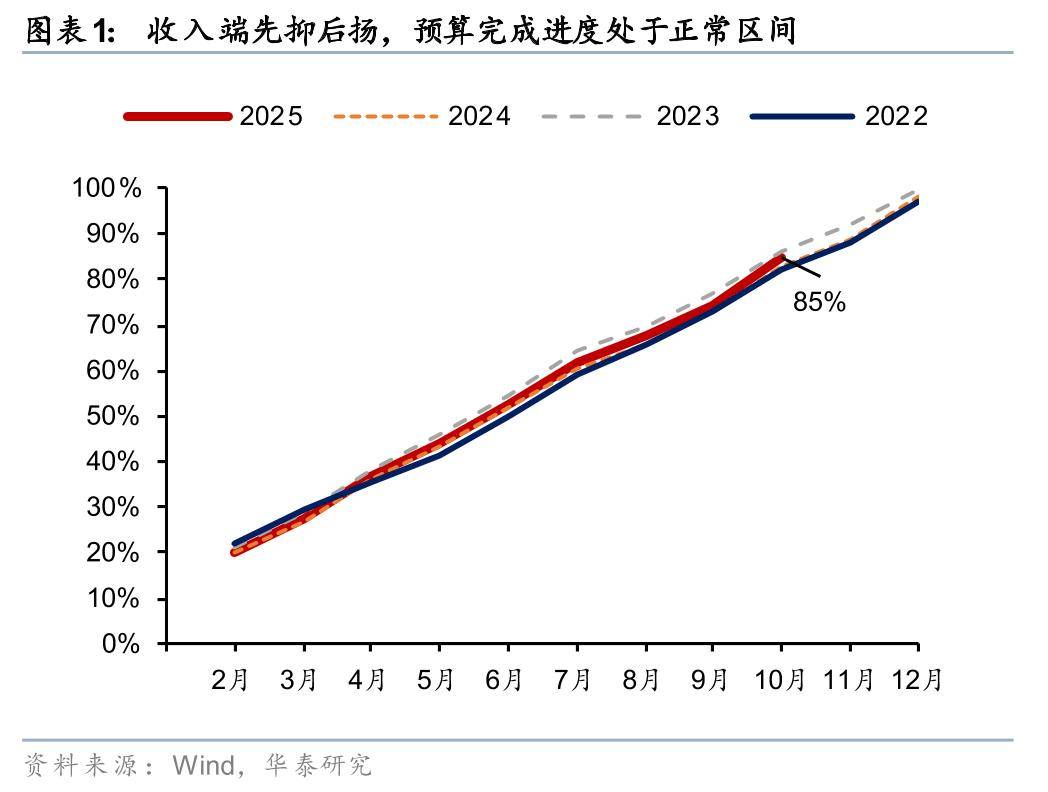
Core Viewpoint - The fiscal policy review for 2025 highlights a balance between stabilizing growth and preventing risks, with significant fiscal expansion not leading to improved fixed asset investment growth [2][3][32]. Group 1: Fiscal Policy Review for 2025 - The budget revenue showed a weak recovery, with a cumulative year-on-year growth turning positive in the first ten months, reaching 85% of the budget execution [5][9]. - Government fund revenue was negatively impacted by declining land transfer income, with a progress rate of 55% in the first ten months [9][12]. - The expenditure side saw a strong increase, with government fund expenditure growth reaching 220% for central government funds, while local expenditure grew by only 7.3% [9][12]. Group 2: Debt Management and Special Bonds - The "6+4+2" debt management plan for 2024 accelerated the debt resolution process, with a total of 3.88 trillion yuan allocated for debt resolution and clearing corporate arrears, exceeding initial expectations [16][20]. - The issuance of special bonds reached 4.4 trillion yuan by mid-November, with a significant portion allocated for debt resolution and land reserve projects, leading to a partial crowding-out effect on infrastructure projects [12][22]. Group 3: Outlook for 2026 - The fiscal policy for 2026 is expected to be more proactive, with a projected deficit rate maintained at around 4%, signaling the necessity of fiscal expansion [3][35]. - New special bond quotas may be increased to approximately 5 trillion yuan to support infrastructure projects, particularly in the context of the "15th Five-Year Plan" [3][35]. - The fiscal revenue is anticipated to remain under pressure due to declining land transfer income, which has historically accounted for 70%-80% of government fund revenue [38][39]. Group 4: Expenditure and Economic Growth - The relationship between GDP growth and fiscal expenditure is expected to persist, with government leveraging fiscal expansion to support economic growth amid weak expectations from residents and enterprises [40][45]. - Central government spending is likely to focus on major projects, with local governments continuing to rely heavily on central transfers due to limited self-financing capabilities [45][46].