
量化投资

Search documents
又一量化私募完成登记!年内这一策略表现抢眼
券商中国· 2025-11-16 07:16
Group 1 - The establishment of Shenzhen Junxing Private Securities Fund Management Co., Ltd. was completed, with a registered capital of 10 million yuan and 7 full-time employees [1] - Wang Pei, the legal representative and general manager, holds 60% of the shares and has a background as a fund manager at previous firms [1] - In 2023, Wang Pei was involved in a labor dispute with his former employer, which led to arbitration [1] Group 2 - As of October 31, 2025, 91.33% of the 10,969 private funds achieved positive returns, with an average return rate of 24.32% [2] - Stock strategies led the performance with an average return of 29.52%, and 92.73% of products in this category were profitable [2] - Quantitative long strategies outperformed with an average return of 36.76% and a 96.52% positive return rate [2] Group 3 - Combination funds showed strong profitability stability, with 96.85% of products yielding positive returns [3] - Bond strategies maintained a conservative approach, achieving an average return of 8.77% but with a 90.09% positive return rate [3] Group 4 - Commodity market volatility posed challenges for futures and derivatives strategies, which had an average return of 13.02% and a positive return rate of 82.43% [4]


量化多头私募公司榜出炉!鸣石、平方和、蒙玺位居前3!
私募排排网· 2025-11-16 03:04
Core Viewpoint - The A-share market has shown a strong upward trend in 2023, with significant internal style differentiation, particularly between small and large-cap stocks, leading to varying performances among quantitative long strategies [2][3]. Group 1: Market Performance - As of the end of October 2023, the Shanghai Composite Index, Shenzhen Component Index, and ChiNext Index have increased by approximately 17.99%, 28.46%, and 48.84% respectively [2]. - In the first half of the year, small-cap stocks outperformed large-cap stocks, but a style switch occurred in late August, with the CSI 300 Index outperforming small-cap stocks in August and September [2]. Group 2: Quantitative Long Strategy Performance - Quantitative long strategy products faced negative excess returns in the months of August and September, marking the worst monthly performance of the year [2]. - However, since October, the excess returns of quantitative long strategies have begun to recover as institutional investors loosened their collective positions [2]. Group 3: Top Performing Private Equity Firms - For firms with over 10 billion in assets, the top three in terms of average excess returns for quantitative long products are Ming Shi Fund, Ping Fang He Investment, and Meng Xi Investment [3][4]. - Ming Shi Fund leads with four qualifying quantitative long products and a total product scale of approximately 5.62 billion, achieving an average excess return of ***% [4]. - Ping Fang He Investment and Meng Xi Investment follow, with their best-performing products achieving excess returns of ***% [5]. Group 4: Mid-Sized Private Equity Firms - In the 50-100 billion category, Bei Yang Quantitative topped the list with five qualifying products and an average excess return of ***% [7][8]. - The firm is noted for its AI-driven quantitative investment approach, led by a team with significant academic credentials [8][9]. Group 5: Smaller Private Equity Firms - In the 20-50 billion category, Han Rong Investment and Lu Xiu Investment ranked first and second, respectively, with average excess returns of ***% [10][11]. - Han Rong Investment focuses on short-cycle price-volume predictions, while Lu Xiu Investment employs a strategy of diversified holdings to achieve stable excess returns [11][12]. Group 6: Smallest Private Equity Firms - In the 0-20 billion category, Shanghai Zi Jie Private Equity ranked fourth, with three qualifying products and an average excess return of ***% [13][15]. - The firm primarily focuses on small-cap strategies, particularly targeting stocks that have experienced significant declines [15].

【金工】市场小市值风格占优、反转效应显著——量化组合跟踪周报20251115(祁嫣然/张威/陈颖)
光大证券研究· 2025-11-16 00:04
Core Viewpoint - The article provides a comprehensive analysis of market factors and their performance over the week, highlighting the positive and negative returns of various investment factors across different stock pools [4][5][6]. Factor Performance Summary - In the large-cap stock pool (CSI 300), the best-performing factors included large net inflows (1.63%), price-to-earnings ratio (1.50%), and the standard deviation of 5-day trading volume (1.40%). Conversely, the worst-performing factors were quarterly operating profit growth rate (-1.67%), 5-day reversal (-1.83%), and total asset growth rate (-2.26%) [5]. - In the mid-cap stock pool (CSI 500), the top factors were downside volatility ratio (2.64%), large net inflows (2.22%), and price-to-book ratio (2.09%), while the underperformers included total asset growth rate (-0.37%), early morning return factor (-0.78%), and momentum spring factor (-1.00%) [5]. - In the liquidity-focused stock pool (Liquidity 1500), the leading factors were logarithmic market value (1.76%), correlation between intraday volatility and trading volume (1.52%), and downside volatility ratio (1.38%). The lagging factors included ROE stability (-1.76%), total asset growth rate (-1.94%), and ROA stability (-2.08%) [5]. Industry-Specific Factor Performance - The net asset growth rate factor performed well in the steel industry, while it was underwhelming in most other sectors. The net profit growth rate factor excelled in the comprehensive industry [6]. - The 5-day momentum factor showed significant momentum effects in the comprehensive, coal, and electrical equipment industries, while reversal effects were notable in the oil, petrochemical, and beauty care sectors [6][7]. Combination Tracking - The PB-ROE-50 combination experienced excess return drawdowns across stock pools, with excess returns of -0.23% in the CSI 500, -0.98% in the CSI 800, and -1.39% in the overall market stock pool [8]. - The public fund research selection strategy and private fund research tracking strategy achieved positive excess returns, with the public strategy outperforming the CSI 800 by 1.82% and the private strategy by 1.06% [9]. - The block trading combination outperformed the CSI All Index, achieving an excess return of 2.39% [10]. - The targeted issuance combination also outperformed the CSI All Index, with an excess return of 2.16% [11].

量化组合跟踪周报 20251115:市场小市值风格占优、反转效应显著-20251115
EBSCN· 2025-11-15 09:54
Quantitative Models and Construction Methods 1. Model Name: PB-ROE-50 Combination - **Model Construction Idea**: The PB-ROE-50 combination is constructed based on the principle of selecting stocks with low price-to-book (PB) ratios and high return on equity (ROE), aiming to capture value and profitability factors[25] - **Model Construction Process**: - Stocks are selected based on their PB and ROE metrics - The portfolio is rebalanced periodically to maintain the desired exposure to these factors - The construction details are referenced in earlier reports[25][26] - **Model Evaluation**: The model experienced a drawdown in excess returns across all stock pools during the week, indicating potential short-term underperformance[25] --- Model Backtesting Results 1. PB-ROE-50 Combination - **Excess Return**: - CSI 500: -0.23% this week, 2.92% year-to-date - CSI 800: -0.98% this week, 15.82% year-to-date - Full Market: -1.39% this week, 18.21% year-to-date[26] - **Absolute Return**: - CSI 500: -1.49% this week, 30.06% year-to-date - CSI 800: -2.10% this week, 38.80% year-to-date - Full Market: -1.91% this week, 46.11% year-to-date[26] --- Quantitative Factors and Construction Methods 1. Factor Name: Residual Volatility Factor - **Factor Construction Idea**: Captures the residual volatility of stocks after controlling for market and sector effects, aiming to identify stocks with stable performance[20] - **Factor Construction Process**: - Calculate the residual volatility of stock returns after regressing against market and sector returns - Rank stocks based on their residual volatility and construct a portfolio with the desired exposure[20] - **Factor Evaluation**: The factor delivered positive returns this week, indicating its effectiveness in capturing stable stocks during the period[20] 2. Factor Name: Leverage Factor - **Factor Construction Idea**: Measures the financial leverage of companies, aiming to capture the risk-return tradeoff associated with leverage[20] - **Factor Construction Process**: - Calculate the leverage ratio of companies (e.g., debt-to-equity ratio) - Rank stocks based on their leverage and construct a portfolio with the desired exposure[20] - **Factor Evaluation**: The factor delivered positive returns this week, suggesting its relevance in the current market environment[20] 3. Factor Name: Beta Factor - **Factor Construction Idea**: Measures the sensitivity of a stock's returns to market returns, aiming to capture systematic risk[20] - **Factor Construction Process**: - Calculate the beta of stocks using historical return data - Rank stocks based on their beta and construct a portfolio with the desired exposure[20] - **Factor Evaluation**: The factor delivered negative returns this week, indicating underperformance in the current market environment[20] 4. Factor Name: Size Factor - **Factor Construction Idea**: Captures the size effect by focusing on small-cap stocks, which tend to outperform large-cap stocks over time[20] - **Factor Construction Process**: - Rank stocks based on their market capitalization - Construct a portfolio with a tilt towards smaller-cap stocks[20] - **Factor Evaluation**: The factor delivered negative returns this week, despite the general preference for small-cap stocks in the market[20] 5. Factor Name: Momentum Factor - **Factor Construction Idea**: Captures the momentum effect by focusing on stocks with strong recent performance[20] - **Factor Construction Process**: - Calculate the past returns of stocks over a specific period (e.g., 6 months or 12 months) - Rank stocks based on their momentum and construct a portfolio with the desired exposure[20] - **Factor Evaluation**: The factor delivered negative returns this week, indicating a reversal effect in the market[20] --- Factor Backtesting Results 1. Residual Volatility Factor - Weekly Return: 0.50%[20] 2. Leverage Factor - Weekly Return: 0.36%[20] 3. Beta Factor - Weekly Return: -1.10%[20] 4. Size Factor - Weekly Return: -0.92%[20] 5. Momentum Factor - Weekly Return: -0.70%[20]
成长稳健组合年内满仓上涨61.61%
量化藏经阁· 2025-11-15 07:08
Group 1 - The core viewpoint of the article is to track the performance of various active quantitative strategies developed by GuoXin Securities, focusing on their relative performance against the active equity fund median [2][3][6]. - The report includes four main strategies: Excellent Fund Performance Enhancement Portfolio, Super Expected Selection Portfolio, Broker Golden Stock Performance Enhancement Portfolio, and Growth Stability Portfolio [2][3][6]. Group 2 Excellent Fund Performance Enhancement Portfolio - This portfolio aims to outperform the median return of active equity funds by utilizing a quantitative approach based on the holdings of top-performing funds [7][36]. - As of this week, the portfolio's absolute return is -1.80%, with a year-to-date return of 25.03%, ranking in the 58.46 percentile among active equity funds [11][38]. Super Expected Selection Portfolio - This portfolio selects stocks based on the criteria of exceeding expectations and analyst upgrades, focusing on both fundamental and technical analysis [13][42]. - The portfolio's absolute return this week is -2.36%, with a year-to-date return of 41.40%, ranking in the 27.15 percentile among active equity funds [21][43]. Broker Golden Stock Performance Enhancement Portfolio - This strategy utilizes a stock pool from broker recommendations and aims to optimize the portfolio while controlling deviations in stock selection and style [19][44]. - The portfolio's absolute return this week is -2.34%, with a year-to-date return of 32.74%, ranking in the 42.32 percentile among active equity funds [22][45]. Growth Stability Portfolio - This portfolio employs a two-dimensional evaluation system for growth stocks, prioritizing stocks closer to their earnings report dates to capture potential excess returns [27][48]. - The portfolio's absolute return this week is 0.29%, with a year-to-date return of 54.37%, ranking in the 11.65 percentile among active equity funds [31][49].

私募基金年度策略和私募行业创新:量化产品新风向,宏观策略新动态
SINOLINK SECURITIES· 2025-11-15 07:06
Group 1 - The report highlights the ongoing trend of de-dollarization globally, with a resilient domestic economy in China [21][28][29] - The U.S. fiscal deficit continues to rise, with projections indicating a deficit-to-GDP ratio around 5% for 2025-2030, driven by inflexible spending on social security and healthcare [6][9] - Foreign ownership of U.S. Treasury bonds has decreased from 35% in 2015 to approximately 25%, with significant reductions from China and Japan [13][18] Group 2 - The report discusses the increasing interest in quantitative private equity strategies, particularly in the context of the A-share market, where small-cap stocks have shown strong performance [53][45] - The report notes a significant rise in the number and scale of newly registered private equity products, with September 2025 seeing 1,048 new products and a total scale of 5.97 trillion yuan [62][61] - The performance of quantitative strategies has been impacted by market conditions, with small-cap strategies experiencing high excess returns earlier in the year, but facing challenges as large-cap tech stocks gained momentum [53][60] Group 3 - The report emphasizes the importance of macroeconomic factors and the potential for CTA (Commodity Trading Advisor) strategies to return to a favorable environment as market volatility increases [77][80] - It notes that the CTA strategies have shown significant performance differentiation, particularly in response to policy-driven market changes [80][89] - The report suggests that the long-term trend of de-dollarization and geopolitical tensions may create opportunities for gold and other commodities, reinforcing the necessity of holding gold as a hedge [21][28][86]

“星耀领航计划”走进禅龙资产 解码从固定收益向科创转型的发展之路
Zhong Guo Zheng Quan Bao· 2025-11-15 02:51
Core Viewpoint - The "China Galaxy Securities · China Securities Journal Private Equity Industry Starry Navigation Plan" aims to empower private equity firms that excel in professional capabilities, technological innovation, and compliance governance, fostering an efficient industry ecosystem that connects technology, capital, and the real economy [1] Group 1: Strategic Transformation Driven by Technology - Zenlong Asset, established in 2014, initially gained recognition in fixed income investment and has since expanded into stock and quantitative strategies, managing approximately 7.5 billion yuan [2] - The firm focuses on hard technology sectors such as semiconductors, high-end manufacturing, and AI, with a systematic approach to technology investment through dedicated funds and strategies [2] - The transition to quantitative strategies is driven by the team's technological background and aligns with national economic transformation and policy support for the tech manufacturing sector [2] Group 2: Integration of Social Responsibility - Zenlong Asset incorporates social responsibility into its business model, creating a unique "investment-empowerment-feedback" closed-loop system [3] - The firm enhances the efficiency of capital use for tech companies through financial investment and deep technical collaboration, exploring partnerships with AI firms for model optimization and data application [3] - The company has proactively engaged in educational equity and mental health initiatives, establishing programs that provide professional training for teachers in under-resourced areas and psychological support for students [4] Group 3: Future Outlook and Collaboration - Zenlong Asset anticipates significant advancements in investment strategies through collaboration with AI technology firms, enhancing the intelligence of quantitative models and data processing [5] - The firm is expanding its collaboration with brokerage institutions, recognizing their role in supporting the scalable development of quantitative strategies [6] - The company aims for its quantitative and stock products to constitute over 50% of its total scale within three years, reinforcing its influence in the technology finance sector [6]
“星耀领航计划”走进禅龙资产
Zhong Guo Zheng Quan Bao· 2025-11-14 20:12
Core Insights - The article discusses the strategic transformation of Zenlong Asset, a private equity firm, from fixed income investments to technology-driven and innovative investment strategies, emphasizing its commitment to social responsibility [1][2]. Group 1: Strategic Transformation - Zenlong Asset was established in 2014 and initially gained recognition in the private equity sector through fixed income investments, being rated among the top bond trading institutions for two consecutive years [2]. - The firm began building its stock and quantitative teams in 2021, indicating a proactive approach to transitioning towards technology and innovation [2]. - Zenlong Asset currently manages approximately 7.5 billion yuan, with a product line that includes bonds, stocks, and quantitative strategies, focusing on sectors like semiconductors, high-end manufacturing, and AI [2]. Group 2: Social Responsibility - Zenlong Asset integrates social responsibility into its business model, creating a unique "investment-empowerment-feedback" loop [3]. - The firm supports the growth of technology companies not only through financial investments but also by enhancing operational efficiency through specialized fund management [3]. - Zenlong Asset has initiated educational and mental health projects, such as the "Looking Up to the Stars Education Public Welfare Fund," aimed at promoting educational equity and mental health support in schools [4]. Group 3: Future Outlook - The firm anticipates significant advancements in AI and quantitative strategies, aiming for a 50% share of its total assets to be allocated to these areas within the next three years [6]. - Zenlong Asset views collaboration with brokerage firms as crucial for the scalable development of quantitative strategies, highlighting the importance of technological support [6]. - The "Starry Navigation Plan" is expected to foster a positive industry ecosystem by promoting private equity's role in supporting technological innovation and social responsibility [6].
私募年内平均收益超24%,量化多头大赚36.76%
Guo Ji Jin Rong Bao· 2025-11-14 13:53
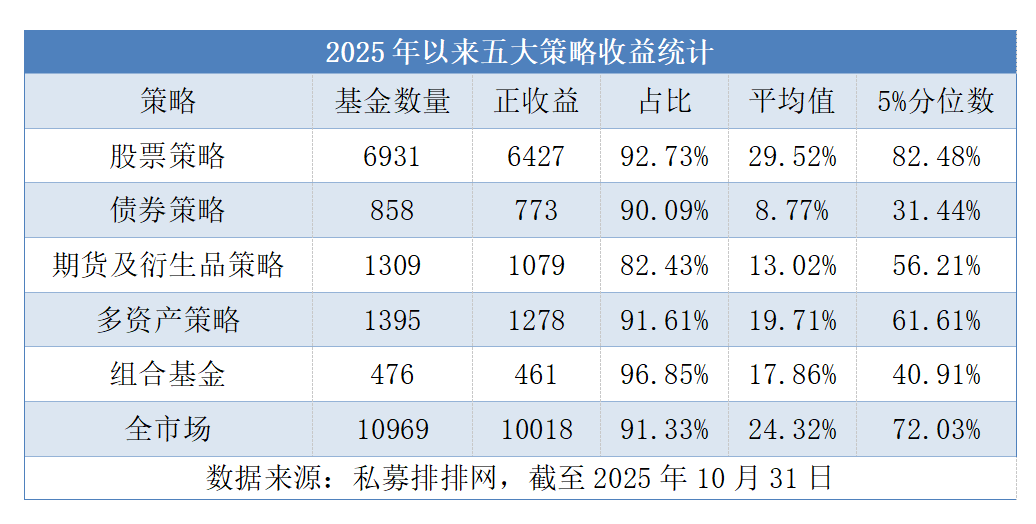
Core Insights - As of October 31, 2025, 91.33% of the 10,969 private equity funds achieved positive returns, with an average return rate of 24.32% [1][3] - The top 5% of funds yielded an impressive return of 72.03%, indicating a strong performance across the market [1][3] Strategy Performance - **Equity Strategy**: Leading with an average return of 29.52%, 92.73% of equity funds reported positive returns. Among 6,931 funds, 6,427 were profitable, with the top 5% achieving a return of 82.48% [1][3] - **Multi-Asset Strategy**: Ranked second with an average return of 19.71% and a positive return rate of 91.61%. This strategy effectively captured equity market gains while diversifying risks through bonds and commodities [1][3] - **Combination Funds**: Showed strong stability with 96.85% of funds in positive territory, although the average return of 17.86% was slightly lower than that of multi-asset strategies [1][3] - **Bond Strategy**: Maintained a conservative approach with an average return of 8.77%, but 90.09% of funds achieved positive returns, highlighting its risk-averse nature [2][3] - **Futures and Derivatives Strategy**: Experienced moderate performance with an average return of 13.02% and 82.43% of funds in positive territory, affected by volatile commodity prices [2][3] Sub-Strategy Insights - **Quantitative Long Strategy**: Emerged as the top performer within equity strategies, boasting an average return of 36.76% and a positive return rate of 96.52%, significantly outperforming subjective long strategies [3][5] - **Subjective Long Strategy**: Achieved a return of 29.72%, with a notable 5% percentile return of 86.45%, indicating strong performance in specific sectors like technology [4][5] - **Market Neutral and Long-Short Strategies**: Reported lower average returns of 9.22% and 18.29%, respectively, due to their hedging mechanisms limiting upside potential [4][5] Market Dynamics - The performance of quantitative strategies has been attributed to several factors, including rapid sector rotation in technology and high trading volumes in the A-share market, which support high-frequency trading [6]
私募今年以来平均收益超24%,股票策略领跑五大策略
Zheng Quan Shi Bao· 2025-11-14 07:16
Core Insights - The A-share market has shown a slow upward trend since 2025, with a significant recovery in the bond market and notable performance in stock index futures and precious metals [1] - Private equity funds have performed exceptionally well this year, with 91.33% of products achieving positive returns and an average return rate of 24.32% as of October 31, 2025 [1] Summary by Strategy Type - **Equity Strategy**: Leads with an average return of 29.52% and a positive return rate of 92.73%, with 6,427 out of 6,931 products making profits, benefiting from the structural market rally in A-shares [1] - **Multi-Asset Strategy**: Ranks second with an average return of 19.71% and a positive return rate of 91.61%, effectively capturing equity market gains while diversifying risks through bonds and commodities [1] - **Combination Funds**: Show strong profitability stability with a positive return rate of 96.85%, although the average return of 17.86% is slightly lower than that of multi-asset strategies [1] Bond and Commodity Strategies - **Bond Strategy**: Maintains a steady style with an average return of 8.77%, the lowest among the five strategies, but with a strong positive return rate of 90.09%, reflecting robust risk defense capabilities [2] - **Commodity Strategy**: Faces challenges due to volatile prices in oil and gold, resulting in a relatively modest average return of 13.02% and a positive return rate of 82.43% [2] Quantitative Long Strategy Performance - The quantitative long strategy has excelled with an average return of 36.76% and a positive return rate of 96.52%, significantly outperforming the overall equity strategy [2] - Factors driving this success include adaptability to structural market conditions, high liquidity in the A-share market, volatility benefits, and enhanced data processing through AI technology [3]