电动化

Search documents
中年男人的梦中情车,崩盘了
首席商业评论· 2025-11-01 03:39
Core Viewpoint - Porsche is experiencing a significant decline in financial performance, with a 99% drop in operating profit and a 6% decrease in sales revenue, marking a dramatic fall from its previous status as a leading luxury car brand [4][11][12]. Group 1: Financial Performance - In the first three quarters of 2025, Porsche reported sales revenue of €26.86 billion, down 6% from €28.56 billion in the same period of 2024 [5][11]. - The operating profit plummeted to €40 million from €4.035 billion, a staggering 99% decrease [5][11]. - The company faced a loss of €966 million in the third quarter, contrasting with a profit of €974 million in the same quarter of the previous year [4][11]. Group 2: Market Position and Historical Context - Porsche was once a darling of the European capital market, achieving a valuation of €75 billion at its IPO in September 2022, and briefly exceeding €83 billion in market value [6][8]. - The brand's sales in China, previously its largest market, fell by 26% in the first three quarters of 2025, with a notable 42% drop in the first quarter alone [13][14]. Group 3: Strategic Challenges - The decline is attributed to multiple pressures, including the shift towards electric vehicles, geopolitical factors, and changing consumer preferences [19][24]. - Porsche has postponed the launch of several electric models and extended the lifecycle of its fuel and hybrid models, indicating a strategic pivot back to internal combustion engines [19][21]. - The company is facing significant costs due to U.S. tariffs, with an estimated loss of €700 million for the year, further complicating its financial recovery [22][24]. Group 4: Internal Reforms and Future Outlook - Porsche is undergoing a major restructuring, including a reduction in the number of dealerships in China and a focus on localizing its product offerings [29][31]. - The company plans to cut 1,900 jobs and has appointed a new CEO, Michael Leiters, to lead the brand through this transitional phase [31][32]. - The management anticipates that 2025 will be a challenging year, with recovery expected to begin in 2026 [31][32].

崔东树:2025年9月中国占世界汽车份额38%
Xin Lang Cai Jing· 2025-11-01 00:29
Group 1 - The global market share of Chinese automobiles has increased, with September's share rising to 38%, up 2 percentage points from last year [1] - In 2024, China's global automotive market share is projected to reach 34.2%, and by the first nine months of 2025, it is expected to rise to 34.5% [1] - Among the world's top 10 automotive companies, two Chinese firms have shown significant growth in market share, with BYD ranking 6th, Geely 9th, and Chery 11th [1] Group 2 - The development of electrification has contributed to the decline of some international automotive brands, while the U.S. market remains temporarily strong and markets like India, represented by Suzuki, are performing well [1] - Overall, there has been a significant decline in market share for most international brands [1]


【2025年三季报点评/华域汽车】客户结构持续优化,业绩超预期
东吴汽车黄细里团队· 2025-10-31 15:21
Core Viewpoint - The company reported a steady growth in revenue and profit for Q3 2025, indicating a positive performance that slightly exceeded expectations [3][9]. Financial Performance - In Q3 2025, the company achieved an operating revenue of 46.18 billion yuan, with a quarter-on-quarter increase of 9.43% and a year-on-year increase of 4.23% [3]. - The net profit attributable to the parent company was 1.80 billion yuan, reflecting a quarter-on-quarter increase of 12.0% and a year-on-year increase of 11.9% [3]. - The net profit excluding non-recurring items was 1.57 billion yuan, with a quarter-on-quarter increase of 6.4% and a year-on-year increase of 3.1% [3]. Customer Structure and Sales - The company is diversifying its customer base, with a focus on expanding beyond SAIC Group. In Q3 2025, the production volume for key customers showed mixed results: SAIC Volkswagen and SAIC General decreased by 3% and 13% respectively, while Tesla and BYD increased by 19% and 11% respectively [4]. - Sales from external customers, particularly from companies like Seres and Xiaomi, have helped fill the gap left by the declining sales from SAIC Group [4]. Profitability and Cash Flow - The gross margin for Q3 2025 was 12.6%, showing a quarter-on-quarter increase of 0.4 percentage points and a year-on-year increase of 0.8 percentage points, attributed to the scale effect from business growth [6]. - The net cash flow from operating activities reached 9.977 billion yuan in Q1-Q3 2025, representing a year-on-year increase of 77.56%, indicating improved sales collection efficiency and optimized working capital management [7]. Strategic Developments - The company successfully acquired a 49% stake in SAIC Qingtao for 205.897 million yuan, marking its entry into the solid-state battery sector, which supports its future development in the new energy industry [8]. Earnings Forecast and Investment Rating - The company maintains revenue forecasts for 2025-2027 at 173.1 billion, 182.6 billion, and 187.1 billion yuan, with year-on-year growth rates of 2.5%, 5.5%, and 2.5% respectively [9]. - The net profit forecasts for the same period are 7.1 billion, 7.7 billion, and 8.0 billion yuan, with corresponding year-on-year growth rates of 6.5%, 7.9%, and 4.4% [9].


调研速递|浙江涛涛车业接待天风证券等13家机构 电动高尔夫球车需求旺盛 第二品牌TEKO加速渠道布局
Xin Lang Cai Jing· 2025-10-31 13:06
Core Viewpoint - The company conducted an institutional research call from October 27 to 31, 2025, discussing key topics such as the demand for electric golf carts, the development of its second brand, and progress in large-displacement all-terrain vehicles [1][2]. Group 1: Electric Golf Cart Market Demand - The demand for electric golf carts in the U.S. is driven by three main factors: significant advantages in the Chinese supply chain, price competitiveness due to inflation raising car prices, and a shift in consumer habits towards short-distance travel [2][3]. Group 2: Second Brand TEKO Strategy - The company launched the second brand TEKO to enhance dealer density, which targets a younger demographic with a more stylish design while maintaining similar specifications and pricing to the existing brand DENAGO [3][4]. Group 3: Large-Displacement All-Terrain Vehicle Development - The company is progressing with the development of large-displacement all-terrain vehicles, with the 300CC model in normal production, the 350CC model in testing, and the 500CC model in small batch production [4][5]. Group 4: R&D Investment Strategy - The company focuses on "electrification, intelligence, and high-end" as core R&D directions, planning to increase investment in large-displacement all-terrain vehicle engine and vehicle development, with a new research institute in Chongqing to enhance R&D efficiency [5][6]. Group 5: Performance Growth Outlook - The company anticipates steady sales growth driven by the release of overseas production capacity, enhanced brand influence, and expanded sales channels, with a clear plan for continuous performance improvement through R&D and product optimization [7].


涛涛车业(301345) - 301345涛涛车业投资者关系管理信息20251031
2025-10-31 12:18
Group 1: Market Demand and Trends - The demand for electric golf carts in the U.S. is strong due to China's complete electric vehicle supply chain and mature electrification technology, making these carts competitive in design, intelligence, and cost-effectiveness [2] - The market for electric golf carts is expanding as they replace or supplement some household and personal vehicle usage, driven by rising car prices and maintenance costs [3] Group 2: Brand Strategy and Product Differentiation - The company launched the second brand TEKO to increase dealer density, with pricing similar to the first brand DENAGO but with distinct design and marketing strategies [3] - TEKO targets a younger demographic with a stylish and dynamic design, while DENAGO focuses on a non-chain dealer network [3] Group 3: Product Development and R&D Investment - The company is progressing with the production of 300CC all-terrain vehicles, testing 350CC models, and has begun small-scale production of 500CC models [4] - Plans to establish a research institute in Chongqing aim to accelerate the development of high-displacement all-terrain vehicle engines [4] - The company will increase R&D investments in electric and intelligent product upgrades, with a focus on high-end strategies [4] Group 4: Future Growth and Performance Outlook - The company expects continued sales growth due to improved overseas capacity, brand influence, and expanded sales channels [4] - A clear development plan includes increased R&D investment across products, channels, and capacity to ensure sustained performance growth in the coming years [4]
一汽大众产销率先突破3000万辆,新战略聚焦电动化与出海
Xin Lang Cai Jing· 2025-10-31 10:51
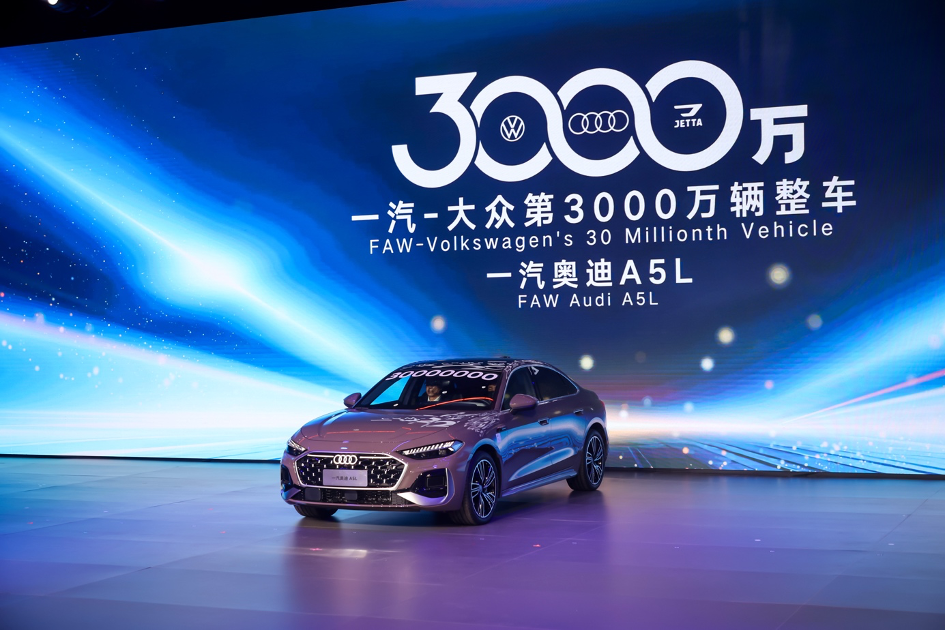
Core Insights - FAW-Volkswagen has officially launched its 30 millionth vehicle, the FAW Audi A5L, marking it as the first passenger car manufacturer in China to surpass this milestone [1][3] - The event was attended by various dignitaries, highlighting the significance of this achievement in the context of Sino-German cooperation and the development of China's automotive industry [3] Group 1 - The milestone of 30 million vehicles signifies a new chapter in China's automotive industry, showcasing the benefits of open cooperation for industrial progress [3] - FAW-Volkswagen's growth trajectory reflects the deep integration of Sino-German automotive industries and China's transition from a "big automotive country" to a "strong automotive country" [4] - The company plans to launch nearly 30 new products in the next five years, with over 20 being new energy vehicles, continuing its strategy of "oil-electric hybrid" development [4] Group 2 - FAW-Volkswagen's R&D investment will average nearly 10 billion annually, focusing on intelligent driving and software, with its self-developed hybrid engine achieving a thermal efficiency of over 47%, a global leading level [4] - The company will explore new local operation models for its Jetta brand and implement an "outgoing, incoming, and upward" strategy for global expansion [4] - The achievement of 30 million vehicles is seen as a starting point for the company's transformation towards electrification, intelligence, and global market expansion [4]
扣非净利润狂飙5699%!上汽集团三季度盈利、“造血”能力双爆发
Hua Xia Shi Bao· 2025-10-31 10:37
Core Viewpoint - SAIC Motor Corporation reported significant growth in both revenue and net profit for the third quarter of 2025, driven by market expansion and operational efficiency improvements [2][3]. Financial Performance - In Q3 2025, SAIC achieved total revenue of 169.4 billion yuan, a year-on-year increase of 16.2%, and a net profit attributable to shareholders of 2.08 billion yuan, up 644.9% [2]. - For the first three quarters, total revenue reached 468.99 billion yuan, growing by 9%, while net profit totaled 8.1 billion yuan, reflecting a 17.3% increase [2][4]. - The net cash flow for Q3 was 10.9 billion yuan, marking a 47.8% year-on-year increase, and for the first three quarters, it was 31.94 billion yuan, up 70.9% [2][3]. Sales Performance - In the first three quarters, SAIC sold 3.193 million vehicles, a 20.5% increase year-on-year, with retail sales reaching 3.378 million units [4]. - The company regained its position as the top seller in the domestic automotive market, achieving a monthly sales increase of over 40% in September [4][5]. Strategic Initiatives - SAIC has implemented a new operational framework focusing on "independent brands, new energy, and overseas markets," which has led to a 29.2% increase in sales of its independent brands [5][6]. - The company has invested over 150 billion yuan in electrification and intelligence, resulting in nearly 26,000 effective patents and advancements in various vehicle technologies [7][8]. Market Outlook - The company plans to launch over ten new models in overseas markets over the next three years, covering various powertrain types and vehicle categories [8]. - SAIC aims to enhance its independent brand business and adapt to market demands while focusing on domestic and international growth opportunities [8].

中年男人的梦中情车,崩盘了
创业邦· 2025-10-31 10:19
Core Viewpoint - Porsche is experiencing a significant decline in financial performance, with a 99% drop in operating profit and a 6% decrease in sales revenue, marking a dramatic shift from its previous status as a leading luxury car brand [5][11][19]. Financial Performance - In the first three quarters of 2025, Porsche reported sales revenue of €26.86 billion, down 6% from €28.56 billion in the same period of 2024 [7]. - The operating profit plummeted to €40 million from €4.035 billion, a staggering 99% decrease [6][11]. - The company faced a loss of €9.66 billion in the third quarter, contrasting with a profit of €9.74 billion in the same quarter last year [6][11]. Market Position and Historical Context - Porsche was once a darling of the European capital market, achieving a valuation of €750 billion during its IPO in September 2022, but has since seen its market value halved [8][14]. - The brand's sales in China, previously its largest market, fell by 26% in the first three quarters of 2025, marking a significant shift in consumer demand [14][15]. Strategic Challenges - The decline in sales is attributed to multiple pressures, including the shift towards electric vehicles, changing market dynamics, and evolving consumer preferences [9][19]. - Porsche has postponed the launch of several electric models and extended the lifecycle of its fuel and hybrid vehicles, indicating a strategic pivot [19][25]. - The company has also terminated its battery production plans, incurring a restructuring cost of approximately €2.7 billion [19][21]. Competitive Landscape - The luxury car market is becoming increasingly competitive, particularly in China, where domestic brands are rapidly gaining market share [23]. - Porsche's traditional luxury positioning is being challenged by new entrants offering similar features at lower prices [23]. Organizational Changes - Porsche is undergoing significant internal restructuring, including a leadership change with the appointment of Michael Leiters as the new CEO, effective January 1, 2026 [30]. - The company plans to reduce its dealer network in China and focus on major cities, reflecting a shift in strategy to better align with local consumer needs [28][30]. Future Outlook - The company anticipates that 2025 will be a challenging year, with expectations for recovery beginning in 2026 [25][30]. - Porsche aims to enhance its product offerings by focusing on personalization and understanding consumer preferences, particularly in the Chinese market [26][28].

开特股份(920978):汽车业务增速亮眼关注26年产能释放,布局机器人+液冷拓宽新赛道
Shenwan Hongyuan Securities· 2025-10-31 08:22
Investment Rating - The report maintains a "Buy" rating for the company [1] Core Insights - The company reported strong performance in Q3 2025, with revenue reaching 2.93 billion yuan, a year-over-year increase of 42.13% and a quarter-over-quarter increase of 11.55% [6][9] - The automotive market remains robust, with the company's products covering nearly all automotive brands in China, contributing to a significant increase in sales [9] - The company is actively investing in R&D, with a 49.60% year-over-year increase in R&D expenses, focusing on robotics and liquid cooling technologies [9] Financial Data and Profit Forecast - For the first three quarters of 2025, the company achieved revenue of 796 million yuan, a year-over-year increase of 43.84%, and a net profit of 130 million yuan, up 37.24% year-over-year [6][8] - The projected total revenue for 2025 is 1,108 million yuan, with a year-over-year growth rate of 34.0% [8] - The estimated net profit for 2025 is 194 million yuan, reflecting a growth rate of 40.4% [8] Investment Analysis - The company has a solid order book with key clients like BYD, which reported a sales increase of 18.64% year-to-date [9] - The company is expected to release additional production capacity in 2026, which will likely enhance its earnings potential [9] - The report has revised profit forecasts upward, estimating net profits of 1.94 billion yuan for 2025, 2.52 billion yuan for 2026, and 3.05 billion yuan for 2027 [9]
读懂高端座驾的过去、现在与未来
第一财经· 2025-10-31 07:16
Core Insights - The high-end automotive industry is at a critical juncture, balancing the need to consolidate traditional values with the urgency to explore new values driven by technological advancements and changing consumer demands [1][3] - The collaboration between Yicai and Fudan University aims to provide a comprehensive analysis of the core values, market changes, and future competitive landscape of high-end vehicles, offering insights for industry participants and consumers [1][3] Market Dynamics - The industry faces challenges from both traditional and emerging players, with competition manifesting through price wars and technological breakthroughs [3] - Achieving a strategic balance between maintaining a century-old legacy and embracing innovation is crucial for determining future market positions and growth paths for brands [3] Consumer Insights - The profile of ultra-luxury car consumers includes business owners, investors, professional partners, and heirs, with a significant portion having investable assets exceeding 10 million [7] - The acceptance of electric powertrains in ultra-luxury vehicles is high, yet concerns persist regarding the potential dilution of brand identity and the driving experience [8][10] Brand Recognition - Maybach ranks at the top of the ultra-luxury brand recognition list, with a score of 4.61 out of 5, followed closely by other brands such as Rolls-Royce and Bentley [7] - Consumers show a strong inclination towards owning or intending to own brands like Maybach, Rolls-Royce, and Bentley, indicating their market dominance [7] Electric Vehicle Concerns - While there is a high acceptance of electric vehicles, concerns include the inability of electric powertrains to replicate the driving experience of traditional fuel engines (87.5%) and worries about the adequacy of electric vehicle range and charging capabilities (62.5%) [10] - The rapid technological evolution of electric vehicles raises concerns about depreciation and resale value, with 56.3% of consumers expressing apprehension [10]