
专利悬崖

Search documents
荣昌生物拿下56亿美元大单 双抗技术缘何频获跨国巨头追捧?
2 1 Shi Ji Jing Ji Bao Dao· 2026-01-13 23:12
Core Insights - The collaboration between AbbVie and Rongchang Biopharma marks a significant shift in the global oncology treatment landscape, highlighting the trend of "Chinese innovation + global market" in drug development [1][2] Group 1: Collaboration Details - AbbVie and Rongchang Biopharma signed an exclusive licensing agreement for the development, production, and commercialization of RC148, a bispecific antibody targeting PD-1 and VEGF [1] - Rongchang Biopharma will receive an upfront payment of $650 million and is eligible for up to $4.95 billion in milestone payments, along with a tiered royalty on net sales outside Greater China [1][2] Group 2: Market Implications - The deal allows Rongchang Biopharma to accelerate clinical trials for RC148 in China and globally, while also supporting the development of other pipelines [2] - AbbVie aims to enhance its product portfolio in immuno-oncology, particularly in the emerging PD-1/VEGF bispecific antibody space, which could improve its competitiveness in solid tumor treatments [2] Group 3: Industry Trends - The PD-1/VEGF bispecific antibody represents a new class of cancer therapies that may overcome tumor resistance mechanisms by simultaneously blocking PD-1 and VEGF [3][5] - Chinese companies are leading in this field, with significant advancements and approvals, such as the launch of Ak112/Ivonescimab by Kangfang Biopharma, which is the first bispecific antibody combining tumor immunity and anti-angiogenesis mechanisms [3] Group 4: Broader Market Dynamics - The global interest in PD-1/VEGF bispecific antibodies is rising, with several Chinese firms successfully engaging in business development (BD) transactions, reflecting the increasing recognition of Chinese innovative drug assets by multinational pharmaceutical companies [6][7] - In 2025, the total value of Chinese innovative drug licensing transactions exceeded $130 billion, accounting for 49% of the global total, indicating a significant shift in the global pharmaceutical landscape [7][8] Group 5: Future Outlook - The increasing number of approved innovative drugs in China, along with the growing bargaining power of Chinese companies in licensing agreements, suggests a transition from a "follow" to a "lead" position in global pharmaceutical innovation [8][10] - The ability of Chinese companies to negotiate favorable terms in BD transactions is becoming crucial, emphasizing the importance of pipeline strength, data quality, and structured deal design [9][10]


千亿美元“专利悬崖”逼近!美股制药巨头瞄准收购新药,中小盘生物科技股迎来“超级溢价”投资盛宴?
智通财经网· 2026-01-09 07:45
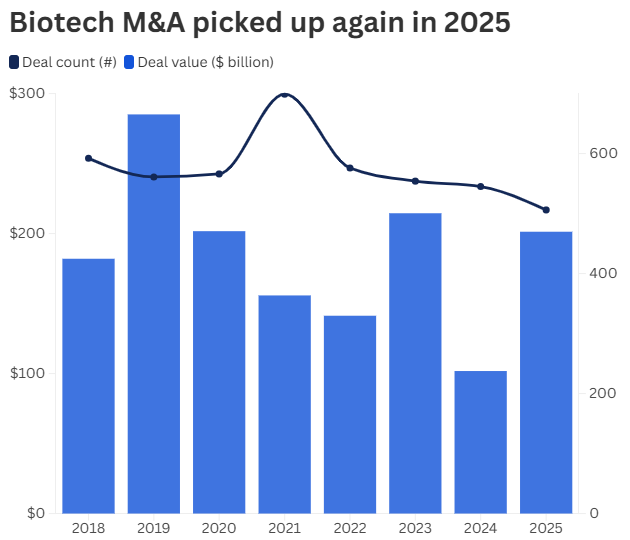
Core Insights - The biotechnology industry has seen a significant resurgence in merger and acquisition (M&A) activity in September and October 2025, following a period of low activity earlier in the year, driven by the easing of pressures on drug pricing and tariffs, as well as the initiation of a new interest rate cycle [1][2][13] - Major pharmaceutical companies are actively seeking to fill revenue gaps due to impending patent expirations, with a projected loss of at least $173.9 billion in annual sales by 2032 from the loss of patent protection on blockbuster drugs [1][5][15] M&A Activity - The competition for high-quality assets is intensifying, exemplified by the high-profile bidding war between Pfizer and Novo Nordisk for Metsera and its leading weight-loss candidate, highlighting the urgency for companies to secure promising products [1][12] - The "patent cliff" phenomenon is a significant driver of M&A activity, as many blockbuster drugs from major companies are approaching the end of their patent protection [6][12] - Between 2014 and 2023, approximately half of the blockbuster drugs approved were acquired rather than developed in-house, with Eli Lilly and AstraZeneca leading in the number of drugs obtained through acquisitions [6][12] Strategic Focus - Companies like GlaxoSmithKline and Novartis are recognizing the need for "complementary transactions" to expand their product lines, with Novartis emphasizing its strong cash flow to invest in business development [7][12] - The focus on acquiring mid-stage assets with validated biological technologies is seen as a strategic priority, with investment amounts typically ranging from $1 billion to $2 billion [7][12] Market Dynamics - The GLP-1 weight-loss drug market has become one of the most competitive segments in the pharmaceutical industry, with over 60 companies developing more than 120 metabolic drugs, providing ample M&A targets [12] - The biotechnology sector has experienced cycles of boom and bust, with the COVID-19 pandemic initially boosting investor interest and valuations, followed by a period of uncertainty due to regulatory pressures [13][14] Future Outlook - Analysts predict that 2026 will present one of the best investment opportunities in decades, driven by the resolution of healthcare policy uncertainties and further interest rate cuts [14] - The potential for significant price reductions on certain blockbuster drugs starting in 2026, as outlined in the Inflation Reduction Act, may increase the urgency for pharmaceutical companies to pursue M&A [14][15]


Wolfe Research:默沙东(MRK.US)应对Keytruda“专利悬崖”有方 上调评级至“跑赢大盘”
智通财经网· 2026-01-09 05:37
Group 1 - Wolfe Research upgraded Merck & Co. (MRK.US) from "in line with peers" to "outperform," setting a target price of $135 [1] - Analyst Alexandria Hammond noted that Merck is well-positioned to handle the impending loss of exclusivity for its blockbuster cancer drug Keytruda's intravenous version [1] - Based on physician feedback, it is expected that by 2029, Merck will convert 41% of Keytruda's intravenous revenue to its newly approved subcutaneous version, Qlex, leading to a $6 billion increase in Keytruda's revenue forecast for 2030 compared to market consensus [1] Group 2 - Merck is reportedly in talks to acquire biotechnology company Revolution Medicines (RVMD.US), with a potential deal price between $28 billion and $32 billion [2] - If the acquisition is completed, it would be one of the largest pharmaceutical deals since Pfizer's $43 billion acquisition of Seagen at the end of 2023 [2] - Since 2021, Merck's late-stage product line has nearly doubled due to internal development and large transactions, such as the $11.5 billion acquisition of Acceleron [2] Group 3 - Wolfe Research downgraded AbbVie (ABBV.US) from "outperform" to "in line with peers," removing the previous target price of $275 [2] - The downgrade reflects the belief that AbbVie's stock price has fully accounted for the strong performance of its new immunology products, Skyrizi and Rinvoq [2] - Skyrizi and Rinvoq have become the dominant forces in AbbVie's immunology and inflammation portfolio following the patent cliff of the blockbuster drug Humira [2]

临床急需的境外药品,将加速入华
21世纪经济报道· 2026-01-09 05:27
Core Viewpoint - The new policy from the National Medical Products Administration (NMPA) aims to expedite the entry of globally innovative drugs into China, significantly altering the approval timeline for thousands of foreign drugs already on the market, particularly for rare and chronic diseases [1][3]. Group 1: Policy Changes - The NMPA encourages the application of clinically urgent foreign drugs and allows for priority review and approval for those that meet specific criteria [1][3]. - A new pre-inspection method for rare disease drugs will reduce the registration inspection time from 60 days to 40 days for sample inspections, and from 90 days to 70 days for standard review and sample inspection [1][3]. - The policy establishes a communication channel for applicants to discuss data utilization and priority review with the drug review center before formal application submission, which is crucial for expediting the process [3][4]. Group 2: Special Provisions for Rare Diseases - The new policy allows for the acceptance of foreign data and conditional approvals, which can exempt domestic clinical trials, thus shortening the time to market and reducing costs [3][4]. - A special inspection system for rare disease drugs has been established, allowing for a minimum sample size of two batches instead of three, addressing the challenges of sample scarcity and time constraints in rare disease research [3][4]. Group 3: Regulatory and Market Implications - The policy optimizes the overseas review and risk management mechanisms, allowing for remote inspections, which reduces the burden on companies while raising standards for quality control and transparency [4]. - Temporary import channels for urgently needed drugs during the application process have been established, particularly benefiting rare disease medications [4][5]. - The overall regulatory environment is shifting from a focus solely on low prices to a comprehensive evaluation of clinical value, enabling multinational pharmaceutical companies to achieve reasonable returns by demonstrating the clinical value of their products [7][8]. Group 4: Market Trends and Future Outlook - The global pharmaceutical industry is expected to face a "patent cliff" with approximately $236 billion at stake from 2025 to 2030, prompting multinational companies to adjust their strategies in China [7]. - The Chinese pharmaceutical market is evolving into a dual focus on both importing innovative drugs and supporting domestic innovation, with significant growth in the innovative drug sector [11][12]. - The NMPA approved a record 4,087 drug registration applications in 2025, including 76 innovative drugs, indicating a significant acceleration in the approval process [12][14].

审评审批新政开路,加速引进临床急需境外已上市药品
2 1 Shi Ji Jing Ji Bao Dao· 2026-01-08 11:31
Core Insights - The new policy from the National Medical Products Administration (NMPA) aims to expedite the entry of globally innovative drugs into China, particularly for rare and chronic diseases, by revising the approval timeline for thousands of foreign drugs already on the market [1][2] Group 1: Policy Changes - The NMPA encourages the application of urgently needed foreign drugs, allowing them to be included in the priority review and approval process [1][3] - For rare disease drugs that are urgently needed but not yet available in China, the policy allows for a pre-inspection application process, reducing the registration inspection time from 60 days to 40 days for sample inspections, and from 90 days to 70 days for simultaneous standard review and sample inspection [1][3] - The new policy simplifies previous high inspection requirements, making it easier for rare disease drugs to enter the Chinese market [1][3] Group 2: Industry Impact - The new policy is expected to significantly impact the pharmaceutical industry by accelerating the market entry of urgently needed drugs, particularly for rare diseases, thus addressing the issue of drug accessibility for patients [2][5] - The introduction of a mechanism for foreign generic drug applications is anticipated to provide more economical treatment options alongside original drugs, potentially reducing the financial burden on patients [2][5] - The policy encourages pharmaceutical companies to conduct global synchronized research and applications in China, which may lead to better resource allocation and earlier inclusion of China in global research plans [2][5] Group 3: Regulatory Framework - The policy establishes a communication channel for applicants to discuss data utilization and priority review with the drug review center before formal application submission, which is crucial for expediting the process [3][4] - It allows for the acceptance of foreign clinical data and conditional approvals, which can significantly shorten the time to market and reduce costs [3][4] - The policy also optimizes the risk management mechanism for foreign reviews, allowing for remote inspections, which eases the burden on companies while raising quality control standards [4][5] Group 4: Market Dynamics - The global pharmaceutical industry is projected to face a "patent cliff" of approximately $236 billion from 2025 to 2030, prompting multinational companies to adjust their strategies in China [6][7] - The new policy shifts the focus from a "low-price only" approach to a comprehensive evaluation of clinical value, creating conditions for multinational companies to receive reasonable returns on their products [6][7] - The market for rare disease drugs is expected to become a new growth area, with the policy lowering barriers for these drugs to enter the Chinese market [6][7] Group 5: Future Considerations - The implementation of the new policy may face challenges, including the need for complementary measures, particularly regarding insurance integration [7][8] - The regulatory capacity of relevant agencies will be tested as the new policy significantly compresses review timelines, requiring enhanced human resource allocation and professional capabilities [8][9] - The pharmaceutical sector is expected to see a strong rebound in 2025, driven by AI and innovative drugs, reflecting a qualitative leap in China's innovation capabilities [10][11]
115亿美元天价!买了个“配角”:默沙东的清醒,与市场的误读
Xin Lang Cai Jing· 2026-01-06 04:30
Core Insights - Merck's approval of Sotatercept in China marks the completion of a significant regulatory milestone following its $11.5 billion acquisition of Acceleron in 2021, indicating a strategic move to diversify beyond its blockbuster drug Keytruda [3][9] - Sotatercept is positioned as a risk-hedging asset rather than a new growth engine, with peak sales expectations of $3-4 billion, contrasting sharply with Keytruda's over $25 billion annual sales [4][5] Strategic Positioning - The drug serves as a stabilizing asset for Merck, helping to mitigate the impending loss of exclusivity for Keytruda in 2028, and aims to re-establish Merck's presence in the cardiovascular (CV) market [5] - Sotatercept's unique mechanism as the first activin signaling pathway inhibitor allows it to avoid direct competition with existing standard treatments, carving out a niche in the high-end market [5] Commercial Reality - Early sales performance of Sotatercept has been strong, with projected revenues of $419 million in its first year and $336 million in a single quarter of the following year, indicating a potential for significant market impact [6] - However, the drug faces structural challenges, including high reimbursement hurdles from insurers and additional monitoring requirements that complicate its prescription process [7] Chinese Market Dynamics - The rapid approval of Sotatercept in China reflects Merck's strategic focus on this market, but it also faces unique challenges, particularly regarding the payment capabilities of the patient population [8] - The drug's high cost limits its initial accessibility to affluent patients, necessitating negotiations for inclusion in national insurance schemes, which may require significant price reductions [8] - The competitive landscape in China is evolving, with domestic companies developing similar therapies, creating a limited window for Merck to establish a strong market presence before local competitors emerge [8]
2026年,全球生物制药行业有哪些新变局?
Sou Hu Cai Jing· 2026-01-06 02:55
Core Insights - The global biotechnology industry is at a pivotal turning point in 2026, marked by a significant rebound in merger and acquisition (M&A) activity, with 173 BD transactions in 2025, a notable increase from 136 in 2024, and total transaction values reaching $146.8 billion, up 218% from the previous year [1][2] - The changing regulatory environment, including the implementation of the IRA and the legislative challenges of the Biodefense Act, alongside the Federal Reserve's interest rate cuts, is redefining capital flows and asset pricing logic [1] Industry Transaction Evolution - The biopharmaceutical sector is transitioning from an abnormal to a normal state in terms of transaction activity, following a peak during the COVID-19 pandemic, with a notable decline in 2023-2024 due to valuation discrepancies and multiple uncertainties [1][2] Transaction Trends and Preferences - In 2025, 58% of the total transaction value was attributed to marketed products and late-stage clinical assets, reflecting a clear preference among pharmaceutical companies for lower-risk assets amid a looming $300 billion patent cliff [2][3] Emerging Treatment Areas and Technologies - The focus of investment is shifting, with neurological diseases approaching oncology in transaction value, indicating a significant change in investment priorities [3] - Cardiovascular and metabolic diseases, driven by the GLP-1 drug trend, have become the third-largest investment hotspot, while interest in rare diseases and gene therapy has cooled [4] - New technological platforms such as bispecific antibodies and molecular glue degraders are emerging, while AI applications are rapidly transitioning from concept validation to integration into workflows, enhancing clinical trial success rates [4] China's Market Growth - The Chinese biopharmaceutical market has seen a tenfold increase in Western capital investment, growing from $6 billion in 2020 to $61 billion by Q3 2025, now accounting for 35% of global alliance investment [5] - China's shift from a "fast follower" to an "innovation source" is supported by a flexible regulatory environment and strategic government backing, fostering rapid drug development [5] Future Outlook - The biopharmaceutical industry is at a critical crossroads in 2026, characterized by substantial cash reserves, imminent patent cliffs, evolving technology platforms, and changing geopolitical dynamics, presenting both opportunities and challenges [6] - For Chinese biopharmaceutical companies, this period represents a golden opportunity to engage in the global innovation ecosystem and enhance independent innovation capabilities [6]

中国创新药大爆发,一年出海狂揽9400亿,超越美国
2 1 Shi Ji Jing Ji Bao Dao· 2026-01-04 12:52
Core Insights - China's innovative drug transaction value has surpassed that of the United States, indicating growing global recognition of domestic innovations [1][4] - The total transaction amount for outbound licensing of innovative drugs from China is projected to reach $135.655 billion by December 31, 2025, with a significant increase in both upfront payments and transaction numbers compared to 2024 [1][4] - The surge in outbound licensing reflects the international community's acknowledgment of the value of Chinese innovative drugs, driven by reforms in drug approval processes and supportive policies [1][4] Transaction Overview - In 2025, the total amount of outbound licensing transactions for innovative drugs from China exceeded $1,300 billion, with over 150 transactions, significantly surpassing the 2024 figures of $519 billion and 94 transactions [4][5] - The first transaction of 2025 involved Innovent Biologics partnering with Roche, receiving an upfront payment of $80 million and potential milestone payments of up to $1 billion [4] - Notable transactions include a record upfront payment of $1.25 billion from 3SBio to Pfizer for a global licensing agreement, and a total transaction amount exceeding $12 billion with GSK [5] Market Dynamics - The demand for Chinese innovative assets is expected to persist as multinational corporations (MNCs) face patent cliffs and cost-cutting pressures [8][9] - The global pharmaceutical supply chain is undergoing significant adjustments, with MNCs increasingly looking to China for early-stage innovative pipelines due to cost-effectiveness and potential superior outcomes [9][10] - The shift in business development (BD) models is evident, with a move towards co-development and co-commercialization agreements, allowing Chinese companies to play a more active role in global markets [10][11] Industry Trends - China's innovative drug pipeline accounts for approximately 30% of the global total, with significant achievements in key therapeutic areas such as PD-1/VEGF bispecific antibodies [8] - The industry is transitioning from a "fast-follower" to a "first-in-class" model, emphasizing the importance of clinical value and unmet medical needs [6][15] - The approval of 76 innovative drugs in 2025, with a high percentage being domestically developed, highlights the growing capabilities of Chinese pharmaceutical companies [5][6] Future Outlook - The innovative drug sector in China is expected to face challenges in maintaining the momentum of BD transactions, with concerns about sustainability and the potential for a slowdown in transaction values [14][15] - The focus for 2026 will likely shift towards solidifying clinical value and addressing unmet needs, particularly in oncology and autoimmune diseases [15][16] - The Chinese regulatory body plans to implement more measures to support the rapid development of innovative drugs, indicating a commitment to fostering industry growth [15][16]
中国创新药大爆发,一年出海狂揽9400亿,超越美国
21世纪经济报道· 2026-01-04 12:43
Core Viewpoint - China's innovative drug transaction value has surpassed that of the United States, indicating that domestic innovations are gradually gaining recognition in the global mainstream market [1][2]. Group 1: Transaction Data and Growth - By December 31, 2025, the total transaction amount for China's innovative drug business development (BD) overseas reached $135.655 billion (approximately 948.3 billion RMB), with an upfront payment of $7 billion and a total of 157 transactions, significantly exceeding the 2024 figures of $51.9 billion and 94 transactions [1][2]. - The total amount of overseas licensing for innovative drugs in China for 2025 is 2.5 times that of 2024 and 3.2 times that of the U.S. during the same period [2]. - The first transaction of 2025 involved Innovent Biologics partnering with Roche, receiving an upfront payment of $80 million and potential milestone payments of up to $1 billion [2]. Group 2: Notable Collaborations - In May 2025, 3SBio set a record for upfront payments in China by securing a global licensing agreement with Pfizer for $1.25 billion upfront and a total transaction value of $6 billion [3]. - Other significant collaborations include Heng Rui Medicine's partnership with GSK exceeding $12 billion and Innovent's collaboration with Takeda potentially reaching $11.4 billion [3]. Group 3: Industry Trends and Future Outlook - The surge in BD transactions is attributed to multinational corporations (MNCs) facing a "patent cliff" and cost-cutting pressures, increasing their demand for Chinese innovative assets [6][10]. - China's innovative drug pipeline accounts for approximately 30% of the global total, positioning the country as a significant player in key therapeutic areas such as PD-1/VEGF bispecific antibodies [6]. - The industry is transitioning from a "fast-follower" to a "first-in-class" or "best-in-class" model, emphasizing lean research and precise financing [4][10]. Group 4: Market Dynamics and Challenges - The global pharmaceutical supply chain is undergoing deep adjustments, and the valuation system is being restructured, presenting challenges for China's BD transactions [10]. - The industry is expected to face execution risks and potential disputes, with a consensus that while the BD boom will continue, the scale of transactions may not sustain the same explosive growth seen in 2025 [10][12]. - The focus for 2026 will shift towards solidifying clinical value and addressing unmet clinical needs, particularly in oncology and autoimmune disease sectors [10][12].

超越美国!中国创新药出海爆单,2025年交易超1300亿美元
2 1 Shi Ji Jing Ji Bao Dao· 2026-01-04 10:21
Core Insights - China's innovative drug transaction value has surpassed that of the United States, indicating a growing global recognition of domestic innovations [1][3] - The total transaction amount for outbound licensing of innovative drugs from China is projected to reach $135.655 billion by December 31, 2025, with a significant increase in both upfront payments and transaction numbers compared to 2024 [1][3] - The surge in outbound licensing reflects the international community's acknowledgment of the value of Chinese innovative drugs, driven by a series of reforms and policies encouraging innovation [1][4] Transaction Overview - In 2025, the total amount of outbound licensing transactions for Chinese innovative drugs exceeded $1,300 billion, accounting for 49% of the global total, significantly surpassing the $519 billion recorded in 2024 [3][4] - The first transaction of 2025 involved Innovent Biologics partnering with Roche, which included an upfront payment of $80 million and potential milestone payments of up to $1 billion [3] - Notable transactions include a record upfront payment of $1.25 billion from 3SBio to Pfizer for a global licensing agreement, highlighting the increasing scale of these deals [3][4] Market Dynamics - The demand for Chinese innovative assets is expected to persist as multinational corporations (MNCs) face patent cliffs and cost-cutting pressures [7][8] - The global pharmaceutical supply chain is undergoing significant adjustments, with a shift in focus towards collaborative development and commercialization models, such as the Co-Co model [9][10] - Chinese companies are increasingly recognized for their capabilities in developing innovative therapies, moving from being fast followers to first-in-class innovators [6][7] Future Outlook - The Chinese innovative drug sector is anticipated to experience a critical sales growth phase starting in 2026, transitioning from a focus on research and development to performance realization [5][6] - The industry is expected to face challenges in maintaining the momentum of high-value transactions, with a potential shift in focus towards clinical value and unmet medical needs [12][14] - Regulatory support from the National Medical Products Administration (NMPA) is expected to enhance the development of innovative drugs, particularly those with new mechanisms and targets [14]
