
多元化配置

Search documents
“含金量”上升!银行理财产品11月榜单揭晓
Zhong Guo Zheng Quan Bao· 2025-12-18 14:41
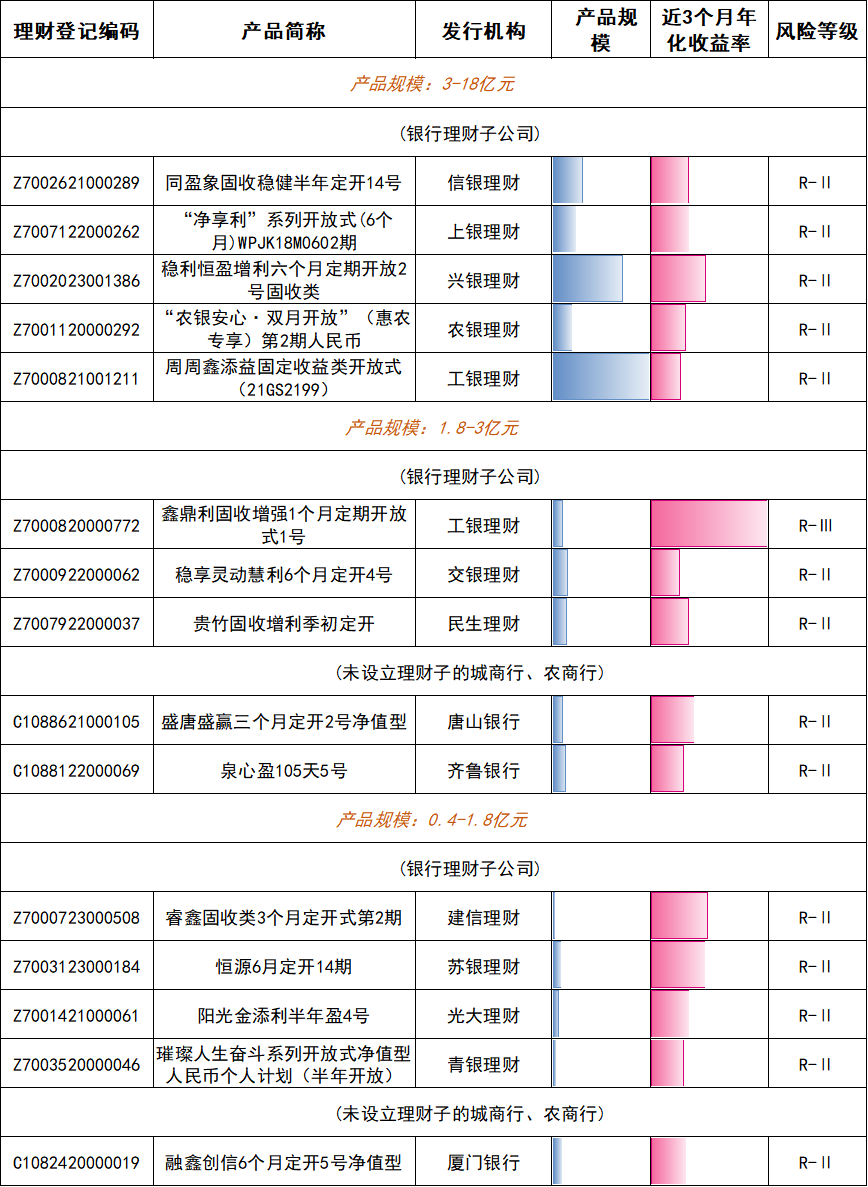
Group 1 - The core viewpoint of the article highlights the increase in the 10-year government bond yield by 4.6 basis points to 1.84%, indicating a widening yield spread, while credit bond issuance shows signs of recovery with a significant increase in issuance scale [1] - The A-share market experiences heightened investor risk aversion, with major indices showing varying degrees of decline, particularly the Shanghai Composite Index, which fell by 1.67% for the month [1] - As of the end of November 2025, the total number of bank wealth management products in the market reached 45,358, an increase of 900 from the end of October, with 2,767 new products launched during the month [1] Group 2 - Among the newly issued products, fixed-income products dominate, totaling 39,723, which is an increase of 829 from the previous month [1] - Bank wealth management subsidiaries accounted for 29,850 products at the end of the month, representing 71.52% of the total, with a 3.64 percentage point increase compared to the end of October [1] - The new products launched by bank wealth management subsidiaries accounted for 76.87% of the total issuance in the market [1] Group 3 - The overall risk level of the products listed in November continues to converge towards a medium-low level, with 97.14% of the products falling into the second (medium-low) and third (medium) risk categories [12] - A total of 34 institutions were listed in November, an increase of 6 from the previous month, with city commercial banks accounting for 9 of these institutions [16] - The five institutions with the highest number of listed products include Xinyin Wealth Management, Industrial Bank Wealth Management, Xingyin Wealth Management, Zhaoyin Wealth Management, and Jianxin Wealth Management, collectively accounting for 37.14% of the total [16] Group 4 - The products listed in November exhibited a notable characteristic of diversification, with over 40% of the listed products including gold ETFs in their investment portfolios [19] - The asset combinations of the listed products displayed a multi-regional and multi-type diversification feature, with significant allocations to high liquidity assets such as government bond ETFs and bond funds to mitigate risks [19] - Certain products showed a concentrated investment in non-standard assets (trusts, interbank loans) and local government bonds, particularly from regions like Shandong and Jiangsu [19]


“含金量”上升! 银行理财产品11月榜单揭晓
Zhong Guo Zheng Quan Bao· 2025-12-18 13:09
Group 1 - The core viewpoint of the article highlights the increase in the issuance of credit bonds and the growth in the number of bank wealth management products, indicating a recovery in the market despite rising risk aversion among investors in the A-share market, with the Shanghai Composite Index declining by 1.67% in November [1] - The total number of bank wealth management products in the market reached 45,358 by the end of November, an increase of 900 from the end of October, with 2,767 new products launched during the month [1] - Fixed-income products dominate the market, with 39,723 products available, reflecting a month-on-month increase of 829 [1] Group 2 - The report indicates that the risk level of the products listed in November has shifted towards a medium-low level, with 97.14% of the products falling into the second (medium-low) and third (medium) risk categories [11] - A total of 34 institutions were represented in the November rankings, an increase of 6 from the previous month, with city commercial banks accounting for 9 of these institutions [15] - The report emphasizes that over 40% of the listed products included gold ETFs, showcasing a trend towards diversification in asset allocation, with a balanced mix of equity and bond investments [18]
DWS:AI驱动“理性繁荣” 明年投资前景乐观可期
Zhi Tong Cai Jing· 2025-12-16 03:31
Group 1 - DWS's Chief Investment Officer Vincenzo Vedda compares the current tech stock valuations to the "irrational exuberance" of the late 1990s, suggesting that the current situation is more of a "rational exuberance" driven by AI [1] - Vedda emphasizes the need for investors to be selective, as not all AI companies will succeed, and warns of potential market adjustments despite a generally optimistic outlook for 2026 [1][2] - The forecast for the S&P 500 index is set at 7500 points by the end of 2026, supported by AI investment trends and a projected 10.9% double-digit earnings growth [3] Group 2 - DWS predicts a 7.0% earnings growth for the Stoxx Europe 600 index, with a target level of 600 points by the end of 2026, indicating limited upside compared to U.S. markets [3] - Emerging markets are expected to see a 13% earnings growth by 2026, with the MSCI Emerging Markets index projected to reach 1480 points, reflecting significant upside potential despite higher risks [3] - The forecast for U.S. 10-year Treasury yields is a slight increase to 4.15% by the end of 2026, while the euro is expected to stabilize around 1.15 against the dollar [3]
扩大内需,成为2026年最紧迫的事
大胡子说房· 2025-12-15 02:50
Core Insights - The article highlights the paradox of China's trade surplus, which reached a historic high of $1.08 trillion in the first eleven months of 2025, indicating a strong export performance but underlying issues in domestic consumption [1][5] - It emphasizes that a large trade surplus does not necessarily equate to a strong economy, as it may reflect an inability to consume domestically, leading to over-reliance on exports [1][5] Trade Surplus Analysis - China's trade surplus is calculated as the difference between exports and imports, with exports growing by approximately 5.9% in 2025 while imports remained stagnant or even declined in some months [1][5] - The significant surplus is attributed to low domestic consumption, as consumers are hesitant to spend on housing and vehicles, causing companies to focus on exporting excess production [1][5] Export Dynamics - The export of photovoltaic components has surged in quantity, but the total export value growth has not kept pace, with some months showing a decline in monetary value due to drastic price reductions [3][4] - Companies are resorting to "price for volume" strategies to maintain cash flow and market share, resulting in thin profit margins that hinder wage increases for workers [4] Domestic Consumption Challenges - The decline in the real estate sector has severely impacted consumer confidence and spending, as many individuals have their wealth tied up in property, leading to a defensive saving mentality [5] - Despite nominal growth in disposable income of about 5.3% in 2025, the faster growth in savings indicates a reluctance to spend, driven by fears of economic instability [5] Policy Recommendations - The article suggests several policy measures to stimulate domestic demand, including capacity reduction, urbanization initiatives, and targeted fiscal policies to alleviate the financial burden on citizens [5] - It advocates for a shift in investment focus from real estate to diversified asset allocation, emphasizing the importance of investing in cities with net population inflows [5] Future Economic Outlook - The article predicts a prolonged low-interest-rate environment globally, influenced by economic downturns and rising debt levels, which will create volatility in capital markets [5] - Investors are advised to maintain a diversified portfolio that includes high-dividend stocks and growth sectors, while also preparing for potential market uncertainties [5]

每日钉一下(日元加息,对全球市场会有什么影响?)
银行螺丝钉· 2025-12-12 13:58
Group 1 - The article discusses the importance of diversifying investments across different asset classes, including both RMB and foreign currency assets, as well as stocks and bonds, highlighting the role of US dollar bond funds in this strategy [2] - A free course is offered to provide systematic knowledge on investing in US dollar bond funds, including course notes and mind maps for efficient learning [2] Group 2 - The article examines the impact of rising interest rate expectations for the Japanese yen on global markets, referencing historical context where Japanese assets experienced a bubble in the late 1980s, leading to a significant market decline [5] - Japan's 10-year government bond yield fell from around 8.5% in the 1980s to near zero by 2015, with the Bank of Japan using low interest rates to stimulate the economy during prolonged downturns [5][6] - The low interest rate environment in Japan led to an international arbitrage strategy where investors borrowed yen at low costs to invest in other assets, benefiting from both currency and interest rate gains [6][8] Group 3 - Warren Buffett's investment strategy is highlighted, where he issued low-interest yen bonds to finance purchases of Japanese stocks with high dividend yields, specifically targeting the five major Japanese trading companies [9] - These trading companies are characterized by cross-shareholding, which is common in Japan, and they offer attractive dividend yields, averaging 4%-5% at the time of Buffett's investment [9][10]

100万元才能买3年期大额存单? 主要针对高端客户 20万元起仍在售 专家:建议储户考虑多元化配置|一探
Di Yi Cai Jing· 2025-12-03 13:20
近日,工行3年期大额存单起售门槛提至100万的消息引发市场广泛关注。第一财经记者实地走访深圳多 家银行发现,工行正在发售的2025年第四期3年期个人大额存单起存金额确为100万元,年利率为 1.55%,但是这针对部分高端和私行客户,为其提供充裕的购置需求,20万元起购的产品依然在售。专 家建议储户未来考虑多元化配置。更现场、更财经,一探究竟! 近日,工行3年期大额存单起售门槛提至100万的消息引发市场广泛关注。第一财经记者实地走访深圳多 家银行发现,工行正在发售的2025年第四期3年期个人大额存单起存金额确为100万元,年利率为 1.55%,但是这针对部分高端和私行客户,为其提供充裕的购置需求,20万元起购的产品依然在售。专 家建议储户未来考虑多元化配置。更现场、更财经,一探究竟! ...

这个标准,是专业投资与盲目投机的重要分水岭
Sou Hu Cai Jing· 2025-11-29 07:51
市场周度评论 本周(2025年11月24日至11月28日),全球主要股指普遍上扬,风险偏好持续改善。美股表现强劲,纳 斯达克指数以4.91%的涨幅领跑,标普500与道琼斯工业指数分别上涨3.73%和3.18%,科技板块情绪显 著回暖。亚太市场同步反弹,日经225指数上涨3.35%。 A股市场整体反弹,成长风格占优。创业板指大涨4.54%,深证成指与科创50分别上涨3.56%和3.21%, 上证指数与沪深300涨幅相对温和,分别为1.40%和1.64%。市场呈现普涨格局,超84%个股上涨,但日 均成交额略有萎缩,显示部分资金观望情绪仍存。 行业方面,科技主线突出。通信、电子、传媒板块领涨,涨幅均超4%,而银行、石油石化等传统板块 承压。港股市场同步走强,恒生科技指数上涨3.77%,卖空金额大幅下降,显示空头情绪明显缓解。 然而,分散本身并非目的。若没有谨慎选股作为根基,多元化可能沦为平庸化的分散,甚至因持有质地 不佳的标的而拖累整体收益。真正的风险控制,需要在市场喧嚣中保持冷静,敢于在过热时卖出高估标 的,在低估时买入优质资产。 谨慎选股要求投资者深入理解企业的商业模式、竞争优势与财务状况。它关注的是企业的内在 ...
每日钉一下(哪些品种是固收+基金,我们该如何选择呢?)
银行螺丝钉· 2025-11-28 14:07
Group 1 - The article emphasizes the importance of diversifying investments across different asset classes, including both RMB and foreign currency assets, as well as stocks and bonds [2] - It introduces a free course that systematically covers investment knowledge related to US dollar bond funds, indicating a growing interest in this area among investors [2] - The article highlights the rapid growth of "fixed income +" products in recent years, driven by declining deposit rates and increasing investor attention [7] Group 2 - "Fixed income +" funds typically add a small amount of stocks or convertible bonds to a pure bond base, leveraging the negative correlation between stocks and bonds to achieve stable returns while reducing volatility risk [5] - Traditional "fixed income +" products include primary bond funds, secondary bond funds, and mixed bond funds, with secondary bond funds and mixed bond funds being the most classic types [5] - The broader category of "fixed income +" also encompasses hedge funds and all-weather strategy funds, which may not hold a high proportion of bonds but use strategies to control volatility risk [5][7]

对冲AI泡沫风险,外资巨头加码中国科技股
Huan Qiu Wang· 2025-11-19 03:03
【环球网财经综合报道】近日,伴随着市场对"AI泡沫"的担忧加剧,美国科技股正持续遭到猛烈抛售,投资者信 心受到严峻考验。然而,在此背景下,华尔街的目光正悄然转向东方。一位管理着6.6万亿美元资产的瑞银全球财 富管理高管最新发声,高呼是时候将目光投向中国的人工智能股票了。 瑞银全球财富管理美洲区资产配置主管Jason Draho日前明确表示,中国科技板块提供了一种颇有吸引力的方式来 平衡美国科技股持仓,尤其是在当前美国科技股估值过高、市场疑虑逐渐升温的背景下。他强调了一个关键洞 察:"虽然看起来中美科技板块可能会走势同步,但实际上二者相关性较低。"Draho解释说,这种低相关性源于双 方存在的竞争关系以及背后驱动因素的差异。他举例称,今年早些时候中国深度求索(DeepSeek)聊天机器人的 发布,就曾导致美国科技股的显著下跌。"如果中国科技或人工智能模型最终表现出色,就能起到多元化配置的作 用,"Draho在接受采访时表示,"它们背后的驱动因素既有国内政策,也有技术本身的差异,因此不仅可能跑赢各 自市场,走势也可能在一定程度上相互独立。" 在过去几天内,摩根士丹利和摩根大通等顶级投行也纷纷发表看涨观点。摩根士丹 ...


资管巨头发声 看多亚洲尤其是中国
Zhong Guo Ji Jin Bao· 2025-11-18 09:27
Core Insights - Allianz Investment emphasizes that the Asian market, particularly the Chinese stock market, is a key diversification choice for investors who are currently overexposed to U.S. equities [1][5]. Group 1: U.S. Monetary Policy and Fixed Income - Allianz's Chief Investment Officer for Fixed Income, Zeng Zheng, predicts further interest rate cuts by the Federal Reserve, with a terminal rate of around 3.5% by mid-2026 [1][3]. - Zeng highlights that fixed income remains a core tool for capital preservation amid macroeconomic volatility and policy divergence, urging investors to focus on maintaining portfolio resilience through prudent duration management [3][4]. - The investment return drivers are shifting, with 2025 returns driven by credit spread narrowing, while 2026 is expected to be primarily driven by spreads [3]. Group 2: Asian Market Opportunities - Zeng notes that many investors are heavily weighted in U.S. stocks, particularly in large tech sectors, and there is a trend of capital returning to Asia from global markets [6]. - The current low allocation of global investors to Asian stocks presents a significant opportunity, especially as Asian stocks have a low correlation with U.S. equities, making them a critical diversification choice [6]. Group 3: Key Investment Themes in Asia - Four major themes driving investment opportunities in Asian stocks include: 1. Innovation in technology manufacturing, particularly in semiconductors, AI, and biotechnology, especially in China and South Korea [7]. 2. Corporate reforms in China, South Korea, Japan, and Singapore aimed at enhancing shareholder value through buybacks and improved governance [7]. 3. Supply chain diversification benefiting markets like India as companies reduce geopolitical and operational concentration [7]. 4. Emerging consumer trends driven by growing domestic consumption and digital infrastructure, particularly in China and India [7]. Group 4: China's Economic Strategy - Allianz's Senior Economist for Asia, Tang Jicheng, identifies two key focuses of China's economic strategy: continued investment in advanced manufacturing and efforts to boost domestic consumption [9]. - The "14th Five-Year Plan" outlines five strategic areas for attention, including modern industrial systems, technological breakthroughs, a unified domestic market, human-centered urbanization, and international cooperation [10]. Group 5: Asset Allocation and Gold - Allianz's Head of Multi-Asset Growth, Hartwig Kos, indicates that risk assets remain attractive, with a shift towards more diversified global allocations beyond U.S. equities [13]. - Gold is reaffirmed as a strategic asset, increasingly driven by geopolitical uncertainty and de-dollarization, making it a vital component of a low-correlation, robust multi-asset investment portfolio [13]. Group 6: Sustainable Investment Trends - Allianz's Head of Sustainable and Impact Investing, Matt Christensen, notes that sustainable investment regulation is entering a new phase, with a shift from mere disclosure to clearer product classifications in the EU [15]. - Impact investing is maturing, with growing recognition of achieving market-level returns, particularly in private markets, supported by clearer outcome and reporting standards [16].