慢牛行情

Search documents
【机构策略】A股市场情绪整体上持续回暖
Zheng Quan Shi Bao Wang· 2026-01-23 01:07
Group 1 - A-shares experienced a volatile upward trend on Thursday, with major indices closing higher, indicating a potential short-term consolidation phase after recent gains [1][2] - Positive factors such as the "14th Five-Year" industrial guidance, overseas liquidity easing, and domestic policy support are expected to provide ongoing support for the A-share market [1] - Market sentiment is gradually improving, with structural opportunities remaining as daily trading volume stays above 2.5 trillion yuan [1] Group 2 - The market showed a mixed performance with most sectors rising, and recent hot themes experiencing orderly rotation, maintaining high investor sentiment and profitability [2] - Oil and gas extraction and military industries attracted continuous capital attention, while previously strong precious metals sectors began to show significant differentiation [2] - The semiconductor sector, which had previously shown strong performance, experienced a pullback, indicating internal differentiation within the sector [2]
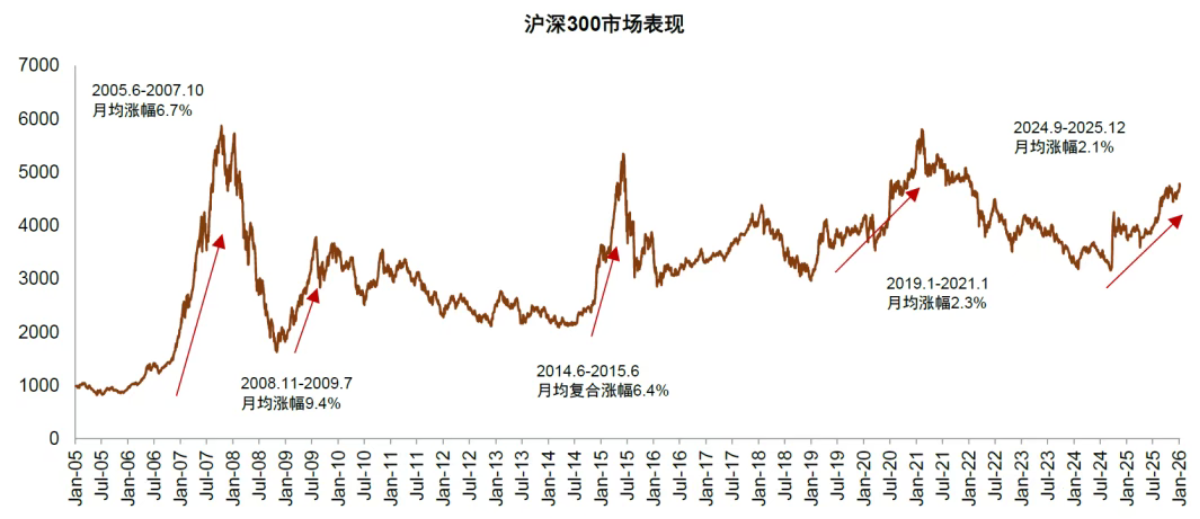
这次“慢牛”真的来了?中金:本轮牛市目前斜率为史上最小
Mei Ri Jing Ji Xin Wen· 2026-01-21 01:41
Group 1 - The core viewpoint of the articles indicates that regulatory measures are being implemented to "cool down" the market, including raising margin financing ratios, large-scale redemptions of broad-based ETFs, and suspending high-priced stocks for review [1][3] - Despite significant outflows from ETFs, the market has shown resilience, with sectors like power grid equipment and domestic demand experiencing upward rotations, maintaining high trading activity among investors [1] - Institutions are optimistic that under various reforms, the A-share market is expected to transition from a "short bull, long bear" pattern to a "slow bull" market similar to those in the US, Japan, and Europe [1] Group 2 - According to CICC, the current environment for A-shares is more conducive to a slow bull market than at any time in history, driven by factors such as the restructuring of international monetary order, economic transformation, and significant changes in profit drivers [3] - The market is expected to remain optimistic about long-term trends, with funds that missed the initial rally entering the market during adjustments, providing support for the market's bottom [3] - In terms of investment strategy, under the current volatile conditions, it is suggested to focus on broad-based indices, with low-risk investors encouraged to invest in large-cap value and growth style indices, such as the CSI 300 ETF and the ChiNext 50 ETF, which have the lowest management fees in the market at 0.15% per year [3]

A股盘前播报 | 日债风暴叠加格陵兰危机,“抛售美国”重现!美股债汇三杀
智通财经网· 2026-01-21 00:50
Market Overview - The Japanese long-term bond market is experiencing significant sell-offs, leading to a "sell America" trading pattern, causing declines in U.S. stocks, bonds, and the dollar [1] - The S&P 500 recorded its largest drop in October, with popular Chinese concept stocks also declining [1] - The 10-year U.S. Treasury yield rose above 4.29%, while the dollar fell nearly 0.5%, briefly dropping below 98 [1] Macro Policy - A comprehensive policy package aimed at boosting domestic demand has been announced, with a focus on promoting private investment and key sectors [2] - The National Development and Reform Commission is working on a strategic implementation plan for expanding domestic demand from 2026 to 2030 [2] - The Ministry of Finance has released five policies, including optimizing personal consumption loan subsidies [2] A-Share Market - Goldman Sachs maintains a "slow bull" outlook for A-shares, expecting over 3 trillion RMB in new capital inflows despite recent cooling in the margin trading market [3] - The Shanghai Composite Index has recently broken through significant thresholds, with domestic asset reallocation potentially accelerating [3] - An estimated 2 trillion RMB from individual investors and over 1 trillion RMB from institutional investors are expected to flow into the market [3] Urban Renewal and Infrastructure - The Ministry of Natural Resources and the Ministry of Housing and Urban-Rural Development have issued measures to support urban renewal actions [4] - The initiative allows for the development of state-supported industries using existing land and property resources, with transitional policies in place [4] - Urban renewal efforts are currently expanding to 35 cities, with potential for further pilot expansions, focusing on new infrastructure and regional development [4] Medical Device Industry - The National Healthcare Security Administration has clarified charging guidelines for robotic surgeries, which is expected to accelerate the commercialization of medical devices [11] - The medical device industry is anticipated to evolve towards a higher development stage, leveraging technological platforms and AI diagnostics [11] Commercial Aerospace - The commercial aerospace sector is witnessing a surge, with multiple satellite launches by banks occurring recently [12] - Currently, the completion rate for the deployment of two major satellite constellations in China is only about 1%, indicating significant growth potential in the coming years [12]


读研报 | 理解增量资金,别总盯着总量
中泰证券资管· 2026-01-20 11:33
Core Viewpoint - The article discusses the importance of incremental capital as a market confidence indicator and a key factor in assessing market trends, highlighting the challenges in accurately predicting its inflow [1] Group 1: Incremental Capital Estimates - Different research reports provide varying estimates for incremental capital inflow in 2026, with projections ranging from 1.6 trillion to 3 trillion yuan, indicating significant discrepancies [1] - The analysis suggests that understanding the sources and types of capital is more practical than merely estimating total amounts [1] Group 2: 2025 Incremental Capital Breakdown - According to the Guosen Securities strategy report, the incremental capital for 2025 is divided into two phases: the first half sees retail investors transferring 240 billion yuan, foreign capital returning approximately 100 billion yuan, and long-term investments from insurance funds amounting to about 420 billion yuan [2] - The second half of 2025 is expected to see significant inflows from private equity and leveraged trading, with an estimated 700 billion yuan entering the market since July and around 400 billion yuan from private equity funds [2] - The sectors attracting the most capital in the first half include technology and dividend stocks, while the second half sees inflows into non-ferrous metals, electronics, and new energy sectors [2] Group 3: 2026 Main Sources of Incremental Capital - The Huatai Securities strategy report identifies three main sources of incremental capital for 2026: high-risk preference retail funds, medium-low risk preference retail funds, and long-term capital [4] - High-risk preference funds include retail, financing, and private equity funds, while medium-low risk funds consist of maturing fixed deposits with an estimated 8% allocated to non-monetary asset management products [4] - The Huaxin Securities report anticipates public funds, wealth management funds, and insurance funds as the top three sources of incremental capital [4] Group 4: Market Outlook - The article suggests that if a slow bull market becomes the prevailing trend, the main sources of incremental capital will likely be insurance and absolute return-focused funds, indicating potential investment opportunities [5]

喜娜AI速递:今日财经热点要闻回顾|2026年1月20日
Xin Lang Cai Jing· 2026-01-20 11:24
Group 1: A-Share Market Dynamics - The potential incremental capital scale for A-shares in 2026 may reach 3 trillion yuan, with public funds, insurance capital, and bank wealth management as the main contributors [2][7] - After the market warmed up since December 2025, retail investors' willingness to enter the market increased, with a net inflow of 155.7 billion yuan in the first week after New Year [2][7] - A-share market experienced a decline on January 20, with the ChiNext index dropping nearly 2%, influenced by regulatory actions and external market pressures [2][7] Group 2: Economic Forecasts and Trends - The IMF has raised the economic growth forecast for China and the US, predicting growth rates of 4.5% and 4.0% for China in 2025 and 2026, respectively [3][8] - The IMF warns that the AI boom could act as a "double-edged sword," potentially leading to financial market adjustments if productivity expectations are reassessed [3][8] Group 3: Corporate Developments - Yingfang Microelectronics announced a major asset restructuring plan, aiming to acquire 100% stakes in Shanghai Xiaokeli and Fujide China to enhance its semiconductor service platform [3][8] - 451 A-share listed companies have disclosed their 2025 earnings forecasts, with 156 companies expecting positive results, driven significantly by AI [4][9] Group 4: Regulatory Actions - The Zhejiang Securities Regulatory Bureau imposed penalties exceeding 83 million yuan on a prominent investor for market manipulation, resulting in a three-year ban from the securities market [4][9] Group 5: Global Market Reactions - US stock index futures and European stocks fell sharply following Trump's announcement of tariffs on European goods, with Germany indicating a unified response from Europe [5][10]

高盛维持A股“慢牛”预判
Di Yi Cai Jing Zi Xun· 2026-01-20 08:51
Group 1 - The core viewpoint of the article is that the A-share market is expected to continue a "slow bull" trend in 2026, with healthy market conditions compared to the "crazy bull" of 2015, and any signs of overheating will prompt quick policy adjustments [2][4] - Goldman Sachs predicts that over 3 trillion RMB of new domestic capital will flow into the stock market in 2026, including approximately 2 trillion from individual investors and over 1 trillion from institutional funds [2][5] - The net buying of southbound funds is expected to reach 200 billion USD (approximately 1.4 trillion RMB) in 2026, setting a new historical high [2][5] Group 2 - Recent market signals indicate a cooling trend, with the trading volume dropping below 3 trillion RMB after reaching 3.94 trillion RMB on January 14 [3][4] - The increase in financing margin ratios by exchanges is seen as a measure to cool the margin trading market, while some previously popular sectors are showing signs of risk [4] - Investor sentiment indicators for individual investors are not showing excessive confidence compared to previous high-confidence periods, suggesting a more controlled risk environment [4][5] Group 3 - The driving force behind the market's rise is shifting from valuation expansion to profit-driven growth, with expected profit growth rates accelerating from 4% in 2025 to 14% in 2026 and 2027 [5][7] - The total amount of dividends and buybacks is projected to approach 570 billion USD (approximately 4 trillion RMB), while IPO fundraising is expected to exceed 100 billion USD (approximately 700 billion RMB), marking an 80% year-on-year increase [5][6] - There is a notable increase in interest from overseas investors in the Chinese market, although large-scale buying has not yet materialized [5][6] Group 4 - The macroeconomic outlook indicates that China's GDP is expected to grow by 4.8% in 2026, with a "front low, back high" growth pattern anticipated due to base effects [7][8] - The export sector is expected to remain a core driver of economic growth, with a projected annual growth rate of 5% to 6% in export volume over the next few years [2][7] - Consumer spending is showing structural differentiation, with service consumption expected to outpace goods consumption, while government spending is anticipated to provide support as debt pressures ease [7][8]


高盛维持A股“慢牛”预判
第一财经· 2026-01-20 08:38
2026.01. 20 "因此,慢牛行情继续开展的概率较高。"刘劲津在1月20日的媒体会上称,高盛维持对A股将继续演 绎"慢牛"行情的预判。 该机构的模型指标显示出,近期,个人和机构投资者的估值偏好提升,但投资者情绪并未过热。资金 层面,高盛预测,2026年将有超过人民币3万亿元的国内新增资本流入股市,其中包含约2万亿的个 人投资者配置、逾1万亿机构资金。同时,2026年南向资金净买盘有望达到2000亿美元(约合人民 币1.4万亿元),再创历史新高。 宏观方面,高盛首席中国经济学家闪辉预计,2026年出口将继续保持强劲,成为拉动经济增长的核 心动力,预测未来几年中国出口量将每年增长5%至6%。 外资尚未大规模买入 今年开年,A股"开门红",沪指在突破4000点之后,快速站上4100点,火热行情在近期继续升温,1 月14日,两市成交额达到3.94万亿元。不过,1月19日两市日成交额缩量至3万亿以下。 本文字数:2164,阅读时长大约4分钟 作者 | 第一财经 周楠 封图 | AI生成 2026年开年以来,A股行情拾级而上,沪指连续突破重要整数关口,但在近期,两融市场迎来降温 信号,A股缩量震荡,前期的热门概念股 ...

高盛维持A股“慢牛”预判,上涨动力切换为盈利驱动
Di Yi Cai Jing· 2026-01-20 06:29
Market Overview - The A-share market has shown a steady upward trend since the beginning of 2026, with the Shanghai Composite Index breaking through significant psychological barriers, although recent signals indicate a cooling in the margin trading market and a decline in previously popular concept stocks [1][2] - Goldman Sachs maintains a positive outlook for the A-share market, predicting a continuation of a "slow bull" market, contrasting it with the "crazy bull" market of 2015, citing healthier market conditions and quick policy adjustments if overheating occurs [1][3] Investor Sentiment and Capital Inflow - Goldman Sachs' model indicates that both individual and institutional investors have increased their valuation preferences, but overall investor sentiment has not reached overheating levels [3][4] - The firm forecasts over 3 trillion RMB in new domestic capital inflows into the stock market in 2026, including approximately 2 trillion from individual investors and over 1 trillion from institutional investors [1][4] Economic Growth and Exports - Goldman Sachs' chief economist predicts that exports will remain a core driver of economic growth in 2026, with an expected annual growth rate of 5% to 6% for the next few years [1][7] - The GDP for 2025 is estimated at 140 trillion RMB, with a growth rate of 5%, while 2026 is projected to see a GDP growth rate of 4.8%, with a "front low, back high" growth pattern anticipated [7][8] Sector Performance and Investment Trends - The market's upward momentum is expected to shift from valuation expansion to profit-driven growth, with corporate profit growth projected to accelerate from 4% in 2025 to 14% in 2026 and 2027 [4][8] - Goldman Sachs highlights a positive outlook for AI-related sectors and has upgraded hardware stocks to a high allocation, while favoring service sectors in consumer areas and focusing on materials in cyclical sectors [4][6] Foreign Investment and Market Dynamics - Despite a strong start to the year, foreign capital has not yet entered the market on a large scale, although interest from overseas investors has increased [4][5] - The firm anticipates that global bullish investors may narrow their underweight positions in Chinese stocks, potentially leading to an additional 10 billion RMB in buying [5]
慢牛背景下,券商板块行情会缺席吗?
Mei Ri Jing Ji Xin Wen· 2026-01-20 00:26
Group 1 - The core viewpoint of the report from CITIC Securities is that the recent short-term adjustment in the securities sector does not indicate the end of the market trend, as the sector is currently supported by strong fundamentals at a low valuation level [1] - The report identifies two potential upward paths for the securities sector under a slow bull market: one is based on the stabilization of trading volume leading to valuation increases, and the other is driven by unexpected financial policy catalysts that could break through valuation ceilings [1] - Both scenarios suggest that the brokerage market will not be absent, and a window for left-side positioning is gradually approaching [1] Group 2 - Huatai Securities indicates that the expectation for the U.S. uranium replenishment cycle is strengthening, which further reinforces the logic of the uranium mining sector from the demand side [2] - The report highlights that due to rigid supply-side bottlenecks, uranium prices are expected to remain in an upward channel [2] - The recommendation continues to favor domestic uranium suppliers in the U.S. and trading partners, as they are likely to benefit first from the tight supply expectations [2] Group 3 - CITIC Securities emphasizes the upcoming release of Tesla's Optimus Gen3 in the first quarter, which is expected to maintain market anticipation for the robotics sector [3] - The report notes that Tesla's supply chain is gradually entering a verification phase, focusing on quality segments to capture certainty and core changes [3]


A股震荡轮动下,如何抓住机会?
Guo Ji Jin Rong Bao· 2026-01-19 18:30
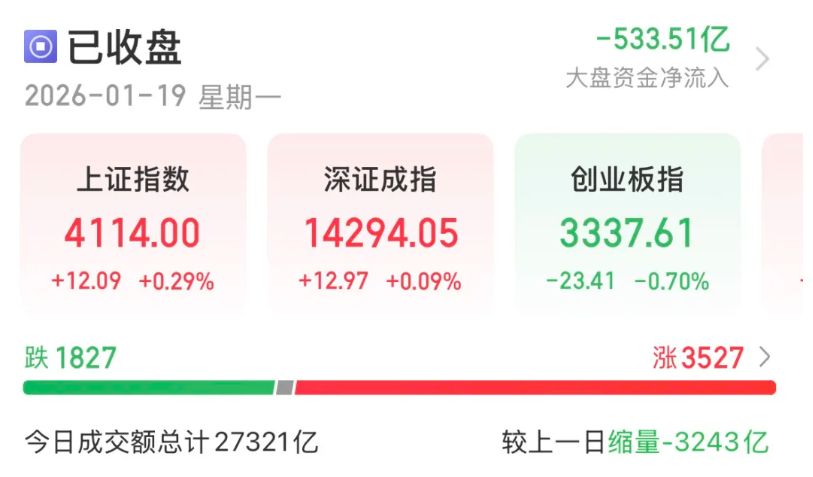
Core Viewpoint - The A-share market continues to experience narrow fluctuations, with most stocks closing in the green but showing increased differentiation and accelerated rotation, particularly in the power equipment sector, aerospace, and a continued pullback in AI applications [1][3]. Market Performance - The Shanghai Composite Index rose by 0.29% to 4114 points, while the ChiNext Index fell by 0.7% to 3337.61 points. The Shenzhen Component, CSI 300, and Northbound 50 indices showed slight gains, while the Sci-Tech 50 and SSE 50 indices experienced minor declines [4]. - The trading volume decreased to 324.3 billion yuan, with a total turnover of 2.73 trillion yuan. As of January 16, the margin financing balance in the Shanghai and Shenzhen markets increased to 2.73 trillion yuan [4]. Stock Performance - A total of 3527 stocks closed higher, with 103 hitting the daily limit up, while 1828 stocks closed lower, with 30 hitting the daily limit down. Only 16 stocks had a daily turnover exceeding 10 billion yuan [6]. - Notable performers included TBEA Co., Ltd. (30.50 yuan, +66.6%), Goldwind (27.70 yuan, +2.44%), and China Satellite (104.89 yuan, +2.93%) [7][12]. Sector Analysis - The power equipment sector saw significant gains, with 23 stocks hitting the daily limit up. Key contributors included TBEA Co., Ltd., which rose by 66.6%, and several other companies in the sector showing increases of over 10% [12][13]. - The chemical, oil, automotive, and military sectors also performed well, while sectors such as computers and communications experienced declines [10][15]. Investment Strategy - Investors are advised to focus on sectors with strong industrial trends, clear policy expectations, and robust earnings performance. There is a caution against sectors that have seen significant price increases and high valuations [3][15]. - The market is expected to maintain a "slow bull" trend under policy support, with a focus on structural opportunities in industries like new energy, digital economy, and aerospace [14][18].