新零售模式

Search documents
百亚股份: 2025年半年度报告
Zheng Quan Zhi Xing· 2025-08-15 16:14
Core Viewpoint - The report highlights the financial performance and strategic initiatives of Chongqing Baiya Sanitary Products Co., Ltd. for the first half of 2025, showcasing growth in revenue and net profit despite challenges in cash flow and market competition. Financial Performance - The company reported a revenue of CNY 1,763,899,831, representing a 15.12% increase compared to CNY 1,532,255,704 in the same period last year [2] - Net profit attributable to shareholders was CNY 188,037,757, a 4.64% increase from CNY 179,706,570 [2] - The net cash flow from operating activities decreased by 64.55% to CNY 67,681,434 from CNY 190,939,304 [2] - Total assets decreased by 11.82% to CNY 1,896,547,793 from CNY 2,150,862,064 at the end of the previous year [2] Business Overview - The company specializes in the research, production, and sales of disposable personal hygiene products, including sanitary napkins, baby diapers, and adult incontinence products [3][5] - Major brands include "Free Point," "Good," and "Danning," which are positioned in the mid-to-high-end market segment [3][11] - The company employs a multi-brand and differentiated development strategy, focusing on the Sichuan-Chongqing market while expanding nationally and enhancing e-commerce capabilities [6][12] Market Trends - The disposable hygiene products market in China is projected to reach CNY 132.13 billion in 2024, with a growth rate of 13.8% from 2023 [7] - The female hygiene products market is expected to grow by 23.3%, while the baby hygiene products market is projected to decline by 1.7% [7] - There is a trend towards high-end, diversified, and personalized products as consumer health awareness increases [8] Competitive Position - The company has established a strong brand image in the domestic market, with "Free Point" ranked second among local sanitary napkin brands in terms of market share [10] - The company has received multiple awards for product quality and innovation, including recognition as a "Chinese Famous Trademark" [9][10] - The company maintains a competitive edge through advanced production technology, a robust supply chain management system, and a focus on research and development [14][15]
首店经济如何催生现象级消费场景
Qi Lu Wan Bao· 2025-08-07 21:09
Core Insights - Hema Fresh's first store in Yantai opened on July 25, attracting over 40,000 daily visitors in its first week and a 50% increase in online orders compared to pre-opening levels [1][3][4] Group 1: Store Performance - The store has become a phenomenon in consumer experience, ranking among the top in sales nationwide for Hema Fresh [1][3] - Daily customer flow has remained high, with staff working around the clock to restock popular items like durians and king crabs [3][4] - The store features a mix of high-end and affordable products, integrating shopping and dining experiences [4][5] Group 2: New Retail Model - Hema Fresh operates under a new retail model that emphasizes fresh products and quality, supported by a robust supply chain and direct sourcing [5][6] - The model combines online and offline resources, allowing for rapid delivery and high inventory turnover, outperforming industry averages [5][6] Group 3: Economic Impact - The success of Hema Fresh's first store reflects the "first store economy" in Yantai, which has been actively promoted by local government policies [7][8] - Yantai's retail sector has shown resilience, with a 6.2% year-on-year growth in retail sales, driven by a young population eager to spend [8] Group 4: Future Outlook - The store's management anticipates sustained popularity for at least another month, with plans to enhance service and supply chain efficiency [9] - The local government aims to leverage Hema Fresh's model to encourage more brands to enter the market, fostering a modernized commercial landscape [9][10]
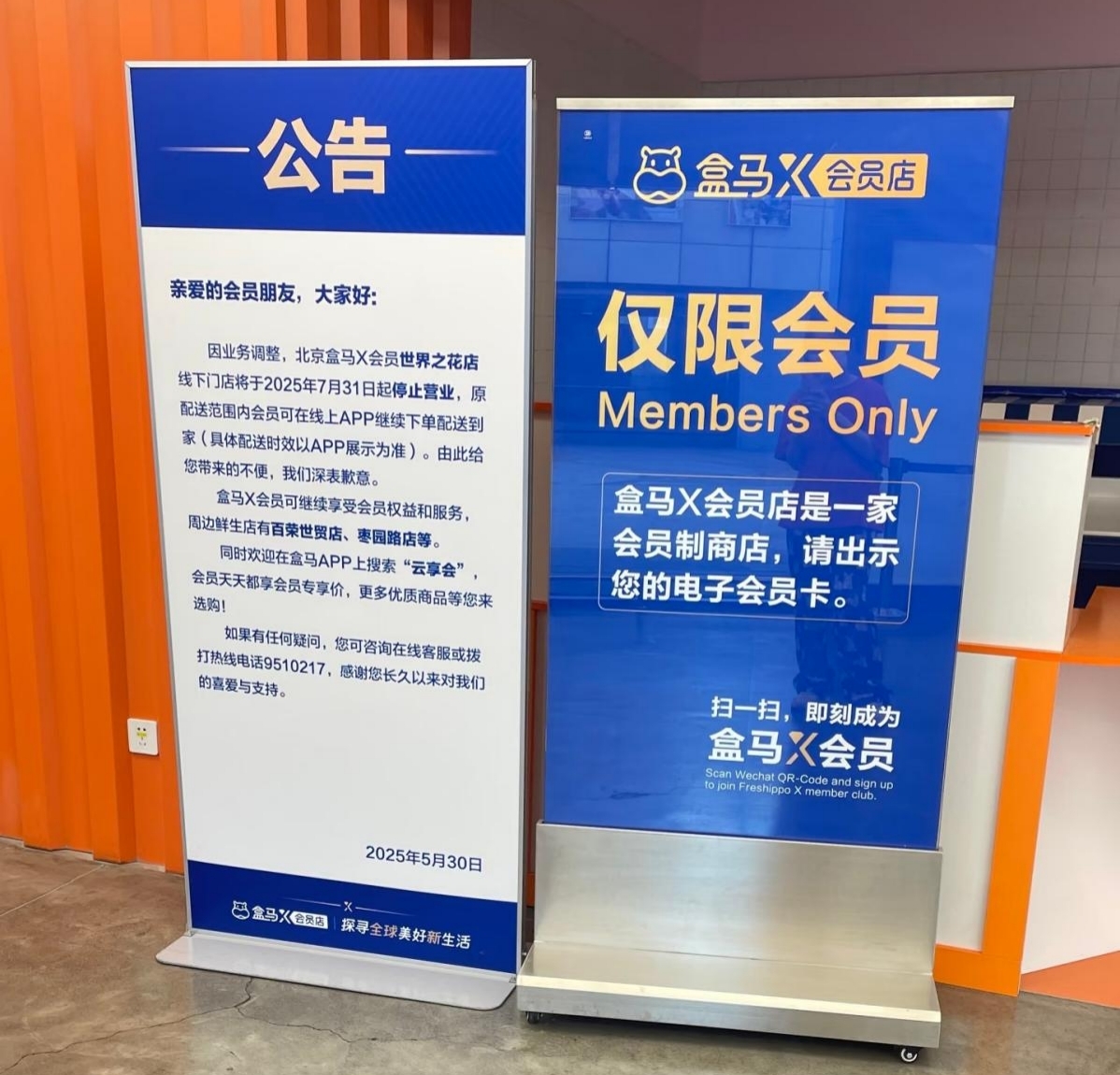
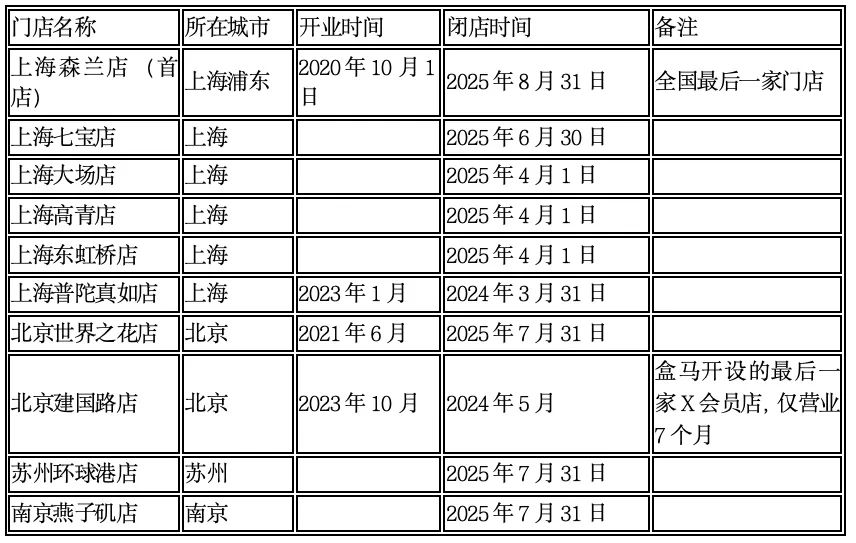
盒马X会员店黯然退场,中国定位专家顾均辉:定位失误的必然结果
Cai Fu Zai Xian· 2025-08-07 09:16
Group 1 - The core strategy of Hema has been clarified as a dual-line approach focusing on Hema Fresh and Hema NB, with Hema Fresh leading the market and Hema NB expanding its market share in the community supermarket sector [1] - Hema X membership store is set to close its Shanghai Senlan store, marking its complete exit from the retail stage, less than five years after its first store opening [4] - The failure of Hema X is attributed to a fundamental misalignment in positioning rather than just market environment changes, highlighting the importance of brand perception in consumer behavior [4][5] Group 2 - The primary challenge for Hema X is the difficulty in cultivating consumer awareness of the paid membership model, which is not well established in the Chinese retail market compared to competitors like Sam's Club [5] - Hema X's contribution to Hema's overall sales is less than 10% as of 2023, indicating a severe imbalance between investment and returns due to its high-cost, asset-heavy positioning [7] - Hema X lacks a differentiated product system, with its offerings closely resembling those of Hema Fresh, failing to provide unique and attractive products that meet consumer expectations [8] Group 3 - Successful positioning requires a deep understanding of target consumer perceptions and needs, which Hema X failed to achieve by attempting to cover a broad market, including lower-tier cities with less consumer awareness of membership value [9] - The high barriers to entry in the membership warehouse sector and the need for unique value recognition in consumer minds are critical lessons from Hema X's failure [12]

日均4万人次,盒马首店催生现象级消费场景,烟台人为何爱买买买
Qi Lu Wan Bao Wang· 2025-08-07 01:31
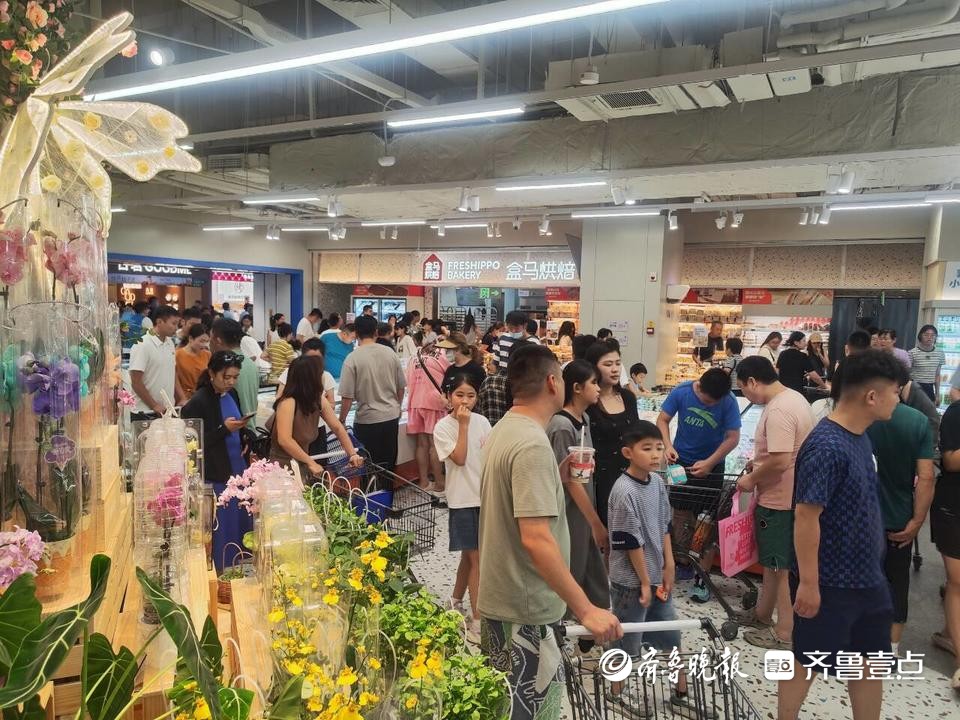
齐鲁晚报.齐鲁壹点闫丽君王琳 "开业一周日均客流4万+、线上订单比开业前激增50%"——这是盒马鲜生烟台首店开业一周来的成绩。这家4000平方米的网红超市烟台 店自7月25日开业以来,带来了当下稀缺的现象级消费场景,客流源源不断,周销量排名该品牌全国门店前列。 作为烟台招引的首店品牌,盒马现象级消费场景诞生的背后原因是什么?由这一现象看城市消费升级,烟台能否培育出更多火爆的消费 场景?近日,齐鲁晚报.齐鲁壹点记者多方探访寻找答案。 连续一周限流 7月25日,盒马鲜生烟台首店开业。开业当天,不少网友曾在网络平台发布视频记录人流如织的火爆现场。 7月29日下午3点左右,齐鲁晚报.齐鲁壹点记者来到位于烟台大悦城(000031)负一楼的盒马鲜生超市,看见超市出口处依然排着长队, 人群中几乎人人都拎着盒马购物袋,还有两三个人拎五六个盒马袋子,缓慢往外走。 7月29日,在盒马鲜生烟台首店,不少市民前来选购商品 进入盒马鲜生超市发现,无论是烘焙区、果饮区,还是生鲜区、餐饮区都围满了人。 "我们刚从龙口过来,以前老买盒马代购,听说盒马烟台首店开业了就来转转,实体店比代购的新鲜,东西也多。"龙口市民张艳艳带着 家人和朋友赶来, ...

从高光到落幕,盒马X会员店将全线关停
Guo Ji Jin Rong Bao· 2025-08-05 09:20
Core Insights - Hema's X membership store model, once seen as a promising new retail strategy, is set to close completely by August 31, marking a significant retreat from the membership store market in China [1][4] Group 1: Store Operations and Closure - As of August 5, only four Hema X membership stores remain operational, with the last one in Shanghai announcing its closure [1] - The X membership store model was launched in October 2020, aiming to create a unique membership shopping experience, but has failed to sustain its presence in the market [1][2] Group 2: Expansion and Membership Statistics - In 2021, Hema X membership stores experienced rapid expansion, with a goal to surpass Hema Fresh, reaching a membership count of 2.97 million by the end of the 2022 fiscal year [2] - Membership fee revenue contributed 588 million yuan, indicating a significant financial input from this segment [2] Group 3: Strategic Shift and Future Direction - In 2023, Hema paused membership renewals, indicating a strategic pivot towards Hema Fresh stores and community discount stores, deeming the X membership store as a non-strategic business [4][5] - Following a leadership change in March 2024, Hema reported nine consecutive months of profitability and a 50% year-on-year increase in customer numbers, contrasting sharply with the declining X membership store segment [5] Group 4: Market Challenges and Competitive Landscape - Experts suggest that the failure of Hema X membership stores stems from a lack of core retail values and service, particularly when compared to established competitors like Sam's Club and Costco [6] - Economic downturns and consumer fatigue have further exposed the weaknesses in Hema's membership model, highlighting issues with product differentiation and supply chain efficiency [6]
商超白酒成新宠,零售巨头如何引领白酒市场新风潮?
Sou Hu Cai Jing· 2025-07-28 00:10
Core Insights - A new force is reshaping the liquor market, driven by large retail giants like Pang Donglai, Sam's Club, and Hema Fresh, which are innovating sales strategies and capturing consumer interest [1][3] Group 1: Market Trends - The "Jiu Gui Jiu - Free Love" series launched by Pang Donglai in collaboration with Jiu Gui Jiu sold out quickly at a price of 200 yuan, indicating strong market demand [1] - Sam's Club's "General Fen" white liquor, priced at 115.9 yuan for a 950ml bottle, has consistently ranked at the top of white liquor sales on the Sam's app [1] - The trend of self-drinking and dining out is becoming mainstream as business banquets and gift-giving scenarios decline, leading to a demand for high-quality "daily liquor" priced below 300 yuan [3] Group 2: Retail Strategies - Retailers are leveraging customized white liquor to enhance competitive differentiation and brand influence, which allows them to maintain pricing power and attract more customers [4] - The collaboration between retail and production sectors is crucial, as supermarkets provide a new opportunity for small and medium-sized liquor companies to navigate industry cycles [4] - Supermarkets are utilizing their traffic advantages and membership data to effectively reach a broad consumer base, significantly reducing distribution costs [4] Group 3: Sales Performance - The sales of white liquor in supermarkets have become a common phenomenon, with products like "Free Love 1995" from Pang Donglai and "Green Neck Xi Feng" performing strongly [1][3] - The sales strategy focused on quality and cost-effectiveness has not only led to substantial sales performance for supermarkets but also provided new development insights for the liquor industry [6]

人人乐超市摘牌:曾经的“巷战”之王,市值仅存1%黯然退场
Guan Cha Zhe Wang· 2025-07-15 05:36
Core Viewpoint - The article discusses the decline and delisting of Renrenle, a prominent private supermarket chain in Shenzhen, highlighting its struggles against competition and failure to adapt to market changes, ultimately leading to its exit from the stock market [3][11]. Company Overview - Renrenle, founded in 1996, initially thrived in the retail market, competing directly with international giants like Carrefour and Walmart [4][6]. - The company went public in 2010, becoming the "first private supermarket stock," with a market value exceeding 130 billion yuan at its peak [6]. Financial Performance - Renrenle's stock was delisted on July 4, 2024, after entering a trading suspension on June 13, 2024, with a final share price of 0.36 yuan, marking a drastic decline from its peak market value of 136 billion yuan [3][6]. - The company reported a revenue of 14.3 billion yuan in 2024, a 49.86% decrease year-on-year, and a net loss of 170 million yuan, following consecutive years of losses [9]. Strategic Missteps - The company failed to adapt to the rise of e-commerce, leading to a strategic misalignment that resulted in significant financial losses [8][10]. - Renrenle's aggressive expansion strategy, including a "five-year ten-thousand store plan," overlooked the importance of profitability and operational efficiency, contributing to its financial struggles [8][9]. Management Issues - The company faced internal challenges, including a family-controlled management structure that led to high turnover among key executives and a lack of strategic direction [10][11]. - Frequent changes in leadership and management practices created instability, further exacerbating the company's decline [10][11]. Industry Context - Renrenle's delisting reflects broader challenges faced by traditional supermarkets in China, with many struggling to compete against e-commerce and changing consumer behaviors [12][19]. - Other major retailers, such as Carrefour and Walmart, have also faced significant challenges, with many closing stores and restructuring their business models in response to market pressures [12][19].


激烈竞争下传统商超面临转型压力
Jin Rong Shi Bao· 2025-07-11 01:41
Core Viewpoint - Renrenle, a traditional retail chain, is set to delist from the Shenzhen Stock Exchange on July 4, 2025, marking a significant shift in China's retail landscape amid increasing competition and the rise of e-commerce [1][2]. Company Summary - Founded in 1996, Renrenle was once a flagship retail enterprise in Shenzhen and was listed in 2010 as "the first private supermarket stock" [2]. - The company faced its first loss in 2012, struggling with rising costs and intensified competition, leading to a decline in customer numbers and continuous losses from 2014 to 2023 [2][3]. - In 2024, Renrenle reported a revenue of 1.43 billion yuan, a year-on-year decrease of 49.86%, and a net profit attributable to shareholders of -17 million yuan, compared to a loss of 498 million yuan the previous year [2]. Industry Summary - The challenges faced by Renrenle reflect broader issues within the traditional retail sector, including high operational costs, declining foot traffic, and the impact of e-commerce [3][4]. - Analysts note that the retail industry is entering a phase where leading companies like Walmart are performing well, while mid-sized players like Renrenle and Carrefour struggle due to lack of scale and flexibility [4]. - The emergence of new retail formats, such as discount retail and membership supermarkets, poses additional challenges for traditional retailers, necessitating a shift towards efficiency and differentiation to survive [5][6].
77%受访酒企市场遇冷!当消费者定义价值,白酒业从何雄起?丨封面观酒
Sou Hu Cai Jing· 2025-06-19 11:50
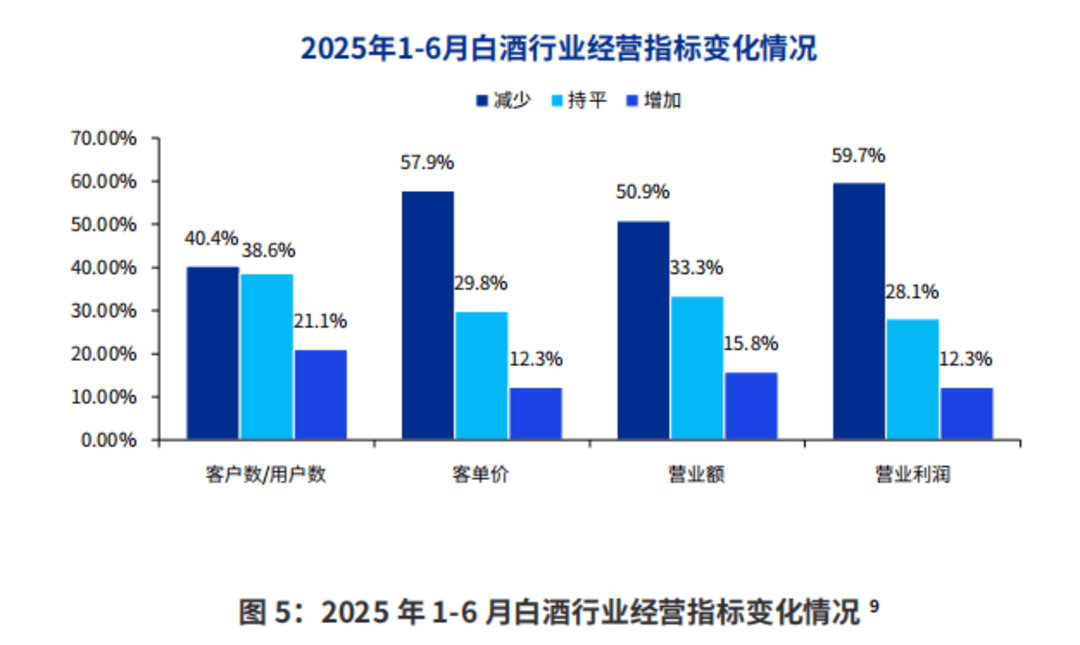
Core Insights - The report highlights a significant shift in the Chinese liquor industry, indicating that the core proposition has transitioned from "enterprise-led" to "consumer-defined value" [1] - The industry is facing challenges such as capacity growth, demand slowdown, and price declines, with a notable shift in consumer preferences towards higher cost-performance alternatives [2][5] Industry Overview - The Chinese liquor industry is currently experiencing a "triple period overlap" characterized by policy adjustments, differentiated consumption structure, and deep adjustments in existing competition [2] - In Q1 2025, the national liquor production was 1.032 million kiloliters, representing a year-on-year decline of 7.2% [2] - 59.7% of enterprises reported a decrease in profits, indicating significant pressure on the industry due to cautious consumer sentiment and rising costs [2] Demand Dynamics - Only 21.1% of enterprises reported an increase in customer numbers, reflecting a consensus on the shrinking consumer base for liquor [5] - Sales during major holidays were disappointing, with 61.5% of distributors and retailers noting a decrease in consumption during the Spring Festival and subsequent days [5] - The report indicates a "旺季不旺" (peak season not prosperous) scenario, with limited demand recovery and weakened consumption scenarios [5] Pricing Trends - The report shows a downward trend in pricing, with the best-performing price ranges being 100-300 RMB, 300-500 RMB, and below 100 RMB [8] - The most significant price inversion occurs in the ranges of 800-1500 RMB, 500-800 RMB, and 300-500 RMB, indicating challenges for products in the mid-range [8] Market Sentiment - 77% of enterprises reported a cooling market, with only 2% perceiving signs of market recovery [13] - The sentiment reflects a persistent pessimism compared to the previous year, where 80% of enterprises felt the market was cooling [13] Strategic Responses - Over 80% of distributors and retailers prioritize cash flow preservation, while 66.7% of liquor producers focus on expanding market share [14][18] - Strategies include concentrating resources on core products, developing new products, and targeting younger demographics [18] Online Sales Growth - From January to May, online liquor sales exceeded 60 million bottles, with total sales surpassing 3 billion RMB [21] - 42.9% of enterprises reported growth in online business, indicating a shift towards digital channels in response to weak traditional sales [21] Long-term Industry Outlook - The report emphasizes the need for a shift in industry expectations, advocating for a focus on value enhancement rather than blind expansion [25] - Recommendations include evolving the manufacturer-distributor relationship into a "value community" and enhancing service experiences in both online and offline channels [25]
新股消息 | 极易科技闯关港交所 中国跨境进口电商运营服务商中排名第一
智通财经网· 2025-06-18 13:19
Core Insights - The article highlights the growth and positioning of the company, Jiyi Technology, as a leading digital retail comprehensive operation service provider in China, focusing on AI-driven brand asset management and cross-border e-commerce services [3][4]. Company Overview - Jiyi Technology is recognized as the second-largest digital retail comprehensive operation service provider in China and the fifth-largest e-commerce operation service provider based on GMV projections for 2024 [3]. - The company ranks first among cross-border import e-commerce operation service providers in China according to GMV for 2024 [3]. Financial Performance - The company's GMV increased from 8.2 billion RMB in 2022 to 11.1 billion RMB in 2023, representing a growth of 35.1%, and is projected to reach 15 billion RMB in 2024, further increasing by 35.3% [4]. - Revenue figures for the years 2022, 2023, and 2024 are approximately 1.12 billion RMB, 1.36 billion RMB, and 1.4 billion RMB respectively [4][6]. - The company reported annual profits of approximately 37.6 million RMB in 2022, 24.9 million RMB in 2023, and 49.8 million RMB in 2024 [4][6]. Service Capabilities - Jiyi Technology has established partnerships with over 200 global brands across various sectors, including health, beauty, fast-moving consumer goods, home, and appliances [3]. - The company provides digital retail comprehensive operation services to major supermarkets, assisting traditional retailers in integrating online and offline channels [3]. Market Positioning - The company has transitioned from a traffic-oriented e-commerce operation model to a consumer demand-driven model, focusing on product innovation and consumer scenario construction [4].