
港股估值修复

Search documents
人民币持续走强!南向资金9月加仓超1100亿港元
券商中国· 2025-09-17 21:45
Core Viewpoint - The offshore RMB has strengthened against the USD, indicating a potential long-term appreciation cycle for RMB assets, with significant inflows into Chinese technology stocks in the Hong Kong market driven by expectations of US Federal Reserve interest rate cuts [2][4]. Currency and Market Performance - On September 17, the offshore RMB broke the 7.10 mark against the USD, reaching a high of 7.0995, the first time since November of the previous year. The onshore RMB also hovered around the 7.10 mark, with a peak of 7.1036 [3]. - The Hong Kong dollar has also strengthened, moving away from the weak end of its peg against the USD, trading at 7.78 HKD per USD as of September 17 [3]. - The one-month Hong Kong Interbank Offered Rate (HIBOR) has decreased from 4% at the end of August to 3.21% on September 17, indicating easing liquidity conditions [3]. Foreign Investment Trends - There has been a notable increase in foreign capital inflows into Chinese assets, with foreign investment in the Hong Kong market rising to 66%, compared to 79% in 2022, suggesting room for further growth [4]. - In August, foreign investors allocated nearly $45 billion to emerging market stocks and bonds, with China receiving a significant portion, totaling a net inflow of $39 billion in bonds and stocks [4]. Southbound Capital Inflows - Southbound capital has accelerated, with over 110 billion HKD added in September alone, contributing to a total net purchase of over 1.1 trillion HKD year-to-date. Internet leading companies have been the focus of this inflow [5]. - The Hang Seng Tech Index surged by over 11% in September, reaching a new high of 6300 points, with significant contributions from major tech stocks like Tencent and Alibaba [5][6]. Market Outlook - The Hang Seng Tech Index is currently valued at only half of the Nasdaq, indicating substantial room for valuation recovery. The market is expected to benefit from abundant liquidity and the anticipated US interest rate cuts [5][6]. - The combination of easing monetary policy in both the US and China is likely to create a favorable environment for further capital inflows into the Hong Kong stock market, which is viewed as a global valuation low point [6].

发飙了!港股突然全线大涨,发生了什么?
天天基金网· 2025-09-17 08:08
Core Viewpoint - The Hong Kong stock market has experienced a significant surge, with major tech stocks like Baidu, NIO, Meituan, and JD Group seeing substantial gains, driven by positive sentiment and upgraded ratings from foreign investors [3][4][6]. Group 1: Market Performance - The Hang Seng Technology Index rose over 3.6%, while the Hang Seng Index increased by more than 1.4%, indicating a strong performance in the tech sector [3]. - Alibaba's stock opened 2.74% higher, reaching a nearly four-year high, contributing to the overall market capitalization of Hong Kong stocks exceeding HKD 3 trillion [4]. - The year-to-date performance of the Hang Seng Index has surpassed 30%, outperforming the S&P 500's less than 20% increase [8]. Group 2: Analyst Ratings and Forecasts - Citigroup maintained a buy rating for Tencent, setting a target price of HKD 735 per share, based on a comprehensive valuation method [6]. - Goldman Sachs raised Alibaba's cloud valuation from USD 36 to USD 43 per ADS, adjusting the target price for Alibaba's stock to USD 179 for U.S. shares and HKD 174 for Hong Kong shares, while maintaining a buy rating [7]. - Credit Suisse reiterated a strong buy rating for BYD's H-shares and A-shares, with target prices of HKD 140 and RMB 140, respectively, reflecting a positive outlook on the electric vehicle market [6]. Group 3: Market Sentiment and Trends - The Hong Kong stock market is characterized by a shift in the composition of major indices, with new economy companies now making up 70% of the MSCI China Index, while traditional sectors like finance and real estate have decreased in weight [9]. - The overall market turnover rate remains at 60%-70%, lower than that of A-shares and U.S. stocks, indicating potential for growth as liquidity conditions improve [10]. - Analysts suggest that the current market environment favors a bottom-up approach to stock selection, focusing on undervalued companies as institutional investors show increased interest in Chinese assets [10].


内外资奔涌共振驱动港股流动性稳步提升
Zheng Quan Ri Bao· 2025-09-15 16:12
Group 1 - The continuous inflow of domestic and foreign capital into the Hong Kong stock market reflects a global capital "rebalancing" logic adjustment, driven by increased uncertainty in global economic growth and a robust recovery in the Chinese economy [1][2] - The Hong Kong stock market has shown significant performance, with the Hang Seng Index and Hang Seng Tech Index both rising over 30% year-to-date, supported by earnings recovery and strong growth in sectors like new consumption and AI [2][3] - Despite the strong performance, the valuation levels of Hong Kong stocks, particularly in the tech sector, remain significantly lower than those in other major global markets and A-shares, indicating a potential for valuation correction [2][3] Group 2 - Structural trends in the Hong Kong stock market are evident, with capital favoring sectors and leading companies that have strong earnings support, growth potential, and favorable policies, such as Alibaba, Tencent, Xiaomi, and SMIC [3] - The continuous inflow of capital is expected to enhance the overall valuation levels of the Hong Kong market and provide investors with opportunities to share in market growth [2][3] - The improvement of the connectivity mechanism is anticipated to further enhance liquidity in the Hong Kong stock market, solidifying its position as an indispensable hub connecting mainland China and global markets [3]
摩根士丹利:港股估值吸引力凸显,国际投资者加速回流
Huan Qiu Wang· 2025-09-14 02:52
Core Insights - The Hong Kong capital market is experiencing a strong recovery this year, driven by continuous inflow of southbound funds, the return of international investors, and a surge in listings of quality innovative companies [1] Group 1: Market Dynamics - Southbound funds have accumulated to approximately $129 billion this year, surpassing the total for the previous year, with an average daily trading volume exceeding $30 billion, nearly doubling year-on-year [1] - The valuation discount of H-shares relative to A-shares is narrowing, indicating a revaluation of Hong Kong stocks by the market [1] Group 2: Investment Trends - The trading volume of dual-listed companies in Hong Kong has risen to 36%, indicating a shift of funds from U.S. stocks back to Hong Kong stocks [1] - Investors are increasingly favoring direct investments in Hong Kong stocks to mitigate geopolitical risks and seize opportunities for the revaluation of Chinese assets [1] Group 3: International Investor Engagement - There has been a significant increase in foreign participation in new stock projects facilitated by Morgan Stanley, with strong interest from sovereign funds and long-term capital [1] - Many international investors believe that despite the recovery in valuations of leading Chinese companies, Hong Kong stocks still present numerous undervalued quality targets compared to U.S. stocks [1] Group 4: Structural Changes in the Market - The influx of southbound and foreign capital is leading to profound changes in the structure of the Hong Kong stock market, with a shift in funds from traditional financial and real estate sectors towards new economy sectors [1] - The investment logic of international investors is transitioning from "passive tracking" to "active exploration," with innovative companies that possess global competitiveness becoming core beneficiaries [1]

ETF总规模近一个月增长近10%
Zheng Quan Ri Bao· 2025-09-11 16:15
Core Insights - The total scale of ETFs increased by 458.8 billion yuan in the past month, reaching 5.13 trillion yuan, marking a nearly 10% growth [1] - The number of ETF shares rose by 115.4 billion, totaling 2.9 trillion shares, with 16 new products launched, bringing the total to 1,288 [1] - The financial sector saw the largest increase in shares, followed by the sub-segment of the chemical industry and the Hong Kong internet sector [1][2] ETF Performance - Ten products experienced a scale increase of over 10 billion yuan, with several broad-based products growing by over 20 billion yuan, such as Huatai-PB CSI 300 ETF and CSI 300 ETF E-Fund, which grew by 24.3 billion yuan and 21.6 billion yuan respectively [1] - The top-performing thematic ETFs included Guotai Securities ETF and E-Fund ChiNext ETF, both exceeding 10 billion yuan in growth [2] Thematic and Cross-Border ETFs - The chemical industry and artificial intelligence sectors are attracting significant investment, with the Penghua Chemical ETF growing by over 14 billion yuan and the E-Fund AI ETF increasing by 5.6 billion yuan [2] - Cross-border ETFs are becoming a key channel for investing in Hong Kong stocks, with the Fuguo Hong Kong Internet ETF growing by 19.8 billion yuan and the Huatai-PB Hang Seng Technology ETF increasing by 8.2 billion yuan [3] Market Trends - The current low valuation of A-shares and ongoing domestic growth policies are driving demand for broad-based ETFs, which are seen as a risk-diversifying investment option [2] - The demand for cross-border ETFs is rising due to improved valuation expectations in Hong Kong and the attractiveness of technology and financial sectors [3]
外资,全线加仓!
证券时报· 2025-08-30 09:28
Core Viewpoint - Foreign institutional investors are significantly increasing their holdings in Chinese assets, particularly in H-shares of companies like CATL, ZTE, and WuXi AppTec, indicating a growing confidence in the Chinese market [2][4]. Group 1: Foreign Investment Activities - JPMorgan increased its long position in CATL H-shares from 5.98% to 6.06% and in ZTE H-shares from 6.27% to 6.98% [4]. - Citigroup raised its long position in ZTE H-shares from 6.71% to 7.17% and in WuXi AppTec H-shares from 4.71% to 5.12% [4]. - Morgan Stanley increased its long position in CATL H-shares from 4.96% to 6.05% and in Ganfeng Lithium H-shares from 4.20% to 6.06% [4]. Group 2: Market Performance - The Hang Seng Index recorded a monthly increase of 1.23% in August, marking four consecutive weeks of gains [2][7]. - On August 29, the Hang Seng Index rose by 0.32%, while the Hang Seng Tech Index increased by 0.54% [7]. - Southbound capital saw a significant net purchase of HKD 120.46 billion on August 29, reversing the previous day's net selling trend [7]. Group 3: Sector Insights - The lithium battery industry is experiencing a "de-involution," with a consensus on price discipline emerging, which is expected to improve the competitive landscape [5]. - The solid-state battery industrialization process is accelerating, with several companies planning to achieve mass production by 2026 [5]. - WuXi AppTec's stock surge is driven by favorable policy changes, including the recent announcement of new drug listings by the National Healthcare Security Administration [5]. Group 4: Future Outlook - Analysts expect the Hong Kong market to benefit from improved global liquidity conditions as the Federal Reserve's monetary policy shifts towards a more dovish stance [7][8]. - The ongoing economic stabilization policies in mainland China are anticipated to accelerate the earnings recovery of listed companies, further supporting the Hong Kong market [7]. - The deepening of the Hong Kong listing system reforms is expected to enhance market asset quality and liquidity [7].




港元走高逼近强方保证,港股将向何处去?
Di Yi Cai Jing· 2025-08-28 12:33
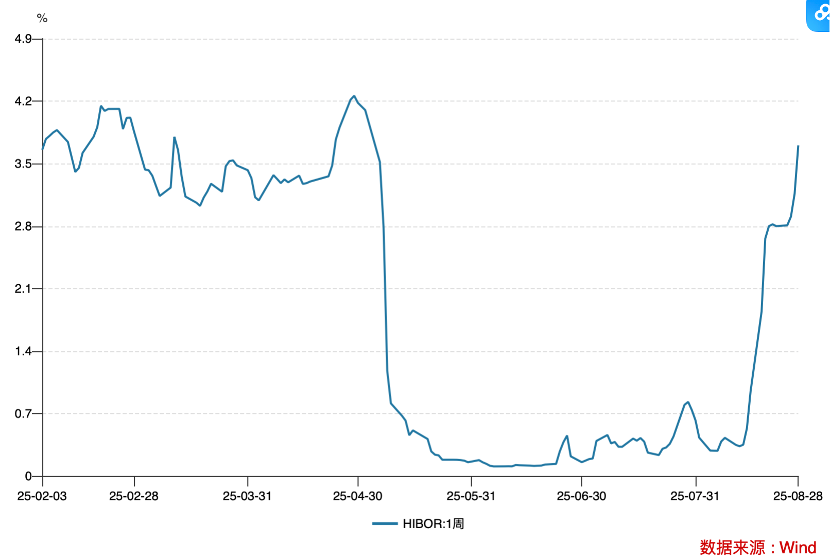
Group 1 - The Hong Kong dollar has experienced a significant appreciation, driven by both supply contraction and demand expansion, which typically attracts overseas capital inflow and benefits the Hong Kong stock market [5][10][12] - The Hong Kong Monetary Authority intervened in the market by buying HKD to stabilize the exchange rate, leading to a reduction in bank reserves to a historical low [5][10] - The recent surge in the Hong Kong Interbank Offered Rate (HIBOR) is a short-term impact that may suppress the market but is not expected to have lasting effects [3][11] Group 2 - The HIBOR has seen a sharp increase, with the overnight rate rising to 3.982%, the highest level since May [3][4] - The demand for the Hong Kong dollar has increased significantly, with record net inflows from southbound capital [7][9] - The IPO market in Hong Kong remains robust, contributing to sustained demand for the Hong Kong dollar [9][11] Group 3 - The performance of the Hong Kong stock market has lagged behind the A-share market, with the Hang Seng Index showing a modest increase compared to significant gains in the A-share indices [12][14] - Historical trends indicate that a stronger Hong Kong dollar can catalyze overseas capital inflow, which may positively impact the stock market [12][13] - Despite concerns about rising HIBOR rates potentially leading to market declines, past experiences suggest that such increases do not necessarily result in sustained downturns for the stock market [13][14]
红利港股ETF(159331)收红,南向资金流入或支撑估值修复
Mei Ri Jing Ji Xin Wen· 2025-08-21 07:30
Group 1 - The core viewpoint is that the Hong Kong stock market is expected to benefit from the continuous inflow of southbound funds, with clear signs of valuation recovery [1] - In a low interest rate environment, the attractiveness of high dividend sectors in the Hong Kong stock market has increased, particularly in the upstream resource industry, which has performed well overall [1] - Recent market sentiment has been improving, with rising expectations for a Federal Reserve interest rate cut further boosting risk appetite for Hong Kong stocks [1] Group 2 - In the medium to long term, the valuation advantages of the Hong Kong stock market and the trend of industrial transformation and upgrading remain promising, with the technology and consumer sectors likely to continue rising under dual support from policies and funds [1] - The current market maintains a "Hong Kong dividend" allocation, with certain upstream resource sectors benefiting from "anti-involution" sentiment and capital inflows, showing notable performance [1] - The Hong Kong Dividend ETF (159331) tracks the Hong Kong Stock Connect High Dividend Index (930914), which selects high dividend companies that meet continuous dividend criteria from the Stock Connect range, covering multiple industries such as finance, energy, and industrials [1]
中泰国际:港美利差收窄预期下 资金面有望持续利好港股表现
智通财经网· 2025-08-20 07:38
Group 1: Hong Kong Stock Market - Current valuation of Hong Kong stocks has significantly recovered, with the Hang Seng Index's forecast PE at approximately 11 times, returning to the peak levels of 2018-2019 [1][2] - Risk premium is at a historical low, and the AH premium has reached a six-year low, indicating a favorable market environment [1][2] - The market is entering a seasonal lull in August, with mid-year earnings reports expected to validate the fundamentals, and some stocks may experience profit-taking from "good news" [1][2] - Despite potential technical corrections, the ample liquidity in the Hong Kong market suggests that any adjustments will likely be limited in scope [1][2] Group 2: U.S. Stock Market - In July, U.S. retail sales growth has shown a steady slowdown, while PPI exceeded expectations, leading to a shift in interest rate cut expectations [3] - The S&P 500 index reported an 11.2% growth in corporate earnings for the second quarter, indicating robust earnings growth [3] - The U.S. Treasury is replenishing the TGA account, with ONRRP balances dropping to $57.2 billion, which may lead to decreased liquidity in the financial system in the coming weeks [3] Group 3: U.S. Treasury Bonds - The ten-year U.S. Treasury yield is fluctuating around 4.30%, influenced by mixed inflation data and the need for fiscal policy adjustments [4] - Short-term yields may face upward pressure due to concerns over persistent inflation and the impact of Treasury bond issuance [4] - The focus remains on key data such as the core PCE to further assess the impact of tariffs on inflation [4] Group 4: Currency and Trade - The offshore RMB has shown slight volatility but remains around the 7.18 level, indicating a stable and strong central parity [5] - The extension of the U.S.-China trade truce for an additional 90 days suggests ongoing negotiations, which may lead to fluctuations in the exchange rate [5]
港股估值持续修复 四大赛道ETF受机构关注
Zhong Zheng Wang· 2025-08-05 09:13
Group 1 - The Hong Kong stock market experienced a significant rise in July, with the Hang Seng Index and Hang Seng Tech Index both increasing by over 2.8%, and the Hang Seng Stock Connect rising by 4.7% [1] - There has been a resonance inflow of both domestic and foreign capital into the Hong Kong stock market this year, leading to a sustained liquidity environment [1] - According to Guosen Securities, Hong Kong stocks remain in a reasonable valuation range compared to A-shares, with a focus on five key investment directions: undervalued internet and AI leaders, innovative pharmaceuticals, resources and commodities benefiting from anti-involution, strong fundamentals in new consumption, and improving performance in non-bank financial institutions [1][2] Group 2 - The Hong Kong Innovative Pharmaceutical ETF (513120) has seen a year-to-date return exceeding 100% as of July 29, with its latest scale surpassing 16 billion yuan, making it the largest innovative pharmaceutical ETF in the market [2] - The Hang Seng Consumption ETF (159699) tracks the Hang Seng Consumption Index, including 50 leading Hong Kong consumer stocks, and offers a balanced distribution that aligns with the consumption trends of Generation Z [2] - The Hong Kong Non-Bank Financial ETF (513750) is the only ETF tracking the Hong Kong non-bank financial index, with significant holdings in major insurance companies and has seen continuous net inflows, reaching a scale of 12.5 billion yuan and a year-to-date return of over 40% [2] Group 3 - Fund professionals believe that the four ETFs covering technology, innovative pharmaceuticals, new consumption, and non-bank financial sectors provide investors with a convenient tool for a diversified exposure to Hong Kong stock opportunities [3] - Institutional analysis highlights the long-term allocation value of the Hong Kong technology and pharmaceutical sectors, especially with the deepening of anti-involution policies and rising global inflation expectations [3]