睡眠经济

Search documents
这五个助眠“好建议”纯属帮倒忙
Bei Jing Qing Nian Bao· 2025-10-27 01:20
Core Insights - The article discusses common misconceptions about sleep aids and offers correct practices to improve sleep quality [1] Misconceptions and Correct Practices - Misconception: Going to bed early and lying down will help fall asleep. Correct Practice: Limit time spent in bed awake and establish a consistent wake-up time to build sleep drive [2] - Misconception: Avoiding screens before bed is essential for good sleep. Correct Practice: Use devices for relaxation, such as watching light documentaries or listening to soothing podcasts, while managing screen time and settings [3] - Misconception: Caffeine should be completely avoided to prevent insomnia. Correct Practice: Individual sensitivity to caffeine varies; morning consumption may not affect sleep negatively for many [4][5] - Misconception: High-tech sleep products guarantee better sleep. Correct Practice: Sleep is a natural bodily function; focus on good habits rather than relying solely on technology [6] - Misconception: Everyone needs to sleep a full 8 hours every night. Correct Practice: Sleep needs are dynamic; as long as one feels energized during the day, occasional shorter sleep is not a concern [7]
博实结(301608):业绩表现亮眼 海外+AIOT放量驱动成长
Xin Lang Cai Jing· 2025-10-27 00:45
Core Viewpoint - The company has demonstrated strong financial performance in Q3 2025, with significant improvements in profitability and revenue growth across various business segments [1][5]. Group 1: Financial Performance - In the first three quarters of 2025, the company achieved operating revenue of 1.272 billion, a year-on-year increase of 21.66%, and a net profit attributable to shareholders of 180 million, up 33.95% year-on-year [1]. - In Q3 alone, the company reported operating revenue of 467 million, representing a year-on-year growth of 24.31% and a quarter-on-quarter increase of 2.07%. The net profit for the same quarter was 73 million, showing a year-on-year increase of 64.42% and a quarter-on-quarter growth of 7.72% [1]. - The company improved its sales gross margin to 23.84% in the first three quarters, up 0.54 percentage points year-on-year, and the net profit margin reached 14.19%, an increase of 1.30 percentage points year-on-year [1]. Group 2: Business Development - The company is actively developing smart sleep terminals under the "sleep economy" trend, with expected revenue of nearly 200 million in 2024, accounting for 14.2% of total revenue [2]. - The smart sleep terminal business utilizes an ODM model and has established stable partnerships with clients since 2023, expanding product categories based on customer needs and entering the Chinese market [2]. - The company is accelerating the expansion of its smart vehicle terminal business into high-margin overseas markets, focusing on commercial vehicles in the EU, Americas, and Middle East regions [3]. - In the two-wheeled transportation sector, the company is benefiting from the acceleration of electric bicycle smart technology, partnering with leading clients to enhance its product offerings and increase revenue from smart components [4].
一年卖出 300 多万个枕头,亚朵跨行做对了什么丨晚点周末
晚点LatePost· 2025-10-26 11:09
Core Viewpoint - The article emphasizes that Atour is successfully transforming its retail business by focusing on user experience and product innovation, akin to technology companies, rather than merely selling hotel-related products [2][3]. Group 1: Retail Performance - In 2024, Atour sold over 3 million deep sleep pillows and 770,000 deep sleep quilts, with retail revenue growth exceeding 120%, now accounting for half of its hotel business revenue [2]. - Atour's retail brand "Atour Planet," established only four years ago, ranks among the top four in China's home textile industry, with its core products leading in e-commerce platform categories [2][6]. Group 2: Strategic Focus - Atour's founder, Yelv Yin, emphasizes the importance of understanding user changes rather than focusing on competitors, dedicating time to engage with user feedback on platforms like Xiaohongshu [3][4]. - The decision to significantly reduce SKUs and concentrate on sleep-related products was made to enhance resource allocation and focus on a specific market segment, despite the short-term revenue sacrifice [5][10]. Group 3: Product Development - Atour's approach to product design shifted from making pillows that users adapt to, to creating pillows that adapt to users, resulting in the development of the deep sleep pillow Pro 1.0 [6][7]. - The deep sleep pillow quickly became the top-selling product across platforms, demonstrating that addressing real user pain points is crucial for success [7][12]. Group 4: Supply Chain and Standards - Atour is transforming its supply chain by setting high standards and collaborating closely with suppliers to ensure product quality, similar to Apple's approach with iPhone production [10][12]. - The establishment of "deep sleep standards" quantifies comfort through metrics like dynamic pressure stability and temperature control, moving beyond traditional industry parameters [13][14]. Group 5: Market Positioning - Atour's online sales strategy has rapidly evolved, with over 90% of its revenue coming from online channels, contrasting with traditional home textile brands that lag behind in digital transformation [14][15]. - The company's ability to leverage its hotel network as a testing ground for products has provided a unique advantage in the market, allowing for direct consumer engagement [14][15]. Group 6: Management and Adaptation - Atour's management philosophy includes rapid response to customer feedback and a commitment to long-term value creation, moving away from short-term performance metrics [17][19]. - The company has implemented a "no overnight negative reviews" policy to ensure quick resolution of customer issues, enhancing service quality and customer satisfaction [17][19]. Group 7: Continuous Innovation - Atour believes in continuous iteration of both hotel and retail products, with annual updates to core offerings, ensuring they remain competitive in a rapidly evolving market [21][22]. - The focus on maintaining a vibrant organizational culture and innovative product development is seen as essential for long-term success in the traditional home textile industry [21][22].



银发经济崛起,母婴店如何抓住机遇以布局全家营养
Sou Hu Cai Jing· 2025-09-29 12:49
Core Insights - The traditional maternal and infant industry is facing challenges due to declining birth rates, prompting a shift towards the silver economy, which is projected to reach a market size of 8 trillion yuan [7][8] - The elderly population in China has reached 310 million, accounting for 22% of the total population, with a significant increase in demand for health and nutrition products [7][8] - The silver economy presents unprecedented opportunities for maternal and infant stores to expand their market by focusing on family health management [7][8] Market Transformation - The demographic shift is reshaping consumer market dynamics, with the aging population influencing health consumption patterns [7][8] - The traditional maternal and infant market is experiencing stagnation, necessitating a broader focus on family health management [7][8] - Many store owners acknowledge that they have lost at least 60% of the health consumption market by not adapting to these changes [8] Silver Economy Insights - The health needs of the elderly population are characterized by a high prevalence of chronic diseases, with a 79.4% disease rate among those over 60, driving demand for preventive health products [9] - The consumption of health products among the elderly is rapidly growing, with a 30.1% increase in health supplements and a 32.2% increase in assistive devices [9] - The shift in consumption from "passive aging" to "active enjoyment of aging" reflects a growing focus on quality of life and mental well-being [9][10] Strategic Pathways for Maternal and Infant Stores - Maternal and infant stores can leverage their expertise in child health to expand into the silver economy, utilizing their established trust and community resources [10] - Future product innovations should focus on three key areas: gastrointestinal health, sleep improvement, and emotional management, catering to the specific needs of the elderly [10] - The transition from a product-centric model to a service-oriented approach, including personalized health management, is essential for enhancing customer loyalty [10][11] Professional Empowerment and Training - Enhancing professional service capabilities is crucial for building trust with the elderly consumer base, necessitating training for store owners and staff [10][11] - Successful transformation requires a long-term commitment and strategic focus, avoiding the pitfalls of seeking quick results [11] - Learning from successful international examples, such as Japanese drugstores, can provide valuable insights into cultivating consumer habits and preferences [11]

科技周报|蓝战非多平台被禁止关注,京东宣布三年带动万亿生态
Di Yi Cai Jing· 2025-09-28 03:29
Group 1 - The "Beijing Plan" for super node intelligent computing applications was released, aiming to develop industry-specific intelligent entities by integrating various model algorithms and creating a plug-and-play platform by 2026 [2] - The gaming live-streaming industry experienced a boom from 2016 to 2018, leading to significant wealth creation but also the downfall of many streamers and companies that could not keep pace [3] - Shanghai Zhiyuan became the new controlling shareholder of Shangwei New Materials, with a market value of 92.46 billion yuan for the acquired shares, resulting in a floating profit of nearly 8.5 billion yuan [4] Group 2 - Changjiang Storage's parent company completed its shareholding reform, with an estimated valuation exceeding 160 billion yuan [5] - Meituan's new generation of unmanned delivery vehicles received approval for cross-district trials in Shenzhen, expanding the service radius beyond 30 kilometers [6] - Zhuanzhuan announced a shift from C2C to C2B2C model, closing its "free market" business due to challenges in trust and supply [8] Group 3 - Alibaba plans to reduce its stake in Suning.com, with no impact on the company's control or ongoing operations [9] - JD.com aims to drive a trillion-scale AI ecosystem over the next three years, with a focus on enhancing supply chain efficiency through its open-source AI architecture [10] - The dialogue between Zhou Hongyi and Luo Yonghao highlighted the evolution of AI and the importance of intelligent agents in future developments [11] Group 4 - Xiaohongshu launched the "Xiaohong Card" to enhance local life services, marking a new attempt at commercialization and potentially reshaping the local lifestyle industry [12][13] - Zhihu completed an upgrade to its search capabilities, transitioning from passive responses to proactive service, enhancing user experience in research and learning [14] - Hongmeng Smart's focus on health sleep scenarios was showcased with a new smart bed product, tapping into the growing sleep economy market projected to reach 658.68 billion yuan by 2027 [15]
近五成中国成人被失眠困扰,睡眠经济相关企业存量超2万家
Qi Cha Cha· 2025-09-24 07:01
Core Insights - Nearly 50% of Chinese adults are troubled by sleep issues, with a sleep disturbance rate of 48.5% among individuals aged 18 and above, primarily characterized by difficulties in falling asleep, frequent awakenings, and early waking [2] - The sleep economy in China is projected to exceed 1 trillion yuan by 2030, driven by a market currently valued at over 500 billion yuan [2] Group 1: Current Market Landscape - As of September 23, there are 20,900 sleep economy-related enterprises in China, predominantly located in East China (39.47%) and South China (25.44%) [3] - Major cities such as Beijing, Shanghai, Guangzhou, and Shenzhen account for 26.44% of these enterprises, with Shenzhen alone housing over 2,000 related companies [3] Group 2: Financial Aspects - More than 50% of sleep economy-related enterprises have a registered capital of 10 million yuan or more, with 25.26% of these companies having a registered capital between 10 million and 50 million yuan [4] - Companies with a registered capital of 50 million yuan or more also represent 25.21% of the total [4] Group 3: Industry Composition - The majority of sleep economy-related enterprises belong to the manufacturing sector, accounting for 31.66%, followed by scientific research and technical services at 27.42% [5]
功能寝具行业迎发展转型关键期
Xiao Fei Ri Bao Wang· 2025-09-23 02:43
Core Viewpoint - The increasing sleep issues among the Chinese population, particularly among younger generations, have led to a booming "sleep economy," with the market size expected to exceed 534.9 billion yuan by 2024 [1][2]. Market Demand and Growth - Nearly half (48.5%) of adults in China experience sleep disturbances, with the rate increasing with age [1] - The "sleep economy" market size reached 499.58 billion yuan in 2023, projected to grow at a compound annual growth rate (CAGR) of 8.5% [2] - Sales of sleep-related products, such as split mattresses and smart mattresses, have seen significant growth, with increases of 299% and 82% respectively [3] Industry Innovations - Companies are leveraging technology and cross-industry collaborations to enhance product offerings, such as smart mattresses with multi-dimensional sensors and specialized mattresses for different age groups [2] - The use of advanced materials from aerospace technology in sleep products is an example of innovation in the industry [2] B2B Market Opportunities - The demand for functional bedding is not limited to consumer markets; high-end hotels are shifting focus from luxury hardware to deep experience, enhancing guest satisfaction and increasing revenue [3] - Smart mattresses in elderly care facilities can monitor health conditions, providing timely alerts to family members [3] Industry Challenges - The functional bedding industry faces issues such as product homogeneity and a lack of differentiation in design and features [4] - Smaller companies struggle with high R&D costs, leading to imitation rather than innovation, and some resort to using substandard materials [5] Regulatory and Ethical Concerns - There are concerns about misleading advertising and inadequate after-sales service, which can harm consumer trust and market integrity [5] - Experts suggest that industry associations should establish clear standards and definitions to guide production and marketing practices [6] Recommendations for Improvement - Companies are encouraged to adopt responsible marketing practices, ensuring accurate representation of product capabilities [6] - Establishing efficient after-sales support systems and clear return policies is essential for enhancing consumer confidence [6]

海信家电:科龙空调与年轻用户紧密相连,聚焦睡眠经济与健康家居两大增量市场
Mei Ri Jing Ji Xin Wen· 2025-09-19 10:49
Group 1 - The core viewpoint is that Hisense is focusing on upgrading its home air conditioning business through its two main brands, Hisense and Kelon, to compete in the market [1] - Hisense's Kelon brand is targeting young consumers by emphasizing the sleep economy and healthy home trends, aiming to strengthen its brand image among younger demographics [1] - The company positions itself on cost-effectiveness, aiming to meet the essential demand of young consumers for high quality at low prices [1]

家纺行业的深度修复版图:三大赛道爆发点,
3 6 Ke· 2025-09-15 03:07
Core Viewpoint - The article discusses the structural growth opportunities in the sleep market, particularly in China, highlighting the increasing consumer demand for quality and intelligent sleep products driven by various consumer segments [1][12]. Demand Side: Five Major Consumer Profiles - The "Self-Indulgent" group values high-quality living and is willing to invest in luxurious sleep experiences, integrating aesthetics into their sleep environment [1]. - The "Pet Owners" prioritize hygiene and durability in bedding products, seeking features like antibacterial properties and easy maintenance to ensure a healthy sleep environment [3]. - The "High-Pressure Compensators" are looking for instant sleep aids and are willing to pay a premium for products that alleviate stress and improve sleep quality [5]. - The "Family Responsibility" group seeks solutions that balance family duties with sleep efficiency, favoring easy-to-clean and durable bedding materials [7]. - The "Health Anxiety" group is focused on improving sleep quality through smart technology and specialized materials, addressing health concerns related to sleep [9]. Supply Side: Technological Product Reconstruction - The industry is undergoing a materials revolution, with innovations like 3D antibacterial fibers and eco-friendly manufacturing processes enhancing product quality [12]. - Smart technology is evolving from a novelty to a central role in sleep management, with a significant percentage of consumers interested in AI-enabled sleep products [13][16]. - Design philosophy is shifting towards a holistic experience, with new standards for bedding products that encompass multiple performance metrics [16]. Key Growth Areas in the Industry - The smart bedding segment is transforming into a health management ecosystem, with leading companies focusing on a closed-loop system for monitoring and improving sleep quality [18]. - The integration of skincare elements into bedding products is becoming a trend, reflecting consumer desires for multifunctional products that combine sleep and beauty [18]. - Sleep solutions are becoming more fragmented, with products designed for various environments, indicating a need for innovative materials and compact designs [18]. Conclusion - The future of the bedding industry is centered around user needs, emphasizing the importance of data-driven and service-oriented value delivery to capitalize on the structural growth opportunities in the sleep economy [20].
家具行业半年考:龙头盈利“率先反转” 智能家居成增长引擎
Xin Hua Cai Jing· 2025-09-11 04:27
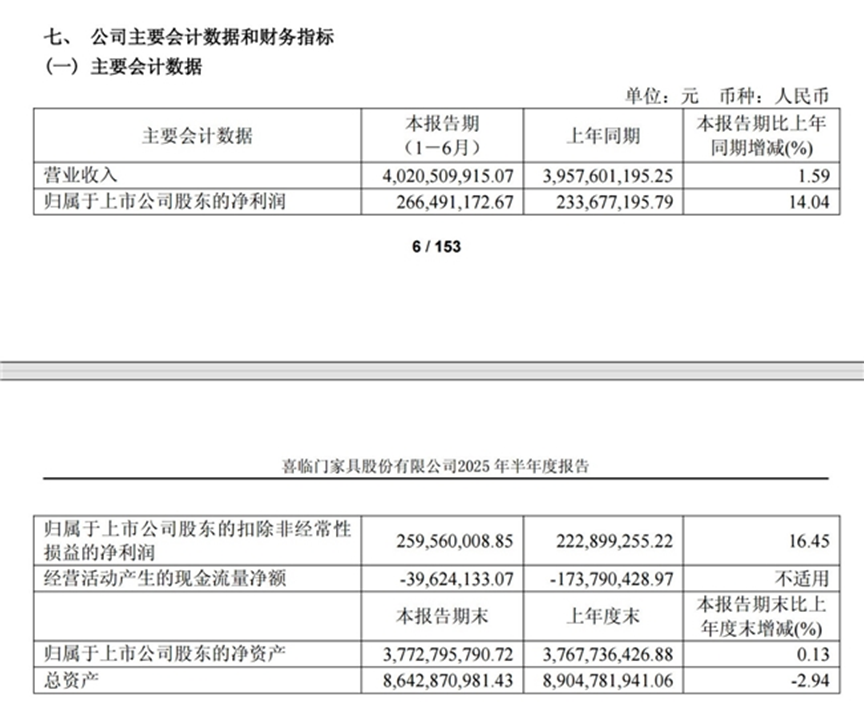
Core Insights - The home furnishing industry is experiencing a "premature reversal" trend due to the dual benefits of consumer promotion policies and the traditional consumption peak in the fourth quarter [1] Group 1: Industry Performance - Leading companies are showing resilience in profitability, with significant improvements in financial metrics [2] - Gujia Home achieved revenue of 9.801 billion, a year-on-year increase of 10.02%, and a net profit of 1.021 billion, up 13.89%, indicating effective cost control and product optimization [2] - Xilinmen reported revenue of 4.021 billion, a slight increase of 1.59%, with net profit rising 14.04% to 266 million, showcasing strong profit elasticity [2][4] - Mengbaihe's revenue reached 4.316 billion, up 9.35%, with net profit increasing by 17.82% to 115 million, benefiting from a low base effect [2] - Mosi's revenue declined by 5.76% to 2.478 billion, with net profit down 4.14% to 358 million, reflecting challenges in the high-end market [2] Group 2: Profitability and Margins - The industry shows a divergence in profitability, with companies focused on high-end smart products experiencing notable margin improvements [3] - Xilinmen's gross margin reached 36.28%, up 1.51 percentage points, indicating a clear and solid profit reversal despite minimal revenue growth [3] Group 3: Growth Drivers - The recovery in the home furnishing industry is driven by strong growth in segments like smart home and sleep economy, fueled by consumer demand for quality sleep and personalized products [6] - Companies are focusing on smart product development, with Xilinmen expanding its AI mattress series and Gujia Home enhancing its "whole-home smart ecosystem" [6][7] - The integration of smart features in products, such as voice-controlled electric sofas, is becoming standard in mid-to-high-end offerings [7] Group 4: Challenges and Opportunities - The industry faces challenges from raw material price fluctuations, real estate adjustments, and insufficient consumer confidence, alongside increased competition in international markets [8] - Companies are adopting various strategies, such as Mengbaihe's overseas production base to avoid trade barriers and Xilinmen's investment in R&D for smart products [8] - The home furnishing sector is currently valued at historical lows, reflecting market caution, but signs of an "early reversal" are emerging across various fields and companies [8] - The outlook for the second half of 2025 suggests that sectors like sleep economy and smart home may continue to outperform the industry, presenting potential investment opportunities [8]