航天强国

Search documents
第三届商业航天发展大会:顶层设计落地 商业航天迈入发展新阶段
Yang Shi Wang· 2025-12-25 02:17
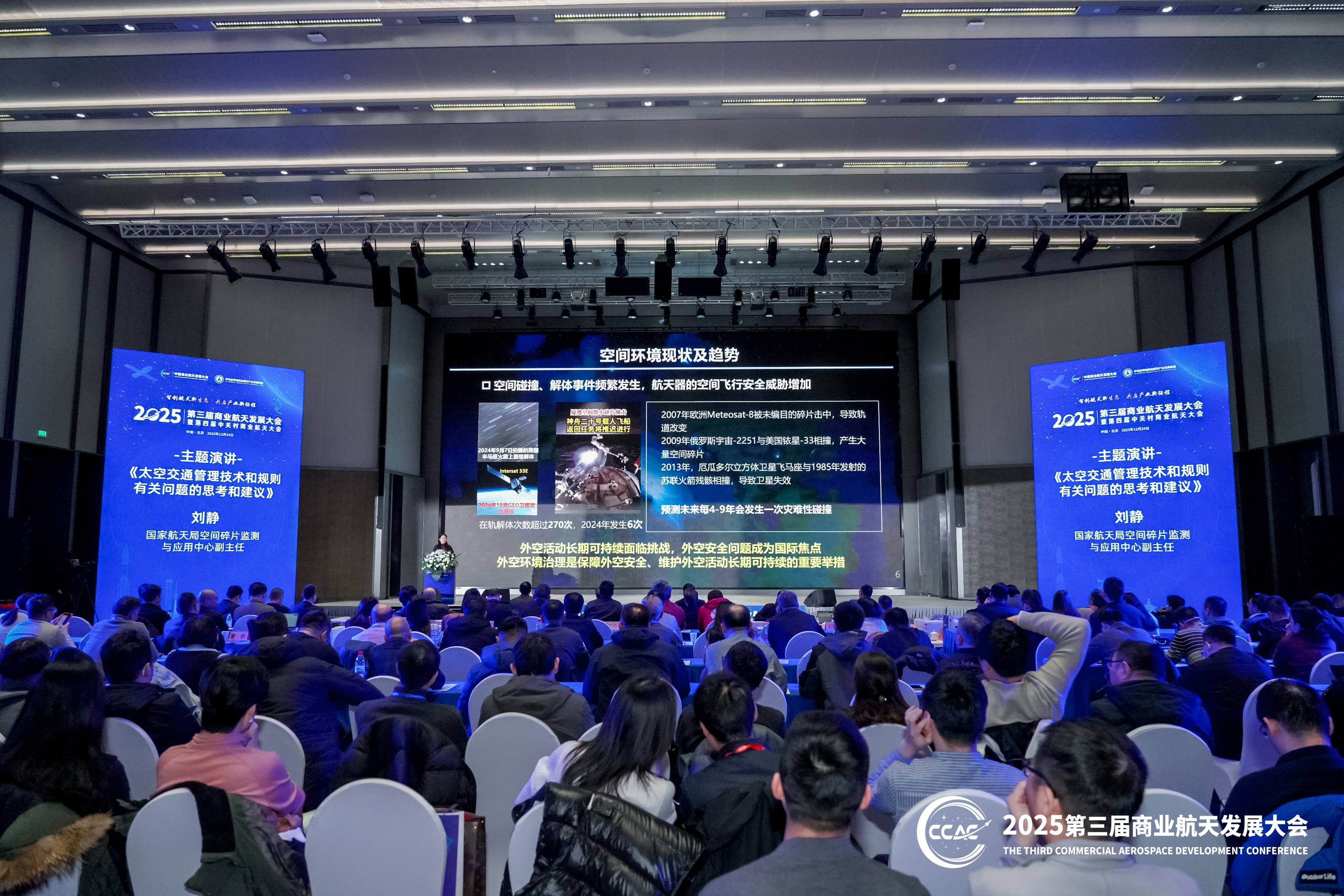
Core Insights - The global commercial aerospace industry is currently experiencing rapid development, with significant growth in China since 2015 due to supportive government policies [1] - The 2025 Third Commercial Aerospace Development Conference emphasized the importance of key technological innovation for high-quality industry development, focusing on various critical areas such as manned spaceflight and advanced aerospace materials [4] - The industry is transitioning from a nurturing phase to becoming a strategic pillar of the economy, supported by comprehensive policy frameworks and the establishment of dedicated management mechanisms [4] Industry Developments - The frequency of domestic commercial rocket launches has increased, and the IPO processes for companies have accelerated, indicating a critical phase of transformation from quantitative accumulation to qualitative leap [7] - The upcoming "China Commercial Aerospace Industry Development Report (2025)" is expected to highlight the industry's entry into a new stage of scale and commercialization, predicting sustained high growth and significant market expansion [7] - The report will also address industry pain points and propose targeted solutions, serving as a vital reference for government policy, corporate strategy, and investor decisions [7] Talent Development - A significant skills gap exists in the commercial aerospace sector, prompting the launch of the "Starry Future" talent cultivation plan, which aims to provide customized training aligned with industry needs [8] - The plan intends to deliver 1,000 skilled professionals annually over the next 3-5 years, ensuring a steady supply of talent for the industry's sustainable development [8] Financial Initiatives - The "Leading Innovation Commercial Aerospace Alliance Science and Technology Innovation Fund" has been established with an initial scale of 2 billion yuan, focusing on high-growth startups and technology innovation projects in the commercial aerospace sector [11] - This fund aims to address financing challenges in the industry by providing patient capital, particularly in critical areas such as core components and advanced manufacturing processes [11] - The conference also facilitated the signing of multiple cooperation agreements in aerospace equipment manufacturing and satellite application services, marking a new phase of collaborative efforts in technology and commercialization [11]


军转民投资机会凸显!商业航天、可控核聚变逆市活跃,主力资金大手笔押注国防军工
Xin Lang Cai Jing· 2025-12-11 12:02
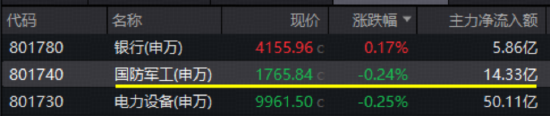
高人气国防军工ETF(512810)汇聚海陆空天军工核心资产,盘初一度涨超1%创阶段新高,而后震荡 回落,最终小幅收跌0.28%,表现显著好于大市。全天成交8105万元,较上日放量逾两成。 国防军工ETF(512810)成份股27涨1平51跌,商业航天、可控核聚变概念股逆市领涨,西部超导涨 4.95%,中国卫星涨4.89%创10年新高。权重股跌多涨少成主要拖累,中国船舶跌1.64%,中航沈飞跌 2.54%。 近期商业航天概念反复走强,或为阶段主线。"航天强国"目标引领下,国内商业航天发展进入快车道, 卫星发射频次持续增加,"出海"业务同步加速,民营火箭技术亦持续突破。此外, paceX拟最快于2026 年中后期IPO,募资超300亿美元,卫星组网与太空算力的想象空间有望进一步打开。 数据来源:沪深交易所等。 风险提示:国防军工ETF被动跟踪中证军工指数,该指数基日为2004.12.31,发布于2013.12.26。文中提 及个股仅为指数成份股客观展示列举,不作为任何个股推荐,不代表基金管理人和基金投资方向。任何 在本文出现的信息(包括但不限于个股、评论、预测、图表、指标、理论、任何形式的表述等)均只作 为参考 ...
人民币升值!创近一年新高
Mei Ri Jing Ji Xin Wen· 2025-12-04 05:31
今天,市场关注的朱雀三号终于发射升空。 从结果来看,飞行任务完成,火箭二级进入预定轨道。 在大家关注的可回收方面,在火箭一级回收验证过程中发生异常燃烧,未能实现在回收场坪的软着 陆,回收试验失败。 可回收火箭有多重要?达哥简单说一说。 商业航天的最大瓶颈是火箭成本。如果能实现火箭可回收,那么意味着商业航天的成本都会大幅下 降。 有机构表示,一旦可回收发射技术实现规模化应用,有望将发射成本下降30%-50%。 可回收发射技术实现后,后续的重点是高频复用、成本降到极致。只要做到这两点,那么,一个低 成本、高频次、规模化的中国太空时代正在来临,未来太空经济版图也将发生重大变化。 马斯克旗下的星链,大家都熟知。到目前为止,星链卫星发射总数超过10000颗,其中在轨正常运 行的卫星超过8000颗。 目前,上证指数下方有四个短期支撑位,一是11月28日的低点3856点,二是11月24日反弹以来回撤 61.8%的3853点,三是11月24日反弹以来回撤80.9%的3835点,四是11月24日低点3816点。 在大国科技竞争加剧的背景下,谁也不想头顶上有这么多的外国卫星"覆盖"自己的国家。此外,卫 星所处的太空资源也是有限的 ...
【公募基金】市场延续缩量,海外风险释放——公募基金权益指数跟踪周报(2025.11.24-2025.11.28)
华宝财富魔方· 2025-12-01 10:13
分析师:王骅 登记编号:S0890522090001 分析师:宋逸菲 登记编号:S0890524080003 投资要点 权益市场回顾: 上周(2025.11.24-2025.11.28)小盘股涨幅居前,成长风格表现强于价值风格,全A日均交 易额 17312 亿,环比上周继续下降,市场活跃度仍待修复。临近年末,各路资金面临业绩考核收尾,调仓换 股、求稳减少净值波动成为主流行为,增量资金入场意愿较低。 权益市场观察: 海外风险释放:继10月初的贸易争端后,全球各方冲突呈现持续降温的发展势头。2026年是美国的中期选举 年,近期特朗普政府在共和党党外和党内均遭遇不小挑战,接下来其重心或将重新聚焦于美国国内。 科技方向:在存量博弈的背景下,在科技方向内部,资金还出现了明显的"拉踩"现象。上周国内科技板块的主 要共识也集中于谷歌产业链。 商业航天:短期来看,商业航天呈现比较典型的主题投资范式,跟随重点事件或政策密集落地展开行情;长期 来看,可重复使用/大型液体火箭的新技术突破、发射场建设加速、终端应用场景落地将共同推动产业规模化发 展。 主动权益基金指数表现跟踪: 主动股基优选指数:上周收涨2.88%,成立以来累计录得 ...

国内外产业政策周报:商业航天司设立,整治内卷聚焦价格治理及储能-20251130
CMS· 2025-11-30 07:00
Domestic Policy Topics: Establishment of Commercial Space Administration, Focus on Price Governance and Energy Storage - The establishment of the Commercial Space Administration aims to address the overlapping functions and decentralized management of multiple departments in the commercial space sector, marking a key step towards standardized and scaled regulation [4][7][8] - The recent policy developments include the issuance of a development plan for commercial space, which outlines 22 key measures across five areas, such as encouraging the layout of the space industry chain and supporting the development of new technologies and products [4][10][12] - The National Development and Reform Commission (NDRC) is actively working to address issues of disorderly price competition in various industries, emphasizing the need for a standardized approach to maintain market order and support high-quality development [16][20] - The Ministry of Industry and Information Technology (MIIT) held discussions with manufacturers in the energy storage and power battery sectors to promote high-quality development and address competitive order within the industry [17][20] Overseas Policy Topics: US-China Presidential Call, Developments in the Russia-Ukraine Issue - A recent phone call between Chinese President Xi Jinping and US President Donald Trump highlighted the importance of stabilizing US-China relations and discussed key issues such as Taiwan and the Ukraine crisis [4][9] - The ongoing developments in the Russia-Ukraine situation include significant negotiations between Russian President Putin and Ukrainian President Zelensky, with discussions on potential agreements to end the conflict [4][9] Consumer Supply and Demand Adaptation Policy Issuance - The implementation plan issued by six departments aims to enhance the adaptability of consumer goods supply and demand, targeting the optimization of supply structures and the establishment of three trillion-level consumption fields and ten hundred-billion-level consumption hotspots by 2027 [21][25] - The plan emphasizes the importance of aligning consumption upgrades with industrial upgrades, promoting new technologies and models, and expanding the supply of high-quality consumer goods [21][24] - A total of 22 consumer promotion policies have been introduced this year, with a significant focus on fiscal subsidies, particularly for vulnerable groups and sectors [23][27]
三大利好集中来袭!卫星板块再迎大爆发!
Zheng Quan Shi Bao· 2025-11-28 06:52
Core Viewpoint - The satellite sector is experiencing a significant surge driven by three major positive developments, including the upcoming launch of the Zhuque-3 rocket, the introduction of a new space awareness satellite constellation, and the acceleration of space data center construction in Beijing [1][2]. Group 1: Major Developments - The Zhuque-3 rocket, developed by Beijing Blue Arrow Aerospace, is set for its maiden flight on November 29, marking a potential milestone as China's first operational reusable launch vehicle [2]. - A new generation of space awareness satellites is being launched, with plans to deploy 156 satellites starting in the first half of next year, aimed at creating a global near-Earth monitoring network to enhance satellite operation safety [2]. - Beijing is advancing its space data center initiatives, with plans for multiple data centers, each with a capacity of approximately 1GW, to support space-based data transmission and computational services [2]. Group 2: Industry Outlook - The satellite internet industry ecosystem conference is scheduled for December 4 in Shanghai, indicating growing interest and investment in the sector [3]. - The "14th Five-Year Plan" has been approved, emphasizing the development of strategic emerging industries in aerospace, which is expected to further stimulate growth in the satellite sector [3]. - The construction of space data centers is planned in three phases, with significant technological breakthroughs anticipated between 2025 and 2035, leading to large-scale satellite production and deployment [4].
卫星概念股走强,相关ETF涨约2%
Mei Ri Jing Ji Xin Wen· 2025-11-28 03:01
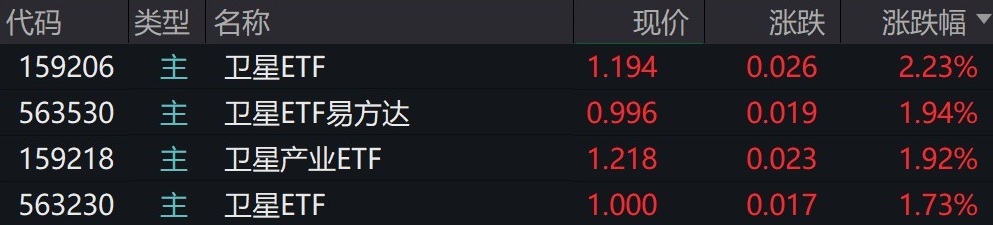
Group 1 - Satellite concept stocks have strengthened, with Huazhong Chuangtong rising over 4%, Zhenxin Technology up over 3%, and Aerospace Electronics, China Satellite, and Longsheng Technology each increasing over 2% [1] - Satellite-related ETFs have risen approximately 2% due to market influences [1] Group 2 - Several ETFs related to satellites have shown positive performance, with the main satellite ETF (code: 159206) at a price of 1.194, up 2.23%, and the E Fund satellite ETF (code: 563530) at 0.996, up 1.94% [2] - Analysts indicate that as the "space power" initiative enters the implementation phase, more supportive policies for the aerospace industry are expected, directing more resources towards this sector [2] - Space infrastructure and applications, represented by rockets and satellites, are anticipated to become key development areas under the "space power" strategy [2]



四中全会精神在基层丨海南文昌:把诗篇写在蓝天
Yang Guang Wang· 2025-11-27 01:12
王凤宇:展望"十五五",我们将围绕服务国家重大战略,持续优化产业布局,强化创新驱动,加快 形成"百箭千星"商业发射能力,全力打造国家商业航天先行示范区、航天新经济样板区和国际一流商业 航天港。 央广网北京11月27日消息(记者金歆竹 董彬 魏安)据中央广播电视总台中国之声《新闻和报纸摘 要》报道,党的二十届四中全会提出,"加快建设制造强国、质量强国、航天强国、交通强国、网络强 国"。海南文昌国际航天城持续推动商业航天产业高质量发展,瞄准航天强国目标发力奋进。 长征十二号运载火箭发射任务刚完成不久,海南国际商业航天发射公司发射事业部总工程师鄢利清 和团队就投入到发射工位的恢复与改进工作中,为发射工位能够适应更多型号火箭提前做好准备。 "十四五"期间,海南商业航天发射场一期仅用时878天就实现从开工到成功首发。今年夏天,发射 场的双工位在5天内实现2枚火箭连续发射,让"高密度"发射目标由规划变成现实。 鄢利清:以前从转场到发射,我们大概需要五六天。优化之后,从转场到发射可能只需要三四天就 可以了。时间要缩短,但是我们的测试内容要覆盖全面。 近年来,文昌国际航天城持续推动商业航天产业高质量发展,商业航天发射场具备双 ...
智明达(688636.SH):未来将加大商业航天领域的投入与布局
Ge Long Hui· 2025-11-25 07:48
Core Viewpoint - The company has strategically entered the commercial aerospace sector several years ago, focusing on various related businesses, including commercial rocket engine control, satellite data links, and high-performance computing for ground stations [1] Group 1: Business Development - The company has successfully participated in the development of commercial rocket engine control and satellite data link systems [1] - Recent approval of a private placement by the securities regulatory authority will fund research and industrialization of unmanned equipment and embedded computing for commercial aerospace [1] - The company aims to expand its product line and establish dedicated product lines to create new business growth drivers [1] Group 2: Strategic Direction - In alignment with the strategic direction of becoming a "strong aerospace nation" as outlined in the 20th National Congress, the company plans to increase investments and layout in the commercial aerospace sector [1] - The company intends to enhance the revenue contribution of commercial aerospace products to its overall income [1]

多重利好引燃,卫星ETF(159206)持续走高,盘中申购超2000万份!
Sou Hu Cai Jing· 2025-11-25 02:54
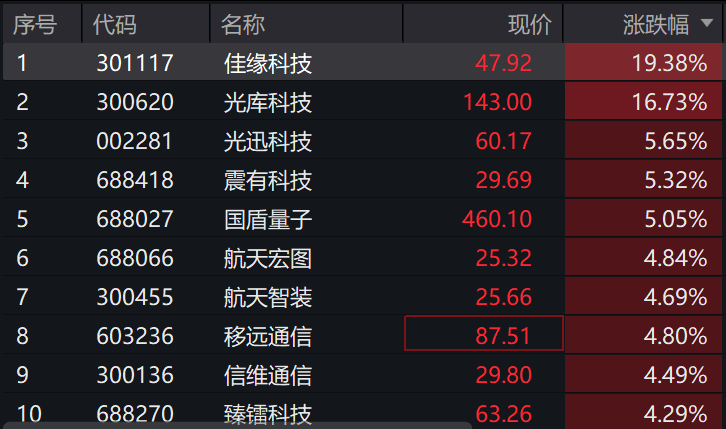
Core Insights - The satellite ETF (159206) has seen a significant increase of 2.17%, with over 20 million units subscribed during the trading session, indicating strong investor interest in the sector [1] - Key component stocks such as Jiyuan Technology and Guangku Technology have experienced substantial gains, with Jiyuan Technology rising over 19% and Guangku Technology increasing over 16% [1][2] - The successful first flight of China's reusable rocket "Zhuque-3" is expected to significantly reduce launch costs and accelerate the domestic satellite internet constellation deployment [2] - The Ministry of Industry and Information Technology has officially launched a commercial trial for satellite IoT services, marking a critical step in China's low-orbit satellite communication sector [3] - The satellite IoT trial aims to promote the healthy development of emerging industries like commercial aerospace and low-altitude economy, providing wide-area low-speed data connectivity services across various sectors [3] Industry Developments - The successful first flight of Zhuque-3 validates its reusable capabilities, which could enhance China's competitiveness in the commercial aerospace sector [2] - The satellite IoT initiative aligns with China's "14th Five-Year Plan" for building a strong aerospace nation, potentially invigorating the private economy and accelerating the commercialization of the satellite industry chain [3] - The satellite ETF (159206) focuses on commercial aerospace and satellite communication, with an overweight position in satellite manufacturing, poised for growth under the "strong aerospace nation" backdrop [3]