贬值交易

Search documents
In 2025, bitcoin showed how spectacularly wrong price forecasts can be
Yahoo Finance· 2025-12-30 12:00
Core Insights - The crypto market experienced a dramatic "flash crash" on October 10, 2025, where Bitcoin (BTC) fell by $12,000, nearly 10%, leading to over $19 billion in liquidations and a total market cap loss of $500 billion [1][2]. Group 1: Market Performance - Following the crash, Bitcoin's value dropped more than 30% from its peak of $126,223 set just six days prior, indicating a potential for the first full-year loss since the crypto winter of 2022 [2]. - The year began with optimistic Bitcoin price predictions, but the October crash significantly altered the outlook, with many forecasts failing to materialize [3]. Group 2: Price Predictions - Long-term forecasts for Bitcoin included predictions as high as $1 million by 2025 from various analysts, including Samson Mow and Adam Back, driven by factors like ETF inflows and institutional buying [5][6]. - Even conservative estimates, such as those from JPMorgan, had raised year-end targets to $165,000 before the crash, reflecting a growing demand for alternative stores of value [6]. - Post-crash, Michael Saylor maintained bullish sentiment, predicting Bitcoin could reach $150,000 by year-end, supported by significant purchases of BTC by his company [7].
金饰价格刚刚跌破1400元关口
3 6 Ke· 2025-12-30 03:25
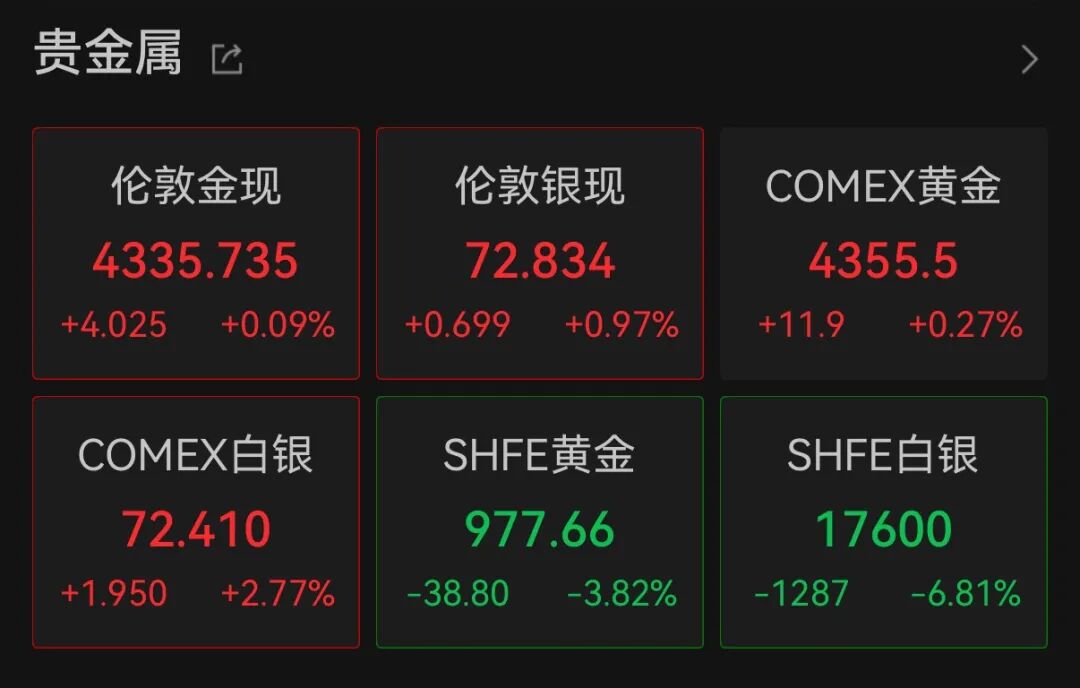
Group 1 - The core point of the article highlights a significant drop in gold prices, with spot gold falling by 4.42% and COMEX gold futures down by 4.45%, marking the worst single-day performance since October 21 [2] - Domestic gold jewelry prices also saw substantial declines, with brands like Chow Sang Sang, Lao Miao, and Lao Feng Xiang reporting drops of 53 CNY, 44 CNY, and 45 CNY per gram respectively [2] - The article indicates that the recent price movements are influenced by increased trading margins for precious metals, including a 10% increase for gold futures, which may lead to heightened volatility in the market [4] Group 2 - UBS has noted that short-term risks in precious metal trading have increased, suggesting that profit-taking by short-term investors could lead to further price fluctuations [4] - CITIC Futures reports that the macro environment remains favorable for precious and non-ferrous metals, although short-term risks should be monitored, particularly for silver which may face further corrections [4] - The report emphasizes that the weakening status of the US dollar as a reserve currency could provide further upward momentum for gold prices, indicating a potential correlation between dollar depreciation and gold price increases [4]

从加密狂潮到做空日债:复盘2025年令市场“心跳停止”的十一大押注
智通财经网· 2025-12-29 03:44
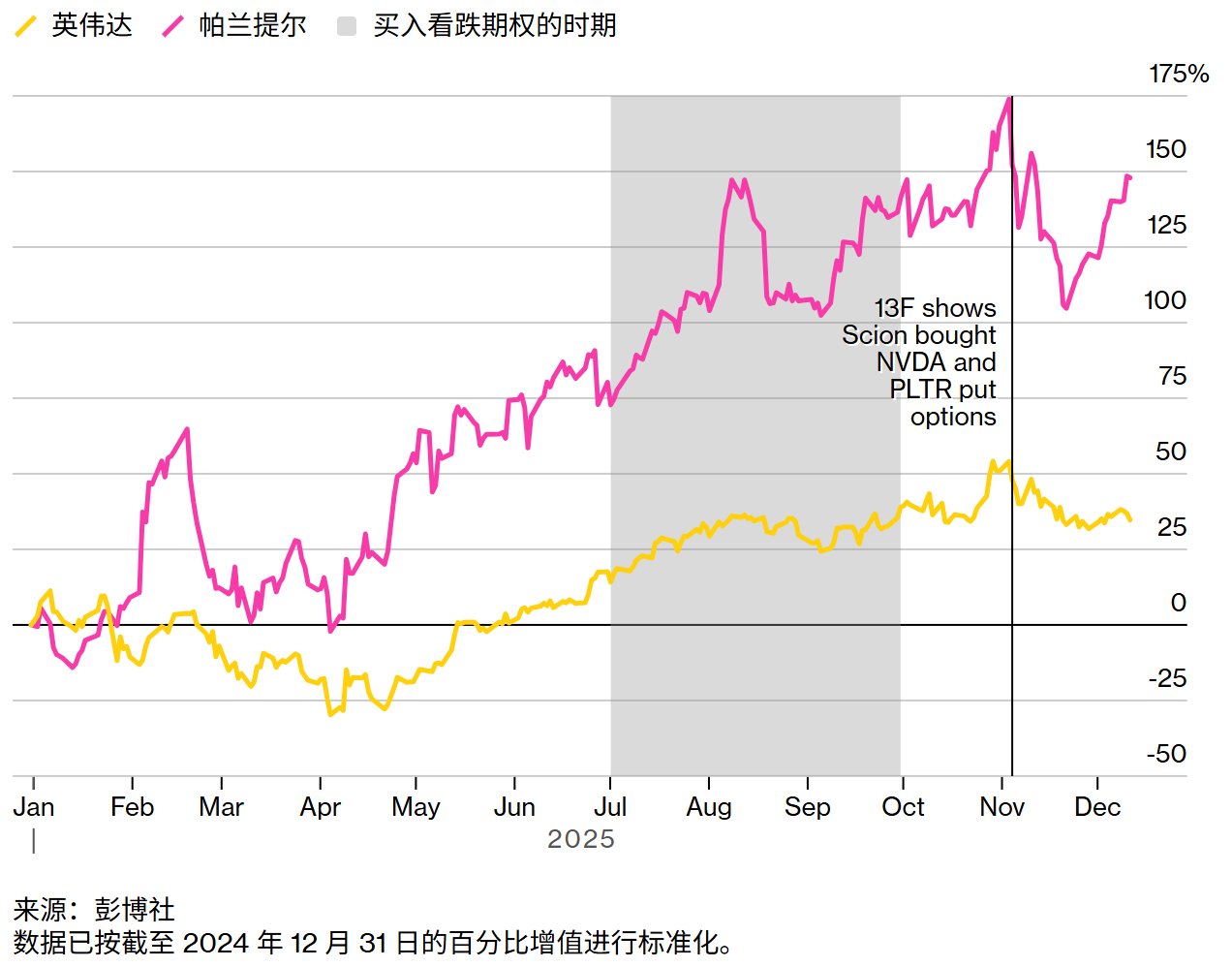
Group 1: Cryptocurrency and Political Influence - The year 2025 saw a surge in speculative trading linked to Donald Trump's brand, particularly in the cryptocurrency sector, with significant investments in assets associated with him [1][2] - Trump's family launched various tokens, including a meme coin and Melania Trump's own token, which experienced dramatic price declines by the end of the year, with some down nearly 99% [2][3] - Despite political momentum, these assets could not escape the fundamental volatility of the cryptocurrency market, highlighting the risks of speculative trading [1][3] Group 2: AI Stocks and Short Selling - Scion Asset Management disclosed protective put options on Nvidia and Palantir, signaling skepticism about their high valuations amid a market driven by AI hype [1][4] - The put options had strikingly low strike prices compared to the stocks' closing prices, indicating a bearish outlook from a well-known investor, Michael Burry [3][4] - This move reflects underlying doubts about the sustainability of AI-driven market gains, suggesting potential for significant market corrections [3][4] Group 3: European Defense Stocks - European defense stocks surged due to geopolitical shifts, with companies like Rheinmetall and Leonardo seeing year-to-date gains of approximately 150% and over 90%, respectively [6][8] - Investment managers, previously hesitant to engage with defense stocks, have now revised their strategies to include these assets, indicating a paradigm shift in investment focus [6][10] - The demand for defense-related investments has extended into the credit market, with new financial instruments being created to support military spending [6][10] Group 4: Gold and Inflation Hedge - The narrative of "devaluation trading" emerged as investors sought refuge in gold and cryptocurrencies amid concerns over national debts and inflation, leading to record highs for both assets [10][11] - This trend reflects a complex interplay between macroeconomic fears and the demand for safe-haven assets, with gold reaching unprecedented levels [10][11] - The market dynamics suggest that while fears of devaluation persist, strong demand for secure assets can coexist with broader economic uncertainties [10][11] Group 5: South Korean Stock Market - The South Korean stock market experienced a remarkable rise, with the Kospi index climbing over 70% in 2025, driven by government policies aimed at revitalizing the capital market [12][14] - Despite the impressive performance, local retail investors remained skeptical, opting to invest heavily in U.S. stocks instead, indicating a disconnect between foreign and domestic investor sentiment [12][18] - The government's ambitious target of reaching a Kospi index of 5000 has gained traction among major financial institutions, suggesting potential for continued growth [12][14] Group 6: Japanese Bonds - The Japanese bond market, once considered a "widowmaker," transformed into a profitable short-selling opportunity as yields surged, driven by government spending and interest rate hikes [22][25] - The Bloomberg Japan bond index recorded significant losses, marking it as the worst-performing major bond market globally [22][25] - Investor sentiment remains bearish, with expectations of further rate increases and ongoing fiscal challenges contributing to a negative outlook for Japanese bonds [22][25] Group 7: Credit Market Dynamics - The credit market in 2025 revealed vulnerabilities as several previously reliable borrowers faced significant financial distress, leading to a series of defaults and restructurings [30][31] - Notable cases included companies like Saxo Global and New Fortress Energy, which saw their bond values plummet, raising concerns about the overall health of the credit market [30][31] - The fragmentation of debt holders and the lack of transparency in borrowing practices have heightened risks for investors, prompting warnings from industry leaders [30][31]


港股概念追踪 黄金、白银均创新高 贵金属盛宴何时结束?(附概念股)
Jin Rong Jie· 2025-12-29 00:14
Group 1: Market Overview - The global precious metals market is experiencing a historic rally, with gold and silver prices reaching all-time highs on December 26, 2025, with London gold spot hitting $4549.9 per ounce and silver peaking at $79.4 per ounce, marking an annual increase of over 174% for silver [1] - Since the beginning of 2025, gold has led the precious metals market, while silver has shown significant gains, with COMEX silver futures rising over 172% [1] - The domestic precious metals market has also seen substantial increases, with Shanghai gold futures up 62% and silver futures up over 157% year-to-date [1] Group 2: Market Dynamics - The Shanghai Futures Exchange announced adjustments to trading parameters for gold and silver futures due to market volatility, including a 15% limit on price fluctuations and changes in margin requirements [2] - Silver has been listed as a "critical mineral" by the U.S. Geological Survey, indicating potential inclusion in tariff discussions, which may introduce new trade risks [2] - The silver market has been in a state of supply-demand imbalance, with global inventories at a ten-year low, further supporting price increases [3] Group 3: Future Outlook - Analysts predict that gold prices will continue to benefit from liquidity conditions resulting from Federal Reserve interest rate cuts, with global gold ETF inflows expected to be a significant buying force [3] - The demand for silver is increasingly driven by industrial applications, particularly in green energy and AI infrastructure, which is expected to provide a solid long-term upward basis for silver prices [3] - The market may experience increased volatility as gold prices detach from fundamental indicators, with future trends likely influenced by Federal Reserve policies and U.S. economic movements [4] Group 4: Related Companies - Zijin Mining (02899) is projected to have a CAGR of 12% in gold production from 2020 to 2024, with strong growth in copper and gold production planned for 2024-2028 [5] - Jiangxi Copper (00358) is a significant silver producer in China, with stable production and international competitiveness, which may benefit from rising silver prices [6] - Shandong Gold (01787) has a rich resource base and ongoing projects, with expected net profits of 30.30 billion, 50.83 billion, and 59.38 billion yuan from 2024 to 2026 [6] - China Silver Group (00815) is a professional silver producer with comprehensive operations, although it reported a decline in revenue and net profit in 2024 [6]
黄金涨破4500!白银翻倍狂欢,美元信用崩塌,普通人如何保卫财富
Sou Hu Cai Jing· 2025-12-28 14:25
Core Viewpoint - The unprecedented surge in gold and silver prices reflects a deep-seated distrust in the value of the US dollar, driven by a combination of monetary policy decisions and escalating national debt [2][4][6]. Group 1: Price Surge and Market Dynamics - Gold prices reached a historic high of $4549.95 per ounce, with a year-to-date increase of 72%, while silver surged to $78.18, marking a 169% rise [2][4]. - The dramatic price increases are characterized as a "doomsday hedge," deviating from traditional inflation-hedging logic [2]. - The market is experiencing a collective frenzy as investors abandon paper currency in favor of precious metals [2][10]. Group 2: Monetary Policy and Economic Implications - The Federal Reserve's recent decision to lower the federal funds rate by 25 basis points to a range of 3.5%-3.75% is seen as a capitulation, contributing to the decline in dollar value [4]. - Continuous rate cuts amidst persistent inflation signal a shift towards a "flooding" monetary policy to sustain a fragile economic bubble [4][6]. - The market's expectation of further declines in borrowing costs has led to a compression of returns on dollar-denominated assets, making non-yielding assets like gold and silver more attractive [4][6]. Group 3: Debt Crisis and Investor Behavior - The escalating national debt, described as a "debt black hole," is prompting investors to flee from sovereign bonds and fiat currencies, further driving demand for gold [8]. - The concept of "devaluation trading" highlights the market's awareness of government strategies to dilute debt through money printing, leading to a loss of confidence in currency value [8]. - The US national debt has reached a critical point where each second sees an increase, undermining future purchasing power and creating a vicious cycle of debt [8][10]. Group 4: Future Outlook and Societal Impact - The surge in gold and silver prices is perceived as a preemptive move by savvy investors preparing for a potential liquidity crisis in 2026, which could be more severe than the 2008 crisis [10]. - The anticipated inflation resulting from currency devaluation is expected to significantly impact American households, effectively halving the purchasing power of the dollar [12]. - The current financial landscape is viewed as a profound restructuring of monetary order, signaling the end of the "credit fiat currency era" and favoring hard assets [12].
黄金和白银升至纪录新高 受美国降息预期和地缘政治风险推动
Xin Lang Cai Jing· 2025-12-23 14:58
Core Viewpoint - Gold and silver prices have reached historical highs, driven by escalating geopolitical tensions and expectations of further interest rate cuts in the U.S. [2][7] Geopolitical Factors - The recent increase in gold's appeal as a safe-haven asset is attributed to heightened geopolitical tensions, particularly regarding Venezuela, where the U.S. has intensified pressure on President Nicolás Maduro's government [2][7] - Ahmad Assiri from Pepperstone Group noted that while these developments have not triggered complete risk-off sentiment, they have certainly increased the potential demand for gold as a necessary safe-haven asset [2][7] Market Performance - Gold prices have surged by 70% this year, potentially marking the best annual performance since 1979, largely due to increased purchases by central banks and significant inflows into gold ETFs [2][8] - The world's largest precious metals ETF, SPDR Gold Trust, has seen its holdings increase by over 20% this year [8] Investor Behavior - Recent price surges have been primarily driven by retail investors rather than institutional ones, with concerns over rising debt levels leading to a sell-off of sovereign bonds and their currencies [8] - The influx of retail investor funds into gold ETFs is noted to be less sticky, suggesting continued price volatility [8] Price Trends - Gold and silver have not experienced sell-offs despite entering overbought territory, as indicated by their relative strength index (RSI) readings above 80 for gold and close to 80 for silver [9] - Current price levels of $4,500 for gold and $70 for silver are viewed as reference points rather than hard resistance levels, indicating solid support for both metals [9] Future Projections - Several banks, including Goldman Sachs, predict that gold prices will continue to rise, with a base case scenario of $4,900 per ounce by 2026, while also highlighting potential upside risks [8]
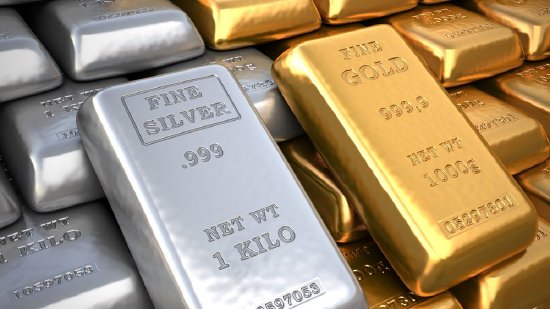
太疯狂,集体飙涨!有人看傻眼,“下午刚买的,还没发货就赚了”
Xin Lang Cai Jing· 2025-12-23 12:09
Core Viewpoint - The gold market is experiencing a significant surge, with both gold and silver prices reaching historical highs, driven by expectations of future interest rate cuts by the Federal Reserve and geopolitical tensions [1][6][14]. Group 1: Gold and Silver Price Trends - As of December 23, domestic gold is priced at 1009.40 RMB per gram, while international gold is at 4486.27 USD per ounce, reflecting a strong upward trend [1][7]. - On December 22, gold prices increased by over 2%, with silver also showing a notable rise, indicating the strongest annual performance in over 40 years for both metals [1][3]. - Year-to-date, gold and silver have appreciated by 69% and 137% respectively, marking the largest annual gains since 1979 [3][12]. Group 2: Domestic Market Response - Domestic gold jewelry prices have reached new highs, with brands like Chow Tai Fook and Lao Feng Xiang seeing significant price increases [4][9]. - Consumer interest in gold has surged, with foot traffic in jewelry stores increasing by approximately 30% in certain areas, despite high prices [11]. - Online markets are also witnessing a boom, with reports of rapid price increases for silver products shortly after purchase [13]. Group 3: Factors Driving Price Increases - The recent price surge is attributed to traders betting on potential interest rate cuts by the Federal Reserve, alongside geopolitical risks that enhance gold's appeal as a safe haven [6][14]. - Analysts suggest that the combination of slowing job growth in the U.S. and lower-than-expected inflation data supports the narrative for further rate cuts [14]. - Investment behavior is shifting, with concerns over rising national debt levels prompting a move away from sovereign bonds towards gold [14].
一路狂飙!金饰克价突破1400元 现货黄金逼近4500美元关口
Sou Hu Cai Jing· 2025-12-23 09:41
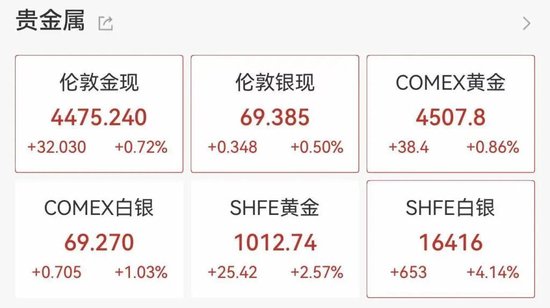
Core Viewpoint - The gold and silver markets are experiencing significant price increases, with gold prices reaching historical highs and expectations for strong annual gains, driven by central bank purchases and investor demand for alternative assets [2][5][6]. Group 1: Gold Market Performance - COMEX gold prices have recently surpassed $4500 per ounce, with a current price of $4507.8 per ounce, reflecting a 0.5% increase [2]. - On December 22, spot gold prices crossed the $4400 per ounce mark, and during the trading session, COMEX gold futures surged by 2.13% to $4480.6 per ounce [2]. - As of December 23, spot gold reached a peak of $4497.754 per ounce, marking a new historical high, and is currently priced at $4475.24 per ounce, up 0.72% [3]. Group 2: Domestic Gold Jewelry Prices - Domestic gold jewelry prices have risen, with several brands increasing their prices above 1400 yuan per gram. For instance, Chow Tai Fook and Chow Sang Sang have set their prices at 1403 yuan per gram, while Lao Miao Gold is at 1402 yuan per gram [2][4]. Group 3: Silver and Other Precious Metals - Silver prices have also surged, with spot silver reaching above $70 per ounce for the first time on December 23 [4]. - In the Chinese market, platinum and palladium futures hit their 10% daily limit, achieving new highs since their listing [4]. Group 4: Market Regulation and Risk Management - The Shanghai Futures Exchange has implemented measures to cool down the silver futures market, including adjustments to trading limits and transaction fees [5]. - The Shanghai Gold Exchange has issued notifications to enhance market risk control, urging members to be aware of market volatility and to maintain risk management practices [5]. Group 5: Investment Trends and Predictions - Analysts note that the recent decline in U.S. CPI has strengthened expectations for a more accommodative Federal Reserve policy, contributing to the rise in precious metal prices [5]. - Goldman Sachs predicts that gold prices could reach $4900 per ounce by the end of 2026, driven by high demand from central banks and potential shifts in investor asset allocation [6][7].
金价,还在涨
Xin Lang Cai Jing· 2025-12-23 09:01
Core Viewpoint - The price of spot gold continues to rise, reaching a new historical high of $4497.754 per ounce, with a current price of $4475.24 per ounce, reflecting a 0.72% increase [1][8]. Gold Market Performance - COMEX gold futures initially broke through the $4500, $4510, and $4520 per ounce levels before retreating, currently priced at $4507.8 per ounce, up 0.5% [3][8]. - On December 22, spot gold surpassed $4400 per ounce, with COMEX gold futures rising by 2.13% to $4480.6 per ounce, and COMEX silver futures increasing by 2.37% to $69.09 per ounce, indicating the potential for the largest annual gains since 1979 [3][9]. Domestic Gold Jewelry Prices - Domestic gold jewelry prices have surged, with several brands exceeding 1400 yuan per gram. For instance, Chow Tai Fook and Chow Sang Sang have raised their prices to 1403 yuan per gram, while Lao Miao Gold has increased its price to 1402 yuan per gram [3][10]. Other Precious Metals - Other precious metals have also seen significant increases, with spot silver reaching $70 per ounce for the first time on December 23. Additionally, platinum and palladium futures on the Guangzhou Futures Exchange hit their daily limit of 10%, marking new highs since their listing [10]. Market Regulation Measures - In response to the overheated trading environment, the Guangzhou Futures Exchange has set a position limit of 500 contracts for non-futures company members or clients for platinum and palladium contracts [10]. - The Shanghai Futures Exchange has implemented several risk prevention measures for silver futures, including adjustments to trading limits and transaction fees, aimed at cooling the market and promoting rational trading [11]. Economic Indicators and Predictions - Analysts note that the U.S. November CPI and core CPI growth rates have dropped to multi-year lows, reinforcing expectations for a dovish Federal Reserve policy, alongside geopolitical risks and central bank gold purchases supporting rising precious metal prices [11]. - According to Bloomberg's forecast, both gold and silver are expected to experience their strongest annual gains since 1979, with gold prices having surged approximately two-thirds this year due to central bank purchases and inflows into exchange-traded funds (ETFs) [11][12]. Investor Behavior - Investors are increasingly turning to gold as a hedge against concerns over the value of sovereign bonds and currencies, driven by "devaluation trades" [12]. - Goldman Sachs predicts that gold prices could reach $4900 per ounce by the end of 2026, suggesting that current forecasts may underestimate risks and highlighting a potential shift towards broader asset diversification among private investors [12][13]. Risks and Market Dynamics - Morgan Stanley warns that high silver prices may negatively impact photovoltaic demand, while cautioning about potential technical selling pressure from the Bloomberg Commodity Index rebalancing starting January 8, which could lead to significant forced selling in silver and gold [13].
太疯狂!金价彻底爆了!有人拖行李箱抢购,“下午刚买的,还没发货就赚了……”
Xin Lang Cai Jing· 2025-12-23 04:58
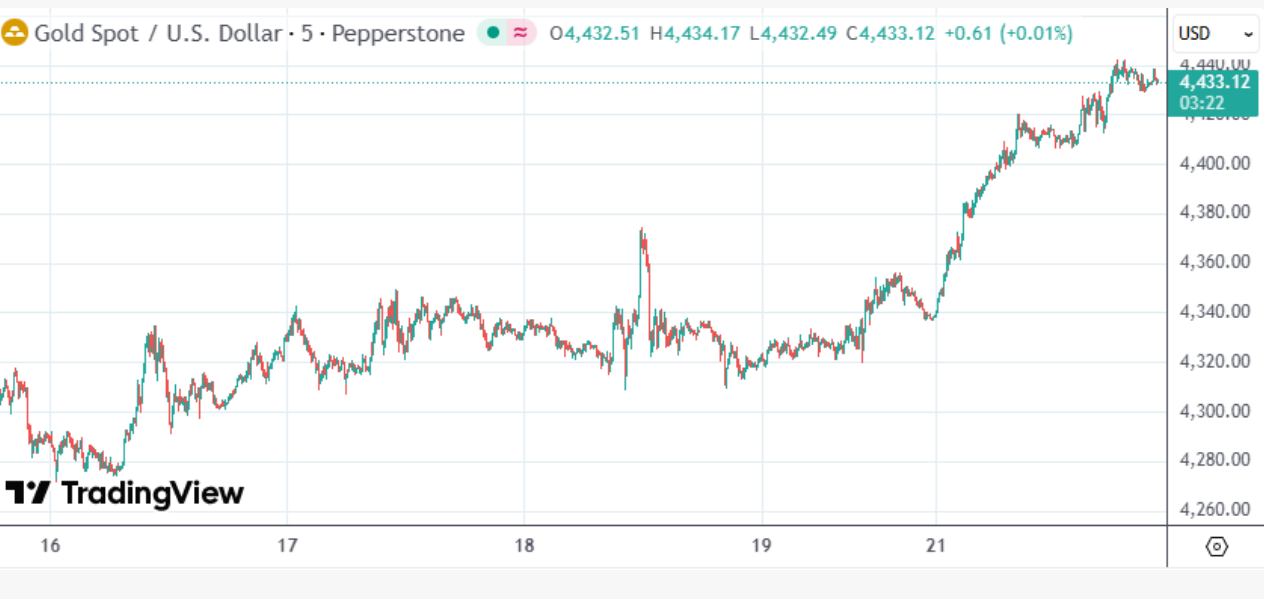
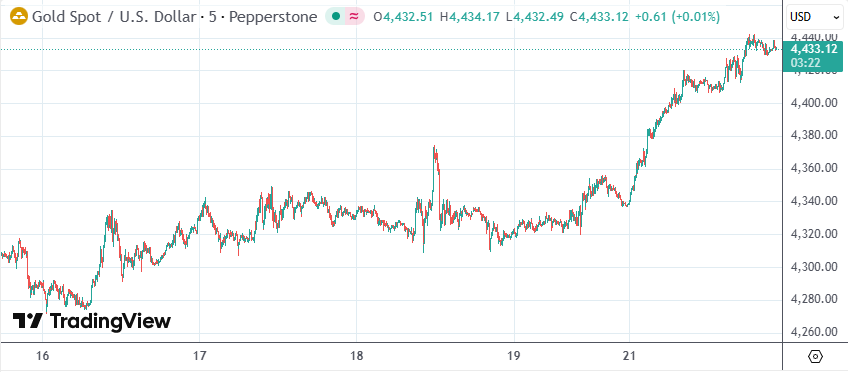
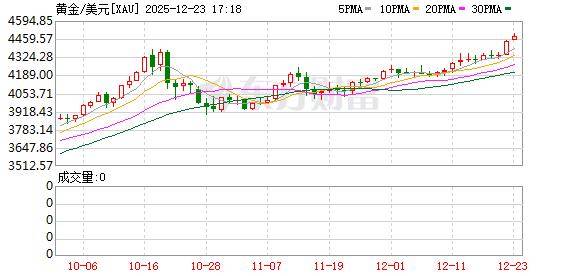
现货黄金5分钟图 具体行情显示,现货黄金日内一度涨超2.3%报每盎司4442.22美元,现货白银一度涨3.3%报每盎司69.46美元,双双刷新历史纪录,年内金银分别累涨69%和 137%,势将创下1979年以来的最大年度涨幅。 现货黄金日线图 周一(12月22日)纽约时段,现货黄金价格加速上涨,日内涨幅扩大至2%,有望与现货白银一同录得逾四十年来最强劲的年度表现。 12月23日消息,国际金银续创新高。COMEX黄金期货涨2.13%,报4480.6美元/盎司;COMEX白银期货涨2.37%,报69.09美元/盎司。 根据每天更新的价格,12月23日黄金实物价格如下: | 国内现货 | 国际现货 | 黄金实物 | | | --- | --- | --- | --- | | 品牌 | 银行 回收 | | | | 品牌 | | 价格(元/克) | 日涨跌幅 | | 周大福 | | 1368 | +0.59% | | 老凤祥 | | 1365 | +0.22% | | 周六福 | | 1319 | +0.53% | | 周生生 | | 1367 | +0.59% | | 六福珠宝 | | 1366 | +0.59% | ...