
贸易强国建设

Search documents
在扩大高水平对外开放中奋力谱写海关新篇章——访海关总署署长、党委书记孙梅君
Xin Hua She· 2025-11-28 12:31
Core Viewpoint - The article emphasizes the importance of expanding high-level opening-up in China, particularly through customs reforms and initiatives to enhance trade and security, as outlined in the 15th Five-Year Plan [1][2]. Group 1: Customs Role in Trade and Security - Customs plays a crucial role as the "gatekeeper" of the nation, balancing development and security while facilitating trade [2][3]. - Since the 14th Five-Year Plan, customs has managed an average of 5.2 billion tons of imports and exports, valued at 41.5 trillion yuan, maintaining the largest global trade volume [2]. - In the first ten months of this year, China's import and export volume reached 37.3 trillion yuan, showing a year-on-year growth of 3.6% [2]. Group 2: Key Initiatives for Customs Development - Customs will focus on enhancing national security by establishing a comprehensive risk prevention system and improving capabilities for risk identification and response [3][4]. - Efforts will be made to improve customs clearance efficiency through special actions for cross-border trade facilitation and the implementation of innovative measures [4][5]. - The promotion of trade innovation will involve optimizing customs regulations and supporting the development of new trade models, including e-commerce and green trade [4][5]. Group 3: High-Level Opening-Up and International Cooperation - The customs authority aims to align with international high-standard trade rules to facilitate market access and reduce barriers [6][7]. - There will be a focus on building diverse open platforms and supporting the development of free trade zones, particularly in Hainan [7][8]. - The "Belt and Road" initiative will be supported through the "Smart Customs" partnership plan, enhancing cooperation with participating countries [7][8]. Group 4: Hainan Free Trade Port Development - The Hainan Free Trade Port is set to officially start operations on December 18, with customs implementing innovative regulatory measures to ensure smooth operations [9][10]. - A robust risk prevention system will be established, utilizing big data and AI to enhance risk management capabilities [10][11]. - Infrastructure upgrades and pressure testing for customs operations are underway to ensure readiness for the free trade port's launch [11].
扩大外贸领域制度型开放
Ren Min Ri Bao· 2025-11-14 07:49
Group 1: Trade Innovation and Development - The "14th Five-Year Plan" emphasizes promoting trade innovation and accelerating the construction of a strong trade nation [1] - In goods trade, there is a focus on market diversification and the integration of domestic and foreign trade, expanding intermediate goods and green trade [1] - The establishment of national import trade promotion innovation demonstration zones aims to increase imports to meet industrial transformation and people's needs [1] Group 2: Digital Trade and E-commerce - The creation of national digital trade demonstration zones is intended to enhance openness in the digital sector and promote institutional innovation in cross-border data and international internet access [2] - The role of cross-border e-commerce comprehensive pilot zones will be leveraged to develop cross-border e-commerce in conjunction with industrial sectors [2] - Support for foreign trade enterprises and e-commerce platforms in global logistics and warehousing infrastructure is crucial for advancing cross-border e-commerce [2]
扩大外贸领域制度型开放(专家点评)
Ren Min Ri Bao· 2025-11-13 22:02
Core Insights - The "14th Five-Year Plan" emphasizes promoting innovative development in trade and accelerating the construction of a strong trade nation [1][2] - The plan aims to enhance the digitalization of trade processes and expand both goods and service trade [1][2] Goods Trade - The strategy focuses on diversifying markets and integrating domestic and foreign trade, while expanding trade in intermediate goods and green trade [1] - Establishing national import trade promotion innovation demonstration zones to increase imports, catering to industrial transformation and improving citizens' quality of life [1] - Enhancing the digitalization level across all trade segments and strengthening the application of electronic documentation [1] Service Trade - The establishment of national service trade innovation development demonstration zones to boost support for service exports through fiscal, financial, and export tax rebate measures [1] - Expanding traditional service exports in sectors such as transportation, tourism, and construction, while fostering new growth points in inspection, professional services, digital culture, cloud services, and data services [1] - Promoting the integration of artificial intelligence with service trade to enhance standardization and cultivate new growth momentum in service trade [1] Digital Trade - The creation of national digital trade demonstration zones to facilitate openness in the digital sector and innovate systems for cross-border data and international internet access [2] - Enhancing the standardization of digital trade and aligning with international standards to optimize the development environment for digital trade [2] - Leveraging cross-border e-commerce comprehensive pilot zones to promote the development of cross-border e-commerce and support foreign trade enterprises in global logistics and warehousing [2]
中国经济圆桌会丨专家:进博会彰显磁吸力贵在“稀缺”
Xin Hua Wang· 2025-11-09 02:13
Core Viewpoint - The China International Import Expo (CIIE) showcases China's unique position in the global market, emphasizing its role as a significant platform for imports amid rising global trade uncertainties [1] Group 1: Significance of CIIE - CIIE is the world's first national-level exhibition focused on imports, highlighting its irreplaceable charm due to its rarity [1] - The event serves as a countermeasure against rising protectionism and de-globalization trends in certain countries, reinforcing China's commitment to open trade [1] Group 2: China's Economic Contributions - China's development, driven by five-year plans, continues to contribute significantly to the world, providing certainty in its growth and openness [1] - The transition from being the "world's factory" to a "global market" underscores China's strong purchasing power, which is a key attraction of CIIE [1] Group 3: Economic Influence and Standards - CIIE reflects China's economic discourse power, facilitating standard alignment and optimizing the open ecosystem with other countries [1] - The expo is a vital driver for strengthening China's position as a trade powerhouse [1]
提升“中国价格”影响力 碳酸锂期货助力贸易强国建设
Qi Huo Ri Bao Wang· 2025-10-20 00:46
Core Viewpoint - The article emphasizes the shift in China's trade development focus from scale expansion to quality and efficiency improvement, highlighting the importance of establishing a self-controlled pricing system to enhance China's influence in international trade [1]. Group 1: Trade Development Strategy - The 20th National Congress of the Communist Party of China has decided to accelerate the construction of a trade power, shifting the focus of trade development to improving quality and efficiency [1]. - The current global environment, characterized by significant commodity price fluctuations and geopolitical risks, necessitates a move away from reliance on overseas pricing models [1]. Group 2: Company Overview - Zhongzhe Commodity Group, established in January 2017, focuses on wholesale and retail of bulk commodities, including agricultural products and energy chemicals [2]. - The company entered the lithium ore trade in Australia in September 2023, initially engaging in simple spot trading before expanding into international trade by the end of 2024 [2]. Group 3: Challenges and Innovations - Zhongzhe Metal faced challenges in resource channels and pricing models, struggling with traditional pricing methods that lacked flexibility and transparency [3]. - The company recognized the need to innovate its trading model to establish a foothold in the Australian lithium market, leading to the exploration of a new pricing model based on carbon lithium futures [3][4]. Group 4: Successful Implementation - In March 2025, Zhongzhe Metal developed a pricing system using carbon lithium futures as a core anchor, which allowed for a transparent and dynamic pricing solution [4]. - The first successful trade in May 2025 demonstrated the effectiveness of this new pricing model, resulting in a 3% lower price for a Jiangxi lithium salt factory compared to overseas platforms [5]. Group 5: Market Transformation - The success of the initial trade shifted the attitude of Australian mining companies towards futures pricing, leading to direct cooperation with Zhongzhe Metal by July 2025 [6]. - By the third quarter of 2025, Zhongzhe Metal had established direct communication with multiple Australian mining companies, with lithium trade volume exceeding 60,000 tons, accounting for 20% of the total trade volume [7]. Group 6: Industry Support and Training - The rapid growth of Zhongzhe Metal in the lithium market was supported by training and resources provided by the Guangxi Futures Exchange, which has conducted over 1,000 training sessions nationwide [8][9]. - The "Green to New" industry service plan initiated by the Guangxi Futures Exchange aims to enhance risk management capabilities and promote the use of futures tools among new energy enterprises [10].
碳酸锂期货助力贸易强国建设
Qi Huo Ri Bao Wang· 2025-10-19 16:06
Core Viewpoint - The article emphasizes the shift in China's trade development focus from scale expansion to quality and efficiency improvement, highlighting the importance of establishing a self-controlled pricing system to enhance China's influence in international trade [1]. Group 1: Company Overview - Zhongzhe Commodity Group, established in January 2017, operates as a trading platform for bulk commodities, including agricultural products, energy chemicals, and metals [2]. - The company entered the lithium market in September 2023, shortly after the launch of lithium carbonate futures on the Guangxi Futures Exchange [2]. Group 2: Challenges and Innovations - Initially, Zhongzhe faced challenges in international lithium trade due to a lack of resources and reliance on traditional pricing models, which led to difficulties in negotiations with Australian miners [3][4]. - The company recognized the need to innovate its trading model and sought to establish a new pricing system based on Guangxi Futures Exchange's lithium carbonate futures [4][5]. Group 3: Successful Implementation - In March 2025, Zhongzhe successfully created a pricing system using the "LC2507 contract price - fixed basis" model, which allowed for a transparent and adaptable pricing mechanism [4][5]. - The first successful trade in May 2025 involved purchasing lithium ore from Australia at a price 3% lower than that of overseas platforms, demonstrating the effectiveness of the new pricing model [5][6]. Group 4: Market Impact and Growth - Following the initial success, Zhongzhe established direct communication with multiple Australian mining companies, significantly increasing its trade volume in lithium [6][7]. - By the third quarter of 2025, Zhongzhe's lithium trade volume exceeded 60,000 tons, accounting for 20% of its total trade volume [7]. Group 5: Industry Support and Training - The Guangxi Futures Exchange has played a crucial role in supporting companies like Zhongzhe through extensive training programs, enhancing their understanding and application of futures tools [8][9]. - Over 1,000 training sessions have been conducted nationwide, benefiting over 200,000 participants, which has helped companies integrate into the lithium industry ecosystem [9]. Group 6: Future Outlook - Zhongzhe aims to deepen cooperation with overseas mining companies and promote the use of Guangxi Futures Exchange's lithium carbonate futures as a pricing benchmark, contributing to the establishment of "Chinese prices" in the international market [7][10]. - The Guangxi Futures Exchange plans to continue enhancing its market service capabilities and support for various industries, ensuring that the futures market becomes a strong backing for companies in the lithium battery sector [10].
透视关键词看外贸做大体量、做强结构、锻造韧性
Yang Shi Wang· 2025-10-14 07:09
Core Insights - During the "14th Five-Year Plan" period, China's foreign trade has shown resilience and growth despite global challenges, with a focus on enhancing both domestic and international markets [1] Group 1: Trade Volume and Growth - The scale of China's goods trade has continuously expanded, surpassing $5 trillion and $6 trillion, projected to reach $6.16 trillion in 2024, a 32.4% increase from the end of the "13th Five-Year Plan" [1] - China has maintained its position as the world's largest trader for eight consecutive years [1] Group 2: Trade Structure and Quality - The export proportion of high-tech products in goods trade reached 18.2%, with exports of electric vehicles, lithium batteries, and photovoltaic products increasing by 2.6 times compared to 2020 [2] - Knowledge-intensive service trade is expected to grow by 38% compared to 2020, with digital delivery services seeing nearly a 40% increase [2] Group 3: Trade Partnerships and Diversification - ASEAN has been China's largest trading partner for five consecutive years, with China becoming a top three trading partner for over 150 countries and regions [2] - Trade with Belt and Road Initiative countries has exceeded 50% of China's total trade [2] Group 4: Supply Chain and Economic Support - China's foreign trade has seen improved flexibility in its industrial and supply chains, with events like the China International Import Expo serving as bridges for international economic cooperation [2] - China's foreign trade remains a significant contributor to global trade growth, supporting the recovery of the world economy [2]
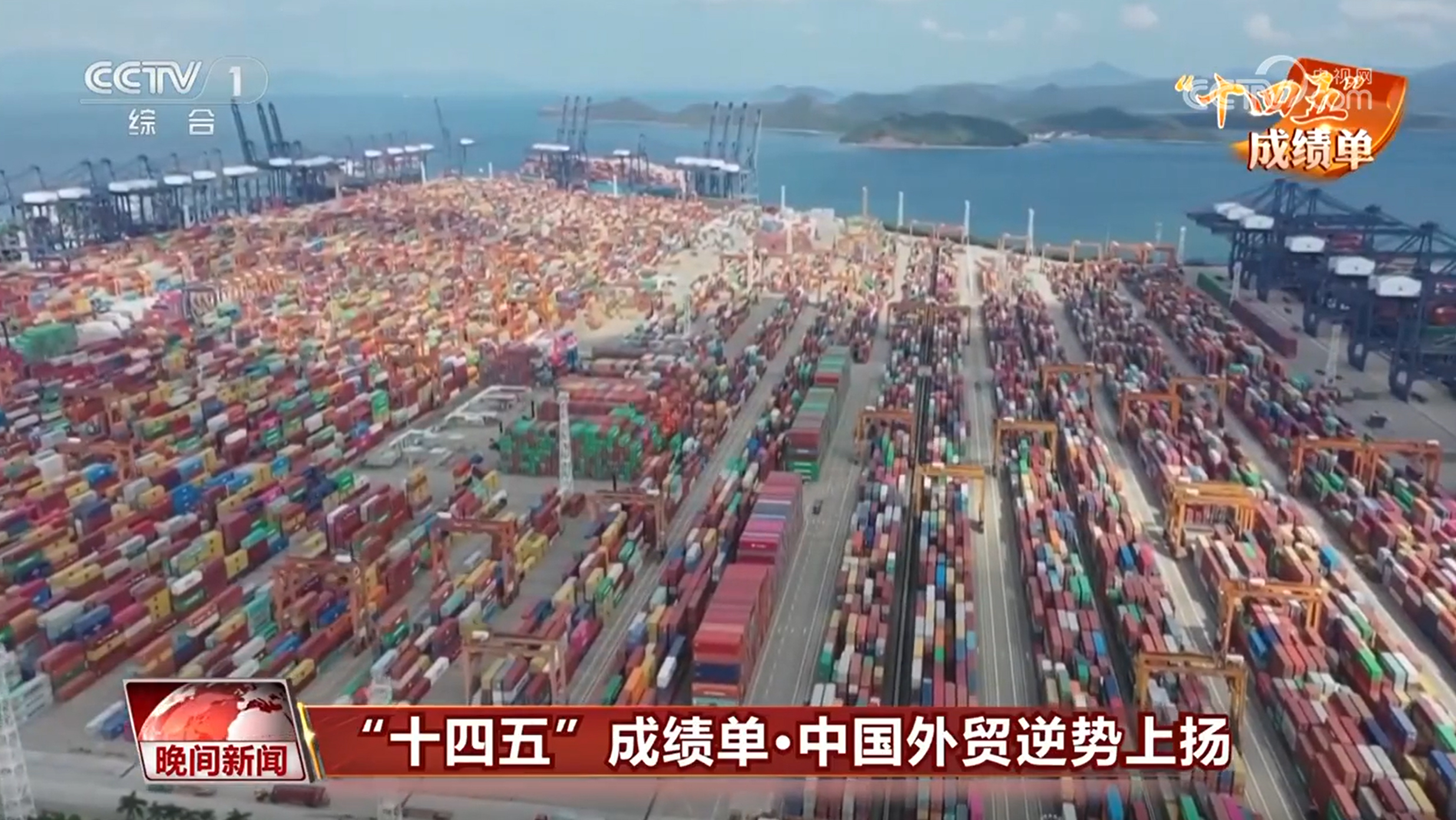
“十四五”成绩单丨“含金量”“含新量”持续攀升 中国外贸逆势上扬
Yang Shi Wang· 2025-10-13 15:07
Core Insights - During the "14th Five-Year Plan" period, China's foreign trade has shown resilience and growth amidst global changes, achieving significant milestones in trade volume and structure [1][3]. Trade Volume Expansion - The scale of goods trade has consistently surpassed $5 trillion and $6 trillion, projected to reach $6.16 trillion in 2024, marking a 32.4% increase compared to the end of the "13th Five-Year Plan" [3]. - Service trade is expected to exceed $1 trillion for the first time in 2024, ranking second globally [3]. Structural Optimization - The export proportion of high-tech products in goods trade reached 18.2% [4]. - Exports of "new three items" such as electric vehicles, lithium batteries, and photovoltaic products have increased by 2.6 times compared to 2020 [4]. - Knowledge-intensive service trade volume is projected to grow by 38% compared to 2020, with digital delivery services seeing nearly a 40% increase [4]. Resilience and Diversification - ASEAN has been China's largest trading partner for five consecutive years, with China becoming a top three trading partner for over 150 countries and regions [6]. - Trade with Belt and Road Initiative countries is expected to exceed 50% in 2024 [6]. - The China-Europe Railway Express has surpassed 110,000 trips, reaching 229 cities in Europe [6]. Supply Chain and Economic Support - The industrial and supply chains in China's foreign trade have become more complete and flexible, with events like the China International Import Expo serving as bridges for international economic cooperation [8]. - China's foreign trade continues to be a significant contributor to global trade growth, supporting the recovery of the world economy [8].

期货赋能托举中国贸易强国梦
Qi Huo Ri Bao Wang· 2025-09-11 18:37
Group 1 - The core viewpoint of the articles emphasizes the transition of China's trade focus from scale expansion to quality and efficiency enhancement, with futures markets playing a crucial role in this transformation [1][15][18] - The rise of "Chinese futures" is enabling domestic companies to establish pricing power in international trade, moving away from reliance on international price indices [2][3][17] - The integration of futures tools into trade practices is enhancing negotiation efficiency and reducing risks associated with price volatility, thereby fostering a more collaborative environment between upstream and downstream partners [4][8][12] Group 2 - The application of futures in various sectors, such as chemicals and agricultural products, is leading to a significant shift in pricing strategies, with domestic futures prices becoming benchmarks for international transactions [5][6][10] - Companies are increasingly adopting innovative trading models, such as basis trading and rights trading, which allow for more flexible pricing and risk management tailored to specific needs [7][9][16] - The use of futures tools is helping to stabilize supply chains by providing mechanisms for price management and risk mitigation, thus enhancing overall resilience against market fluctuations [10][11][14] Group 3 - The transition from a focus on scale to value-driven trade is seen as essential for building a strong trade nation, with futures markets serving as a foundational infrastructure for this shift [15][18] - There is a growing recognition that participation in futures markets not only aids in risk management but also serves as a means to gain competitive advantage and influence in global trade [17][18] - The development of a robust network of trade companies is crucial for enhancing China's position as a trade power, with an emphasis on improving the use of futures and derivative tools in international trade [18]
贸易强国与新质生产力相互赋能
Guo Ji Jin Rong Bao· 2025-08-18 02:32
Core Viewpoint - The global economic and trade landscape is undergoing profound restructuring, with the U.S. deviating from its long-standing advocacy for trade liberalization, imposing tariffs on various trade partners, including China, which exacerbates trade policy uncertainty and severely impacts the global economy [1] Group 1: New Quality Productivity - New quality productivity has emerged as a core support for China's trade resilience, with a 2.9% year-on-year increase in goods trade and a 7.2% increase in exports in the first half of the year [2] - Exports of electromechanical products grew by 9.5%, accounting for 60% of total exports, with high-end equipment exports increasing by over 20% [2] - The export of industrial robots surged by 61.5%, and green low-carbon products saw a 12.7% increase, indicating robust development in new quality productivity [2] Group 2: International Trade Dynamics - New quality productivity has become a "hardcore backing" for China in international economic and trade negotiations, with significant global competitiveness in key industries such as rare earths [3] - China holds 48.4% of global rare earth reserves and 68.5% of annual production, establishing a complete industrial chain from mining to deep processing [3] - The dependency of the U.S. and Japan on Chinese rare earths for critical industries highlights the strategic importance of new quality productivity in trade [3] Group 3: Trade Power Construction - Trade power construction is proactive in paving the way for the development of new quality productivity, facilitating a "technology-industry-trade" cycle [4] - The rapid growth of high-end equipment and green products in export data reflects global market demand for new quality productivity, which in turn stimulates R&D investments [4] - Trade interactions foster technological exchanges and cooperation opportunities, enhancing the flow of innovative elements and supporting the development of new quality productivity [4] Group 4: Industrial Upgrading and Global Integration - The development of new quality productivity relies on trade platforms to achieve "scale leap," integrating global resources and embedding domestic industries into high-end global value chains [5] - China's transition from a resource advantage to a technology advantage in the rare earth industry exemplifies the role of international trade in expanding market demand and driving technological upgrades [5] - The enhancement of rule-making power through increased trade influence supports the "safe development" of new quality productivity, creating a stable environment for technological innovation and industry protection [5] Group 5: Strategic Integration - The mutual empowerment of trade power and new quality productivity is a strategic choice for China to respond to challenges and seize opportunities in the restructured global economic landscape [6] - New quality productivity provides core momentum and discourse power for trade power construction, while trade power construction expands market space and improves the industrial ecosystem for new quality productivity [6]