资产多元化

Search documents
8133吨、2333吨、2303吨:一场跨越世纪的黄金“储备赛”
Sou Hu Cai Jing· 2026-01-07 03:37
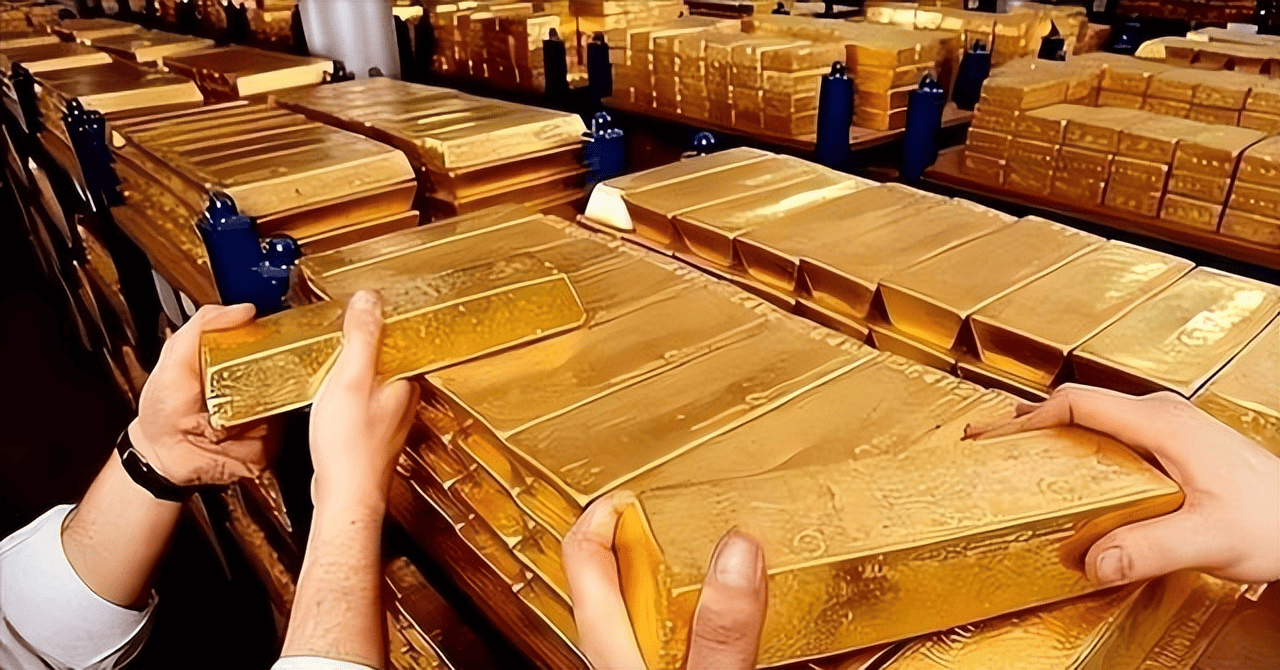
Core Insights - The article discusses the ongoing competition among countries regarding gold reserves, highlighting the strategic importance of gold in financial security and geopolitical power dynamics [1][3]. Group 1: Gold Reserves Comparison - The United States holds the largest gold reserves at 8,133 tons, accounting for 69% of its foreign exchange reserves, which serves as a cornerstone for the credibility of the US dollar [3]. - Russia has significantly increased its gold reserves to approximately 2,333 tons by 2025, with gold making up 26% of its foreign exchange reserves, particularly after Western sanctions post-Crimea [3]. - China's gold reserves stand at 2,303 tons, which is relatively low compared to its status as the world's second-largest economy, indicating potential for future growth [3][5]. Group 2: Strategic Approaches to Gold Accumulation - Since 2009, China has adopted a strategy of gradually increasing its gold reserves while reducing its holdings in US Treasury bonds, aiming for asset diversification and strengthening the international credibility of the Renminbi [5]. - Russia's gold accumulation is seen as a means to create a financial defense system independent of Western payment systems, especially highlighted during the Russia-Ukraine conflict [3][5]. - The global surge in gold prices, projected to exceed $2,500 per ounce by 2025, has intensified the trend of central banks increasing their gold reserves, particularly among emerging market countries [5]. Group 3: Broader Implications of Gold Reserves - The competition for gold reserves transcends national borders, with countries like Russia and China exploring new financial models supported by gold, such as gold-backed digital currencies [5]. - The article emphasizes that gold serves not only as a crisis response mechanism but also as a symbol of trust and independence among nations, shaping a new multipolar financial landscape [5].

维勒鲁瓦警告美国政策侵蚀美元霸权 多极化货币体系或成定局
Sou Hu Cai Jing· 2026-01-06 10:05
Core Viewpoint - The comments from ECB Governing Council member Villeroy indicate that U.S. government criticism of the Federal Reserve threatens the dollar's position in the global economy [1] Group 1: Impact on Dollar's Dominance - Recent U.S. policies attacking the independence of the Federal Reserve and raising doubts about U.S. fiscal discipline are damaging key pillars of the dollar's dominance [1] - Concerns are growing that the U.S. may increasingly "weaponize" the dollar-based global payment system, prompting some regions to develop alternative payment systems [1] - These U.S. policies are undermining global investor confidence in dollar assets and may accelerate the trend of asset diversification [1] Group 2: Inflation in France - Recent data shows that France's annual inflation rate slowed to 0.7% in December, marking a seven-month low [1] - This decline in inflation is viewed positively for France's real income and maintaining favorable interest rate levels [1]
日本散户无视日股牛市“出逃”!资本外流加剧日元长期疲软
Zhi Tong Cai Jing· 2026-01-05 01:51
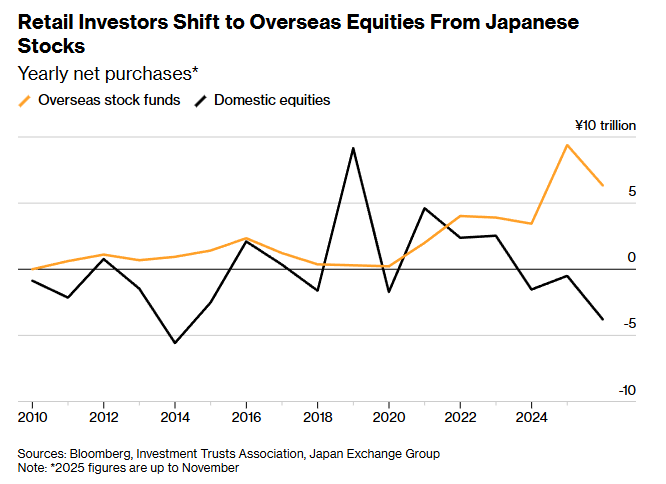
Core Insights - Japanese retail investors are shifting their focus from domestic stocks to overseas equities, with net sales of Japanese stocks reaching 3.8 trillion yen (approximately 24.3 billion USD) by November 2025, the highest level in over a decade [1] - Concurrently, net purchases of foreign stocks through investment trusts by Japanese retail investors are hovering around a record 9.4 trillion yen in 2024, indicating a strong appetite for foreign assets driven by a weaker yen [1][3] Group 1: Market Trends - The outflow of funds from Japan is exerting depreciation pressure on the yen, with expectations that it may weaken to 160 yen per dollar or more by the end of 2026 [6] - The Bank of Japan's interest rate hikes and increased government spending are influencing the yen's value, contrasting with policymakers' goals to encourage domestic investment [3][6] Group 2: Investor Sentiment - Retail investors express a belief that U.S. stocks, particularly large tech companies, hold greater potential, especially in the context of AI growth [3] - Concerns about overexposure to U.S. tech stocks may lead Japanese retail investors to reconsider their investment strategies, particularly as the AI boom shows signs of slowing [8] Group 3: Economic Indicators - The Tokyo Stock Exchange index rose by 25% in 2025, outperforming the S&P 500 index, driven by strong corporate earnings and supportive government policies [3] - Structural factors, such as the yield gap between Japanese and U.S. bonds, are contributing to the yen's lack of attractiveness for yield-seeking investors [6]
狂买黄金的人,都看懂了什么?
Sou Hu Cai Jing· 2025-12-31 00:13
Core Insights - The gold market experienced a record-breaking surge in Q3 2025, with total demand increasing by 3% year-on-year to 1,313 tons, and value demand soaring by 44% to a historic $146 billion [2][4]. - Year-to-date, total gold demand reached 3,717 tons, with a value exceeding $384 billion, reflecting a 41% year-on-year increase [2]. Investment Demand - Investment demand, driven by ETFs and gold bars and coins, accounted for a significant portion of the gold market, with global investment demand reaching 537 tons in Q3, a 47% year-on-year increase [3][4]. - The surge in investment is attributed to "certainty anxiety," with geopolitical instability and expectations of U.S. interest rate cuts driving investors towards gold as a safe asset [4][6]. - The "FOMO effect" (Fear of Missing Out) has also played a role, as rising gold prices attract more investors, creating a positive feedback loop [4]. Central Bank Purchases - Central banks globally net purchased 220 tons of gold in Q3, a 28% increase from the previous quarter and a 10% year-on-year rise [6][9]. - This reflects a long-term strategic shift towards gold, with emerging market central banks actively increasing their gold reserves [7][9]. - Notable purchases included Kazakhstan (18 tons), Brazil (15 tons), and China (5 tons), indicating a trend of "de-dollarization" among central banks [7][9]. Jewelry Consumption - In contrast to investment and central bank demand, global gold jewelry consumption fell by 19% year-on-year to 371 tons in Q3, marking the worst performance for the third quarter since 2020 [10]. - High gold prices have impacted purchasing power, particularly in major markets like India and China, where demand has significantly declined [10][11]. - Despite the drop in volume, the value of jewelry consumption increased by 13% to $41 billion, indicating a shift in consumer behavior towards higher-value products [10][11]. Supply Side - Global gold supply grew by 3% year-on-year to 1,313 tons in Q3, with mine production reaching a record high of 977 tons [12]. - However, uncertainties in mining operations and lower-than-expected recycled gold supply pose challenges to future production [13][14]. - The combination of surging demand and moderate supply growth reinforces the supply-demand balance, supporting gold prices [14]. Future Trends - The future trajectory of the gold market will hinge on three key variables: the performance of the U.S. dollar and interest rates, geopolitical and economic risks, and the supply-demand gap [15][18]. - Gold is viewed as a stabilizing asset for portfolio diversification, particularly in the current complex economic environment [15][18].
【环球财经】遭遇获利了结贵金属29日全线大跌!纽约金价单日跌超200美元 银价收跌超10%
Xin Hua Cai Jing· 2025-12-30 06:14
Group 1 - The core viewpoint of the articles highlights a significant decline in gold and silver prices on December 29, 2023, with gold futures dropping by $211.8 to $4,350.2 per ounce, a decrease of 4.64%, and silver futures falling by $8.035 to $71.640 per ounce, a drop of 10.08% [1][2] - Analysts attribute the sharp decline in precious metal prices primarily to year-end profit-taking by investors, following a historic price surge, which has amplified price volatility in thin trading conditions [1][2] - Despite the recent downturn, market analysts suggest that this drop is merely a correction within the broader upward trend of precious metal prices [1][2] Group 2 - Robert Gottlieb, former head of precious metals trading at JPMorgan and HSBC, indicates that the pivotal moment for gold occurred after the outbreak of the Russia-Ukraine conflict in 2022, leading emerging market central banks to diversify their assets and reduce reliance on the dollar [2] - The critical moment for silver was identified as this summer, when investors recognized the limited supply of silver in the global market, exacerbated by strong industrial demand depleting above-ground silver stocks [2] - UBS forecasts a steady increase in gold demand through 2026, predicting that gold prices could reach $5,000 per ounce by September 2026, with potential spikes to $5,400 per ounce due to political or economic turmoil surrounding the U.S. midterm elections [2]
2026年全球黄金市场展望
Sou Hu Cai Jing· 2025-12-30 01:21
Core Insights - The global gold market is expected to experience significant fluctuations in 2026, influenced by geopolitical tensions, economic uncertainties, and monetary policy changes. The gold price has already reflected market consensus on economic growth, inflation, and monetary policy expectations, indicating potential for range-bound trading [1][19][48]. Group 1: 2025 Gold Market Performance - In 2025, the gold market performed exceptionally well, with prices reaching over 50 historical highs and a cumulative increase of over 60%, marking it as one of the best-performing assets since 1971 [1][11]. - The strong performance was driven by multiple factors, including heightened geopolitical and economic uncertainties, a weaker dollar, and declining bond yields, leading investors to diversify their portfolios with gold [1][11][19]. Group 2: 2026 Market Outlook - The outlook for 2026 is uncertain, with three potential macroeconomic scenarios identified: mild recession, vicious cycle, and return of re-inflation, each affecting gold prices differently [2][19][21]. - In a mild recession scenario, gold prices could rise by 5% to 15% due to lower interest rates and a weaker dollar, supported by continued central bank purchases and new investment inflows [26][31]. - In a vicious cycle scenario, escalating geopolitical and economic risks could lead to a significant downturn, potentially pushing gold prices up by 15% to 30% as demand for safe-haven assets increases [2][31]. - Conversely, in a return of re-inflation scenario, rising interest rates and a stronger dollar could lead to a decline in gold prices by 5% to 20% due to increased opportunity costs and shifting risk preferences [35][36]. Group 3: Central Bank Demand and Supply Dynamics - Central bank demand for gold remains a crucial support factor, with emerging market central banks expected to increase their gold purchases, particularly in response to geopolitical tensions [37][40]. - The supply of recycled gold is currently low due to increased use of gold as collateral for loans, particularly in India, which could impact market dynamics if economic conditions worsen [44][46]. Group 4: Investment Demand and Market Sentiment - Investment demand, particularly from gold ETFs, is anticipated to play a significant role in driving gold prices, with current holdings showing potential for growth [31][32]. - The overall sentiment in the gold market is shaped by ongoing economic uncertainties, with gold continuing to serve as a key tool for portfolio diversification and risk protection [48][49].

遭遇获利了结,贵金属29日全线大跌
Xin Hua Cai Jing· 2025-12-30 00:55
Group 1 - The core viewpoint of the articles highlights a significant decline in gold and silver prices, attributed to profit-taking by investors as the year-end approaches, despite a previous record high for both metals [1] - On February 29, 2026, gold futures fell by $211.8 to $4,350.2 per ounce, marking a 4.64% decrease, while silver futures experienced a more volatile day, initially rising over 5% to a historical high of $82.67 per ounce before closing down 10.08% at $71.640 per ounce [1] - Analysts suggest that the drop in precious metal prices is a temporary correction within an overall upward trend, with future price movements dependent on structural changes in the role of gold and silver in global investment portfolios [1][2] Group 2 - Robert Gottlieb, former head of precious metals trading at JPMorgan and HSBC, noted that the pivotal moment for gold occurred after the outbreak of the Russia-Ukraine conflict in 2022, leading central banks in emerging markets to diversify their assets by purchasing gold [2] - The critical moment for silver was identified as this summer, when investors recognized the limited supply of silver in the global market, exacerbated by strong industrial demand that has depleted above-ground silver stocks [2] - UBS forecasts a steady increase in gold demand through 2026, predicting that gold prices could reach $5,000 per ounce by September 2026, with potential spikes to $5,400 per ounce due to political or economic turmoil surrounding the U.S. midterm elections [2]
2026年全球黄金市场展望——百尺竿头,能否更进一步-世界黄金协会
Sou Hu Cai Jing· 2025-12-29 16:19
Core Insights - The global gold market performed exceptionally in 2025, achieving over 50 historical highs and a cumulative increase of over 60%, making it one of the best-performing asset classes [1][11][15] - The price surge was driven by four main factors: geopolitical and economic uncertainty contributed 8 percentage points, a weaker dollar contributed 10 percentage points, trend momentum contributed 9 percentage points, and economic expansion contributed 10 percentage points [1][15][23] - Central banks continued to increase their gold holdings, although not at the peak levels of the past three years, but still significantly above historical averages, providing crucial market support [1][11][15] 2026 Market Outlook - The gold market's trajectory in 2026 will heavily depend on macroeconomic developments, with current gold prices reflecting market consensus on economic growth, inflation, and monetary policy [1][24][26] - Three core scenarios for 2026 are outlined: - **Mild Recession Scenario**: If U.S. economic growth slows and the Federal Reserve implements unexpected rate cuts, gold prices may rise by 5% to 15% [6][30] - **Vicious Cycle Scenario**: If geopolitical tensions escalate, leading to a synchronized global economic slowdown, gold could see a strong increase of 15% to 30% [6][33] - **Reinflation Return Scenario**: If economic policies lead to stronger-than-expected growth and inflation pressures, gold prices may face a decline of 5% to 20% due to increased opportunity costs [6][35] Key Uncertainties - Central bank gold purchases and recycled gold supply are significant variables affecting the gold market in 2026 [1][36] - Emerging market central banks still hold a lower proportion of gold reserves compared to developed economies, and geopolitical tensions may accelerate their gold purchasing [1][36] - A potential decline in gold purchases back to pre-pandemic levels could pose challenges for the market [1][36]

Mhmarkets迈汇:黄金的“再定价”逻辑
Sou Hu Cai Jing· 2025-12-23 11:33
Core Viewpoint - The strategic value of gold is being redefined amid significant changes in the global economy, with expectations for gold prices to stabilize above $4,000 by 2025, driven by trade tariff disruptions and central banks' pursuit of asset safety [1][3]. Group 1: Market Dynamics - The strong performance of gold prices is attributed to a temporary decline in the US dollar index and changes in the US interest rate environment, which have created upward space for non-monetary assets [3]. - In Q3 2025, approximately $109 billion of incremental capital flowed into the global gold market, reflecting a 50% surge in demand compared to historical averages, indicating a defensive mindset towards traditional bond assets [3]. Group 2: Central Bank Influence - Despite high gold prices, some countries may reduce physical gold purchases due to budget constraints, but the strategic direction of increasing gold's share in foreign reserves remains unchanged [4]. - Many central banks still have gold reserves below 10%, representing a significant potential for replenishment, which supports the bullish outlook for gold prices in 2026 [4]. Group 3: Future Projections - Currently, mainstream investors hold only 2.8% of their portfolios in gold, far below historical equilibrium levels, suggesting that if this allocation approaches 5%, or if there is a minor shift of 0.5% from US Treasury holdings, gold prices could theoretically reach $6,000 [4]. - Due to cyclical limitations in gold mining, supply-side delays are expected to amplify demand-side premium effects, with gold prices projected to further approach $5,400 by 2027 [4].

彻底沸腾!涨疯了!创历史新高,50次!
券商中国· 2025-12-23 10:38
Core Viewpoint - The precious metals market is experiencing a rare "collective frenzy," with significant price surges across various metals, particularly gold and silver, driven by macroeconomic factors and geopolitical tensions [1][2]. Price Surge in Precious Metals - On December 23, gold and silver prices surged, with spot gold reaching a high of $4,497 per ounce and COMEX gold futures breaking the $4,500 per ounce mark. This marks the 50th time this year that gold prices have set a new record [2][4]. - In the domestic market, Shanghai gold futures hit a peak of 1,018 yuan per gram, while several gold jewelry brands quoted prices above 1,400 yuan per gram [2]. - Silver futures also saw significant gains, with the main contract surpassing 16,500 yuan per kilogram, reaching a historical high [2]. Performance of Precious Metals - Year-to-date, gold has increased by approximately 65%, while silver has surged by 120%, significantly outperforming gold. Platinum and palladium have also seen substantial gains, with monthly increases of 42% and 46%, respectively [2][6]. - The A-share precious metals sector has mirrored the bullish trend, with stocks like Shandong Gold rising nearly 7% [2]. Macroeconomic Influences - The rise in gold prices is attributed to macroeconomic conditions, including a dovish stance from the Federal Reserve and weaker U.S. non-farm payroll and CPI data, which support further rate cuts [4][5]. - Global central banks are increasing their gold reserves, with the International Monetary Fund (IMF) reporting that central bank gold reserves are expected to rise to 36,200 tons by the end of 2024, increasing their share of official foreign exchange reserves from 15% to nearly 20% [6]. Supply and Demand Dynamics - Silver, platinum, and palladium are experiencing sharper price increases due to supply-demand imbalances and significant capital inflows. On December 23, spot silver reached $69.98 per ounce, while platinum and palladium futures hit their respective limits [8][9]. - The demand for silver is particularly strong, with a notable increase in COMEX silver delivery notices, indicating a tight supply situation [9]. Future Outlook - Institutions generally believe that precious metals will maintain strong support in the medium to long term, although short-term volatility risks are increasing. The Shanghai Gold Exchange has issued warnings about market instability and advised members to enhance risk awareness [11]. - Analysts suggest that while the current bullish trend is supported by macroeconomic factors, caution is advised against chasing prices in a rapidly rising market. It is recommended to wait for pullbacks before making new investments [11].